In The Land Of FREE we still Keep on Rockin'

It's Not Dark Yet

Plain and Fancy

Music gives soul to universe, wings to mind, flight to imagination, charm to sadness, and life to everything.

Plato

Wednesday, July 28, 2021

Atlanta Rhythm Section - Back Up Against The Wall (1973 us, splendid southern rock, 2018 japan SHM remaster)


The 11 songs on this album present a mix of up-tempo tunes and ballads-an approach that would become a cornerstone of the group's future success. The pace overall is slower and more restrained than where the group would go with future albums. But it is a beautiful timepiece of a group of talented musicians playing quality songs and working together to establish their collective sound. 

There's a mix of tempos, both between songs and within individual tunes, which the band would refine on future records. Two of the songs, the rocking Back Up Against the Wall and the reflective Conversation, would become staples of the band's live set. Eight original songs feature songwriter/producer Buddy Buie's writing in partnership with other members of the band, and three covers are highlighted by a version of Joe South's Redneck. 

The album starts off with “Wrong “ an acoustic, mid-tempo song with a country feel. The pace picks up with this rocking, up-tempo song about the "hot time" appeal of a small Southern town on “Cold Turkey Tenn”.

 “Will I Live On?” is a beautiful ballad features singer Ronnie Hammond's first breakout vocal performance articulating some eternal questions.  The tempo picks up and shifts repeatedly within “A Livin Lovin Wreck” that also includes harmonica and piano breaks.

Another slower paced song “Superman”, starts as ballad and shifts into blues. “What You Gonna Do About It?” a moderately paced tune musically mirrors the ups and downs of relationships.. “Conversation “ is classic ballad features Hammond's ponderings about a relationship gone bad over a subtle but beautiful musical background.

The opening harmonic wail on “Redneck“ leads into a punchy, up-tempo look at the particular qualities of a certain type of Southerner who receives his proper sendoff. A slower paced song “Make Me Believe It “ that ebbs and flows while examining the search for love.

The title song “Back Up Against The Wall “ is the high point of the album. It's a loping rocker that shows off the band's musical chops and reaches a new level of group energy. The closer “It Must Be Love” is a slower, bluesy song that drives the album home and lets the guitars break out for a glimpse of things to come.


Tracks
1. Wrong (Buddy Buie, James B. Cobb Jr.) - 2:43
2. Cold Turkey, Tenn. (Robert Nix) - 3:17
3. Will I Live On? (Robert Nix, Dean Daughtry) - 2:52
4. A Livin' Lovin' Wreck (Otis Blackwell) - 3:07
5. Superman (Randall Bramblett) - 3:22
6. What You Gonna Do About It? (Ronnie Hammond) - 2:59
7. Conversation (Buddy Buie, James B. Cobb Jr.) - 3:28
8. Redneck (Joe South) - 3:48
9. Make Me Believe It (Buddy Buie, Robert Nix, Ronnie Hammond) - 3:13
10.Back Up Against The Wall (Buddy Buie, James B. Cobb Jr.) - 3:23
11 It Must Be Love (Robert Nix, Dean Daughtry, James B. Cobb Jr.) - 4:06

Atlanta Rhythm Section
*Ronnie Hammond - Vocals, Background Vocals
*Barry Bailey - Guitar
*Dean Daughtry - Keyboards
*J.R. Cobb - Guitar, Background Vocals
*Paul Goddard - Bass
*Robert Nix - Percussion, Drums, Background Vocals 
With
*Al Kooper - Synthesizer, ARP
*Billy Lee Riley - Harmonica

1975-76 Atlanta Rhythm Section - Dog Days / Red Tape (2005 remaster) 

Sunday, July 18, 2021

Crystal Syphon - Family Evil / Elephant Ball (1967-69 us, inpressive garage psych rock, 2021 double disc remaster and expanded)


Here, after over 50 years, is the total recorded output of Crystal Syphon. It is the amalgam of the talents and tastes of six musicians, friends and brothers from the little town of Merced, California. On almost every weekend, dances were held atone of Merced's four musical venues: The American Legion Hall, the Italo-American hall, the Women's Clubhouse, or the Merced Fairgrounds. Crystal Syphon was formed in 1965 by a group of musicians from Merced High School. Originally known as the Morlouchs, the founding members were Jeff Sanders on vocals, his brother Jim Sanderson rhythm guitar and vocals, Tom Salles on lead guitar and vocals, Dave Sprinkel on keyboards and vocals, Roger Henry on bass and Andy Daniel on drums.The band was very much influenced by the sounds of The Beatles and The Byrds, and is evidenced in their ability to do very difficult four part harmonies.

The group played many local area gigs, including Battle Of The Bands, but under the management of Jeff and his older brother Bob, the band began to pursue writing their own music. The band pooled ail their earnings for both equipment and recording sessions, and this practice continued the entire time the band was together. In May of 1966, Roger left the band and was replaced by Bob Greenlee on bass. In 1967, the band recorded Marcy, Your Eyes, Paradise, Have More Of Everything, and Try Something Different at Dick Terzian's studio in Fresno and were 3 track recordings; thus they were essential live with only some mild vocal or guitar overdubs. Other well known artists the band appeared with were Bo Diddley, Creedence Clearwater Revival, The Youngbloods, Quicksilver Messenger Service, Country Joe & The Fish, The Grateful Dead, Buffalo Springfield, Elvin Bishop, Lee Michaels and Santana.

Throughout the band's existence, the band shopped itself to various record labels. With the assistance of Bob Sanders and Richard Delong, who replaced Bob as the band's manager in 1967. Ultimately, the band had several offers to sign, but because they insisted on artistic freedom and complete ownership of their publishing, no agreement was ever reached with a label at the time.

In late 1968, Jim Sanders left the band and was soon followed by Dave Sprinkel. The four remaining members continued on as a four piece group, with Jeff Sanders taking over on keyboards. The band stayed together until late 1969, finally disbanding in early 1970. When Marvin Greenlee moved to Stockton to play in other bands, Tom, Bob and Jeff (now on drums) joined up with Merced guitarist John Fox to form Boogeyman, who recorded a 45 on a local Merced label. They played together for several more years, finally disbanding in 1973.
CD Liner Notes

Tracks
Disc 1 Family Evil 1967-68
1. Marcy, Your Eyes - 3:36
2. Paradise - 3:09
3. Have More Of Everything - 5:25
4. Try Something Different - 3:42
5. Fuzzy And Jose - 7:30
6. Are You Dead Yet? - 2:46
7. In My Mind - 2:42
8. Family Evil - 5:37
9. Fails To Shine - 5:42
10.Winter Is Cold - 6:56
11.Winter Is Cold - 6:12
All songs by Crystal Syphon
Tracks 8-10 recorded live At The Fillmore West 1-21-68
Track 11 recorded 2008


Disc 2 Elephant Ball 1967-69
1. Dawn Sermon - 1:21
2. For All Of My Life - 3:12
3. Tell Her For Me - 3:29
4. Elephant Ball - 4:26
5. Sing To Me - 8:36
6. It's Winter - 3:23
7. Snow Falls - 5:16
8. Don't Fall Brother - 3:20
9. There Is Light There - 6:33
All compositions by Crystal Syphon

Crystal Syphon
*Tom Salles - Vocal, Guitar
*Jim Sanders - Vocal, Guitar (Disc 1 Tracks 1-11, Disc 2 Tracks 1-3)
*Jeff Sanders - Vocals, Organ, Percussion, Drums 
*Bob Greenlee - Bass 
*Dave Sprinkel- Vocals, Organ, Percussion (Disc 1 Tracks 1-3, 5-11,  Disc 2 Tracks 1-3)
*Andy Daniel - Drums (Disc 1 Tracks 1-4, Disc 2 Tracks 1-3)
*Marvin Greenlee - Drums (Disc 1 Tracks 5-10, Disc 2 Tracks 4-9)


Tuesday, July 6, 2021

Rab Noakes - Do You See The Lights? (1970 uk, wondrous jazzy folk psych, 2010 korean remaster)


A gift for writing hook-laden songs and sensitively interpreting the work of American singer/songwriters has brought Rab Noakes to the forefront of Scottish pop music. His 1970 debut album, Do You See the Lights, included "Together Forever," which became a folk-pop hit for Lindisfarne.  Although he agreed to form a band, Steeler's Wheel, with Rafferty, he left the band to resume his solo career before the group recorded their Top Ten hit "Stuck in the Middle With You." Noakes has continued to record on his own.
by Craig Harris

Hearing Rab Noakes' debut LP, Do You See the Light, is a bit like listening to a late-'60s folk-rock recording for the Elektra or Vanguard label that somehow wasn't released. As many contributions as those labels made in this genre, however, a comparison such as this isn't necessarily high praise. For though Noakes at times echoes various early singer/songwriters -- Blonde on Blonde-era Bob Dylan, Donovan, Phil Ochs, Tim Hardin, Fred Neil, Tim Buckley, James Taylor, Tom Paxton, The Basement Tapes-era Dylan -- he doesn't project a strong identity of his own, and his material is blander than the '60s work of any of the aforementioned figures.

It's as if the music has been filtered through a lower common denominator of someone with a large collection of U.S. singer/songwriter LPs with a personal narrative flavor, though sung here with a Scottish accent. Sometimes the triggers of specific comparisons are strong: the easygoing country-rock of "Together Forever" - later covered by Lindisfarne recalls Dylan's "You Ain't Going Nowhere," and "East Neuk Misfortune" suggests early Tim Buckley as well as the idiosyncratically mild but glowing electric guitar tone heard on numerous Elektra folk-rock recordings. It's all competently done on an even emotional keel, but doesn't mark the artist as possessing distinguished talent of his own. 
by Richie Unterberger


Tracks
1. Do You See The Lights? - 4:52
2. Song For A Pretty Painter - 5:19
3. On My Own I Built A Bridge - 3:25
4. Without Me, Just With You - 3:10
5. Somewhere To Stay - 3:36
6. Together Forever - 3:15
7. One More, One Less - 2:51
8. East Neuk Misfortune - 4:11
9. A Question Of Travelling - 3:48
10.Too Old To Die - 3:23
11.A Love Story - 3:24
12.Somebody Counts On Me - 4:17
Music and Lyrics by Rab Noakes 

Musicians
*Rab Noakes - Guitar, Vocals
*Ronnie Rae - Bass
*Alan Trajan - Keyboards 
*Robin McKidd - Guitar, Harmonica

Related Act

Friday, July 2, 2021

Hope - Hope (1972 us, magnificent spiritual art rock with prog touches, 2008 remaster)


Hope was a Christian rock group from LaCrosse, Wisconsin who released an album and three singles. They posses a diversity of really good material and styles, which range from subdued vocal to gentle styling. Instrumentally they exhibit great dexterity and skill which should aid them in finding a place in the hearts of the audience.

Hope's  album released 1972, the line up was Wayne C. McKibbin vocals, guitar, Jim Croegaert vocals, piano, Boyd Sibley vocals, organ, David A. Klug vocals, bass and the drummer Jeff Cozy. Good time music, some of the best cuts include "Where Do You Want To Go" and "Valley Of Hope". The lyrics  implies that this is a spritual trip (Jesus Rock).

Wayne McKibbin, was an accomplished artist, photographer, singer and musician. He played in several bands except Hope, including Jerry Way and the Pacemakers, the Silvertones, the Jesters Three.  Wayne C. McKibbin, died on July 4, 2005, at the age 59, in Three Rivers, California, on his home following a courageous battle with cancer.


Tracks
1. Where Do You Want To Go (Wayne C. McKibbin) - 3:44
2. One Man (Boyd Sibley) - 4:47
3. Find Him (Wayne C. McKibbin) - 4:10
4. Deliverance (Jim Croegaert) - 4:20
5. From Thy Father's Hand (Boyd Sibley) - 5:06
6. Walkin' Over Hills And Valleys (Wayne C. McKibbin) - 4:02
7. One Of These (Jim Croegaert) - 3:31
8. Little Things (David A. Klug) - 3:05
9. Valley Of Hope (Boyd Sibley) - 2:48
10.Cold Morning (Jim Croegaert) - 4:03
11.Everyone Needs (Wayne C. McKibbin) - 4:06

Hope
*Jim Croegaert - Vocals, Piano
*Boyd Sibley - Vocals, Organ
*Jeff Cozy - Vocals, Drums
*David A. Klug - Vocals, Bass
*Wayne C. McKibbin - Vocals, Guitar
With
*Harvey Shapiro - Cello
*Lucien Schmit - Cello
*Homer Mensch - Double Bass
*Russ Savakus - Double Bass
*Alan Rubin - Trumpet, Flugelhorn 
*Joe Ferrante - Trumpet, Flugelhorn 
*Irvin Markowitz - Trumpet, Flugelhorn 
*Raymond Crisara - Trumpet, Flugelhorn 
*Henry Pakaln - Viola 
*Richard Dickler - Viola 
*Arnold Eidus - Violin
*Bernard Eichen - Violin 
*David Nadien - Violin
*Harold Coletta - Violin 
*Harold Kohon - Violin 
*Max Ellen - Violin 
*Tosha Samaroff - Violin


Monday, June 28, 2021

The Dream - Rebellion (1967-71 holland, splendid garage beat, 2014 digi pak remaster)


In 1966 a psychedelic rock band is formed in Tiel, under the name Mother's Love. The musicians were Floris Kolvenbach (guitar), John van Buren (organ, piano), Rini Wikkerink (guitar), John van Buren (drums) and Jan van Doesburg (bass guitar). The latter is replaced by Rob Heuff in 1967. They release two singles: Raise the sails / Saint without glory and Highway to heaven / Lady from the ballroom. One year later an album, Take one, is released. The album doesn't sell well and the name of the band is changed into Dream. With this new name another single is released in 1968, The doting king / Expert jump out. 

This time the band is more succesful. They play concerts with Pink Floyd. In the mean time they change drummers, newcomer is Karel Zwart. In 1969 another single is released, Rebellion / The monarchy, in the same year there is also a new bass player, Edgar Swanenburg. The band is invited to play at the Kralingen festival in 1970, and is invited to play at the first edition of Pinkpop. They also perform on tv, for over an hour in the program Dit is het begin, where they perform parts of the rock-opera The peacock and the rat. In 1971 saw the release of their third single Can you hear me howlin' / Still alive. In 1972 the band ends. Floris Kolvenbach starts the experimental formation Metal Voices. In 1994 he releases the album A journey from Europe to the common world.


Tracks
1. Highway To Heaven - 3:26
2. Mad Man's Worries - 3:51
3. I Feel Good Warmth - 2:53
4. I Gotta Move - 1:26
5. The Doting King - 2:45
6. Expert Jump Out - 2:13
7. Can I Ask You One More Question - 2:39
8. The Monarchy - 5:03
9. Can You Hear Me Howlin' - 3:35
10.Still Alive - 1:11
11.Talesborough Garden - 3:11
12.New Sensations - 2:27
13.Sleeping Rose - 3:44
14.Park Lane - 1:33
15.Four Phone-Calls - 3:19
16.Mr. V. - 3:27
17.We'll Be Back Yesterday Morning - 2:32
18.Met A Girl Today - 3:29
19.Open The Gates - 5:42
20.The Diamond And The Fool - 6:14
21.Dino - 3:12
22.Still Alive - 1:39
Music and Lyrics by Flores Kolvenbach
Tracks 1-4, 11 as Mother's Love
Tracks 11-21 demo recordings
Tracks 11, 12, 14 previously unreleased

Mother's Love (Tracks 1-4, 11)
*Flores Kolvenbach - Vocals, Guitar
*John Van Buren - Organ, Piano, Flute
*Jan Van Doesburg - Bass
*Karel Zwart - Drums, Percussion

The Dream
*Flores Kolvenbach - Vocals, Guitar
*John Van Buren - Organ, Piano, Mellotron, Keyboards
*Karel Zwart - Drums, Percussion
*Edgar Swanenberg - Bass
*Rini Wikkerink - Guitar (Tracks 5-10, 13, 22)
*Rob Heuff - Bass (Tracks 5-6)

Wednesday, June 23, 2021

Joel Scott Hill John Barbata Chris Ethridge - L.A. Getaway (1971 us, superb hard boogie classic rock, 2017 korean remaster)


Probably the greatest and most obscure supergroup album, L.A. Getaway combines the talents of a core group of Joel Scott Hill (guitar/vocals), Chris Ethridge (bass/piano/vocals), and Johnny Barbata (drums). The fact that lead singer Hill remains a largely unknown and under-recognized talent as a singer is one of the reasons for this album's obscurity. Hill's blue-eyed soul vocals on such rockers as "It's Your Love" and Dr. John's brilliant, New Orleans-soaked "Craney Crow" clearly attest to his sheer genius.

Perhaps the album's crowing achievement is a version of Booker T. Jones' slow and smoky gospel/blues workout, "Ole Man Trouble," which is aided by the songwriters' Hammond organ performance and a sterling background vocal arrangement. For this reason alone, L.A. Getaway is worth acquiring, even as an expensive Japanese import. There are numerous guest appearances on the record, including keyboard performances by Dr. John and Leon Russell. In many ways, producer Paul Rothchild used is cache to bring in as much talent on one record as he possibly could, while still retaining the band's overall group identity.

As well, in relation to this, Etheridge's performances are fabulous, particularly on his rare lead vocal on the title track. Barbata also shines on all of the cuts, and his playing dwarfs some of his other, excellent work on records by CSN&Y and the Turtles. In the end, the album remains a vital document of the period (early 1970s), and is well-worth seeking out. 
by Matthew Greenwald


Tracks
1. Bring It To Jerome (Jerome Green) - 2:57
2. It's Your Love (Chris Ethridge, Dave Mason, Joel Scott-Hill) - 3:23
3. Long Ago (Dan Penn, Robert Killen) - 5:17
4. Craney Crow (Malcolm John Rebennack) - 4:55
5. The Promised Land (Chuck Berry) - 3:19
6. Ole Man Trouble (Booker T. Jones) - 5:40
7. Eyesight (Joel Scott-Hill) - 4:59
8. L.A. Getaway (Chris Ethridge, Greg Dempsey, Leon Russell) - 3:36
9. Big City (Chris Ethridge, Joel Scott-Hill) - 3:23
10.So Long (Allen Toussaint) - 3:08

Musicians
*John Barbata - Drums
*Chris Ethridge - Bass, Vocals
*Joel Scott Hill - Guitar, Vocals
*Robert Guseus - Percussion
*Booker T. Jones - Organ
*Clydie King - Vocals
*Sneaky Pete Kleinow - Pedal Steel
*Larry Knechtel - Organ
*Spooner Oldham - Piano
*Leon Russell - Piano
*John Sebastian - Harmonica
*The Blackberries - Vocals
*Dr. John - Piano
*Clarence White - Guitar

Related Acts

Tuesday, June 15, 2021

Heron - Diamond Of Dreams (1977 excellent prog rock with epic folk tones, 2019 remaster with extra track)


The re-named "Mike Heron's Reputation", now Heron hit the shelves in '77 with Diamond of Dreams, which stands as one of Mike Heron's most mature and gratifying works. Mike Heron more known for his works with The Incredible String Band shifts more towards a more rocky side than his earlier folk days. This album stands out as one of the great forgotten rock albums, full of inventiveness and wonderful song writing. Originally released on the famous Bronze label Talking Elephant are pleased to have this release plus a bonus track and all remastered for 2019.


Tracks
1. Are You Going To Hear The Music - 5:12
2. Don't Kill It Carol - 4:29
3. Do It Yourself - Desert Song - 7:03
4. Redbone - 5:00
5. Trim Up Your Love Light - 3:54
6. Draw Back The Veil - 4:40
7. Stranded In Iowa - 6:10
8. Diamond Of Dreams - 7:01
9. Baby Goodnight - 5:39
Words and Music by Mike Heron
Bonus track 9

Personnel
*Mike Heron - Vocals, Guitar
*Mike Tomich - Bass
*Malcolm Le Maistre - Vocals
*John Gilston - Drums
*Frank Usher - Lead Guitar
*Dave Sams - Drums
With
*David Barker - Keyboards


Thursday, June 10, 2021

Colosseum - Live In Montreux (1969 uk, remarkable prog experimental jazz blues rock, 2020 digi pak)


Following their successful appearance here on the Golden Rose TV Festival in April 1969, the band was invited back to play the Montreux Jazz Festival in June to a more youthful audience. The hot sunny weather saw the boys play an impromptu afternoon matinee by the pool, which culminated in a topless Dick Heckstall-Smith diving in to cool down! During that time bootlegs were a big part of the scene.


Tracks
1. January's Search (Dave Greenslade, Jon Hiseman) - 6:56
2. February's Valentyne (Dave Greenslade, Jon Hiseman) - 4:21
3. Beware the Ides of March (Dave Greenslade, Dick Heckstall-Smith, Jon Hiseman, Tony Reeves) - 6:47
4. Mandarin (Dave Greenslade, Tony Reeves) - 9:03
5. Butty's Blues (James Litherland) - 10:23
6. The Time Machine (Jon Hiseman) - 6:03

Colosseum
*Dave Greenslade - Organ, Vibraphone, Piano
*Dick Heckstall-Smith - Saxophones
*Jon Hiseman - Drums
*James Litherland - Guitar, Vocals
*Tony Reeves - Bass Guitar

1969 Colosseum - Valentyne Suite (2004 deluxe expanded edition) 
1969  Colosseum - Those Who Are About To Die Salute You (2004 remaster and expanded)
1970  Colosseum - Daughter Of Time (remaster with bonus track)
Related Acts
1969  Sweet Pain - Sweet Pain
1969  Jack Bruce - Songs For A Tailor (expanded edition)
1970  Keef Hartley Band - Overdog (extra track remaster edition)
1970  Mogul Thrash - Mogul Thrash
1970 Chris Farlowe With The Hill - From Here To Mama Rosa (2010 Flawed Gems extra tracks remaster)
1972  Dick Heckstall Smith - A Story Ended (2006 Japan Remaster)
1973  Tempest - Tempest
1973-82  Bob Theil - So Far...

Saturday, June 5, 2021

Charge - Charge (1972-73 uk, stunning hard acid psych downer blues rock, 2013 xpanded eition)


Some treasures take a while to reveal themselves. When South Coast-based underground heavy rock trio Charge decided to record a 99-copies-only demo album at the beginning of 1973, sadly it failed to set in motion a chain of events that would culminate in fame, fortune and all manner of rock star excess. Instead, the album was ignored by the major record companies to whom copies were sent. Though they never recorded again, the band continued to play the local live circuit for a further couple of years before calling it a day after the tragic death of their drummer, Pete Gibbons. That terrible event seemed to represent the final chapter in the brief and highly obscure Charge story - just another local rock band who'd achieved a measure of regional popularity, enjoyed some good times and been left with numerous fond memories, but were destined to remain completely unknown by the wider world.

And that's the way it was until the best part of two decades later, when a  battered copy of the band's album was sold at a car boot fair for the price of a few pennies. Serendipitously falling into the hands of an individual who was looking to start a reissue record label specializing in obscure late Sixties/early Seventies rock and folk albums, the Charge LP was deemed to fit the bill perfectly. No attempt was made to trace the band: instead, the composer credits that had been on the original LP were removed, one song title that may have given a clue as to the band's whereabouts was altered, and an additional track was artificially created by a crude remix of elements from the side-long suite 'Child Of Nations'. Housed in an irrelevant 17th Century art print, the album was offered to the public for the first time {the original 1973 pressing had never been commercially available}. Only pressed at this stage on vinyl, the album obviously only reached a very limited number of people - mainly early Seventies progressive rock enthusiasts who were hankering after a new thrill. But sales were considered to be good enough to justify a CD release, which appeared in 1995. This version removed the 1992 remix track and was housed in a slightly different detail of the same painting, with a sleeve note that consisted of Tolstoy extracts and an anonymous, jingoistic note on the back cover about "the genius of the British race'.' 

Despite the fact that the demo album they had recorded in their youth was now on sale in both vinyl and CD formats, the surviving members of Charge - guitarist/singer Dave Ellis and bassist Ian MacLaughlin – remained blissfully unaware of the fact. Until, that is, one day in 2010, when Ian decided on a whim to visit a record fair for the first (and, thus far, last) time. Flicking in a distracted manner through the vinyl racks, he was surprised to find an album by a group who shared the same name as his early Seventies band. He was even more taken aback when he turned over the front cover to discover from the song titles that it was actually the album that he, Dave and Pete had recorded in a Luton demo studio nearly forty years earlier. And even that was nothing compared to the surprise he got when, on telling the stall-holder that he was a member of the band who'd recorded it, he discovered that it would cost him £15 to buy a bootleg pressing of his own album...

But everything happens for a reason (or so they say) - and here we are, o that original demo alburn's 40th anniversary, with the first-ever authorized reissue of the Charge LR Furthermore, it transpires that, twelve months before they'd recorded that alburn, a previous incarnation of Charge – at that point called Baby Bertha - had cut an even more limited (just 50 copies) album at the same derno studio. Another fearsome slab of early 1970s bluesy hard rock, the Baby Bertha LP has now been included in its entirety as a bonus offering on this new and definitive version of the Charge album... finally available legitimately after all these years.

Charge and Baby Bertha had their late Sixties roots in  areham, a Hampshire market town situated between the cities of Southampton and Portsmouth. In mid-1969, guitarist and singer Dave Ellis formed his first band, Relative, since returning from overseas, where he'd been a serving member of the British army. With a name inspired by Family (who'd been thinly disguised as Relative in Jenny Fabian's notorious novel Groupie], the band were primarily a product of the British blues rock boom that had sprung up over the previous year or two. Personnel changes were fairly frequent, with Dave Ellis the only real constant until the arrival of bassist Ian MacLaughlin. The two men would strike up a personal and musical rapport that, more than forty years later, continues to endure.

In late 1971, Relative gave way to Baby Bertha, whose line-up was Dave Ellis (guitar, vocals), Roger 'Prof Perry (rhythm guitar), Ian MacLaughlin (bass) and Des Law (drums). By now Dave had been writing songs for some time, and the band decided to make a demo album to showcase their live sound. In January 1972, they booked some time at SRT Studios, a Luton-based operation who advertised in Melody Maker. Playing live in the studio, Baby Bertha cut nine tracks: a mean and moody version of Fleetwood Mac's 'Looking For Somebody' was joined by a playful cover of the Fats Domino chestnut 'Blueberry Hill', but the remaining seven songs were original Dave Ellis compositions. Several tracks - most obviously 'Blues ForYou', 'The Struggle' and the Chicken Shack-style 'Lost My Woman' - confirmed that Baby Bertha were still essentially a heavy blues band, but the likes of 'Song For The Nights' and the thunderous closing track 'Can You? Will You?' suggested a gradual shift to Led Zeppelin/Deep Purple/Free-inspired hard rock territory. There were even occasional hints of a commercial sensibility, with 'Goodbye Good-Day' and 'Now You're Out Of My Life' boasting as many radio-friendly pop hooks and melodic ideas as anything that Slade were doing at the time.

Charge still stands as one of the buried treasures of the early Seventies British underground scene. Notwithstanding the fluff-on-the-needle production, there's a vitality and rawness to the album that suggests that Charge must have been a sensational live band. The opening track, 'Glory Boy From Whipsnade' (truncated to 'Glory Boy' on those unauthorised reissues), is a perfect encapsulation of the band's sound, with Dave's Lemmy esque vocals to the fore over a maelstrom of Hendrix-esque, hard-riffing downer rock. (Some forty years later, Dave has no idea why he referenced Whipsnade in the title - although, given that Whipsnade Zoo was just a few miles down the road from SRT, it's entirely likely that he simply saw the name and liked it when the band were travelling to or from the studio.)

Side One of the Charge album was completed by To My Friends' and 'Rock My Soul' - two further superb slabs of heavy progressive rock which confirm that, in addition to the band's extraordinary blend of power and swagger, they also boasted an outstanding songwriter in Dave Ellis. They also had a greater sense of ambition than many of their rivals, as can be heard on the epic anti-war song suite that took up Side Two of the album. Clearly inspired by Dave's time in the army, 'Soldiers', 'Battles' and 'Child Of Nations' could easily have fallen into the trap of maudlin sentimentality or awkward crassness, but they retain a sureness of touch that's bolstered by the band's sheer instrumental energy and drive.

All that, of course, is an outsider's point of view, delivered some forty years after the album was made. At the time of the recording, the band felt it to be a deeply unworthy document of their live sound, while they were also aware that the total running time of about thirty minutes was a bit on the miserly side (apparently they briefly considered re-recording a couple of tunes from the Baby Bertha LP simply to flesh out the LP, but in the end decided against it). Whereas Baby Bertha had been limited to 50 copies, Charge was pressed in a total quantity of 99 copies (100 or more would have left the band liable for Purchase Tax, the forerunner of VAT), though once again the albums were manufactured without any outer sleeves. As with the Baby Bertha set, a few copies went to family and friends, while the remainder were despatched to record companies in what proved to be a vain attempt at earning a recording contract.

Although record company interest wasn't forthcoming, Charge did become a very popular live band on the South Coast, building up a sizeable fan-base in the two or three years that they were active. However, tragedy struck in mid 1975 when Pete Gibbons - still only 25 years old at the time - suffered a fatal asthma attack. Crushed by the death of a dear friend and a great musician, Dave and Ian couldn't even contemplate continuing the band without him, and Charge were also laid to rest.

Both Dave and Ian went on to play in numerous other bands, but we leave the Charge story at that point. As already mentioned, it took a bootleg release in the early Nineties to belatedly bring their music to a slightly wider audience than it received during the band's lifetime. Hopefully this first-ever legitimate issue of the Charge album, coupled with its previously-unknown-to-exist predecessor, will widen that net still further. After all, music this good really does deserve to reach as many people as possible...
by David Wells, October 2013


Tracks
1. Glory Boy From Whipsnade - 4:02
2. To My Friends - 5:04
3. Rock My Soul - 3:45
4. Child Of Nations - 16:54
5. Looking For Somebody - 4:28
6. Goodbye Good-Day - 4:18
7. Lost My Woman - 2:29
8. The Struggle - 5:06
9. Song For The Nights - 5:03
10.Blues For You - 3:37
11.Now You're Out Of My Life - 2:39
12.Blueberry Hill - 1:53
13.Can You? Will You? - 4:18
All songs by Dave Ellis except track #5 by Peter Green
Tracks 5 - 13 as Baby Bertha

Charge
*Dave Ellis - Vocals, Guitars, Vox 
*Ian McLaughlin - Bass  
*Pete Gibbons - Drums

Baby Bertha
*Dave Ellis - Vocals, Guitars
*Ian McLaughlin - Bass  
*Roger "Prof" Perry - Rhythm Guitar
*Des Law - Drums

Sunday, May 30, 2021

Privilege - Privilege (1969 us, fascinating groovy hard classic rock, 2011 edition)


With Leonetti and Venturini responsible for all of the material, "Privilege" rocked way harder than anything in their earlier Soul Survivors catalog.  In fact anyone looking for another slice of 'Expressway To Your Heart' styled blue-eyed soul will be severely disappointed.  Neither Leonetti or Venturini handled vocals while in The Soul Survivors and it showed on tracks like 'Traitor' and the proto-punkish 'The Quiz', though that actually wasn't a major distraction given the set's raw hard-rock orientation. These guys were also smart enough to vary the sound with 'Circling' and the closer 'Sojourn' slowing the tempo down with a couple of power ballads. Leonetti acquitted himself particularly well, turning in some blazing guitar work throughout.  Highlights included the fuzz-guitar propelled rocker 'People' and the Hendrix-influenced 'Purple Dog', though George Thorogood should've covered 'It's Yesterday'.  Certainly not the year's most original album, but well worth hearing and one of the more pleasant surprises I've come across.  T-Neck also tapped the album for a single in the form of ''Taking Care of You' b/w 'People'
Bad-Cat

An acid rock LP on the Isley Brothers’ T-Neck label? Yes, the unlikely collaboration resulted from a Jimi Hendrix concert at New York’s Syracuse University, supported by the Isleys and mixed soul-rock group, Soul Survivors, who had worked with Tom Bell and Gamble and Huff. When Soul Survivors morphed into Privilege, they convinced the Isleys to sign them to T-Neck, the result being this rare self-titled album, a fine set of hard-rocking originals, expertly produced by the Isleys with plenty of stereo panning, blistering guitar from frontman Edward Leonetti, atmospheric organ from Paul Venturini and melodic bass lines from Jack Douglas, later an engineer for Aerosmith, Lou Reed and Cheap Trick. A true classic.


Tracks
1. Traitor (Edward Leonetti) - 4:42
2. It's Yesterday - 3:59
3. The Quiz - 2:52
4. Circling - 4:26
5. People - 3:52
6. Going Down - 2:44
7. Purple Dog - 2:32
8. Easter - 3:04
9. Taking Care Of You (Edward Leonetti) - 3:18
10.Sojourn (Edward Leonetti) - 4:15
All songs  by Edward Leonetti, Paul Venturini except where stated.

Personnel
*Edward Leonetti - Guitar, Vocals
*Paul Venturini - Organ, Vocals
*Jack Douglas - Bass
*Tommy Brannick - Drums

Related Act
1967  The Soul Survivors - Expressway To Your Heart 

Sunday, May 23, 2021

Horn - On The People's Side (1972 canada, extraordinary prog jazz rock, 2015 remaster)


Largely forgotten, even among the crate-diggers, Horn was a Toronto jazz/rock outfit that seems to have fallen off the musical map even though the band contained drummer Bill Bryans (M.G. and the Escorts, the Government, the Parachute Club) and trumpeter Wayne Jackson (Downchild Blues Band). What's more, it appears that TV mogul Moses Znaimer had his fingers in this pie, right about the same time that he was launching Citytv, and starting up the late-night Toronto airwaves with those soft-core Baby Blue Movies.

The band's only release, On the People's Side melds socially conscious lyrics with the then cutting-edge sounds of jazz fusion - that means plenty of Rhodes pianos, vibraphones and trumpet. And though lyrically the record has aged poorly, with its hoary "brothers and sisters" references, the galloping Zappa-esque signatures and Bitches Brew-era riffs raise the stakes somewhat. The lead-off 'Things in Themselves' and the spry 'Vibrations (vee-bra-syohn)' are cases in point, straddling both prog and jazz, and thus infinitely more interesting than the pedestrian fare of the title track or the seventies rock cliches of 'Free All My Brothers'.
by Michael Panontin


Tracks
1. Things In Themselves (Bruce Burron, David deLaunay) - 3:49
2. Free All My Brothers And Sisters (Bruce Burron, Gary Hynes) - 2:34
3. Roach (Bruce Baron) - 3:46
4. Vibrations (Gary Hynes, Les Clackett, Pierre Martin) - 3:10
5. Pony Buns (David deLaunay, Bruce Burron, Gary Hynes, Les Clackett,  Alan Duffy, Bill Bryans, Wayne Jackson) - 9:37
6. Working Together (David deLaunay) - 5:53
7. On The People's Side (David deLaunay) - 5:36

Horn
*Les Clackett - Lead Vocals
*Bruce Burron - Guitar
*Gary Hynes - Guitar
*David deLaunay - Keyboards
*Wayne Jackson - Trumpet
*Bill Bryans - Drums
*Alan Duffy - Bass

Wednesday, May 19, 2021

Dr. Music - Dr. Music (1973 canada, remarkable jazz fusion rock, 2005 remaster)


Douglas Riley began playing music with the R&B group the Silhouettes in Toronto. Throughout the late '60s and '70s he worked in Canadian television as a musical director and arranger for various music and variety shows, including Music Machine and The Wolfman Jack Show. The jazz group Dr. Music, that included saxist Steve Kennedy who played in a pre-Hawkins group with Robbie Robertson, began on The Ray Stevens Show, touring and recording after the show was cancelled in 1970.

Dr. Music released two eponymously-titled albums, in 1972 and 1973, both on the same label. The 1973 album included a cover version of The Band's "Where Do We Go From Here" from Cahoots, described by Canadian musicologist Bill Munson as "more effective" than The Band's version.

For the first 1972 LP, the group had about 16 members - half of them singers - doing what might be called gospel-rock, not so much in content, but in feel. All of the singers, aside from those who also played instruments, were gone by the time the second LP came out in 1973. By then the gospel was gone, replaced by more jazz-tinged rock, and the next album, Bedtime Stories (1975?) is all jazz, with just one vocal. When Dr. Music Circa 1984 came in 1985, Dr. Music was no longer a group, just whoever Doug Riley chose to use. Riley released the solo album Freedom in 1990 for PM, he passed away on August 28, 2007 of heart failure.
by John Bush


Tracks
1. Long Time Comin' Home (Doug Riley) - 3:58
2. On The Road (Keith Jollimore, Larry Smith) - 5:55
3. In My Life (Doug Riley) - 5.46
4. 6-5 (Steve Kennedy) - 6:35
5. Tryin' Times (Doug Riley) - 3:38
6. Doctor Doctor (Doug Riley) - 5:35
7. Rollin' Releases (Doug Riley, Steve Kennedy) - 7:00
8. Where Do We Go From Here (Robbie Robertson) - 6:40

Dr. Music
*Doug Riley - Organ, Piano
*Doug Mallory - Acoustic, Electric Guitars, Lead Vocals
*Wayne Stone - Drums
*Steve Kennedy - Tenor, Alto Sax, Flute, Vocals
*Barrie Tallman - Trombone
*Keith Jollimore - Baritone, Tenor, Alto Sax, Flute,  Vocals
*Michael Kennedy - Percussion, Vocals

1974  Dr. Music - Bedtime Story

Saturday, May 15, 2021

Woody Kern - The Awful Disclosures Of Maria Monk (1969 uk, fascinating blues prog psych rock, 2013 remaster and expanded)


Woody Kern had its beginning with trio Rik Kenton (who was the focal point during live performances), Mick Wheat and Steve Harris forming the band in 1967 in their hometown of Nottingham. As the pivotal figure, Kenton was often mistakenly identified as the mythical 'Woody' by individuals in the audience at gigs as well as promoters. Later that year, John Sanderson was invited to join the group and the foursome played the Working Men's Club circuit in the Nottingham area.

Their music was a mix of blues, jazz, soul and psychedelia. At the beginning of 1968, after the previous year's psychedelic 'summer of love', recording labels were looking for blues bands to sign. The British Blues Boom was considered the next big thing about to happen in the music world. Woody Kern would travel down the M1 to play at the Marquee. Spotted there at a gig one night, Birmingham agency, Inter City Artists, offered to represent them.

The agency, with other artists such as the Velvet Fogg in its fold, presented Pye records with a package lot of groups that the agency represented, including Woody Kern for recording purposes. In the summer of 1968, Pye requested an album from the group. The album title "The Awful Disclosures of Maria Monk" was inspired by a book of the same name published in 1836 and written by a nun (or, as has been attested, her ghostwriters) describing forced sexual encounters by the priests who lived in the seminary next door.

The original album cover concept, as conceived by Pye, involved a 'nun' (actually a stripper named Lucy) whose habit was falling away from her body in a lurid fashion. (Pye had produced a similarly trashy album cover for the Velvet Fogg.) The finished photos for the projected Woody Kern release looked ridiculous and farcical and as a result Pye used a close-up photo of Steve Harris instead.

The band were teamed with Jack Dorsey, formerly a big band leader, as producer and the album was created in an almost live fashion. The group wanted to overdub additional instrumentation but as John Sanderson relates, all Jack Dorsey "was really interested in was whether we could introduce him to any of the type of girls that he thought must follow a rock band". The group were dissatisfied with the final mix since Dorsey had added effects, without the group's knowledge, that interfered with the blues atmosphere. The album and a single were released but failed to achieve any sales success and the band went their separate ways. 


Tracks
1. Biography - 4:25
2. Blues Keep Falling (Traditional) - 6:05
3. That's Wrong Little Mama (B.B. King) - 3:00
4. Tell You When I'm Gone - 4:11
5. Xoanan Bay - 4:34
6. Uncle John - 6:20
7. Gramophone Man (Mark Andes, Randy California, Ed Cassidy, Jay Ferguson, John Locke) - 4:01
8. Fair Maiden - 4:48
9. Vile Lynn - 5:47
10.Mean Old World (Walter Jacobs) - 2:41
11.Vegtable - 9:54
12.Biography - 4:21
13.Tell You When I'm Gone - 4:08
All songs by John Sanderson, Mick Wheat, Rik Kenton, Steve Harris except where stated

Woody Kern
*Rik Kenton - Guitar, Keyboards, Vocals
*John Sanderson - Saxophone, Flute, Clarinet, Violin
*Mick Wheat - Bass
*Steve Harris - Drums


Tuesday, May 4, 2021

Chris Harwood - Nice To Meet Miss Christine (1970 uk, gorgeous jazzy folk, naked vocals ride a rock-solid back beat with clavinet funk and a wash of luscious strings sending you into a trance-like state, 2006 bonus trax remaster)


Has anybody met Chrissie Harwood?  Let us introduce to you an elusive British artiste who made an equally elusive, immaculate LP, which in the 35 years since its original release, as if by tragic magic, has materialised into thin air.

Recorded for an obscure British label it was the only record she ever made and no singles were ever released. In fact it was seldom heard beyond these shores (aside rumours of an Australian vanity pressing), and alongside Vertigo’s obscure Linda Hoyle LP, late period Transatlantic releases such as CMU’s Space Cabaret and Julie Covington’s early solo LP Beautiful Changes, it remains one of the most sought after English female folk rock records ever released. Until now it has been a mystery amongst pop-historians, DJs and record collectors alike.

For a short time in the early 90s the original LP became a regular exhibit at UK record fairs where aspiring collectors and DJs like myself would be the only buyers willing to take a gamble on this anonymous slab of vinyl housed in its uninspiring black and white sleeve which was devoid of any information likely to inspire any of the old-faire to take a punt. A record shop in Stockport called ‘The 78 Record Exchange’ was rumoured to have a whole box of these LPs sat outside in the rain throughout the late Eighties until the final copy was snapped up for the modest 50 pence asking price. The old cliche “never judge a book by the cover” couldn’t be more apt – and although, in hindsight, the LP has all the enigmatic trappings of an American private press, Smithsonian, folksploitation LP the bland packaging didn’t quite cut the mustard. Since then copies of the LP rarely crop up, only two have cropped up on the ‘necessarily evil’ eBay within the last 3 years and both have commanded figures around the £200 mark (£192 and £228 retrospectively). With a notable resurgence in vintage British folk rock it is little wonder that ‘an original Chris Harwood’ has become something of a holy grail amongst collectors, but few can say they actually know the history behind this sacred LP – the original artist, as I already mentioned, has remained somewhat elusive to say the least.

Throughout the heady summer of 1970 a regular folk tinged fixture at Rick Wakeman’s notorious ‘Brewer’s Droop’ rock pub in London was an unnamed blues-folk outfit featuring a sixteen-year-old singer called Chrissie Harwood. Spellbinding performances were warmly received by the progressive-pop cognoscenti which inspired Chrissie’s latter day squeeze and future husband and rock hack, Mark Plummer, to pursue a record deal resulting in an overnight guinea-pig contract with the launch of a CBS distributed new label owned by an uber-legendary, Mickie-Most-alike called Miki Dallon.

The first release on the short lived Birth imprint (which acted as a sister-label to Dallon’s Youngblood Records) was realised with a half baked business plan, and after a short run of break-neck off-peak studio sessions at Marble Arch (one of which witnessed a temporary power cut) – the LP, ‘Nice To Meet Christine’, was written and recorded with Plummer behind the desk and Ms. Harwood in the vocal booth. In his debut role as producer, Plummer enlisted the services of a host of up and coming progressive rock and folk stars drawing from a little black book of celebrity friends who he had previously interviewed for the likes of Melody Maker and in turn they then created the blueprint for a Rock Family tree-surgeons breakfast.

The original ‘Yes’ guitarist Peter Banks, who would later reform ‘Blodwyn Pig’ was drafted in to play acoustic and pedal steel guitar throughout the entire LP alongside a young Guitarist Dave Lambert who would go on to work with Dave Cousins in ‘The King Earl Boogie Band’ and later join ‘The Strawbs’. Lambert wrote three tracks for the album, a country-rock-boogie number ‘Ain’t Gonna Be Your Slave’, the up-tempo ‘Flies Like A Bird’ and a quasi-political intro track ‘Mama’ which included a Gainsbourg / Melody Nelson-esque choral arrangement courtesy of folk-rock vocal group ‘Design’ (craftily recording under the moniker ‘The Designettes’ to avoid legal wranglings with their new label Epic).

By contacting Joe Cocker’s Hammond organist Tommy Eyre, Plummer would inject ‘the funk’ into the proceedings, which goes some way to explaining why the LP has become a regular inclusion on record collectors wants-lists, especially sought after amongst Hip-Hop producers and die-hard Acid-Jazzers over the last ten years. Eyre (who would play on albums by ‘Juicy Lucy’, ‘The Sensational Alex Harvey Band’ and John Martyn) added sublime twinkles of Fender Rhodes and bursts of Hammond B3 to the LP, most notably on an astonishing, orchestral-funk cover of CSN’s ‘Wooden Ships’ as well as Chrissie’s self penned ‘Gotta Do My Best’ complete with pulsating backbeat courtesy of rock journalist veteran Chris Welsch drumming under the pseudonym J.K. Boots. Chris Welsch also supplied a future-DJ-friendly drum break on another of Chrissie’s original compositions ‘Never Knew What Love Was’, a stripped down arrangement exposing the raw fender bass played on the album by Roger Sutton, fresh from recording the seminal Brian Auger and Julie Driscoll LP ‘Open’.

With extra percussion from drum workshop legend Peter York, more guitars by folk-festival stalwart Mike Maran, and ‘Macdonald & Giles’ saxophonist, Ian MacDonald, contributing to a version of Traffic’s ‘Crying To Be Heard’ the LP unintentionally became an all star super-session (library music enthusiasts might revel in the fact that violins were contributed by session-man and Michel Legrand side-kick Johnny Van Derrick whilst taking a break from recording incidental music for The Pink Panther). Three further tracks were recorded in the session which have never been heard since the original recording.

After the studio bill was paid the LP was delivered, manufactured and sadly, mysteriously disappeared in to the purple ether with minimum commitment in the artwork, marketing and radio-plug department. A crest fallen Chrissie was given the cold, ambiguous explanation that ‘nothing happened’ with her only handcrafted stab at fulfiling the teenage dream. In later years Chrissie would hide her only copies of the ultra rare original release in a cupboard only to smash and tear them to pieces to save the potential humiliation of the record re-appearing at family functions like an embarrassing photo album. To this day since, the mysterious Chris Harwood has shyly put her singer songwriter days behind her and successfully covered the tracks. Fruitless, feeble attempts to track Chrissie down have lead to a string of ‘dodgy’ bootlegs from France, Italy and the UK which have only highlighted ‘Miss Christine’s’ enigmatic position in the mystery of pop history. In a topsy-turvy chain of events, the solo artist would step down the pop-ladder and become a session vocalist. Chrissie’s voice can be heard clearly on two tracks by the Peter Grant discovered ‘Stone The Crows’ backing up lead vocalist Maggie Bell on ‘Sunset Cowboy’ and ‘Crystal Palace Bowl’. The Twickenham born singer also spent extra studio time in an unnamed rock combo recording for Bell Records before a twist of fate saw her take the disappointing music industry in to her own hands and until recently she has worked behind the scenes, promoting pop music overseas.


Tracks
1. Hear What I Have To Say (Chris Harwood) - 3:45
2. Never Knew What Love Was (Chris Harwood) - 2:42
3. Wooden Ships (David Crosby, Stephen Stills) - 4:58
4. Before You Right Now (Dave Lambert) - 3:47
5. Crying To Be Heard (Dave Mason) - 5:03
6. Question Of Time (Roger Sutton) - 3:43
7. When I Come Home (Chris Harwood) - 2:30
8. Gotta Do My Best (Chris Harwood) - 3:18
9. Romance (Chris Harwood) - 3:56
10.Ain't Gonna Be Your Slave (Dave Lambert) - 3:14
11.Flies Like A Bird (Dave Lambert) - 2:36
12.Mama (Dave Lambert) - 3:19
13.When I Come Home (Reprise) (Chris Harwood) - 1:25

Personnel
*Chris Harwood - Vocals, Percussion
*Dave Lambert - Acoustic, Electric, Rhythm Guitar, Backing Vocals, Percussion
*Peter Banks - Acoustic Guitar
*Tommy Eyre - Hammond Organ, Piano 
*Jeff Matthews - Acoustic Guitar, Electric Guitar
*Mike Maran - Acoustic Guitar
*Ian McDonald - Flute, Saxophone
*John Russell Morgan - Stomping, Tambourine
*Jeff Starrs - Vocals
*Roger Sutton - Bass, Celli
*Johnny VanDerrick - Violin
*Pete York - Congas, Percussion 
*Chris Welch - Drums

Friday, April 30, 2021

Blues Magoos - Gulf Coast Bound (1970 us, magnificent jazz blues brass rock, 2020 korean remaster)


As original member Peppy Thielhelm and original producer Bob Wyld expanded the Blues Magoos' foray into Latin music meets mainstream blues, these May 1970 recordings take the previous years' Never Going Back a step further. Gulf Coast Bound is an improvement, retaining John Liello's vibes and percussion and pianist Eric Justin Kas, who is the major songwriting contributor here (strangely enough, he is listed as "Kas" on the album jacket and "Kaz" on the songwriting credits). "Slow Down Sundown" could be the band Chicago vamping without their horn section, some strange imitation monkey-sound vocals making their way onto the platter mixed in with Daddy Ya Ya's out-of-place tambourine as the song fades.

Erik Kas does the lead vocal on the 12-minute-plus opus "Can't Get Enough of You," which sounds like a strange marriage between Steely Dan and Traffic. The problem here is that the band is a notch or two below Traffic and Steely Dan, and despite the general improvement over the last disc and their initial dip into this musical bag, there is no Walter Becker or Dave Mason or Steve Winwood here, or, for that matter, a song as strong as Malo's "Suavecito" or Steely Dan's "Do It Again," which resembles "Can't Get Enough of You." To be fair to this new Blues Magoos, they came two full years before Malo and Fagen/Becker would all hit in 1972, so this album can be viewed as pioneering work. 

It's too bad ABC records didn't keep releasing this musical journey. Liello's vibes add a marvelous touch, and if they were given a few more chances, maybe they could have found another hit single. The seven-minute 54-second instrumental "Magoos Blues" is lightweight John Barleycorn Must Die-era Traffic, and the new rhythm section of drummer Jim Payne and bassist Cooker Lopresti is nondescript enough to not get in the way. Of the pyschedelic/garage rock bands which changed over to another format -- the Electric Prunes, H.P. Lovecraft, etc. -- in what seemed like gambles to become "respectable," this is the best of the lot. Eric Kaz takes "Tonight the Sky's About to Cry" and it, like the rest of this album, would make for good FM radio filler in the middle of the night. "Sea Breeze Express" follows suit, competent and pleasant music, but nothing outstanding, and, unfortunately, nothing as breathtaking as the Electric Prunes' "Get Me to the World on Time" or the Blues Magoos' own "We Ain't Got Nothing Yet," and that is the bottom line. 
by Joe Viglione


Tracks
1. Gulf Coast Bound (Eric Kaz, Peppy Thielheim) - 3:56
2. Slow Down Sundown (Eric Kaz, John Andreolli) - 6:14
3. Can't Get Enough Of You (Eric Kaz) - 12:26
4. Magoo's Blues (Pee Wee Ellis) - 7:58
5. Tonight The Sky's About To Cry (Eric Kaz, John Andreolli) - 4:18
6. Sea Breeze Express (Eric Kaz, Peppy Thielheim, Pee Wee Ellis, Richie Dickon, Jimmy Payne, John Liello, John Cooker LoPresti) - 4:19

The Blues Magoos
*Daddy Ya Ya - Percussion, Tambourine
*Richie Dickon - Congas, Percussion
*Pee Wee Ellis - Percussion, Saxophone
*Eric Justin Kaz - Harmonica, Keyboards, Vocals
*John Liello - Percussion, Vibraphone, Vocals 
*John Cooker LoPresti - Bass
*Jimmy Payne - Drums
*Peppy Thielheim - Guitar, Vocals 

1966  Psychedelic Lollipop (expanded issue)
1967  Electric Comic Book (expanded issue)
1968  Blues Magoos - Basic Blues Magoos (2004 expanded edition)

Wednesday, April 14, 2021

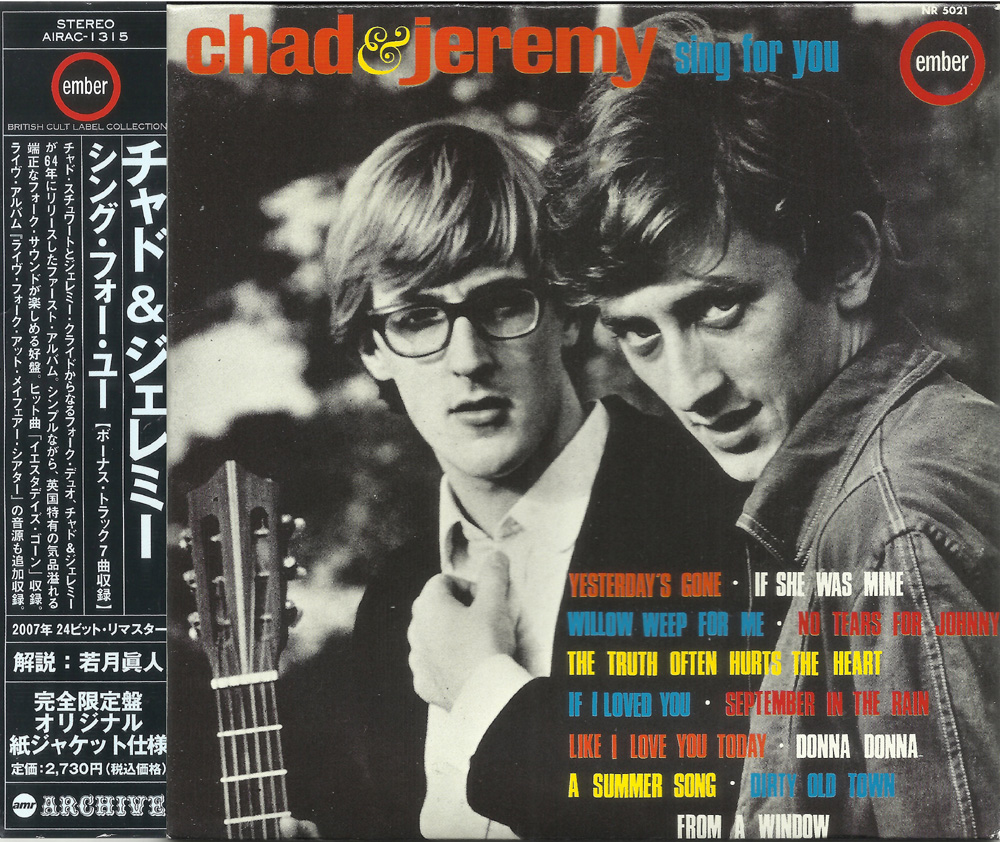
Chad And Jeremy - Sing For You (1964-65 uk, delightful baroque folk rock, 2007 japan extra tracks remaster)


Generally relegated to footnote status, folk/rock duo (heavier on the folk) Chad & Jeremy nonetheless managed a certain level of influence among a group of navel-gazing sensitive types who couldn’t totally commit to either the Beatles or Stones camps. And yet they still managed to make something of a splash riding the crest of a wave that was the British Invasion. At a time when it seemed every artist was copping the sound of the Beatles and/or Stones, Chad & Jeremy remained (relatively) committed to their folk origins. The trouble with this was their particular brand of folk was slowly falling out of favor following the arrival of Bob Dylan.

As if an attempt to split the difference, they embraced an approximation of the British Invasion sound while still attempting to adhere to their folk roots. But it didn’t quite suit the soft folk within which they best operated, and their attempts at continued relevance beyond a few early singles (“Yesterday’s Gone” and the song for which they are perhaps best known, “A Summer Song”) sound forced. They only truly succeeded when sticking closest to their roots; any venture into mainstream pop tended to fall short, sounding like a feeble attempt to tap into a commercial market quickly losing interest in them

Yet throughout, they prove to be fine interpreters of contemporary folk and standards of the genre. They take on Ewan MacColl’s perennial folk classic “Dirty Old Town”, giving it a decidedly country bent. “No Tears for Johnny”, while sounding feather-light, possesses a lyrical profundity and anti-war stance that far surpasses anything Simon & Garfunkel and their ilk ever attempted. It is within these unexpected moments that the music of Chad & Jeremy rises above much of the filler that weighed down their studio albums and prevented them from finding the favor they perhaps deserved. And while they would eventually surrender to the times with their generally well-regarded psychedelic albums Of Cabbages & Kings and The Ark, these early recordings show the pair trying desperately to get their music heard

Unfortunately the music of Chad & Jeremy has been unfairly overlooked by all but the most ardent fans of ‘60s pop music. The duo stands as a fine reminder that the pop landscape wasn’t all Beatles, Stones, Dylan, and Motown.
by John Paul, 14 September 2016


Tracks
1. Yesterday's Gone (David Stuart, Wendy Kidd) - 2:31
2. If She Was Mine (Bobby Goldsboro, Buddy Buie) - 2:02
3. Willow Weep For Me (Ann Ronell) - 2:35
4. No Tears For Johnny (Tom Springfield) - 2:17
5. The Truth Often Hurts The Heart (Clive Metcalfe, Keith Noble) - 2:51
6. If I Loved You (Oscar Hammerstein II, Richard Rodgers) - 2:18
7. September In The Rain (Harry Warren) - 2:31
8. Like I Love You Today (Chad Stuart) - 2:41
9. Donna Donna (Aaron Zeitlin, Sholom Secunda) - 3:00
10.A Summer Song (Chad Stuart, Clive Metcalfe, Keith Noble) - 2:39
11.Dirty Old Town (Ewan MacColl) - 3:08
12.From A Window (John Lennon, Paul McCartney) - 2:16
13.If I Had My Way (Traditional) - 2:22
14.The Morning (Traditional) - 2:22
15.Ain't That Just Like Me (Traditional) - 0:50
16.If I Had A Hammer (Lee Hays, Pete Seeger) - 2:13
17.Yesterday's Gone (David Stuart, Wendy Kidd) - 2:20
18.Stanley And Dora (Traditional) - 1:38
19.A Summer Song (Chad Stuart, Clive Metcalfe, Keith Noble) - 2:41
Tracks 13-18 Live recordings

Musicians
*Jeremy Clyde - Vocals, Guitar
*Chad Stewart - Vocals, Guitar, Keyboards
*Russ Savakus - Bass
*Charles McCracken - Cello
*Lucien Schmit - Cello
*Gary Chester - Drums
*Al Caiola - Guitar 
*Willard Syuker - Guitar  
*George Devens - Percussion
*Al De Risi - Trumpet
*Irvin Markowitz - Trumpet
*Harold Coletta - Viola 
*Harry Zaratzian - Viola
*David Nadien - Violin 
*George Ockner - Violin  
*Harry Katzman - Violin 
*Leo Kruczek - Violin  
*Max Pollikoff - Violin  
*Paul Gershman - Violin  
*Paul Winter - Violin 

1967  Chad And Jeremy - Of Cabbages And Kings (2006 japan bonus tracks remaster) 
1968  Chad And Jeremy - Three In The Attic (2013 edition)