I yield to no man in my admiration of the music of Terry Brooks. Probably best known for his first two albums, Translucent World from 1973 and Raw Power from ’76, Brooks’ style is a maddeningly manic brand of space-psych adorned with some of the fastest, most thrilling solos in rock history.
His unique career has taken in rock stardom, The Vietnam War, teaching, treasure hunting, painting and writing. After a difficult upbringing, Terry got his start on the blues circuit. “I started out playing blues on the black circuit all over the US – the chitlin’ circuit as it was known. I played all over the US with a black band, travelling around with 18 people on a bus – at that time there were no white people in these clubs. I was the only white guy there. This gig started in ’61.
It was a rough time because of the racial tensions. I’d seen a lot of abuse of the band members that were with me, and many bad situations, but playing and travelling around Texas, Mexico, Ohio, Mississippi, Louisiana – man you are talking about having a ball. That was the least money I ever made in music and the most fun I ever had! All we lived for was the note, the sound – and man we could really kick.” In the late ’60s Terry had to take a serious detour away from music. “I ended up in the army in ’nam which we won’t go into. This was the mid-60s and I got drafted.
When I came back I had a pretty tough time for a long while after that with depression and everything and I started playing blues again. It started with the album Translucent World when I was still in a kind of daze. I was just kind of a lost person with all that stuff that had happened to me. All I had was my music and the feeling in my music and I wrote about what I felt.” Translucent World is credited to “Strange” (later releases were credited to Terry Brooks & Strange, and then just to Terry Brooks) and was released on Terry’s own label in ’73.
Fans of heavy-psych guitar should need no introduction to this masterwork that takes the ghost of Hendrix and blasts it into the outer solar system. “Translucent World – you could tell where I was when you listen to it – I was way out there. There was a PO Box that was open for Translucent World that I never checked. When I finally did, there were hundreds of letters from record companies trying to get a hold of me from all over Europe, all the record companies.
I missed a shot there.” At this time Terry also rejected an offer from RCA, “They wanted to change my band and for certain people to go, so I turned them down.” Any fan of heavy psychedelic guitar has not got a complete record collection until they’ve checked out Terry’s music, which they can do at his new website TerryBrooksandStrange.com.
Asked to describe his guitar playing he replies, “It’s a cosmically energised style. I was very careful not to play other people’s music. I was also careful not to look at any other mathematical extrapolations. I didn’t want to be influenced by anything else.”
by Austin Matthews, Shindig Magazine
Tracks
1. Jimi - 4:31
2. Ruler Of The Universe - 11:05
3. The Kiss Of A Butterfly - 6:04
4. Hey Mr. Lonely Man - 4:42
5. Lost - 5:50
6. Spoonful (Live) (Willy Dixon) - 9:41
7. Preacher Of Rock'N'Roll - 6:35
All songs written by Terry Brookes unless otherwise written.
It was the Spring of 1968, and San Francisco was the place to be if you loved "the new rock 'n' roll." What differentiated the new rockers from the original forefathers of the genre— Chuck Berry, Jerry Lee Lewis, Little Richard, Elvis Presley, the Dominoes, the Drifters, and so many others—was that the focus, as well as the presentation of the music, had shifted dramatically. Since the advent of The Beatles a few years before, the emphasis now was far less on the "roll" and much more on the "rock."
With so many middle-class white kids having discovered the joys of rock 'n' roll in their adolescence, it was a natural evolution of musical and cultural values that took rock 'n' roll down its inevitable path 10 or 12 years later. The kids who loved the authentic, unadulterated, R&B-infused rock 'n' roll of the 1950s, and then grew up with intentions of being musicians themselves, had to interpret that music a certain way. And that, more or less, explains how The Loading Zone came to be.
This particular San Francisco band was a horndriven septet led by writer/arranger Paul Fauerso, who also sang and played keyboards in the group. The Loading Zone had been given a chance to record a single for Columbia Records in 1966 but nothing had happened with it, and there was to be no album made for that company. But the next year a small label, Umbrella Records, did get behind an album project for The Loading Zone.
On the strength of this first full effort, RCA Records—whose most successful group signing at this time was San Francisco's own Jefferson Airplane, with their bigselling 1967 LP, Surrealistic Pillow—decided to give The Loading Zone a shot. After all, they were making a lot of money right then with the Airplane, and all the labels were hungry to cash in on this "San Francisco Sound" phenomenon. RCA no doubt was hoping that lightning would strike twice in as many years.
If this Loading Zone band (whose music was described as something called "psychedelic soul") had a Surrealistic Pillow up its sleeve, the business people reasoned, there was lots more money to be made off of this Bay Area music explosion that was taking place. Around the same time that RCA was about to invite The Loading Zone to make an album for them, the band made a choice that a number of San Francisco bands had already made.
That change was noted on stage at the Winterland Ballroom in mid April of '68 by none other than Janis Joplin. "The Loading Zone's going on next," Janis told the audience, as she got ready to do the last song of her set with Big Brother & The Holding Company. "Okay...Wow! You gotta stay and see that chick, man. She's outta sight!" Janis was talking about Linda Tillery, a young black woman recently asked to join and front The Loading Zone as lead vocalist. It didn't take long for Tillery to make an impression on her fellow musicians, and RCA was banking on that appeal translating to rock music fans everywhere.
Big Brother had Janis, the Airplane had Grace Slick. Why not the talented, charismatic Linda Tillery taking The Loading Zone all the way to the top? Well, as history shows, that's not what happened. The Loading Zone, undeniably a good group who earned the respect of many other musicians and were well-received by the people who heard them, never really made it out of their native San Francisco.
They made a good album for RCA, but it did not sell in large quantities, and they were not given the chance to do another one. Columbia Records never regretted its earlier decision to not put its money on The Loading Zone, because by the time RCA signed them Columbia had its own psychedelic soul band taking off (on a subsidiary, Epic Records), another horn-driven San Francisco group called Sly & The Family Stone. Sixty-eight was the year Sly Stone and his integrated band of family and friends began its run of hit singles (with "Dance To The Music"), big-selling albums and influential, boundary-crossing music that ultimately earned them a place in the Rock And Roll Hall Of Fame.
The Loading Zone was handled by an organization called World Funk Management out of Berkeley, California. But in the newly-burgeoning world of funk music, Sly & The Family Stone was pretty formidable competition, locally and everywhere else. It was Sly who became the "King of Funk" in the late Sixties, and it was Sly & The Family Stone that was featured at Woodstock, and in the movie and album that followed.
The Loading Zone, meanwhile, had its brief moment in 1968, then faded out of the picture. Which is not to say, by any means, that their RCA album doesn't deserve its due, especially in view of what was going on in The Loading Zone's musical midst. Let's take, for instance, one of the songs that was on side 2: the re-make of jazz singer Billie Holiday's "God Bless The Child." It is virtually without question that Blood, Sweat & Tears cut this song for its self-titled second LP on Columbia (the album that insured that band's success) because The Loading Zone showed them how it could be done. Al Kooper, an original member of Blood, Sweat & Tears who was ousted from the group after its first LP, referred in his autobiography to B,S&T's version of "God Bless The Child" as a "Las Vegas desecration"—something that would never be said of The Loading Zone's treatment of this classic number.
Maybe that was the problem—The Loading Zone was too respectful of a great song to glitz it up for "crass" commerical purposes. (Kooper also produced a solo album for Tillery, "Sweet Linda Divine," that came out later on Columbia.) The other nine tracks on "The Loading Zone" were a mixture of other song revivals and Paul Fauerso originals.
Perhaps where the group miscalculated was in reaching back several years or more for previously-recorded tunes, instead of trying to come up with mostly (or entirely) original material. (Tillery did no writing at all for the RCA album, suggesting that the record had been all planned-out before she even joined The Loading Zone.) Obviously fans of Detroit music, the band chose three songs associated with Motown Records to put on the album. "Shop Around," which closed side 1, was of course originally done by Smokey Robinson and The Miracles, one of Motown's earliest smash hits. "Danger Heartbreak Dead Ahead" had been a single release for The Marvelettes in 1965 on Motown's Tamla label. (Bonnie Raitt also cut this song, a few years after The Loading Zone did, and it ended up on her debut album.).
The album also featured "Love Feels Like Fire," written by Lamont Dozier and the brother duo of Brian and Eddie Holland, the songwriting team that came up with a bunch of hits for The Supremes. The retro feel of the album may have dashed hopes for a hit on the charts in 1968, but does not at all detract from our enjoyment of the tracks decades later.
The Loading Zone, perhaps, didn't have the knack for hitting the crest of the wave and riding it for fame and riches in the music business, but its members did have a good feel for the music they liked, and they knew how to play it well. Unfortunately, Paul Fauerso and his bandmates drifted into obscurity after 1968, while groups with similar ideas (B,S&T, Chicago, Tower Of Power) went on to enjoy success in the 1970s. Like The Electric Flag, another good Bay Area band from that era, The Loading Zone were also-rans, with a lot of "what if's" to ponder later in life about a career cut short.
Linda Tillery, however, went on to a still-vital career in music. Although hers is not a household name, she has earned the admiration of many music lovers over the years, proving the legitimacy of Janis Joplin's estimation that her talent was "outtasight." Tillery has worked with such recording artists as Oleta Adams, Linda Ronstadt, Boz Scaggs, Santana and the Turtle Island String Quartet. She is also founder of The Cultural Heritage Choir, as well as a member of that ensemble.
by Steve Roeser, June 2001
Tracks
1. No More Tears (Peter Shapiro, Paul Fauerso) - 3.12
2. Love Feels Like Fire (Brian Holland, Edward Holland, Jr., Lamont Dozier) - 4.42
3. Don't Loose Control (Of Your Soul) (Paul Fauerso)- 3.21
4. I Can't Please You (Jimmy Robins) - 4.07
5. Shop Around (Berry Gordy Jr., Smokey Robinson) - 3.50
6. The Bells (Billy Ward) - 3.55
7. Kalui Yuga-Loo (Paul Fauerso) - 3.23
8. God Bless The Child (Billie Holiday, Arthur Herzog Jr.) - 4.45
9. Danger Heartbreak Dead Ahead (Clarence Paul, William Stevenson, Ivy Joe Hunter) - 3.34
10.Can I Dedicate (Paul Fauerso) - 9.37
The Loading Zone
*Linda Tillery - Vocal
*Paul Fauerso - Organ, Piano, Vocal
*Peter Shapiro - Lead Guitar
*Steve Dowler - Rhythm Guitar
*Bob Kridle - Bass
*George Newcom - Drums,
*Todd Anderson - Tenor Sax
*Patrick O'hara - Trombone with
*Frank Davis - Drums on "Can I Dedicate"
"Timeless UK 60's Popsike and Other Delights" is the apt subtitle of this 25-track collection, which spotlights obscurities from the lighter side of slightly psychedelic-influenced British pop/rock of the late '60s. There are a few artists here who had commercial success, like Wayne Fontana, Dave Berry, future Foreigner member Mick Jones (as part of the J. & B.), and future 10cc members Graham Gouldman and Kevin Godley (as part of the awkwardly named Frabjoy & Runcible Spoon).
But basically this is a pretty deep archival dig through material that hasn't often seen the light of day since its original release, in a genre that's never been the most heavily mined of 1960s styles. It's one of the best such digs, too, even though as a 1,000-copy limited edition, it didn't get the exposure of some of CD reissues with a similar concentration. While some of the elements of pop-sike that drive earthier listeners up the wall -- fruity orchestration, florid lyrics, twee preciousness -- are here to varying degrees, their quotient is considerably lighter than usual on this anthology.
It's true you still might want to be in the mood for something on the light side before hearing all of it at once, but the focus is more on decent pop songs with imaginative arrangements and an occasionally (admittedly mild) touch of freakiness than the airy-fairy stuff. Some of the tracks are outstanding, like the J. & B.'s unaccountably seldom-anthologized "There She Goes," which is like a cinematic look at the melancholic underbelly of Swinging London, the Candlelight's quite fine makeover of the Merseybeat-era relic "That's What I Want" into staunch baroque pop with stirring vocal harmonies; Piccadilly Line's "At the Third Stroke," which is as much melodic folk-rock as pop-sike; Toyshop's "Send My Love to Lucy," whose singer sounds uncannily like Stephen Stills; and Fontana's "In My World," perhaps his best solo effort sans the Mindbenders. Even some of the less distinguished and more ornate cuts remain listenable as they pass by, without getting overly sickly sweet.
by Richie Unterberger
Artists - Tracks
1. Thoughts And Words - Morning Sky - 3:36
2. Piccadilly Line - Atthe Third Stroke - 3:03
3. Majority - Charlotte Rose - 2:59
4. J And B - There She Goes - 2:46
5. Playground - The Girl Behind The Smile - 3:02
6. Frabjoy And Runcible Spoon - Animal Song - 2:22
7. Pipes Of Pan - Monday Morning Rain - 3:02
8. Toy Shop - Send My Love To Lucy - 4:20
9. Candlelight Trio - That's What I Want - 2:17
10.Epics - Henry Long - 2:46
11.Finders Keepers - Light - 3:12
12.Martin Martin - Imagine - 2:24
13.Young Brothers - Mirror, Mirror - 3:25
14.Robbie Curtice - The Soul Of Man - 2:32
15.Alan Bown - All I Can - 2:46
16.Jason Paul - Shinea Little Light In To My Room - 2:48
17.Californians - Can't Get You Out Of My Mind - 2:05
18.Wayne Fontana - The Impossible Years - 2:31
19.Wayne Fontana - In My World - 3:04
20.John Bromley - If You Were There With Me - 3:14
21.Ian Gibsons - You Know I Need Your Loving - 3:02
22.Dave Berry - And I Have Learned To Dream - 3:11
23.Majority - Wait By The Fire - 3:14
24.David McNeil - Linda - 2:50
25.Robbie Curtice With Tom Payne - Gospel Lane - 2:38
Australian born Paul Adolphus had lived before in Sweden, India and Sri Lanka. He also had a special relationship with Kyoto, Japan. Both of his first children were born there at different visits. He also came with the right feelings to the right place, which, between 1968 and when he recorded his album, in 1973, was a vibrant creative place. It was there where he met Mitsu Harada.
She contributed piano, organ, koto on his first, privately released album (only 200 were printed) and she did also the production. Recorded in a kind of living room atmosphere, some friends attending, with nature around them and an old Buddhist temple nearby, there was used a very peaceful and meditative, special atmosphere to record the album. The album luckily was recorded well.
The album starts very meditatively with sakuhachi flute, an organ drone, flute, a kind of tabla, electric piano, bass, before a voice, in colour a bit like early John Martyn or like David Thomas Broughton, most of it in English, but also with small parts in Japanese with piano and acoustic guitar, and hand percussion. The quietness swelling into the songs, sounds pretty unique to me.
Further on we hear splendid guitar work (on “It’s Raining” slightly Bert Jansch-like), nice flute improvisations, vibes, and some koto. But sometimes Paul Adolphus also falls back on more recognisable blues standards, in a lets say, Wizz Jones way of song music, less special but acceptable. This blues standard can also come back a bit more vaguely, which is more rewarding. Considering the few different variations in directions, this remains a very special album with many unique moments and a perfect starting point to make this so.
Tracks
1. A Day Is Born - 6:05
2. Good Morning - 4:02
3. She Might Love Me - 2:55
4. Butterfly - 2:03
5. It's Raining - 2:48
6. The New Year - 7:46
7. Looking at the World - 2:53
8. Golden Shore - 4:27
9. Evening Wind - 3:29
10.Forest Lore - 2:44
11.Zandala - 5:05
12.At Days End - 3:24
13.Untitled Hidden Track - 1:57
Words and Music by Paul Adolphus.
The core members of The Cleves were New Zealand born Gaye Brown and her brothers Ron and Graham. All three studied music and formed their own group while in their teens. After adding local lad Milton Lane (rhythm guitar) they became The Clevedonaires ca. 1964. The band's name was taken from their home town of Clevedon, just south of Auckland. According to Bruce Sergent, Lane was replaced by Rob Aicken a few months later, although Vernon Joyson's listing for the group suggests that he came in later.
The Clevedonaires originally played "lightweight folksy music", covering acts like The Seekers, Donovan and the Byrds, and playing church halls and school dances around the South Auckland area. By 1965 they had toughened up their style and were covering tracks by The Who, The Small Faces and The Beatles. Gaye had now started playing organ, allowing Rob Aicken to switch to bass, and they started working the Auckland club circuit.
In 1966 Auckland promoter Benny Levin signed them to his Impact label. "How You Lied" / "Rooftops And Chimneys" came out in 1966, and "He's Ready" / "Lost Women" and "Funny How Love Can Be" / "Don't Ask Me What To Say" in 1967. To promote the singles, the band appeared on local TV shows The We Three Show and C'Mon. Their final Impact single, a cover of Donovan's "Sunny Goodge Street", backed by the Small Faces' "Up The Wooden Hills To Bedfordshire" was released in 1968, just before they relocated to Australia.
Now renamed The Cleves, they were one of several polished Sydney pop bands of the period (e.g. The Executives, The Affair, Aesop's Fables, The Clik) who featured tight harmonies, sophisticated arrangements and relatively light, pop-oriented repertoire. The Cleves' first Australian single appears to have been a promotional recording made for the Marionette Theatre of Australia's long-running children's production of The Tintookies. This enduringly popular children's show was based on Peter Scriven's 1946 book Little Fella Bindi and The Tintookies. (Scriven also created and performed the puppets for the Sixties TV series Sebastian The Fox and the 1968 short film The Painter). The single was issued on the Marionette label in 1968.
In 1969 the group signed with Festival and issued two singles, "Sticks and Stones" / "Don't Turn Your Back" (September 1969) and "You and Me" / "Cassie" (May 1970), plus two EPs, A Taste of Energy and Music from Michael on Festival's newly formed 'prog' subsidiary Infinity in 1970. Music From Michael was a sixteen-minute, ten-part suite recorded for the soundtrack of the "Michael" episode of the three-part Australian film Three to Go. "Michael", directed by Peter Weir, won the Grand Prix at the 1970 AFI Awards and it has recently been included on the DVD release of four short films by Peter Weir. (Another segment, "Toula" featured music by Graheme Bond and Rory O'Donohue). Along with the Bee Gees-like track "Don't Turn Your Back", the EP featured songs recorded for the soundtrack, segued together to form a thematic whole, which "combined certain elements of the British music hall tradition (as espoused by The Beatles) with a more esoteric pop flavour a la The Move".
By this time the band was heading in a more progressive musical direction, and they recorded their highly regarded LP, produced by Richard Batchens, in late 1970. Just before it was released (as part of Infinity's first batch of releases in January 1971) The Cleves backed Sydney DJ Donnie Sutherland on a bubblegum pop single with the outlandish title "Bonnie Bonnie Bonnie Na Na Kiss Him Goodbye" (b/w "I Don't Mind") which came out on Martin Erdman's Violet's Holiday label.
The LP, the highly collectable Cleves has been described by Ian McFarlane as "a prime example of where psychedelic pop gave way to a more progressive aesthetic". The album is dominated by "longer tracks, atmospheric organ/fuzzed guitar interplay and tight vocal harmonies (similar to UK bands on the Vertigo label like Cressida and Affinity)". The highlight was their impressive reading of the George Gershwin classic "Summertime". The album has since become one of the most collectible artefacts of Australia's progressive rock era.
"Gaye Brown's spirited vocals are in the manner of Dutch band Earth & Fire, highly regarded songstress Julie Driscoll and Affinity's Linda Hoyle. Tracks like 'Work Out' and 'Time Has Come' are based on a pop framework but are swelled by soaring fuzzed out leads, and Cressida-like keyboard passages. The highlights include an impressive rendering of the George Gershwin chestnut 'Summertime' (shades of Janis Joplin), then the dynamic 'There is a Place' and the more reflective 'For A Time'." -- Ian McFarlane
After the album came out The Cleves were joined for a short time by guitarist Vince Meloney (guitar; ex-Billy Thorpe and the Aztecs, Bee Gees, Fanny Adams). Not long after, Ace Follington (ex-Chain, Country Radio) subsequently replaced Graham Brown on drums. In October 1971, The Cleves moved to the UK (minus Meloney who had by then formed Flite with Leo De Castro) where they became known as Bitch. Before breaking up the band issued three singles, "Laughing", "Good Time Coming" and "Wildcat". These were apparently released on the Anchor label, distributed by Warner Brothers in the USA. What became of the group members after this time is not known.
Vicious Sloth Collectibles has re-released the Cleves album on CD. Re-mastered from the original tapes, it also includes the songs from the Music From Michael EP as bonus tracks, plus original artwork and liner notes.
Tracks
1. Work Out - 7:05
2. There Is A Place - 5:00
3. Keep Trying - 5:04
4. Time Has Come - 5:00
5. Summertime - 7:35
6. Wait For A Moment - 3:20
7. For A Time - 6:00
8. Waterfall - 4:58
9. You And Me - 3:17
10.Music From Michael - 16:39
The Cleves
*Rob Aicken - Bass
*Gaye Brown - Vocals, Organ
*Graham Brown - Drums (1964-1971)
*Ron Brown - Guitar
*Ace Follington - Drums (1971-)
*Milton Lane - Rhythm Guitar
*Vince Meloney - Guitar
Third volume of this great series focuses on US-released pop-sike covering the period 1965 to 1969. Includes many buried treasures including Robbie Curtice's "When Diana Paints The Picture", Eddie Hodges' "Shadows & Reflexions" (later covered by The Action), The Chicago Loop (including Mike Bloomfield and Barry Goldberg pre-Electric Flag) and both sides of the rare single by 10 year old Mark Radice! Fantastic compilation that no 60's collection is complete without. Similarly limited to 1000 copies only.
Artists - Tracks
1. Eddie Hodges - Shadows And Reflexions - 2:57
2. Michael And The Trees - Show You Love Me - 2:25
3. Wiggs Of 1666 - It Will Never Be The Same - 2:17
4. Giant Jellybean Copout - Look At The Girls - 2:35
5. Network - The Boys And The Girls - 2:56
6. Saturday's Photograph - Gentle Lovin' San Francisco Man - 2:57
7. Mark Radice - Save Your Money - 2:39
8. Mark Radice - Wooden Girl - 2:59
9. Voyage - One Day - 2:35
10. River Deep - Shelley Tell Me Why - 2:12
11. Springfield Rifle - Left Of Nowhere - 3:17
12. Lamp Of Childhood - First Time, Last Time - 2:53
13. Trolley - Toy Shop - 2:32
14. East Side Kids - Take A Look In The Mirror - 2:05
15. London Phogg - The Times To Come - 2:59
16. Carnival - I'm Going Home Tomorrow - 2:05
17. Gaitley And Fitzgerald - Seance Day - 2:20
18. Scandal - Girl, You're Goin' Out A My Mind - 2:32
19. Robbie Curtice - When Diana Paints The Picture - 2:47
20. Chicago Loop - This Must Be The Place - 2:31
21. Saturday's Photograph - Summer Never Go Away - 2:08
Bit 'A Sweet promises to be a chart regular with the bright and creative spark branded into 2086, If 1 Needed Someone and How Can 1 Make You See?. They blend all the pop ingredients - strong vocals, rich production and instrumentation, and a special trick with a tune. This LP may well serve as the group's musical calling card, and with their fresh originality and breezy psychedelics, Bit 'A Sweet will top the charts.
Billboard, 29/6/68
Formerly known as The Satisfactions, this hard-hitting Long Island club act were veterans of the local scene when producer-arranger Steve Duboff (who also worked with The Cowsills, The Monkees, The Insect Trust and others) signed to MGM, the band debuted with the 1967 single 'Out of Sight Out of Mind' b/w 'Is It On - Is It Off?' (MGM catalog number K-13695).
Their sole album was released that May. A likeable blend of psychedelic pop and early synthesizer sounds, it’s presented complete with both sides of their rare 1967 debut 45 (as performed in the movie Blonde On A Bum Trip).
Tracks
1. Speak Softly (Steve Duboff) - 5:10
2. 2086 (Steve Duboff, Art Kornfeld) - 2:50
3. If I Needed Someone (John Lennon, Paul McCartney) - 3:36
4. With Love (Mitch London, Steve Duboff) - 3:50
5. Monday - Tuesday (Steve Duboff) - 1:50
6. Diamonds Studded Eyes (Russell Leslie, Steve Duboff, Dennis Derespino, Mitch London) - 4:02
7. How Can I Make You See (Art Kornfeld, Bill Cowsill, Bob Cowsill) - 2:40
8. Travel (Instrumental) (Steve Duboff) - 5:00
9. A Second Time (Steve Duboff) - 8:30
10.Out Of Sight, Out Of Mind (Doug Morris, Steve Duboff) - 2:36
11.Is It On - Is It Off? (S. Duboff) - 2:53
Bit A Sweet
*Dennis DeRespino - Vocals, Keyboards, Percussion, Guitar
*Russell Leslie - Vocals, Drums, Percussion
*Mitch London - Vocals, Bass, Percussion
*Jack Mieczkowski - Vocals, Guitar, Sitar with
*Steve Duboff - Keybords, Percussion, Production
*Vince Bell - Guitars
*Jimmy "Wiz" Wisner - Strings Arrangements
Fading Yellow Volume Two starts out with the creepy sounding folk rock of Disraeli's What Will The New Day Bring which has also been recently compiled on the Storm in the Garage box set on Akarma.
The July Four bring us the more upbeat Frightened Little Girl which was covered by The Happy Balloon on the Siesta compilation Sombrero, a song that was not on The Fine Art Of Ballooning. A spiritual obscurity from the sixties if there ever was one and definitely worth the covering - or listening in its original form which appeared on a Cameo/Parkway 45 in 1967. The July Four also released this song in an instrumental version called Mr. Miff as the B-side to Frightened Little Girl which would be interesting to hear.
I'll Take it Back by Calliope has a similar unearthly harmony trend that we heard on the recordings by Curt Boettcher's Ballroom group or early Jefferson Airplane.
George Edwards original pre-HP Lovecraft tune Never Mind, I'm Freezing which is featured here and that was originally issued on Dunwich, much preferring his cover of The Beatles' Norwegian Wood. There are some guitar strums which sound C86 inspired.
I really enjoyed the anthemic folk rock of The Poor and two Poor songs are featured here including How Many Tears and Come Back Baby.
Curt Boettcher and Keith Olsen released the amazing Don´t Say Now as the b-side to The Night We Fell in Love (released as The Oracle) in 1967. It's a shame that Curt Boettcher's side projects have not been compiled on a legitimate compilation because they keep coming up here and there and astound everytime.
The Holy Mackerel were an early Paul Williams' band. I have yet to hear a full album by them, but thanks to compilations like the recently released Come To The Sunshine and this one, I can hear select tracks by this Richard Perry production called Scorpio Red. Paul Williams also helped c-write the masterful Peppermint Trolley Co. tune Trust with Roger Nichols. Sadly, Trust has yet to appear on a legit compilation, so every version I've heard (including the original vinyl copy) has that surface noise which plagues so much 1960s music. So please someone reissue The Holy Mackerel and Peppermint Trolley Co. albums soon!
The Higher Elevation's tune The Summer Skies was a project of Tim Gilbert, the writing partner of John Carter from the Strawberry Alarm Clock's Incense and Peppermints - they also released an LP as The Rainy Daze. The Summer Skies is a breezy garage pop gem that is about love in the summertime - the best time of year.
Chris and Craig were Chris Ducey and Craig Smith before they worked with The Monkee's Mike Nesmith as The Penny Arkade. Craig Smith wrote a handful of tunes for the likes of Andy Williams, Glen Campbell and the Monkees before he became known as Maitreya Kali and released two of the weirder self released albums (Apache and Inca) from the 1960s and early 1970s. Oddly, his albums included some of the Penny Arkade Not the Freeze tunes along with solo odds and ends.
Chris Ducey (not Bobby Jameson, who recorded an album with Chris Ducey's song titles *only* under the name Chris Ducey/Chris Lucey without the real Chris Ducey's involvement) ended up later working with Chad of Chad and Jeremy.
The early Chris and Craig single from 1966 included Isha (included here) and I Need You and has an interesting middle eastern feel mixed with some mad harpsichord and harmony vocals to it which preceded both The Monkees and Maitreya Kali middle eastern sitar sounds. It sounds like a tune that would've been unearthed by some 80s band like The Primitives or The Bangles.
The Backseat's Where Is Mary sounds like a chant that would've appeared in Willy Wonka or The Wizard of Oz movies. Larry Tamblyn from The Standells set this Utah group up with what must be some sort of veiled reference to drugs.
Not much is known about The Reign but their Sea Of Dreams has a jazzy and upbeat feel to it which makes me think it might be from New England. It almost sounds like it was taken from a private reel tape too and not a 45 but what do I know. Nice soulful fuzzed out break midway through.
And finally, a mystery instrumental Bonus Track is included to close out this volume of Fading Yellow which has a nice chiming strummed guitar bit to it and shimmering soloing which reminds me of the 1980s British movement of bands like Felt. I'm not sure why it must remain a mystery, but it's certainly a gem.
By Patrick (Gullbuy)
Artists - Tracks
1. Disraeli - What Will the New Day Bring? - 3:08
2. Network - Ears of Stone - 2:50
3. Whispers - Knowin' - 2:36
4. July Four - Frightened Little Girl - 2:30
5. Calliope - I'll Take It Back - 2:36
6. George Edwards - Never Mind, I'm Freezing - 2:30
7. Poor - How Many Tears - 2:26
8. Happy Return - I Thought I Loved Her - 3:42
9. Oracle - Don't Say No - 3:07
10.Rites - Hour Girl - 2:49
11.Dynamics - All She Said - 2:39
12.Holy Mackerel - Scorpio Red - 3:05
13.Peppermint Trolley Co. - Trust - 2:40
14.Higher Elevation - The Summer Skies - 2:10
15.Chris and Craig - Isha - 2:17
16.Backseat - Where Is Mary - 2:18
17.Poor - Come Back Baby - 2:32
18.Cascades - I Bet You Won't Stay - 2:24
19.Sound Set - Mind in a Bottle - 2:51
20.Reign - Sea of Dreams - 2:18
21.Look - In a Whirl - 2:30
22.Unknown Artist - Bonus track - 2:28
Track 22, the "Bonus Track" is in fact "Mr. Miff" by The July Four.
Late-'60s New York-based flower child Cosmic Michael is one of the scads of ultra-obscure recording artists from the original psychedelic era whose records were swept under the rug of time completely. Copies left from the astonishingly small initial pressings have been trading hands among collectors for obscene amounts of money, ranking Cosmic Michael's crude, handmade psychedelia with records of the same era by MIJ, Gary Higgins, and Kenneth Higney.
This disc collects both of Cosmic Michael's private press albums, including a 1969 self-titled set and 1970's After a While. Unlike the drifting stoner vibes of most loner psyche records, Cosmic Michael's talent for boogie-woogie rock piano comes through as equally as the acidic jamming. Tunes like "River City," "Salty Jam," and of course "The Heavy Boogie" are mostly showcases for Michael's grooving boogie organ or piano skills, if couched in extremely muddy lo-fidelity recording quality.
While the self-titled material sees the tunes filled out by a full band, the songs from After a While are of a more stripped-down orchestration, Cosmic Michael's voice in one speaker, piano in the other, and the occasional warbly kazoo or harmonica. While the sparsity of After a While makes it a more eerie affair, it's no less engaging than the fried boogie of the other songs.
Even for his time, Cosmic Michael was by no means a career musician or even remotely concerned with professionalism in music. This innocence and oblivion are largely what makes these very odd songs such a breath of fresh air.
by Fred Thomas
Tracks
1. Now That You've Found It - 3:58
2. Salty Jam - 4:09
3. Theme - 3:46
4. Too Much - 2:55
5. River City - 2:11
6. People's Fair - 2:33
7. Mother Earth - 6:48
8. The Heavy Boogie - 4:26
9. Woodstock Nation - 3:04
10.She's My Girl - 3:55
11.Feel Free - 3:36
12.Rock Me - 5:21
13.After a While - 3:19
14.Shake It Loose - 1:30
15.Fine Spaces of Time - 4:30
16.Let Me Be - 3:41
17.Truckin - 3:18
All tracks written by Cosmic Michael
Tracks 1-8 from "Cosmic Michael" 1969
Tracks 9-17 from "After A While" 1970
*Cosmic Michael - Vocals, Piano, Harmonica, Guitar.
This is a fine example of music that arose after the Beatles caught "A Ticket To Ride". Running the gamut from jolly mid-60s beat-pop through to heavily orchestrated affairs from '69, "Fading Yellow's" overall concept of 'pop-sike' and more so 'other delights' is fully realised.
Some may argue that by the end of the year a certain type of collector will be becoming hot under the collar on hearing mention of a rare '67 Ken Dodd acetate that features lush orchestration and sustained fuzz guitars! Diddy Men in the sky with diamonds, indeed! Cynicism aside, the psych/pop compilation is clearly becoming far poppier with the passing of time, and such a fine example as "Fading Yellow" sits perfectly on the cusp of the "Rubble" series most commercial selections and the more recent and uneven "Ripples" compilations (albeit a lot more interesting).
It's practically a gem after gem ride too. Mike 'Remember You're A Womble' Batt's mournful, sweeping ballad "Fading Yellow" is the perfect summation of what's on offer and is certainly worthy of having an entire compilation named after it. The strings, warm guitar parts and soft vocalising are sumptuous, and a good indication of what's in store. It really is a solid set, and possibly the greatest pop-psych comp to come out in years.
Rather than focus on fifth-division acetate pressings of 'four Lancashire lads trying to be Syd Barret' everything included here is well performed pop saturated in that certain late '60s over-the-top production that so regularly gets classified as psychedelia. And there are plenty of obscure choice cuts to satisfy even the most hardened psych-head. Irish four-piece Jon's "Is It Love" has a great rising chorus, some oriental sounding instrumentation and a middle-eight that has a vague feel of the Troggs psych-pop phase.
Juan & Junior (of Los Brincos fame) sound uncannily like Magna Carta on their whimsical folk-pop cut 'Andurina'. 'Woe, Is Love Dead My Dear?' the b-side of the Koobas rare Danish only 'Sweet Music' 45 sees the 'pudlians getting introspective on their beautifully performed rendition of this Bert Jansch piece (which he also recorded). And amongst the many other strong cuts from the likes of Eddy Howell, Ronnie Bird, Paul & Barry Ryan is American teen trio The Aerovons incredible "World Of You", which was recorded in Abbey Road in 1969.
This not only rates as one of the best cuts on this album, but is also among the finest late '60s EMI discs (and yes, we're talking Pretty Things and Pink Floyd here too). (Rumour has it that their unreleased 1969 album will soon be available on Flower Machine).
Not only timeless, but in every aspect wonderful too. If only more compilations were as good as this.
by Jon 'Mojo' Mills
Artists - Tracks
1. Kate - Strange Girl - 3:03
2. Dean Ford & The Gaylords - That Lonely Feeling - 2:40
3. Eddie Howell - Easy Street - 3:00
4. Mike Batt - Fading Yellow - 3:44
5. Steff Sulke - Oh, What A Lovely Day - 3:04
6. John Williams - Flowers In Your Hair - 2:42
7. The Zephyrs - I Just Can't Take It - 2:30
8. Jon - Is It Love? - 2:51
9. Koobas - Woe, Is Love My Dear - 2:27
10.The Orange Bicycle - Competition - 2:40
11.The Gremlins - The Only Thing On My Mind - 2:05
12.Quintin E Klopjaeger And The Gonks - The Long Way Home - 2:28
13.Sundragon - Far Away Mountain - 2:57
14.Juan And Junior - Andurina - 3:10
15.Hamlet - She Won't See The Light - 2:08
16.Paul And Barry Ryan - Madrigal - 2:17
17.Phil Cordell - Red Lady - 2:25
18.Ronnie Bird - Sad Soul - 2:54
19.Ronnie Bird - Raining In The City - 2:36
20.Elliot's Sunshine - 'Cos I'm Lonely - 3:07
21.Peter Janes - Do You Believe (Love Is Built On A Dream) - 2:53
22.The Bliss - Lifetime - 2:47
23.The Jackpots - King Of The World - 2:50
24.Members Of Time - Dreamin' - 2:38
25.Aerovons - World Of You - 2:24
All ten songs the Purple Hearts released during their brief lifetime (on 1965-1967 singles) are on this meticulously thorough reissue. It also adds four songs they recorded on acetates in early 1965 prior to their recording deal, as well as seven tracks by the Coloured Balls, the band in which singer/harmonica player Mick Hadley and bassist Bob Dames played in the late '60s and early '70s.
The Purple Hearts tracks are the ones the collectors who seek this CD out will be most interested in, as they're solid, punky R&B, very much in the mold of the British bands springing up in the wake of the Rolling Stones circa 1964-1965. The cuts are tough and hard-boiled, and will no doubt recall similar, though superior, British acts such as the Pretty Things and the Graham Bond Organisation.
What makes the Purple Hearts inferior to such acts is that they recorded absolutely no original material, devoting most of their studio performances to covers of songs by the likes of Bond, Paul Butterfield, Bo Diddley, and Muddy Waters. They do, however, pull off a superbly menacing R&B/punk makeover of the spiritual "Early in the Morning," with searing fuzz guitar and voodoo-ish ensemble chanting. Too, their sole 45 to feature cover tunes that weren't well known ("Of Hopes and Dreams and Tombstones"/"I'm Gonna Try") is pretty respectable, though Mick Hadley's vocals aren't quite up to the level of belters like the Pretty Things' Phil May.
The Coloured Balls tracks (in quite variable sound quality), which are much more in a hard rock/blues-rock/psychedelic/progressive rock vein, are apparently taken from "rehearsals, gigs and local TV appearances" -- the liner notes aren't wholly clear on this point. These songs aren't nearly as interesting as the Purple Hearts' material, and are likewise all covers, this time around of songs by Jethro Tull, Steve Miller, and Fleetwood Mac, as well as blues tunes by Howlin' Wolf and Willie Dixon.
The 36-page booklet is exemplary, with liner notes featuring vintage photos and first-hand quotes from original bandmembers, properly honoring the Purple Hearts' status as one of the more notable Australian rock acts of the '60s.
by Richie Unterberger
Tracks The Purple Hearts
1. Talkin' Bout You (Chuck Berry) - 2:08
2. Louie Louie (Richard Berry) - 3:09
3. Long Legged Baby (Graham Graham Bond) - 2:18
4. Gloria (VanMorrison) - 2:54
5. Here 'Tis (EllasMacDaniel) - 2:49
6. Long Legged Baby (Graham Bond) - 1:54
7. Of Hopes And Dreams And Tombstones (Joy Byers) - 2:30
8. I'm Gonna Try (J. WilliamsJohnny Williams) - 2:20
9. Early In The Morning (Traditional) - 2:11
10.Just A Little Bit (Del Gordon) - 1:50
11.You Can't Sit Down (Phil Upchurch, Dee Clark, Cornell Muldrow, Jon Sheldon) - 3:04
12.Tiger In Your Tank (Willie Dixon) - 2:09
13.Chicago (Nick Gravenites) - 2:25
14.Bring It On Home (Sonny Boy Williamson) - 2:58
The Coloured Balls
15.A Song For Jeffrey (Ian Anderson) - 5:42
16.Killing Floor (Howlin Wolf) - 2:58
17.Living In The Usa (Steve Miller) - 4:34
18.Bring It On Home (Willie Dixon) - 4:35
19.Long Grey Mare (Peter. Green) - 3:56
20.Living In The Past (Ian Anderson) - 3:12
21.Living In The Usa (Live) (Steve Miller) - 10:13
Like their West Coast contemporaries Sly and the Family Stone, the Chambers Brothers shattered racial and musical divides to forge an incendiary fusion of funk, gospel, blues, and psychedelia which reached its apex with the perennial 1968 song "Time Has Come Today." The Chambers siblings -- bassist George, guitarist Willie, harpist Lester, and guitarist Joe, all of whom contributed vocals -- were born and raised in Lee County, MS; the products of an impoverished sharecropping family, the brothers first polished their vocal harmonies in the choir of their Baptist church, a collaboration which ended after George was drafted into the army in 1952.
Following his discharge he relocated to Los Angeles, where the other Chambers brothers soon settled as well; the foursome began performing gospel and folk throughout Southern California in 1954, but remained virtually unknown until appearing in New York City in 1965. The addition of white drummer Brian Keenan not only made the Chambers Brothers an interracial group, but pushed their music closer to rock & roll; a well-received appearance at the Newport Folk Festival further enhanced their growing reputation, and they soon recorded their debut LP, People Get Ready.
by Jason Ankeny
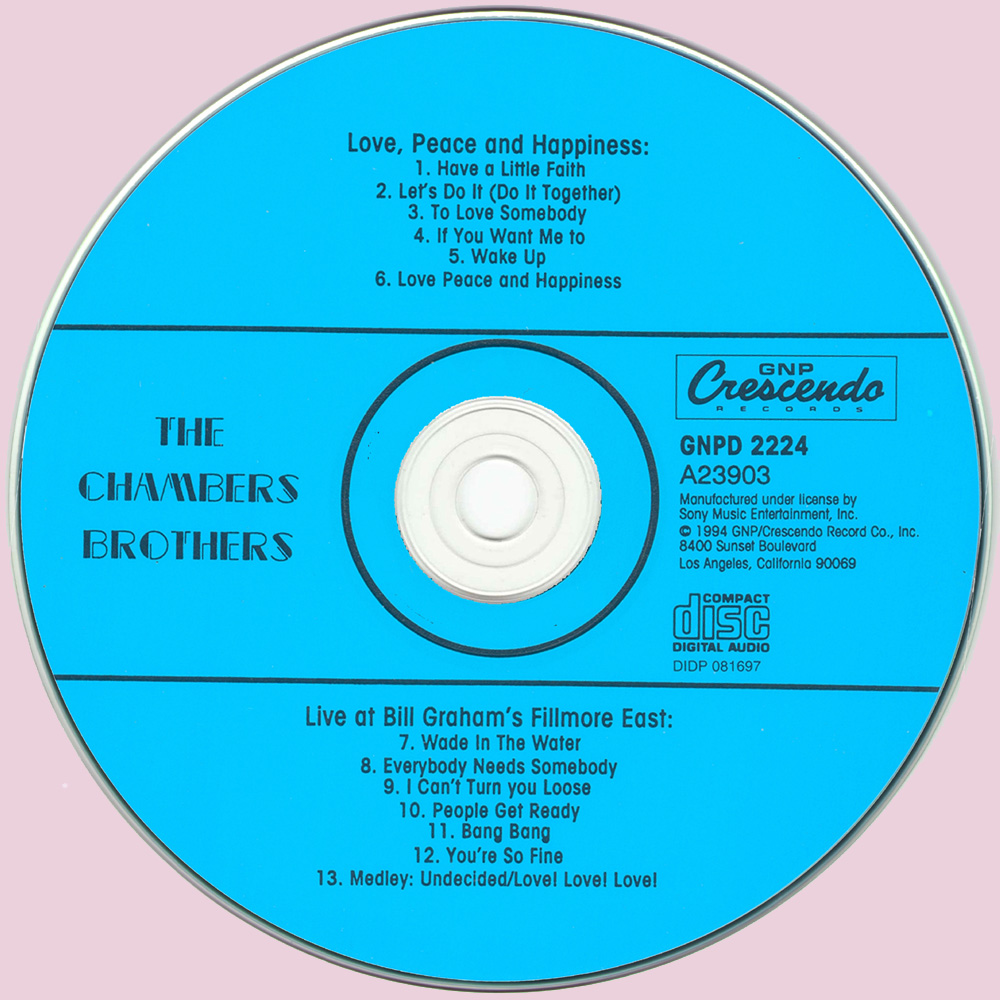
In 1969 the Chambers Brothers released a double vinyl under the title "Love, Peace and Happiness", the first disc contains studio recordings and on the B side there's the same-title classic music piece, while the second disc contains live recordings which took place a year before (1968) at Bill Graham's Fillmore East.
Tracks
1. Have a Little Faith (S. Turner) - 5:11
2. Let's Do It (Do It Together) (S. Turner) - 4:33
3. To Love Somebody (Robin Gibb, Barry Gibb, Maurice Gibb) - 4:36
4. If You Want Me To (S. Turner) - 3:58
5. Wake Up (Marvin Hamlisch) - 2:17
6. Love, Peace and Happiness (The Chambers Brothers) - 16:15
7. Wade in the Water (Traditional) - 10:22
8. Everybody Needs Somebody (Joseph Chambers) - 6:28
9. I Can't Turn You Loose (Otis Redding) - 2:56
10.People Get Ready (Curtis Mayfield) - 4:13
11.Bang Bang (Joe Cuba, Jimmy Sabater) - 7:25
12.You're So Fine (Willie Schofield, Lance Finney, Bob West) - 4:38
13.Medley: Undecided / Love! Love! Love! (S. Robin, C. Shavers / T. McRae, S. Wyche, S. David) - 4:04
If ever there was a "typical" record from what's been retrospectively labeled the "downer folk" genre of the late '60s, Peter Kelley's Path of the Wave might fit that bill as well as any. Records in this style were far from the folk-rock and pop mainstream, however, so it's not exactly a typical late-'60s record per se.
Kelley sings in a breathy sing-speak in the manner of a far gentler mid-'60s Bob Dylan -- "High Flyin' Mama," for instance, sounds a little like "Just Like Tom Thumb's Blues" -- but the backings are far sparer and spookier than those heard on most '60s folk-rock singer/songwriter records. At times, however, the gentle vibe glides into something more incoherent and disturbed, like that of a young man skirting some serious psychiatric trouble as he tries to sort out the crossfire of strange thoughts floating around his head.
The arrangements are largely acoustic, but some mild electric guitar and percussion are heard at times, and "Childhood's Hour" sounds rather like a more aggressive Donovan in its combination of flute and delicately picked acoustic guitar. "The Man Is Dead" opts for blistering blues-rock, but it's not representative of a record that usually presents a troubadour of sorts who sounds like a Dylan wannabe trying to fight down his inner demons.
It's the kind of approach you'd expect from a privately pressed LP of the era, but actually this came out on a pretty sizable label, Sire, with contributions from famous producer Richard Gottehrer (on viola) and future Bruce Springsteen keyboardist Danny Federici (on organ).
by Richie Unterberger
Tracks
1. Apricot Brandy - 2:54
2. High Flyin' Mama - 3:59
3. Christine I - 2:11
4. All I Needed Was Time - 2:33
5. Childhood's Hour - 7:06
6. Man Is Dead - 6:57
7. Christine II - 2:45
8. In My Own And Secret Way - 5:12
9. Path Of The Wave - 3:10
All songs written By Peter Kelley
Hard blues rock band from California formed and lead by Dennis Rodrigues. They also released another one as Growl (Discreet 2209) 1974. The master tapes were shared with Bob Smith during recording of The Visit album which confirms that Utopia's album was released during 1969 - 70.
from Fuzz Acid and Flowers
Tracks
1. I Just Want To Make Love To You (Willie Dixon) - 4:06
2. Me 6:08
3. Young And Crazy 2:19
4. Who's This Man 3:24
5. Walking Blues (Traditional) - 7:11
6. Working Man 4:36
7. On My Feet Again 4:01
8. Ain't No Reason 4:33
9. Hound Dog (Jerry Leiber, Mike Stoller) - 4:04
10.I Wonder 3:29
11.Back Stabbin' Woman 2:12
All songs by Dennis Rodrigues except where noted.
The first album by Boston's most exciting trio, getting rare now as an original, and unavailable to many, it failed to sell after its release despite a good welcome by critics. After more than 40 years the album stands the weight of time and provides nine robust songs with all the fuzz you can ask for, a constant pounding drum beat and even some Eastern influences. The record is probably worth it alone for the great guitar playing of Richard Schamack 'Sham' and its cool psychedelic cover.
Follow up to their seminal 1968 debut, this brings you another example of what the Eden's Children are known for, and why they are openly (even back then) acclaimed as the best Boston band. Led by Richard 'Sham' Schamach's fine guitar playing and backed by the tight rhythm section of bassist Larry Kiley and drummer Jimmy Sturman, the children unload in this album another twelve songs of fuzzy psychedelic sounds. Some people argue this to be even better than their first, but we'll let the listener judge.
Tracks Eden's Children
1. Knocked Out - 3:16
2. Goodbye Girl - 3:20
3. If She’s Right - 2:34
4. I Wonder Why - 3:29
5. Stone Fox - 3:05
6. My Bad Habit - 2:22
7. Just Let Go - 7:43
8. Out Where The Light Fish Live - 5:05
9. Don’t Tell Me - 4:48 Sure Looks Real
10.Sure Looks Real - 4:29
11.Toasted (Larry Kiley) - 2:05
12.Spirit Call - 2:44
13.Come When I Call - 3:44
14.Awakening - 2:08
15.The Clock’s Imagination - 2:54
16.Things Gone Wrong - 4:06
17.Wings (Larry Kiley) - 2:40
18.Call It Design - 3:20
19.Invitation - 3:36
20.Echoes - 2:20
All songs written by Richard 'Sham' Schamach, except where noted.
If any band personified the epic musical voyage of the '60s it was Sir Winston and The Commons from (where else?) Indianapolis, Indiana. Born in 1963 as a surf combo called the Suspicions, Ron Matelic, Don Basore, Herb Crawford, Joe Stout and John Medvescek rode each subsequent pop culture tsunami as it swept across America: from the English Invasion and jangly folk-rock to snotty garage and sitar-laced psychedelia.
Changing their name to Sir Winston & The Commons in 1964 at the urging of Bob Kelly, their booking agent, the boys adopted fake English accents for a brief period while playing weekly fraternity keggers at Indiana and Purdue Universities. "Some could do the accent and some couldn't," chuckles Matelic. "We told people we were from different parts of England. But then we'd run into guys we went to high school with, so we said, 'Forget this.'" Matelic relied on the late night radio signal of WBZ out of- Boston to pick up on the hottest new tunes weeks before his peers, insuring Sir Winston continuous bookings at teenclubs sprouting up all over "Naptown," like the Whiteland Barn, the Flame Club, the House Of Sound and the Westlake Beach Club (with an indoor swimming pool and a detachable roof). "There was a club in every corner of town," recalls Matelic. whose band competed for gigs with the Boys Next Door, the Idle Few, Sounds Unlimited and the Dawn Five.
Sir Winston's new booker, Sonny Hobbs, convinced them to concentrate on original material, which soon garnered a single on Soma Records out of Minneapolis. "We never actually met the Soma people," insists Matelic. "They sent us to Columbia Studios in Chicago to record that single. Herb and I both had fuzz-boxes, so 'We're Gonna Love' was inspired by 'Satisfaction.' The other side, 'Come Back,' we tried to make sound like the Beatles' 'Things We Said Today.'" The crowning achievement of Sir Winston's career must have been "Not The Spirit Of India," a subtle yet peppery ragout from 1967, released on their own label, Nauseating Butterfly! "Herb thought of the label name," smiles Matelic, "the Frisco thing had hit: combine any adjective with any noun." Recording aside, Matelic alleges the most fun the group ever had was on periodic incursions into Chicago.
"We'd charter two buses to take all our family and friends down there to see us play at The Cellar." The band's ultimate kudo may also have come from that Chitown nitery, considering it was frequented by the Shadows Of Knight and Saturday's Children. "Everybody there thought we were really weird," says Matelic, still proud of the backhanded compliment.
by Prof. Jud Cost
Tracks
1.We're Gonna Love (Don Basore) - 2:38
2.Come Back Again (Ronald Matelic) - 2:02
3.Not the Spirit of India (Ronald Matelic, Herb Crawford) 2:15
4.One Last Chance (Don Basore) - 2:39
Sir Winston And The Commons
*Joe Stout - Saxophone
*Herb Crawford - Guitar
*John Medvescek - Drums
*Ron Matelic - Guitar
*Don Basore - Bass