Louisiana Rock 'n' Roll wriggle out from the muddy swamps of Potliquor's home state and straddled the line between country, blues, southern rock and hard rock...all the while throwing in horns just to keep things fresh. With a powerful singer in George Ratzlaff, Potliquor were able to muster some pretty inspired moments on vinyl. "Pot Liquor was a top regional touring act.
Like many great bands, they never sold records like they should have. But they did tour, and expose many young southerners to what amounts to some of the first "southern rock" bands. Some of the best music, ever! And, the best name ever for a southern rock band! As for "Louisiana Rock and Roll", it rocks! From the opening of "You Can't get there form Here, to the closing track, "Guitar Boogie", this is one of the finest rock and roll records.
Tracks
1. You Can't Get There From Here (Casey Kelly) - 3:15
2. Waitin' For Me At The River (George Ratzlaff) - 4:21
3. Taj And Jimmy's Blues (Taj Mahal, Jimmy Reed) - 5:38
4. Rip It Up (Les Wallace, Loretta Wallace) - 2:34
5. H (Les Wallace, Loretta Wallace) - 4:48
6. Louisiana Rock & Roll (George Ratzlaff) - 3:20
7. St. Jude's Blues (Jerry Amoroso) - 2:57
8. Born Under A Bad Sign (William Bell, Booker T. Jones) - 5:20
9. Guitar Boogie (George Ratzlaff) - 3:36
10.For You (Les Wallace) - 4:33
The Potliquor
*Jerry Amoroso - Drums, Percussion, Vocals
*Les Wallace - Guitar, Vocals
*George Ratzlaff - Keyboards, Guitar, Vocals
*Leon Medica - Bass, Vocals
*Guy Schaeffer - Bass, Vocals Additional Musicians
*Glenn Spreen - Moog Synthesizer
*Cy Frost - Strings, Clavinet, Piano
*Unkle Back Wood - Fiddle
*Lee Fortier, Art DeCesare, Bud Brasher - Strings
*Peter Verbois, Bill Ludwig, Nic Rousse, Charlie Deruy - Strings
Mason Proffit were an unknown country-rock band that released 5 good albums between 1969 to 1973. They originally formed out of the ashes of Sounds Unlimited, a hard edged Chicago garage band with a good sense of melody and song structure. Mason Proffit had strong elements of blue grass and folk in their sound but could also rock hard when the mood suited them. They were all excellent musicians and wrote poetic lyrics that occasionally reflected the times (war, protest, and religion).
Wanted was one of the first country-rock records, released off the Happy Tiger label (Dunwich) in 1969. Terry (guitar and vocals) and Johnny Talbot (guitar and vocals) were the foundation of Mason Proffit and often sang beautiful tenor harmonies. Wanted should really be up there with the country rock innovators but many feel that Mason Proffit lacked notoriety because their records were released off small independent labels. It’s an ambitious album to say the least and similar to latter period Byrd gems The Ballad of Easy Rider (1969) and Untitled (1970).
Two Hangmen is a folk-rock song that received lots a radio exposure back in the late 60’s and is now considered a folk-rock classic. It’s by far the most popular song on this record that has many more impressive moments throughout its 30 minutes plus running time. Some songs have sweeping orchestrations, such as the excellent country-rocker, You’ve Finally Found Your Love and a sensitive banjo ballad, Till The Sun’s Gone. Other tracks such as Voice of Change and Rectangle Picture are tuneful, quality songs that skillfully integrate political views and protest the current Vietnam War. A personal favorite is Sweet Lady Love, a pounding bayou rocker with pedal steel guitar and a great acid fuzz solo towards the end. It almost sounds like a great lost Creedence Clearwater Revival track and justifies purchasing this album alone.
For many years Wanted was unavailable but in 2006 the Water record label gave this great album a new lease on life. Mason Proffit would go on to make 4 other fine records though Last Night I Had The Strangest Dream (1971) is often quoted as their masterpiece.
by Jason Nardelli
Tracks
1. Voice Of Change - 2:55
2. A Rectangle Picture - 2:22
3. You Finally Found Your Love - 4:23
4. Sweet Lady Love - 3:53
5. Stewball (Traditional) - 3:32
6. Two Hangmen - 5:01
7. Buffalo - 2:04
8. Walk On Down The Road - 2:57
9. It's All Right - 2:33
10.Till The Sun's Gone Down - 3:26
11.Johnny's Tune - 1:16
All songs by John Talbot, Terry Talbot except track #5
Playing a well behaved version of San Francisco west coast and Midwestern hippie rock with slight progressive moves, 'Miracle Licks' will appeal to those who long for the hazy days of Grand Funk Railroad, early REO Speedwagon and more importantly Quicksilver Messenger Service. 'Honey I Do' is standard '70s good time rock, pleasant enough blue-jean boogie and the type of thing that backed-up clogged airwaves in the early part of the decade, but it's the final track on this side that wins points for creativity. 'The Sun Keep Right On Shining' with its well placed use of Mellotron and haunting melody makes searching for this record all the more worthwhile.
As shamefully post-Woodstock a title as 'Everybody's Got to Have A Song' is, you would be forgiven for expecting the worse but it's actually a very good tune with excellent vocals from John Micaleff who shines on much of the record. 'Never Felt Better' sounds like an REO Speedwagon/ Neal Doughty styled rocker featuring a prairie burning organ solo and barroom piano with 'Take A Look At Yourself' closing out the album along similar lines making for a slightly above average album of groovy Midwest rock- New York style.
Thirty Days Out bass player Monte Melnick ended up as tour manager for New York punk darlings The Ramones, but trying to find much else on this east coast band is next to impossible. The group released a self-titled album in 1971 sent to record stores not in shrink wrap, but housed in a poster of a Steamliner. A novel idea and it received a lot of attention from store owners and record buyers, but the band's second album 'Miracle Lick' didn't fare quite as well and the band folded shortly thereafter.
Tracks
1. Honey I Do (Jack Malken, John Micallef) - 3:54
2. I Need You - 3:23
3. Any Other Day (Phil Lowe) - 3:14
4. Tupelo (Jack Malken, John Micallef) - 2:53
5. The Sun Keeps Right On Shining - 5:40
6. Everybody's Got to Have A Song - 5:25
7. Phoenix - 2:49
8. Never Felt Better - 4:11
9. Take A Look At Yourself - 6:08
All compositions by John Micallef except where stated
Thirty Days Out
*Phil Lowe - Drums, Vocals
*Jack Malken - Lead Guitar, Vocals
*Monte Melnick - Bass, Keyboards, Vocals
*John Micaleff - Vocals, Guitar
*Nicky Harrison - strings
*Bing McCoy, Teddy Taylor - keyboards, mellotron
*Madeleine Bell, Doris Troy, Lisa Strike, Christine Ohlman - background vocals
The beginning of Sitting Bull is closely linked to the musical history of bandleader Bernd Zamulo. Bernd Zamulo grew up near Bremen where he played with a few local bands. At a Lords concert in 1965 he met the band and they clicked from the start and at another gig Bernd was invited to play bass with them. It was a perfect performance and he sung the classic "Boom Boom". Later on that year the Lords bassist, Lord Knut, had a bad accident and was unable to continue playing so they asked Bernd to take his place for the rest of the tour. In the autumn of 1965 Bernd left his band Rhythm Brothers, and joined the Lords. With his other talents as a pianist, guitarist and singer he was quite a find for the Lords.
The following years saw the Lords produce many hit singles arid albums making a lot of money in the process. Bernd was getting restless though and wanted to leave the mainstream and take a change towards more progressive music. He was in a quandary though as he was good friends with the other band members but could not realize his musical ambitions with them.
In the beginning of 1971 he made his decision and left the Lords which in turn led to the break-up of the band who in fact reformed years later. The break-up of the Lords created a furor in press but could not hold Bernd back from his decision and he went looking for new musicians, which didn't take long. Bernd's interest in American Indians led to the group being called Sitting Bull. His past career with the Lords put him in good stead with the music industry making it easier to find a record deal.
To avoid record company influence the band decided to produce their record themselves but this was a costly matter and the money had to come from somewhere. Although Bernd made a lot of money with the Lords he also lived well and his lifestyle had to change, lie moved away from the costly Dusseldorf and moved to a hunting cottage in Oldendorf outside Bremen and sold off some of his luxurious possessions that he accumulated with the Lords.
With a record company advance from CBS Sitting Bull moved into Hamburg's Windrose studio to record their debut LR The band were able to use the excellent facilities and were able to emulate their contemporizes from Britain and America and record whenever they felt like it. They were able to do exactly what they wanted in this top studio and were not bothered about making their music commercial, the love of music was enough. As the sessions were lengthy and costly the band had to move out of their hotel and into an empty house.
When the LP finally arrived CBS took two songs for a single and arranged a promotion tour which proved impossible to finish because the band's lifestyle was so chaotic they were not even able to turn up for some of the dates! The record company was not too pleased about this and the band broke up after being together for nearly two years. With a changed line-up they recorded two singles for Philips. Two titles we have chosen as bonus tracks.
Bernd Zamulo decided to take a break and in 1975 joined up with his former colleagues from the newly reformed Lords where he has stayed until today. Compared with other German bands the Sitting Bull album was a success and entered the LP charts accumulating positive press critique on the way. The autonomy of the music was praised especially the long improvised epic Krautrock songs.
The title song of the album. "Trip Away'' was over ten minutes long and showed the clear structural and musical abilities of the band. Untypical for German bands of the time Sitting Bull were influenced by West Coast music which when given the German treatment was a special experience.
by Manfred Steinheuer
Many thanks to B. Zamulo for his kind help.Translation: Trevor Wilson
Tracks
1. Trip Away (Pit Schimkat, Sabine Schöffler) - 10:19
2. Song Of Junk (Bernd Zamulo, Pit Schimkat, Sabine Schöffler) - 3:51
3. Every Time (Pit Schimkat, Sabine Schöffler) - 3:17
4. Indian Fate (Pit Schimkat, Sabine Schöffler) - 3:55
5. Hopeless Love (Bernd Zamulo, Pit Schimkat, Sabine Schöffler) - 2:50
6. Too Many Stops (Jochen Jaschinski) - 4:24
7. For Me For You (Jochen Jaschinski) - 4:26
8. Business Woman (Pit Schimkat, Sabine Schöffler) - 3:47
9. Lonely Lover (Bernd Zamulo, Pit Schimkat, Sabine Schöffler) - 3:57
10.Clean Survival (Bernd Zamulo, Jochen Jaschinski) - 4:01
11.Motorcycle Mama - 2:07
12.Your Lovin' Man - 1:47
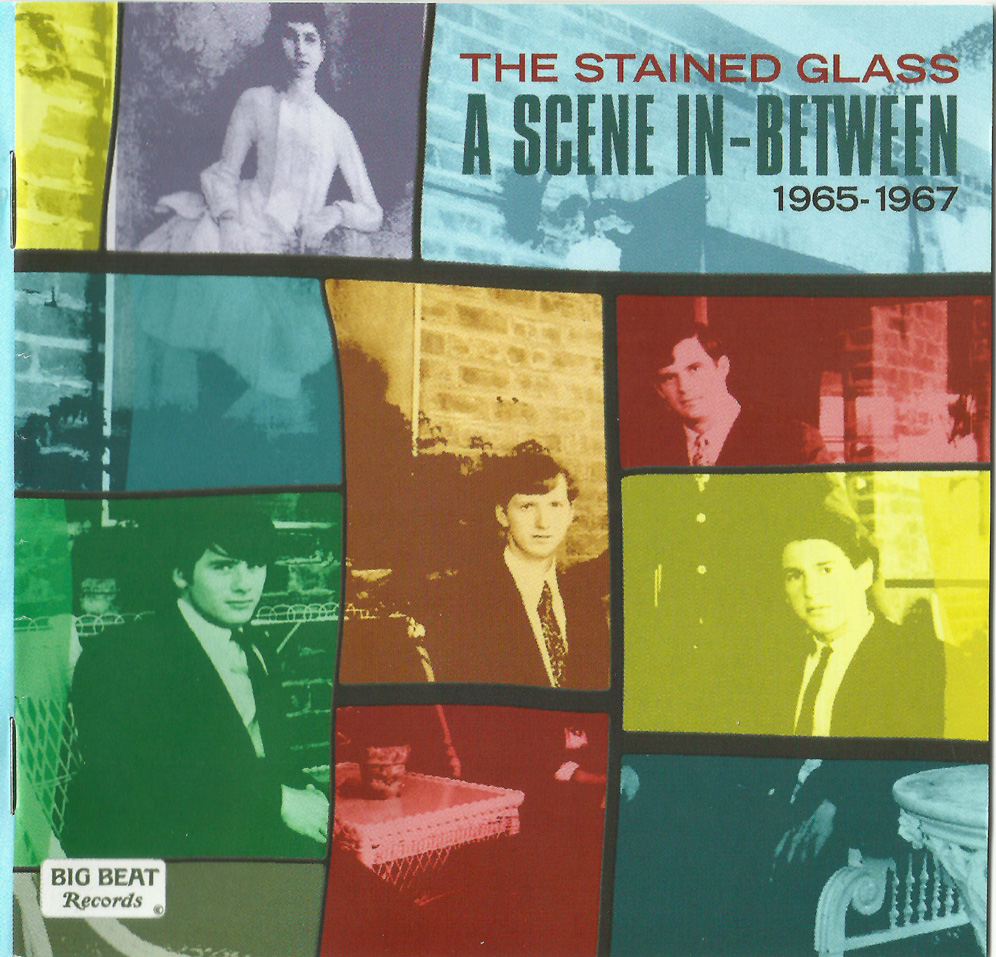
“A Scene In-Between” is the story of a group who fell through the cracks.An act with the Stained Glass’s capabilities should have been huge.Mid-60s San Jose, California had a thriving music scene, but was overshadowed by that of neighbouring San Francisco.
Compared to the garage stylings of the Chocolate Watchband or Count Five, the Glass boasted a quirky and melodic demeanour, one which captured the European beat group zeitgeist better than other local groups.
They had progressive and innovative material, the product of the fertile imagination of bass player Jim McPherson.A singular talent quite without compare on the local scene, McPherson threw musical curveballs that caught the ear, and pollinated each lyric with an intriguing worldview.These were not the thought processes of the typical garage band.
Jim’s songs also benefited enormously from the assistance of drummer Dennis Carrasco and guitarist Bob Rominger.The pair’s superlative vocal and instrumental capabilities drew out the melodic possibilities of the arrangements.Just as important was the founding member of the Stained Glass, Roger Hedge; without his drive the band’s repertoire may never have reached the general public.
The quartet began as the Trolls in 1964, issuing the fantastic punk item ‘Walkin’ Shoes’ themselves before a run of singles on RCA which included the pop-psych gems ‘My Buddy Sin’ and ‘A Scene In-Between’.Although the Glass later signed to Capitol for two albums, including 1968’s acclaimed “Crazy Horse Roads”, our collection focuses on their first incarnation, and presents the best of their released tracks from then, along with a swathe of exceptional unissued recordings that reveal their smart songwriting and innovative sound.Highlights include several sides cut as the Trolls; the rocking out-takes ‘Broken Man’ and ‘Bubble Machine’; intriguing demos such as ‘Second Day’ and ‘Revenge Is Sweet’; and some raw live tracks that further showcase their abilities.All songs are from master tape, and the heavily-illustrated booklet delves into the Stained Glass’ career with great detail.
There are some projects I have toiled at for years, waiting patiently for a break in which to move forward.This particular set has been in my mental In Box ever since I found a copy of ‘Walkin’ Shoes’ in an Oakland disc emporium, not long after moving to the Bay Area over a quarter-century ago.I subsequently located the other Stained Glass records, all of a high standard, but it wasn’t until I investigated their unreleased material some years later that I appreciated how special they were.As each year dragged on, patiently waiting for the various permissions required, I got to know the various parties: Jim McPherson’s supportive widow Evy, the affable Mr Carrasco and the erudite Mr Rominger.Then, as we moved into the home stretch, as if by magic the enigmatic Roger Hedge materialized from the ether.He not only handed me the long-thought-lost Trolls master tapes, but also spun tales of his days when he was a national badminton champion.
Thus with the release of “A Scene In-Between”, this long, strange trip has a most satisfying resolution.Jim McPherson’s aptitude was evident, confirmed by his later association with local SF rock heavies which included John Cipollina’s Copperhead and a successful writing career for others such as Jefferson Starship.His work with the Stained Glass was viewed largely as an apprenticeship, his “baby pictures”, if you will.But the short few years documented on this collection reveal his one-of-a-kind talent was in full flower even at that early stage.And to a man, his fellow travelers: Dennis Carrasco, Bob Rominger and Roger Hedge brought that talent to life with their essential contributions.Any musician should be proud of baby pictures such as these.
by Alec Palao
Tracks The Trolls
1. Walkin' Shoes - 2:08
2. She's Not Right - 2:17
3. How Do You Expect Me To Trust You? - 2:51
4. No Rhyme Or Reason (Roger Hedge) - 2:21
5. Sweeter Than Life - 2:27
6. Such Good Friends - 1:46 The Stained Glass
7. Broken Man - 2:38
8. Lonely Am I (Bob Rominger) - 2:25
9. If I Needed Someone (George Harrison) - 2:12
10.My Buddy Sin - 2:55
11.Vanity Fair - 3:01
12.Revenge Is Sweet (Bob Rominger) - 2:07
13.We Got A Long Way To Go (Barry Mann, Cynthia Weil) - 2:34
14.Inside Ouch - 2:14
15.Too Fit To Be Tied (Demo) - 3:39
16.Dollar Sign Friends (Demo) (Bob Rominger) - 2:18
17.Second Day (Demo) - 2:44
18.Bubble Machine - 2:55
19.Mediocre Me - 2:45
20.A Scene In-Between - 2:38
21.Mr Martyr - 2:21
22.You Keep Me Hangin' On (Live) (Brian Holland, Lamont Dozier, Eddie Holland) - 2:54
23.My Flash On You Live (Arthur Lee) - 3:00
24.2120 S.Michigan Avenue (Live) (Mick Jagger, Brian Jones, Keith Richards, Charlie Watts, Bill Wyman) - 5:28
All Tracks written by Jim McPherson except where noted
In the 1970’s radio was playing great talent on the air as part of the CanCon requirements, and one such group was Toronto’s Dr. Music. An eclectic freeform jazzy R&B group, they fluctuated between 7 and 15 members. Dr. Music was truly the creation and dream of noted arranger/keyboardist Doug Riley.
Riley’s music experience had started years before, when he was recruited to get musicians for CTV’S ‘The Ray Stevens Show’ for season 1969-1970. That was the birth of Dr. Music. When the show was cancelled, Dr. Music decided to stay together, release recordings and tour to support their music.
The first release under the Dr. Music moniker was "I'd Like To Teach The World To Sing" on RCA Records, a split single with The Laurie Bower Singers for a Canadian version of the international Coca-Cola jingle.
This led to a partnership with British engineer/producer Terry Brown and the duo of Brown and Riley led to the their collaboration to form Toronto Sound Recording studio for jingle production. It also included working with then a new Canadian label, GRT Records. Having previously released his solo album 'Foxy Lady' (featuring vocalist Terry Black) on GRT, Riley was able to get the label's backing to release Dr. Music's self-titled debut LP featuring the first single, "Try A Little Harder", and its hit follow-up "Sun Goes By" (both written by Motherlode's Steve Kennedy) in 1972. Dr. Music disbanded at this point as Doug Riley was immersed in his new studio position, and the struggle to do both ventures well led to this decision.
Doug Riley died suddenly on August 28, 2007 of heart failure Doug Riley was at the Calgary airport on route to his home in Little Pond, P.E.I, at that time he was 62 years old.
by Sandy Graham
Tracks
1. Rollin' Home (Doug Riley) - 6:16
2. Sun Goes By (Steve Kennedy) - 3:50
3. One More Mountain To Climb (Neil Sedaka, Howard Greenfield) - 3:16
4. Find Me Some Wine (Wingfat) - 3:31
5. When You Believe (Steve Kennedy) - 4:53
6. Glory Glory (Brian Russell) - 4:20
7. Try A Little Harder (Doug Riley) - 2:48
8. Dreams (Brenda A. Gordon) - 3:53
9. Don't Wait Too Long (Doug Riley) - 4:16
10.Road To Love (Steve Kennedy) - 6:08
Personnel
*Don Thompson - Bass, Vibes, Percussion
*Doug Riley - Organ Bass, Keyboards
*Kenny Marco - Guitars
*Doug Mallory - Guitars
*Terry Bush - Guitars
*Michael Kennedy - Congas
*Dick Smith - Congas
*Terry Black - Harmonica
*Bruce Cassidy - Trumpet, Flugelhorn
*Barm Tollman - Trombone
*Steve Kennedy - Tenor Sax, Flute
*Gary Morgan - Baritone Sax, Alto Flute, Clarinet
*Terry Clark – Drums
*Mouse Johnson - Drums
*Rhonda Silver - Vocals
*Brenda Cordon - Vocals
*Laurel Ward - Vocals
*Terry Black - Vocals
*Steve Kennedy - Vocals
*Brian Russell - Vocals
*Michael Kennedy- Vocals
Howard Werth kick-started his music career with The Lloyd Alexander Blues Band in the sixties (and he doesn't remember it because he was there!), playing a range of music covering the r'n'b / soul / Motown / psychedelia spectrum, and gigging round the circuit at that time, which included such West End all-night haunts as the Flamingo and the Whiskey A (Jo-Go (later to become The Wag Club), as well as thriving suburban venues such as the Blue Opera Clubs. These places all attracted the Motown mods, the art school blues and psychedelic crowds that dominated what was the burgeoning underground scene of that time.
The Lloyd Alexander Blues Band supported U.S. blues legends such as Jimmy Reed, and were the house band at the Uppercut Club in Fast London at a time when artists such as Otis Redding and Jimi Hendrix played there (Hendrix wrote Purple Haze in the dressing room).
Howard was searching for a new set of cultural references and musical triggers to draw from, which culminated in him forming Audience in 1 969. After a debut album for Polydor (reissued on CD by RPM Records). Audience recorded three more great albums for Charisma (now available through Virgin, along with a compilation). At the end of a very productive and hard working four years - w h i c h saw Audience play extensively around Britain, Europe and America (supporting Rod Stewart and The Faces in 1971) - the band were exhausted and in need of new impetus, and split up.
It was at this point that Howard began to work on his first solo album "King Brilliant". Gus Dudgeon produced and the core of the Elton John band provided the hacking, with the help of Bob Weston, fresh from his lime with Fleetwood Mac. The first two tracks to be laid down were ''Lucinda", a single that received a lot of airplay , and "Fading Star", which were recorded with members of Kokomo plus Davey Johnstone from Elton's band. Because of the limitations of vinyl , the track "Mechanical Dream", recorded during the sessions, had to be left off- and this hidden gem (which had never even been mixed) appears here for the very first time. A haunting, atmospheric piece, it sits perfectly with the rest of the material.
It was during the making of this album that Howard was approached by The Doors and asked to fill the space left by Jim Morrison. The Doors flew to England, and Howard spent some time rehearsing with them, but after some agonizing and deliberation, Ray Manzarek decided against The Doors reforming and the project floundered.
However Howard was later to reunite with Ray in Hollywood, where they worked together extensively on Howard's songs, some of which would later be re-worked to form the basis of the album "Six Of One", which was originally released on Howard's own METABop! label.
Howard has stayed involved with music and following the reissue of these two classic solo albums, will be issuing a brand new recording on Luminous shortly. He is also planning to go back on the road playing selected gigs. He will also he contributing to an upcoming Doors tribute album at the request of Ray Manzarek....
Liner-Notes
Tracks
1. Cocktail Shake - 2:59
2. Got To Unwind - 4:50
3. The Embezzler - 4:28
4. A Human Note - 2:47
5. Ugly Water - 6:03
6. Midnight Flyer - 4:12
7. Fading Star - 3:03
8. Dear Joan - 3:12
9. Roulette - 3:28
10.The Aleph - 5:48
11.Lucinda - 3:07
12.Mechanical Dream - 4:21
All songs by Howard Werth
Marc Ellis and William H. Yergin were high school friends, In the fall of 1967, Ellis told him about a friend from Suffern, N.Y., on the Hudson River, who was looking for other band members. So, that summer, Yergin and five others jammed together. Halfway through the summer, they auditioned in New York City at the same theater used by Ed Sullivan.
The band subsequently logged its first contract in middle of the summer of 1968. The recording company, Mr. G, was a division of Audio Fidelity Records, Inc., which was the first company nationally to release a true stereo record, a revelation in the mono-heavy time. Cashbox and Record World magazines, which featured industry news, named Rainbow Press picks of the week. The band’s record company wanted a second album, “Sunday Funnies,” which was recorded around Christmas 1968 and released in the spring of 1969.
“There's A War On” is excellent late '60s soft rock with more than just a touch of psychedelia about it. The ten well-crafted songs are all original, and are delivered smoothly by a tight 6-piece band dominated by Groff's superb vocals. The album's name and the eponymous track are as close as we get to political posturing, which is a great relief as the lack of prosletising let's the strength of the song writing and the band's performance shine through. There are loads of tight vocal harmonies, and plenty of fuzz guitar liberally dispensed throughout this polished and very enjoyable record."
The second LP "Sunday Funnies" was recorded during Christmas vacation at the 8 track studio A&R in NYC. It was released in the Spring of 1969, with the release of the single "Great White Whale". The Rainbow Press was truly a studio band, never going on the road to perform as the Rainbow Press. The group went its separate ways that summer. Yergin went to Case Western Reserve University and became a dentist. Marc and Larry are still in the music industry, Dave uses his musical abilities in his career.
Tracks There's A War On 1968
1. Step Aboard (Marc Ellis) - 3:10
2. A Simple Way (Marc Ellis) - 2:33
3. Cyclic Epic (The Song Of The Barnegat Mosquito) (Larry Milton) - 4:10
4. Better Way (Marc Ellis) - 2:38
5. The Girl That Cannot Love (Marc Ellis) - 4:49
6. There's A War On (Marc Ellis) - 4:20
7. Lightning Streak (Larry Milton) - 2:41
8. I've Found Someone (Larry Milton, Dave Troup, Joe Graff) - 3:14
9. Our Country's Still O.K. (Marc Ellis) - 3:51
10.No One Follows The Daytime (Larry Milton) - 3:38 Sunday Funnies 1969
11.Sightseeing (Marc Ellis) - 3:15
12.Great White Whale (Marc Ellis) - 2:35
13.The Lost Platoon (Ellis, Milton) - 4:30
14.I'll Cry Instead (John Lennon, Paul Mccartney) - 3:28
15.You Warmed Up My Life (Marc Ellis) - 3:45
16.As I Went Out One Morning (Bob Dylan) - 3:44
17.Have You Ever (Larry Milton) - 3:11
18.Sing Your Song (Larry Milton) - 3:22
19.Definitions (Larry Milton) - 3:59
20.Smitty's Rainfall (Larry Milton, Siegal) - 3:41
The Rainbow Press
*Dave Troup - Electric Bass
*Larry Milton - Electric Piano, 12 String Guitar
*Joe Groff – Tambourine, Maracas
*Marc Ellis - Guitar
*Charlie Osborne - Organ
*Bill Yergin - Percussion
The first album from Swallow was produced by Jean Paul Salvatori, who put together the excellent Bootleg Him! double LP of Alexis Korner material this same year, 1972. Jeff "Skunk" Baxter of Ultimate Spinach, later with Steely Dan and the Doobie Brothers, appears on "Come Home Woman," an original from bassist Vern Miller Jr., who was part of the band who opened for the Beatles in 1966, the legendary Barry & the Remains. Miller's presence adds collectability to this debut. "Come Home Woman" would have been perfect for Alexis Korner, come to think of it, a bluesy lament which begins with Baxter's wonderful guitar work and picks up steam, letting George Leh open up and battle the horns -- the voice and instruments stir things up so fine.
"Aches and Pains" is one of the four Vern Miller Jr./George Leh co-writes, and it is gospel-tinged blues which spills over onto "Common Man." There's real personality here, music perhaps a little too earthy for the Blood, Sweat & Tears crowd, but authentic to the max. Recorded and mixed where Aerosmith cut "Dream On" and where Jonathan Edwards of Orphan tracked "Sunshine," "Out of the Nest" is post-Bosstown serious singing and playing. When it is all instrumental, as on pianist/tenor saxman David Woodford's "Shuffle," Boston veteran Parker Wheeler gets a chance to give a counterpoint to J. Geils Band harp player Magic Dick.
The harmonica on "Shuffle" admirably replaces George Leh's distinctive vocal. Leh's got that Nick Gravenites gravel growl on "Something Started Happening," a tune with charging dynamics, perhaps this band's strong suit. Miller's "Brown Eyed Baby Boy" is a plea for love with a solid hook that would work well for the Remains since that group started recording again in the new millennium. The Staple Singers' composition "Why Am I Treated So Bad," also covered by Cannonball Adderley and the Sweet Inspirations, adds another dimension to the mix, the organ of Bob Camacho getting to have its say. Mick Aranda's creative drumming is also worthy of note. Out of the Nest is an excellent document of early-'70s Boston roots rock/blues music with just a touch of jazz. This would make a nice two-fer with its follow-up, 1973's self-titled Swallow.
by Joe Viglione
Tracks
1. Something Started Happening (V. MIller, G. Leh) - 3:35
2. Brown Eyed Baby Boy (V. Miller) - 4:44
3. Jason (V. Miller, G. Leh) - 2:43
4. Why Am I Treated So Bad (K. Staples) - 7:02
5. Confusion, Sadness, Trouble (V. Miller, G. Leh) - 4:48
6. Come Home Woman (V. Miller) - 5:05
7. Aches And Pains (V. Miller, G. Leh) - 4:08
8. Common Man (V. Miller, G. Leh) - 3:02
9. Shuffle (D.Woodford) - 3:22
Swallow
*George Leh - Lead Vocals
*Parker Wheeler - Vocals, Harp
*Vern Miller Jr - Bass, Guitar, Vocals
*David Woodford - Tenor Sax
*Phil Green - Guitar
*Mick Aranda - Drums
*Bob Camacho - Keyboards
*Jay Dewald - Trumpet
*Andy Harp - Trumpet
*Kerry Blount - Sax
*Gordan Kennedy - Trombone
*Jeff Baxter - Steel Guitar On "Come Home Woman"
Wet Willie began as a thrown together blues-rock band during the magical Summer of 1969 "way down in Alabama"...(Mobile, to be precise). The original nucleus of the group that eventually became known as Wet Willie was called Fox. The first "gig" was a booking in Panama City, Florida at a club called the Oddessy, a geodesic dome right on the beach.
Jimmy Hall was out front, a triple threat on lead vocals, sax and harmonica; as one writer said, “Jimmy was who Mick Jagger wanted to be!” Ricky Hirsch played guitars and wrote or co-wrote much of the band’s material, with Jack Hall, Jimmy’s brother, on bass, Lewis Ross on drums and John Anthony on keyboards.
The band relocated to Macon, Georgia in 1970 where they were signed by Phil Walden’s Capricorn label, and got right to work on their self-titled first album. Upon its release later that year, Wet Willie began a relentless touring schedule, and soon became known as one of the hardest working bands of the Southern Rock era. As they put it, they “opened for everyone from A to Z: Allman Brothers to ZZ Top!”
Wet Willie's eponymous debut is a superb slice of Southern rock. The band occasionally is getting into bluesy improvised sections, but their main talent is for laidback Southern grooves.
Tracks
1. Have A Good Time (Maurice Richard Hirsch) - 3:41
2. Dirty Leg (Jack Hall, John Anthony) - 3:41
3. Faded Love (Frank Friedman) - 4:31
4. Spinning Round (Frank Friedman) - 4:18
5. Low Rider (Maurice Richard Hirsch) - 3:01
6. Rock And Roll Band (Maurice Richard Hirsch) - 2:48
7. Pieces (Maurice Richard Hirsch) - 3:12
8. Shame, Shame, Shame (Jimmy Reed) - 3:22
9. Beggar Song (Frank Friedman) - 4:18
10.Fool On You (Frank Friedman) - 7:17
The Wet Willie
*John Anthony - Organ, Piano, Vocals
*Jack Hall - Bass, Vocals
*Jimmy Hall - Harmonica, Percussion, Tenor Sax, Vocals
*Ricky Hirsch - Guitar, Vocals
*Lewis Ross - Drums, Percussion With
*Donna Hall - Vocals
The genesis of Havenstreet goes back to 1969, when Phil Ridgway and Jeff Vinter played in The Gas, an experimental psychedelic band heavily influenced by Barrett-era Pink Floyd. The two friends started to write songs their own songs, ending up as a folk duo. With the offer to record some of their material at a friend's studio, they recruited more musical friends…so Havenstreet was born.
The influences had expanded now to bands and artists such as Peter Hammill, Strawbs, Traffic, Procol Harum, Stackridge, Keith Tippett, Bert Jansch…In the early-mid 70s they recorded a couple of albums which circulated as private cassettes among friends and relatives. In 1977, Havenstreet released "The End Of The Line", a self-released album in a private edition of 250 copies. It was collection of very English songs with evocative, literate lyrics and a stunning progressive folk-rock sound. It featured one of the earliest known tributes to Syd Barrett on the song "When the madcap meets the world".
This expanded double set reissue of Havenstreet's sought after album includes, the original "The End of the Line" album from 1977, a new album called "Perspectives" which presents the best tracks from the privately pressed cassettes The Autumn Wind (1974) and Transition (1976) plus rehearsal recordings for The End of the Line (1975/1976) and previously unreleased recordings for the group's projected fourth album (1979), which was never completed. These amazing tracks range from electric acid-folk to Barrett-esque psych-pop, pastoral folk and Caravan styled prog-rock.
Combining the back-to-basics acoustic feel of the nu-folk generation with a swirly, psychedelic vibe, "The End of the Line" could actually be an album that was made in 2014. But this album was privately released in 1977. Now finally remastered and brought into the present, the retrospective feeling is amplified and should appeal greatly to fans of 70s folk and progressive music. This reissue is a must have even for the lucky few who own an original copy of the album as it comes with a bonus disc, "Perspectives", that compiles non-LP tracks from 1974-79. The quality of the extra material shines through.
by Michael Bjorn (Strange Days Magazine)
Tracks
Disc 1 The End Of The Line
1. German Castles - 3:52
2. When The Madcap Meets The World (Francis Bassett) - 4:30
3. Old Ways And Schooldays - 2:51
4. Music In The Night - 2:45
5. Suspended Animation (Phil Ridgway) - 2:31
6. The H S B Song (Francis Bassett, Jeff Vinter) - 2:08
7. Yesterday Was Summer - 3:20
8. Rain - 3:14
9. The Castle - 3:15
10.Out Of The Fireglow - 4:14
11.The Keeper Of The Tower (Francis Bassett, Jeff Vinter, Phil Ridgway) - 3:16
12.The Photograph - 4:57
15.After Time (Francis Bassett) - 2:57
All compositions by Phil Ridgway, Jeff Vinter except where stated
Disc 2 Perspectites
1. Aftermath (Francis Bassett, Jeff Vinter, Phil Ridgway) - 5:00
2. Falling Leaves In Autumn - 4:19
3. Pat Old Engine - 2:21
4. Family Laughter - 2:38
5. Just An Illusion - 2:49
6. Kick - 4:46
7. Damascus - 4:14
8. Grasshopper - 2:44
9. Your Not Being There - 3:06
10.The Ballroom Of Despair (Francis Bassett, Jeff Vinter) - 4:59
11.Aftersong (Chris Summerfield, Jeff Vinter) - 2:35
12.Village Vespers - 4:27
All song by Phil Ridgway, Jeff Vinter except where noted
Personnel
*Richard Allan - Violin
*Francis Bassett - Piano, Clavinet, Organ
*Phil Ridgway - Acoustic Guitar, Vocals
*Andrew Russell - Flute
*Helen Russell - Vocals
*Robin Smith - Bass, Alto, Tenor Saxophone
*Jenny Tillyer - Rhythm Guitar
*Jeff Vinter - Vocals
*Pete Wills - Drums
As far as homegrown prog bands went (with a couple exceptions), 1970's America was the home of the brave but doomed. Leviathan was one act that actually managed to get one proper album release before disappearing, probably to secure to themselves and their posterity the blessings of not starving to death. Not as derivative of big-name British acts as most of their contemporaries, Leviathan's release (LP Mach Records AMA 12501) instead demonstrates how much more blurred the line between heavy metal and progressive rock had already become in the Colonies than in the Old Blighty.
The opening track "Arabesque" is rife with crunchy guitar riffs, stomping drums and bass, and bluesy vocal melodies delivered with hard rock's throaty harshness and occasional caught-meself-in-the-zipper yells. On the other hand, these are interspersed with a more delicate and harmonically complex sections with acoustic guitar, quick organ cadenzas and especially swirling Mellotron swells. The effect resembles some of Kansas' early works, though the writing is less adventurous and the playing less dynamic. The rest of the album pendulates between these two elements, searching for a right balance with variable success.
On "Seagull" the effect created by the mellifluous middle section full of liquid piano and Mellotron strings and woodwinds in what is otherwise just a slow-grinding, chugalong rock tune is a bit too cut and paste to avoid sounding contrived. Others mix ingredients with greater skill, either giving a straight-forward song a rich prog-style coating and melodic shine ("Always Need You") or using heavy guitar and rhythm section for impressive dynamic swells on an otherwise brooding, classical composition ("Endless Dream"). "Angel of Death" pretty much ditches the prog element, and sounds much smoother - and duller - as a result. The other extreme is the gentle, non-metallic ballad "Angela", which is saved from MOR mundanity by a small but nice harmonic modulation and a frothy use of acoustic guitar and lapping Mellotron strings. It all finally comes together on the closer "Quicksilver Clay", a quite stylish amalgamation of progressive melodic and instrumental richness, and the vigour of an underlying metal base.
It's too bad things don't click more often, because it results in an unbalanced, lopsided album. Admittedly, I am not a fan of the metal style, but when it works, the synthesis of old-style heavy guitar and Mellotron as displayed here is quite novel and charming - certainly enough to make this album worthwhile. Those into heavy prog in the old sense of the word, without thrash riffs, neo-classical shredding or double bass drum havoc, should definitely investigate this one.
by Kai Karmanheimo
Tracks
1. Arabesque - 6:15
2. Angela - 6:40
3. Endless Dream - 9:58
4. Seagull - 5:00
5. Angel of Death - 4:07
6. Always Need You - 3:22
7. Quicksilver Clay - 7:28
8. Why I Must Be Like You - 3:00
9. I'll Get Lost Out There - 3:42
All compositions by Leviathan
Barely forty minutes long, Manorisms has some killer tracks such as the opening 'Rainman' composed by Mike Duke and the melodic 'Street Corner Serenade', which had some minor success as a single reaching Number 30 in the Billboard Hot 100, Fifteen positions higher than the album's second and final single, the aforementioned 'Make You Feel Love Again', Other wonderfully harmonic songs include 'Let It Shine', 'How 'Bout You' and 'One Track Mind'.
Though Manorisms did not yield any major radio hits and all but disappeared without a trace, peaking at a disappointing Number 118 in the US, it remains a forgotten gem and this CD reissue calls for a rediscovery of Wet Willie's majestic yet often sadly overlooked and underappreciated back catalogue.
The band followed Manorisms with their final studio opus, Which One's Willie? which was unleashed to the public in 1979. Recorded in January through to February of 79 at the Record Plant in NYC and LA, the album shows a distinct departure from their Southern rock roots with a more polished approach to soul as it contains some Wilson Pickett ('Stop And Take A Look (At What You've Been Doing)/Don't Let The Green Grass Fool You') and Eddie Floyd ('You Don't Know What You Mean To Me') covers as well as original songs composed by Mike Duke.
The nine track album has some beautifully sung numbers such as the opening 'Ramona' and the dulcet The Hard Way'. Other songs of note include Tired Dreams' and 'Mr. Streamline', which both show the band's knack for creating efficient melodies.
Which One's Willie? peaked at Number 172 in the US and spawned two singles: 'Weekend' which hit Number 29 and 'Ramona' which failed to chart. Though the album was a commercial failure it has enough strong songs to warrant cult status amongst fans of Southern rock.
Wet Willie folded in 1980 after the release of Which One's Willie? though a new incarnation of the band was formed in the 1990s featuring John Anthony (keyboards), Ricky Hirsch (guitars), Jimmy Hall (vocals) and a revolving line-up of musicians, including the late Marshall Smith (he died in 2006 after suffering from heart problems), Mike Duke andTheophilus Lively.
There's no question that Wet Willie has made an impact on the American rock 'n' roll scene having been inducted into the Georgia Music Hall Of Fame in 1996 and the Alabama Music Hall Of Fame in 2001. Though they may not have achieved the mainstream success that some of their peers achieved, they have a small yet devoted fanbase.
by Neil Daniels, 2013
Tracks Manorisms 1977
1. Rainman (M. Duke) - 3:21
2. Make You Feel Love Again (G. Jackson, T. Jones III) - 3:28
3. So Blue (M. Duke) - 3:17
4. We Got Lovin' (J. Hall, J. Hall, M. Duke) - 3:32
5. Don't Turn Me Away (M. Duke) - 4:49
6. Street Corner Serenade (M. Smith, M. Duke) - 4:54
7. One Track Mind (J. Hall, M. Duke) - 3:48
8. How 'Bout You (M. Duke) - 1:14
9. Doin' All The Right Things (The Wrong Way) (M. Duke) - 4:12
10.Let It Shine (J. Hall, J. Hall, M. Smith, M. Duke) - 4:20 Which One's Willie? 1979
11.Ramona (Joe Droukas, Peter Solomon) - 4:36
12.Stop And Take A Look (At What You've Been Doing)/Don't Let The Green Grass Fool You (Jerry Akines, Johnny Belmon, Reginald Turner, Robert Peckman, Victor Drayton) - 4:25
14.Weekend (Mick Jackson, Tommy Mayer) - 6:01
15.Smoke (Michael Duke) - 5:05
16.The Hard Way (Michael Duke) - 4:22
17.Tired Dreams (Michael Duke) - 4:13
18.This Time (Michael Duke) - 4:00
19.Mr. Streamline (Jack Hall, Jimmy Hall, Marshall Smith) - 4:01
20.You Don't Know What You Mean To Me (Eddie Floyd, Steve Carpenter) - 4:11
The Wet Willie 1977 Manorisms
*Jimmy Hall - Lead Vocals, Harmonica, Saxes, Percussion
*Jack Hall-Vocals, Bass
*Mike Duke - Lead Vocals, Keyboards
*Theophilus Lively - Drums, Percussion, Vocals
*Marshall Smith - Vocals, Guitars
*Larry Berwald - Guitars 1979 Which One's Willie?
*Larry Berwald - Guitars
*Mike Duke - Keyboards, Vocals
*Jack Hall - Bass Guitar, Vocals
*Jimmy Hall - Vocals, Harmonica, Saxophone
*Theophilus K. Lively - Drums, Percussion
*Marshall Smith - Guitars, Vocals With
*Paulette Brown, Venetta Fields, Angelle Trosclair, Mighty Clouds Of Joy - Vocals
Jimmy Campbell was born on January 4th, 1944, three years after the Liverpool Blitz, to William and Anastasia Campbell. Only very essential rebuilding had occurred and Liverpool had still not been restored back to normal living conditions. England's vital port city was consumed by the war effort transporting munitions and American soldiers for the invasion of Europe. It is hard to imagine that out of such devastation would arise some of the most creative popular music performers and composers the world has ever known and one that deserves to be known. Jimmy, like most boys teenage boys in Liverpool during this period, became immersed in Eddie Cochran, Little Richard, Elvis, Buddy Holly and Everly Brothers records.
On March 11th, 1961 he would go to see The Beatles play a farewell dance at Aintree Institute and his life would be changed forever. "They were God," recalled Jimmy later. After that event, he began playing guitar like his idols and putting a band together (the Tuxedos) with his mates from Brookfield Comprehensive School in Kirkby. The Tuxedos changed their name to the Pulsating Panthers in 1962 and supported The Beatles at Hambleton Hall in Huyton on January 13th. Soon the Panthers would be playing the famous Cavern and in March of 1964 Cavern compere Bob Wooler would unintentionally change their name to The Kirkbys after the area in Liverpool where most of the band members resided.
The Kirkbys would go on to tour Germany and Finland. A 1964 tour of Finland found the band supporting Herman's Hermits, playing live on Finnish TV and releasing their first single, penned by Jimmy, 'Don't You Want Me No More' b/w 'Bless You' for RCA Finland. The Kirkbys' sole UK single, 'It's a Crime' b/w 'I've Never Been So Much in Love', would be released in 1966 before the band would change their name to the more psychedelic 23rd Turn Off and release the single 'Michelangelo' b/w 'Leave Me Here' for Deram in 1967.
After the 23rd Turn Off fizzled out at the end of 1967, Jimmy would continue to write his very personal songs while working as a toolmaker in a factory to help earn money. Jimmy was very much influenced at this time in his life by musicians Tim Hardin, Bob Dylan, Lennon and McCartney, The Band, and master painters Michelangelo and Van Gogh.
Meanwhile, Merseys' bassist Billy Kinsley had developed a deep friendship with Campbell when the 23rd Turn Off supported the Merseys on a UK Who tour. Billy would spend time at Campbell's flat listening to all of the amazing songs that Jimmy had composed. Although the two Merseys' singles failed to attract much attention, Fontana A&R man Dick Leahy was a confirmed believer in Campbell's songwriting abilities and managed to sign him to a three album recording contract with Phillips.
A Fontana press release from 1969 describes Campbell as: "A 1969 song-writer minstrel like King Richard the Lionheart's Blondel." A Scouse Jack Kerouac beat who, "Rides in trains, boats, planes and hitches rides on giant lorries and jumps into the back of vans to get to his next destination." Campbell did enjoy the beat lifestyle and he often kipped on London benches out of the enjoyment of the experience and not out of need.
A 25-year-old Jimmy was rushed into the Phillips studio complex at Stanhope Place and Bayswater Road in London during the summer of 1968 to record enough material to complete two albums, Jimmy never possessed the self confidence as a solo artist and he would have preferred bringing a band to back him during the sessions. Leahy felt differently and envisioned Campbell as a singer/songwriter like Cat Stevens. Jimmy's nervousness shows on all of the Son ofAnastasia recordings and he described his own voice, years later, as sounding "weedy" on all of the recordings.
Most of the songs were run ' through in just one or two live takes with Jimmy on a borrowed acoustic guitar from Billy Kinsley and his kazoo. So naive was Jimmy about the recording process that he actually backed away from the microphone on the autobiographical 'Tremendous Commercial Potential' when he wastold that they would be doing a 'fade' to end the song!
Jimmy did manage a trip back into the studio in late 1969 to record 'Frankie Joe' with a backing band consisting of Billy Kinsley on bass and Dave Harrison on drums for the B-side of the delayed second single 'Lyanna'. However, by the time 'Lvanna' was released on February 12th 1970, the Fontana publicity machine had already spent its dime promoting Son ofAnastasia. Interesting enough, Jimmy's manager, Hal Carter, had been successful in promoting Jimmy's songs around to other artists.
In 1970, Sgt. Will Scruffham (aka Don Charles) would release covers of 'And They All Came Marching Home' and 'Salvation Army Citadel' (which Jimmy recorded during the Son of Anastasia sessions and would later be released by Campbell himself on his final album, Jimmy Campbell's Album. Rolf Harris also covered 'Salvation Army Citadel' in the same year. Jimmy would only hnd out about the cover version when he happened to see Harris performing the song on BBC TV!
By the end of the 1969, Campbell was in need of additional money and took a job replacing a pre-Badfinger Joey Molland in the Merseybeats. While on tour, Jimmy spent time composing songs for his 1970 follow up album Half Baked, but then that's another story.
by Mark A. Johnston, Dayton, OH 2009
Tracks
1. When I Sit Down To Reason - 1:22
2. Mother's Boy - 2:59
3. Another Vincent Van Gogh - 2:07
4. Penny In My Pocket - 2:35
5. Bright Side Of The Hill - 1:57
6. Dear Marge - 1:29
7. Lyanna - 2:19
8. They All Came Marching Home - 2:21
9. On A Monday - 3:26
10.Lovely Elisa Cope Is Dead - 2:41
11.You'll Break My Heart In Two - 2:18
12.Tremendous Commercial Potential - 2:04
13.Adrian Henri's Party Night (At O'Connor's) - 3:02
14.Another Springtime's Passed Me By - 1:57
15.Michelangelo - 2:57
16.Painting A Song - 1:19
17.Frankie Joe (Bonus Track 1970 Single) - 3:14
Lyrics and Music by Jimmy Campbell
Dr Music was the brainchild of Toronto native and Doug Riley, who first took piano lessons as a child as a means of coping through polio. Born in Toronto in 1945, he took lessons in classical piano at the Royal Conservatory of Music in Toronto beginning at the age of four. Later, in Montreal, he studied pipe organ with Harry Duckworth at St. Anne de Belleville Church, and piano with Paul DeMarky, Oscar Peterson's piano teacher, and eventually developed into one of the country's most up and coming arrangers.
He went on to earn a Bachelor of Music in composition from the University of Toronto, while playing R&B with the Silhouettes, appearing at the Blue Note and the other Toronto nightclubs of the day. and turned down an offer to join Ray Charles' band after working on his 1969 album, DOING HIS THING. He was working as the Music Director for a number of TV shows, when in 1969 Ray Stevens ("Guitarzan," "Ahab The Arab") came calling. CTV had given him his own show, and Riley, dubbed 'Dr Music,' was recruited to put together a band.
Several members came and went at first, but following the cancellation of the show after the 1970 season, Riley kept the core of the group in tact and began touring the local area jazz clubs. The actual band was rounded out with Doug Mallory on vocals and guitar, bassist Don Thompson, vocalist Diane Brooks, and the Kennedy brothers - Michael on vocals and percussion and ex-Motherlode member Steve leading the horns section that also included Gary Morgan, Keith Jollimore, and Barrie Tallman.
RCA approached Riley later that year for a Coca-Cola jingle they were releasing, and so they recorded one of two versions of the new theme song, a cover of The New Seekers' "I'd Like To Teach The World To Sing," with the Laurie Bower Singers doing the other. It was released internationally as a single, gaining both groups some overseas notoriety.
Riley had also just opened up Toronto Sound Recording Studio with producer and engineer Terry Brown (Klaatu, Rush, etc), where they mostly did jingle work. This connection came in handy when looking for a label, as GRT Records was fledgling, and Riley signed a deal with them the following spring, knowing studio time was obviously going to be available. During this period, he also manned the helm for some other GRT projects, including the sole album from Everyday People, and his own debut album, FOXEY LADY.
With a cast of session players including singers Laurel Ward, Brenda Gordon, Trudy Desmond, Rhonda Silver, and Terry Black (who was also featured on FOXEY LADY, Dr Music's eponymous debut album was in the stores later that year. Three singles hit the airwaves before year's end - "Try A Little Harder," Neil Sedaka's "One More Mountain To Climb," and "Gospel Rock." The last single's b-side, "Sun Goes By," was released as its own single the following spring. But following some select shows around the Toronto and Detroit regions, Riley disbanded this version of the group so he could focus on the studio.
But by the end of '72, Riley had resurrected a new version of the group that included Mallory, the Kennedys, Jollimore, and Tallman, along with new drummer Wayne Stone. After some live dates across the country, they went into the studio the first couple of months of the new year, and released their sophomore album that summer, DR MUSIC II. "Long Time Comin' Home" b/w the unreleased "Stay Real" and "Tryin' Times" were released as singles, following in Riley's tradition of finding a common ground between sophisticated jazz arrangements and a pop attitude that got decent airplay. Other noteable cuts included the Robbie Robertson-penned "Where Do We Go From Here," and Steve Kennedy's "6 - 5."
The TV bug bit Riley again, and he worked for the CBC on Keith Hampshire's new program, "Music Machine." That run lasted two seasons, but before the final curtain was dropped in '74, Riley had already reformed Dr Music, which was working as the show's house band.
By that summer, they released their third album, BEDTIME STORY. The new supporting cast had Mallory, Steve Kennedy, Jollimore, and Tallman returning, and new to the lineup were drummers Claude Ranger and Dave Brown, Don Thompson on bass, and trumpet and horns player Bruce Cassidy.
The album was generally more progressive than his previous outings, with a heavier guitar-oriented sound. The songs were longer, and more complex, and the title track (written by Herbie Hancock) b/w the lead-off "I Keep It Hid" became the only single, but didn't fare as well on the charts or in airplay that was expected. So following some dates around the Toronto area, Riley once again disbanded the group so he could concentrate on producing and engineering other artists.