Not much known about this quartet (Harley Baker, Bill Combest, Joe Krasomil and Bob Wall). Signed by Imperial, their self-titled 1969 debut teamed them with producers Charles Greene and Brian Stone (whom we're more familiar with producing soul and R&B acts).
Including a set of late-'60s hard rock, material such as "Not Foolin' Me", "Race with the Devil" and an extended cover of The Buffalo Springfield's "Mr. Soul" had a Steppenwolf-styled feel to them (aka manic vocals, walls of keyboards and an occasional screaming guitar).
With Wall and Baker responsible for most of the material, among the more interesting tracks were the acoustic "Only For You" which offered up their prettiest melody, the country-rocker "What Are Those Things", and "Blue Bones and Ashes" which benefited from a mild psychedelic feel.
Tracks
1. Not Foolin' Me (Bob Wall) - 3:58
2. His Eye Is On the Sparrow (arranged and adapted by Houston Fearless) - 3:10
3. Only For You (Bob Wall) - 3:40
4. Blue Bones and Ashes (Harley Baker) - 2:43
5. Race with the Devil (Adrian Gurvitz) - 2:26
6. Mr. Soul (Neil Young) - 4:58
7. What Are Those Things (Dallas Frazier, A.L. Owens) - 2:11
8. Knock Knock (Bob Wall, Joe Krasomil, Bill Combest, Harley Baker) - 3:12
9. Joshua (arranged and adapted by Houston Fearless) - 2:10
10.Love Has A Habit (Bob Wall) - 3:16
11.Hold Me (Bob Wall) - 2:53
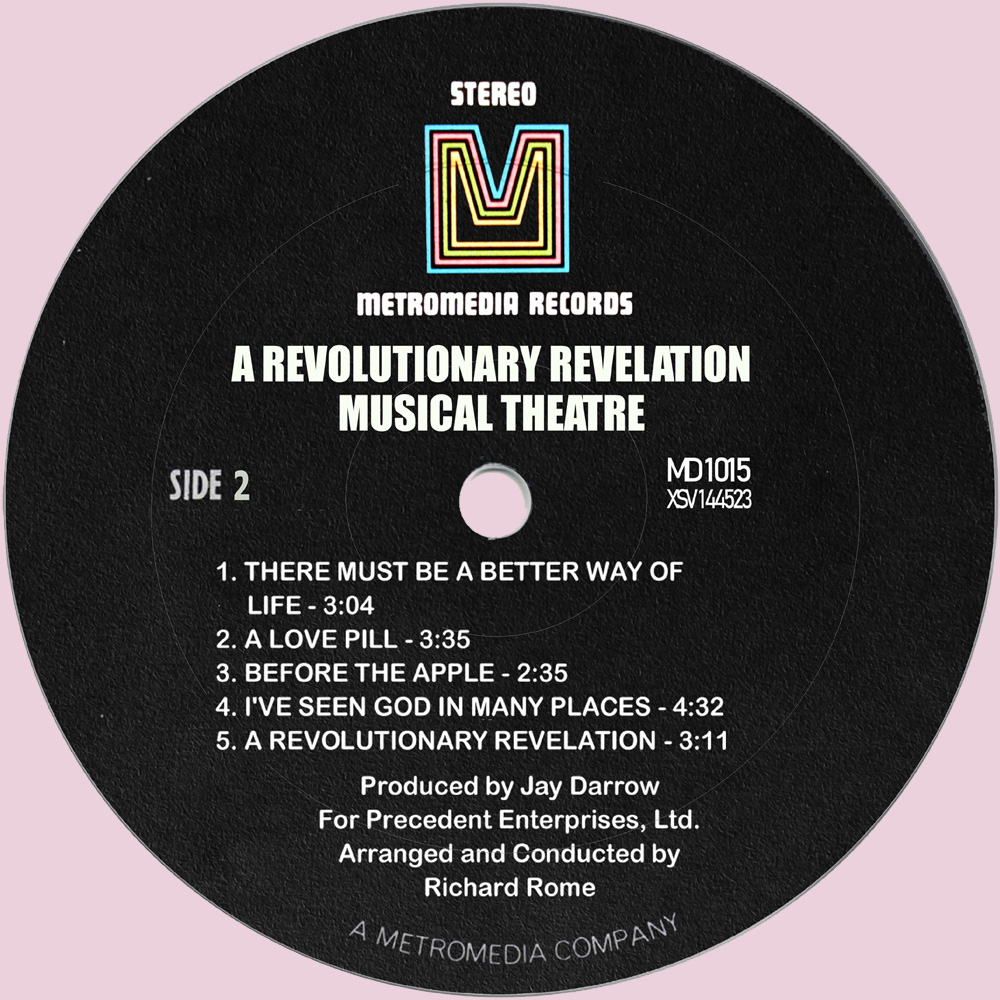
"This album attempts to explain in musical form not only what the youth of today are against but also what they are for. It shows that they are not attacking the ideals of American Democracy as much as wanting them realized. Their beliefs have been woven into a story of related songs.
It is impossible to categorize, as it is similar to nothing else on the music scene. It is simply - today. It is a musical expression against the war, racism, violence, poverty, the destruction of our natural environment, inequality, puritanism and the imbalance of power."
from Rear sleeve-note
With a call-and-response style between the Musical Theatre and an omnipotent voice, the Revolutionary Revelation is a journey which asks questions and provides answers. Protest/leftie/anti-establishment concept album with elements of funk-rock, psychedelia and sunshine pop. Lots of excellent spoken word sections between tracks with weird effects and sounds.
Tracks include ‘Reflections In The Life Of An Assassin’ and ’I’ve Seen God In Many Places'. Very funky with beats all over the place, such as the “we’re gonna turn the Pentagon into a discotheque” section - spoken word/laughter over massive B-Boy drums. Interesting stuff, a real period piece and a completely unique listening experience!
Tracks
1. Revolution - 2:24
2. We Want (Gloria Shayne, Jason Darrow) - 2:03
3. Computer World - 2:45
4. You Only Reap What You Sow (Gloria Shayne, Jason Darrow) - 1:36
5. Reflections In The Life Of An Assassin (Gloria Shayne, Jason Darrow) - 3:05
6. There Must Be A Better Way Of Life - 3:04
7. A Love Pill - 3:35
8. Before The Apple (Jason Darrow, Noel Regney) - 2:35
In 1964 I was a sophomore in high school, and like everyone else, was in awe of the Beatles. I had been playing guitar for a year or so and was having the usual problems keeping a band together for more than a week. I somehow managed to steal the best players from several groups that I had been practicing with. I finally had a band that was good enough to actually play gigs. The group was called "The Spectres". I played lead guitar, my high school classmates Bill Tullis and Bill Turner were lead singer and bass guitar respectively. Danny Marshall, a friend from another school, played rhythm, and Glenn Howerton played drums. That same year, a band known as "The Oxfords" was getting a lot of attention in Louisville.
In 1965 a rift between the Oxfords' leader and drummer Jim Guest and the other four members caused that group to split up. Because we had all seen each other's bands, Jim asked us if we'd like to play with him and become the Oxfords. This worked well, since the other guys in Jim's group liked our drummer better. The two bands swapped drummers and we became the Oxfords. The other guys with Glenn became the Rugbys. They chose this name because they wore rugby shirts when they played.
In 1966 the Oxfords entered a recording studio for the first time. Bill Turner had been replaced by bassist Ray Barrickman, and Danny Marshall had been replaced by guitarist Ronnie Brooks. The first thing we recorded was the Burt Bacharach/Hal David song "(There's) Always Something There To Remind Me". Gene Synder, our booking agent sent a rough mix to Nashville producer Buzz Cason. Buzz liked it, came to Louisville to help us finish it, and most importantly, got us a record deal with Bell Records.
Ray Barrickman sang the lead vocal on this song, but in the fall of 1966 he left the band to attend college out of town. Ronnie Brooks then switched to playing bass, and Bill Tullis started playing rhythm guitar. So when the song was finally released, we had to try to cover the record on gigs with Bill Tullis singing the lead vocal. This worked (more or less), since PA systems weren't all that good in those days. However, shortly after the record's release, the song was quickly recorded by another group and our air play all but stopped.
We recorded our second record "Sun Flower Sun", which was also released on Bell records in 1967. This record made an appearance on Dick Clark's American Bandstand in the "Rate the Record" segment. With a score of only 65, the single was effectively doomed.
Later in 1967 Ronnie left the band and was replaced by bassist Garry Johnson. Garry then left after several months to play bass in the newly-formed Louisville group Elysian Field, with guitarist Frank Bugbee and drummer Marvin Maxwell.
A few years ago Ronnie Brooks wrote several songs for Hank Williams, Jr. Ronnie was invited to the recording session, and as he was talking with Hank he heard someone call out his name. It was Ray Barrickman, who was playing bass in Hank Williams, Jr.'s band.Ronnie is now a music producer in Nashville and was the voice of the middle Budweiser Frog in the TV commercials.
Ronnie's older brother Randy, was a high school classmate and good friend of mine. A few years ago Randy wrote the timeless Christmas classic "Grandma Got Run Over By A Reindeer".
Meanwhile back in the 60's, there was an all-girl band in Louisville known as The Hearby. Jim Guest and I liked their sound and helped them make their first and only record. I was particularly interested in their lead singer Jill DeMarco.
In 1968 our group evolved again. This time, drummer Jim Guest was replaced by Donnie Hale, Dill Asher became the bass player, and most significantly, I asked Jill to join the group.
This was the group that recorded the bulk of the LP material. Donnie's friend Keith Spring was a brilliant musician and orchestrator. Keith agreed to do the orchestrations for the album cuts and played on the recording sessions. Keith, also played in the group for a short time in 1968. However, the musical direction we were going with Keith was far too esoteric for the gigs we were playing (we actually played regularly at Fort Knox during the Viet Nam War). Keith later went on to work with actor/musician Martin Mull and legendary rock group NRBQ. That year we got to open for Frank Zappa and the Mothers at a Louisville rock club and for The Grateful Dead at Bellarmine College.
In 1969, Dill Asher was replaced by bassist Larry Holt, and Donnie Hale was replaced by drummer Paul Hoerni (brother of the Rugby's bass player Mike Hoerni). We recorded several more album cuts and the group's last single "Come On Back To Beer", which was inspired by our contact with Frank Zappa. This single was released on Paula Records and made it to number one on rock radio in Louisville.
In 1970 the album was finally finished. Although we had offers from two record labels, we were uncomfortable with both deals. The labels wanted total control, along with buy-outs of all materials and rights. We decided to release and promote the record ourselves.
In 1971, out of the frustration of not being able to play enough original songs on our gigs, I got heavily involved with a theatrical production that I had written. My show was a rock musical called "Grease". It happed simultaneously with another more-famous production by the same name that was just starting in Chicago. The Oxfords got all greased up and became the pit band for the show. It ran for several weeks on the University of Louisville campus and was also performed in Atlanta and at the University of Kansas.
At that same time, I had gotten a notice from Selective Service to report for a draft physical. I fasted for two weeks and weighed only 117 pounds (10 pounds underweight for my 5'-11" height) at the time of the physical. Because of this, however, I didn't have enough strength to support the weight of my guitar and also sing. I decided I'd switch to playing keyboards and flute and we added guitarist Jerry Canter to the group. We recorded "The City" with this group, but it was never released on vinyl.
Finally in 1972, Paul, Larry, and Jerry all left the band. Quentin Sharpenstein, became the bass player. Quentin had played tuba on the orchestra overdub session for our album four years earlier. Guitarist Tony Williamson, a good friend of Larry, and jazz drummer Bobbie Jones also joined the group. Jill played both guitar and clavinet at various times, and I played a Hammond organ and Rhodes piano.
That same year, Danny King, a friend of mine, opened a recording studio. I volunteered the band's services in trade for studio time, and soon became the studio's engineer. I wasn't paid, but I used this opportunity to record most of the later cuts on the CD.
By this time, it was becoming obvious (even to me) that the Oxfords were not on the road to rock stardom. Jill was especially tired of the situation, the other musicians had opportunities to play with other groups, and I had discovered that my passion was working in a recording studio.
The group disbanded for good in the summer of '72. But hey, that's the cool thing about recording...the music lives on!
by Jay Petach
Tracks
1. My World (Jay Petach, Jill DeMarco) - 3:18
2. Lighter Than Air (Jay Petach, Jill DeMarco) - 2:50
3. Sung At Harvest Time (Quechua Indian Song P. D.) - 3:47
4. Two Poems by e.e. Cummings (Music by Keith Spring) - 4:37
5. Flying Up Through The Sky (Jay Petach, Jill DeMarco) - 3:00
6. Come On 'Round (Jay Petach, Jill DeMarco) - 5:00
7. Young Girl's Lament (Traditional P.D.) - 2:38
8. Trix Rabbit (Jay Petach) - 3:10
9. (There's) Always Something There To Remind Me (Hal David, Burt Bacharach) - 2:58
10. Time and Place (Bill Tullis, Jim Guest, Jay Petach) - 2:20
11. Sun Flower Sun (Jim Guest, Jay Petach) - 2:08
12. Chicago Woman (Jim Guest, Jay Petach) - 2:48
13. Come On Back To Beer (Jay Petach, Jill DeMarco) - 2:37
14. Your Own Way (Algie, S. Jones) - 2:43
15. The City (Jill DeMarco) - 2:45
16. Flute Thing (Jay Petach) - 2:08
17. Cuttin You Loose (Tony Williamson) - 3:12
18. Sweet Lover Man (Jill DeMarco) - 2:38
19. Those Winds (Jill DeMarco) - 3:09
20. Tornado Baby (Jill DeMarco) - 5:59
The mysterious British band Iguana was formed in Southampton in early 70's and released one excellent album originally in 1972 on label Polydor Records. and then disappear without a trace. The core of the band was guitarist/vocalist Bruce Roberts, bass-player John Cartwright and drummer Pete Hunt, The trio was augmented by strong dual brass-section - Ron Taylor on alto sax and tambourine and Chris Gower on trombone also piano played here by Don Shinn.
Despite the album being released on the well-known Polydor label, it quickly became one of its most obscure items, since for some strange reason nobody was interested in the great blend of loud jazz-rock and energetic heavy rock stuffed with progressive elemenets.
The sound of Iguana is rich and colorful, based on permanent juxtapositions of heavy, some what funky guitar sound and jazzy saxophone riffs – most of the songs are catchy and easy-to-get-into, in spit'e of their complex structures, alluding stylistics soul unique, sophisticated and richly orchestrated with vocals reminiscent of Mike Patto.
Though most of the tracks are vocal-driven, there are enough space for adventurous instrumental excursions, the band achieves a perfect balance between song-oriented as is the longest piece on the LP, almost 9-minute 'Price Of Love' reminding Colosseum, Mogul Thrash and other brass rockers of the 1970s. Actually Brainchild's 'Healing Of The Lunatic Owl' would be the closest comparison to Iguana’s. debut, only if Brainchild work was closer to progressive realms, Iguana veers more towards pure rocking sound, making the accent on sheer intensity of the early British rock music.
by Adamus67
Tracks
1. Iguana - 3:33
2. Southampton Blues - 1:47
3. Price Of Love - 8:46
4. Power Of Love - 3:45
5. I Don't Need No Buddy - 3:15
6. Ron's Tune - 4:23
7. Prostitude - 3:31
8. Grey Day Lady - 3:19
9. Celluloid Samba - 3:24
All titles written and arranged by Iguana.
Iguana
*Bruce Roberts - Guitar, Vocals
*Ronnie Taylor - Alto Saxophone, Tambourine
*John Cartwright - Bass, Finger Drums
*Chris Gower - Trombone, Tambourine
*Pete Hunt - Drums, Congas With
*Don Shinn - Piano
In the 1960s, several regional music scenes developed in cities across the United States and caught the ear of a national audience. The music revolution that took place in San Francisco was for real. The times they were a-changin. The 60s counterculture revolution that was taking place in the Bay Area made it ripe ground for a musical phenomenon to develop.
The birth of the hippie scene, the advent of underground FM radio which gave non-Top 40 music a chance to be heard, and several venues (Fillmore, Avalon, Matrix etc.) willing to booking up-and-coming local talent all made the Bay Area a fertile place for groups to grow and develop. The Grateful Dead, Country Joe and the Fish, Big Brother and the Holding Company with Janis Joplin and The Jefferson Airplane are a few of the best-known bands that emerged from this creative environment.
Although they never enjoyed the same national fame, Linn County was one of the most musically sound, in-demand and highly admired outfits in the Bay area, especially by other Bay area musicians. To trace the roots of Linn County's genealogy, one must venture back to their early days to the home state of Iowa when they were known as the Prophets.
An unusual late-'60s band that combined horn-embellished soul-rock with more interesting material utilizing jazz-colored arrangements and somewhat spacy songwriting. There were few parallels for this kind of thing at the time, other than perhaps the only slightly less obscure Insect Trust.
In 1968, the band signed with Mercury Records, moved to San Francisco, California, and changed its name to Linn County. They released their first album Proud Flesh Soothseer in 1968 and toured, performing with bands and people such as: Albert King, Led Zeppelin, Sly & the Family Stone, Eric Burdon & the Animals and Ten Years After. They never became too well known.
Futher albums followed in 1969 and 1970. The band broke up after Clark Pierson left with Janis Joplin. The solo album released by band member Stephen Miller in 1970 includes 4 tracks recorded by the final Linn County line-up.
Tracks
1. Girl Can't Help It (B. Troup) - 4:10
2. Elevator Woman (J. L. Williamson) - 4:04
3. Too Far Gone (S. Miller, F. Walk) - 2:40
4. Suspended (S. Miller, F. Walk) - 8:18
5. Fever Shot (S. Miller, F. Walk) - 6:15
6. Lonely Avenue (J. Frederick, L. Branch) - 7:21
7. Ground Hog Blues (S. Boy Williamson) - 4:38
Linn County
*Stephen Miller - Organ, Vocals
*Larry Easter - Saxophone, Flute
*Dino Long - Bass
*Ray 'Snake' McAndrew - Drums
*Fred Walk - Guitar, Sitar
Larry Evoy and Paul Weldon began jamming together in basements and garages amidst the Toronto musical revolution of the '60's. They were assaulted with a variety of influences, from psychadelia to folk to blues-based styles, and went through several incarnations of various groups. In '66, with band members Craig Hemming on bass and drummer Dave Brown, they placed an ad for a guitarist, settling on Danny Marks. With Evoy handling vocal duties and Weldon on organ, they went through a variety of band names, as well as people behind the drum kit and bass guitar.
A year later they'd settled on their name (the actual name of the bear in a Winnipeg zoo that inspired 'Winnie The Pooh')and with Evoy taking on the drums. They were regulars of the Yorkville coffee house circuit and had also appeared at The Rock Pile, a major club gig at the time with the likes of Paul Butterfield and Led Zeppelin.
They were signed to Capitol Records in '69 - which was uncharacteristic for the label as they were known to take on artists in the likes of Glen Campbell, Bobby Gentry and Wayne Newton. But the gamble paid off when BEARINGS was released the following spring. Considered by many to be one of Canadian rock's best 'first albums', it was a mix of the blues and modern/pop influences. The first single, "You Me and Mexico" reached #3 on the Canadian charts and was certified gold.
Despite only a nominal marketing push, the xylophone and horns beat set to a pop tune also had a respectable showing of #68 Stateside. The album eventually struck gold, selling 50,000 copies in Canada, due in part to the versatility the banned exhibited, such as "The Woodwind Song" and Marks' suggestions of including the remakes of the blues classics - Memphis Slim's "Everyday I Have The Blues" and Freddie King's "Hideaway".
Tracks
1. You Me And Mexico (Larry Evoy) - 3:30
2. Fool (Larry Evoy) - 2:51
3. Cinder Dream (Paul Weldon, Larry Evoy) - 5:27
4. Woodwinds (Danny Marks, Paul Weldon) - 5:03
5. Hideaway (Freddie King, Sonny Thompson) - 4:02
6. Mind Police-Toe Jam (Danny Marks, Larry Evoy, Paul Weldon) - 9:39
7. Sinking Ship (Larry Evoy) - 3:36
8. Every Day I Had The Blues (Peter Hatman) - 7:15
Edward Bear
*Larry Evoy - Drums, Lead Vocals, Tympani, Chimes
*Danny Marks - Lead, Rhyth, Acoustic Guitars, Vocals
*Paul Weldon - Organ, Organ Bass, Piano, Harpsichord, Vocals
They began in the early 60′s as the El Caminos and spent most of the decade playing gigs around the northeast USA and were popular enough to record a few songs at the Bell Sound Studios in New York. They were eventually signed to RCA and decided to change their name to The Glass Prism to better suit the concept of the Poe orientated music they were writing.
Taking the words of some of Poe’s poems, Varano and Christiano moulded sounds which could only have been created in the 60′s and in America – that ended up as a very distinct piece of work. Dominated by the organ sound of Carl Syracuse the songs are littered with piano, drums, electric guitar and bass.
The album begins with a majestic organ and piano led version of “The Raven“. Not all the stanzas are used but the song encapsulates the brooding nature of the poem. This was the single from the album and it’s epic nature makes it one of the stand-out tracks on the album.
The second track is a cheesey-funky version of the poem “To -” which has a great drum intro that trips into stabbing organ chords. It is quite impressive to hear how the band managed to fit the music to the words in a way that it doesn’t sound at all awkward. The lines are sung effortlessly with the arrangement, to such an extent that it is sometimes difficult after hearing the album to read the poems without singing the melody from the songs.
“To One In Paradise” has a dreamy quality, using a range of vocals and at one point a spoken word verse. It ends with a classic 60′s organ sound. Another dreamy mood is evident in “Dream Within A Dream” which opens with a soft and slow tremolo effect on the electric guitar supported by a simple rhythm on the drums (Rick Richards) before the downbeat vocals and chiming organ enter the song. Where “To One in Paradise” was more up tempo and playful in its dreamy arrangement “A Dream Within A Dream” is far more soporific and mournful in its delivery. “Take this kiss upon the brow, and in parting from you now…” – 0f all the poems used this is probably the one I sing most readily when reading the original text.
With “Eldorado” we’re back to cheesey-funk and like many of the songs on this album it consists of a few chords repeated on the organ, which effectively makes the music pulsate, the other instruments and vocals providing interesting details. This song was used as the b-side to “The Raven” but it could have been an A-side because it really grooves – you could almost imagine it on a 60′s TV pop show with a load of dancing-girls in brightly coloured mini-dresses.
Another standout track is provided by another standout poem – “The Conqueror Worm“. Like “The Raven” it has a similarly repetitive but majestic organ and piano lead line which weaves throughout the song, but as always (and as it should be) it is the words, sung with real emphasis, which holds the piece together.
“The Happiest Day The Happiest Hour” is the closest we get to a classic 60′s freak-out. A splurge from the guitar leads to a frenetic drum break propelling the songs to its conclusion, interspersed with short, slightly less manic moments, where the vocals come to the fore. The following track, “Alone”, is similarly crazed – a piano and fuzzed lead guitar slowly emerge from the silence, emerging with dueling vocals and a crazed fuzzed bass line. The quieter moments are like pools of calm sprinkled with twinkling piano and subtle organ.
“Beloved” is guitar led and quite poppy. It has an interesting arrangement and a great lead guitar break in the middle of the song, sounding not to dissimilar to a forgotten early track by Arthur Lee of Love.
The music on this album cannot escape the gloom inherent in Poe’s words and even the more pop-like or uptempo tracks remain plaintive. The vocals on “Hymn” glide over the organ which uses the smooth and percussive effects, becoming a little jazzy to the end when the guitar comes in for support.
The album ends with “A Dream” – an up-tempo workout between the guitar, bass and drums, complete with chiming cow-bell. It has the feel of a hit single but Poe scuppers any chance of it catching on with the opening line:- “In visions of the dark night, I have dreamed of joy departed”.
Originally from Cedar Rapids, Iowa, formed as the Linn County Blues Band, moved to Chicago and then, like many others they migrated to San Francisco in 1968, signed with Mercury Records, changed their name to Linn County and recorded an album under the title 'Proud Flesh Soothseer' which was released in September the same year.
Linn County released three albums from 1968 to 1970. Over the course of their existence, they had seven band members. They never became too well known, and broke up after Clark Pierson left to join Janis Joplin.
This album is mostly detour through its diversity and originality in interpretation, it is a subtle blend of soul / blues and psychedelic rock, full of vibrating organs, flutes and guitars playful catchy. 'Think' bold resumption of James Brown, which opens the album is an interesting synthesis of what this group can do.
The next track 'Lower Lemons', flirts more readily to a form of avant-garde jazz sauce without losing its coating psychedelic, a bit like Jean Luc Ponty playing with the Grateful Dead!
The end of the first side 'Moon Food' and 'Cave Song' is very oriented avant-garde with a flute and sax ubiquitous supernatant from a composition of invoice honest, always between soul, blues and psychedelic rock.
The bravura of the second side is called 'Protect And Serve/Bad Things', it lasts more than 14 minutes. Always very close to the soul with its brass, it offers a free jazz interlude Baroque / Rococo style near the Mothers of Invention, the piece turns blues in the style of Paul Butterfield Blues Band, without neglecting the sax parts to how the Chicago blues of the late 60's. it is a delight to this plate!
The sequence with 'Fast Days', actually quite a title always full of dancing groove, further demonstrates the breadth of technical skills and artistic aura to rediscover this group, the finish recalls once more the Zappa gang ..
I think this album it once again ''monument''- cornerstone decades between 60 and 70.. mixture psycho influences Soul and rock conventions get slightly twisted with avant-garde-tinged jazz arrangements, weird lyrics, and novel (for rock) touches of flute and brass, Uh... must get it by any means!
by Adamus67
Tracks
1. Think (L. Pauling) - 3:31
2. Lower Lemons (S. Miller, L. Easter, F. Walk) - 4:06
3. Moon Food (S. Miller, L. Easter, F. Walk, D. Long) - 6:30
4. Cave Song (S. Miller, B. Miskimen) - 4:28
5. Protect And Serve/Bad Things (S. Miller, L. Easter, F. Walk) - 14:12
6. Fast Days (S. Miller, F. Walk) - 6:44
Linn County
*Stephen Miller - Organ, Vocals
*Fred Walk - Guitar, Electric Sitar
*Dino Long - Bass Guitar
*Larry Easter - Tenor Saxophone, Soprano Saxophone, Flute
*Jerry 'Snake' Mcandrew - Percussion
The Ghost LP is one of the most fabulous UK psych/prog albums. This Birmingham band featured guitarist Paul Eastment, previously in The Velvett Fogg. The album, originally released back in 1970 on the Gemini label in the UK and in 1971 on Exit/Ekipo records in Spain, is one step ahead psychedelia entering the realm of prog music, yet retaining an atmospheric mind expanding feel through it all.
Loads of Hammond organ swirls, pyrotechnical guitar licks, beautiful accoustic guitar parts, and above it all killer vocal arrangements. The lead-off track, "When You're Dead," is the most effective and famous (at least in the world of psychedelic collectordom) cut. Lead singer Paul Eastment sounds much like Family's Roger Chapman, but even creepier (and more ostentatious), as the group vamp around a skin-crawling riff, anchored by an almost garagey shrill organ.
Yet the second song, "Hearts and Flowers," could almost be the work of an entirely different outfit, with the band's other lead singer, Shirley Kent, shining on a pretty folk tune reminiscent of some of Fairport Convention's most precious early numbers (Shirley would later move on to record the "Fresh Out" LP as Virginia Tree). Top quality remastered sound, an impressing addition to your psych prog collection!
Tracks
1. When You're Dead (Paul Eastment, Paul Keatley) - 4:25
2. Hearts And Flowers (Shirley Kent) - 2:54
3. In Heaven (Terry Guy) - 3:21
4. Time Is My Enemy (Shirley Kent) - 4:06
5. Too Late To Cry (Paul Eastment, Paul Keatley) - 5:04
6. For One Second (Terry Guy) - 5:25
7. Night Of The Warlock (Paul Eastment, Terry Guy) - 4:22
8. Indian Maid (Terry Guy) - 4:21
9. My Castle Has Fallen (Paul Eastment) - 2:57
10.The Storm (Paul Eastment, Paul Keatley) - 3:36
11.Me And My Loved Ones (Terry Guy) - 4:09
12.I'Ve Got To Get To Know You (Shirley Kent) - 4:02
The Ghost
*Daniel MacGuire - Bass Guitar
*Charlie Grima - Drums, Percussion
*Paul Eastment - Lead Guitar
*Terry Guy - Organ, Piano
*Shirley Kent - Vocals
Although Memphis Sam Pearlman has lauded Rock's occasional awesome capacity for speaking without words, a more elusive standard has emerged for measuring rock achievement: speaking with words. Rock has always spoken through a tremendous array of perfectly appropriate "cliches." But that's just a basic ground for novel paths in use of the mere word and its extension and transcendence. Here is where The Innocence sums it all up. Mairzy Doats is a readymade classic.
Mere words reduced to mere sounds regrouped into new mere words which are somehow more poetically evocative than the originals. Here The Innocence speaks with somebody else's speech composed of just a pile of word play. Just playful as a silly kids' song, it has been allowed to crystallize into a monument to non serious word play. And now, after John Lennon's great books have validated just this type of "game."
The Innocence has come to resurrect Mairzy Doats and give Rock an addition so perfect for Rock and so long inevitable. And There's Got To Be A Word (Beyond the Meaning of Love) is even more than this. Groping for new words which mean more than words which already mean a whole bunch! Just look at the most obvious gem of all. The Innocence: you can even dig the pseudo-plural name of the group.
by Richard Meltzer
Tracks
1. There's Got To Be A Word (Beyond The Meaning Of Love) (D Ciccone, Jimmy Wisner) - 2:25
2. Mairzy Doats (Drake, Hoffman, Livingston, Jimmy Wisner) - 1:14
3. Someone Got Caught In My Eye (Andreoli, Poncia Jr, Anders, Poncia) - 1:59
4. All I Ask (D Ciccone, Jimmy Wisner) - 2:48
5. Your Show Is Over (D Ciccone, Jimmy Wisner) - 2:45
6. A Lifetime Lovin' You (Andreoli, Poncia Jr, Anders, Poncia) - 2:21
7. Whence I Make Thee Mine (Andreoli, Poncia, Cordell, Jimmy Wisner) - 1:44
8. It's Not Gonna Take Too Long (Andreoli, Poncia Jr, Anders, Poncia) - 2:05
9. All I Do Is Think About You (Linde, Bloom Jimmy Wisner) - 2:30
10.I Don't Wanna Be Around You (Ripp, Andreoli, Poncia Jr, Anders, Poncia) - 2:08
11.Do You Believe In Magic (J Sebastian, Jimmy Wisner) - 2:23
12 I Don't Wanna Be Around You (Bonus Track, Single Version) (Ripp, Andreoli, Poncia Jr, Anders, Poncia) - 2:08
13.There's Got To Be A Word (Beyond The Meaning Of Love) ( Bonus Track, Single Version) (D Ciccone, Jimmy Wisner) - 2:24
The Innocence
*Peter Anders
*Vini Poncia
*Artie Ripp
I like what this album has to say. It is rather concept, the music is well thought out. It adheres to no particular genre. A lot of people have borrowed its ideas. It's one of the very first independent LPs I know of. I hope you like it.
Iggy Pop
Kill City was by all measures a desperate effort, a singularly honest and heartfelt perfomance a genuine progression of our song writing, and another in a long line of flops that were later resurrected and heralded as masterpieces.
By the time it was released as a record, both Iggy and I were off doing other things with our lives, but with this release we are not only reunited in our musical endeavors but in our appreciation of this album, its remix, and its importance to us as artists.
James Williamson
Tracks
1. Kill City - 2:34
2. Sell Your Love - 3:41
3. Beyond The Law - 3:22
4. I Got Nothin' - 3:26
5. Johanna - 3:23
6. Night Theme - 1:20
7. Night Theme (Reprise) - 1:05
8. Consolation Prizes - 3:38
9. No Sense Of Crime - 3:56
10.Lucky Monkeys - 3:39
11.Master Charge - 3:41
Human Instinct is a continuation of the group, the Four Fours. The transition to Human Instinct began in 1966 when Trevor Spitz, founding member of the Four Fours, decided to leave when the other group members wanted to embark on a trip to England to seek their fortune and fame.
Back in New Zealand Maurice replaced Bill Ward with a friend of his from Palmerston North, 21 year old Billy Tekahika, who had been with the Sinners. Billy was later better known as Billy TK. Frank Hay stayed for a short time, but when Maurice decided to take the band on a national tour, he decided to leave and was replaced by Michael Brown. During the tour Michael left to join Dunedin band, the Klap, and was replaced by Peter Barton.
After the tour, a short residency was taken up at the Bo Peep in Auckland, before Greer, Barton and Tekahika flew to London in February 1969 for a second assault on Britain. When they arrived there, they immediately bought a massive PA and lighting system and attracted an audience who wanted to experience the mountain of sound. The group's repertoire at this stage was all original. Although Greer handled most of the vocals, the focal point of the trio was Billy TK, who was becoming a guitar legend in his own right.
The second visit only lasted three months, but during that time they did meet up with Doug Jerebine, previously with the Embers and the Brew. Doug was in England also trying to crack the London scene. He was there recording under the name Jessie Harper. Doug had impressed Maurice and in time Human Instinct were to record seven of his songs.
On their return to New Zealand, they began recording an album at Astor studios. About half way through it Peter Barton left the group and Larry Waide was brought in to complete the album. Released late 1969, the album was called 'Burning Up Years'. From it came the single 'I Think I'll Go Back Home'/'You Really Got Me'.
Work then began immediately on the second album. It was recorded in June 1970 and released as 'Stoned Guitar'. From it came the singles 'Midnight Sun'/'Idea' and 'Black Sally'/'Tomorrow'. These were the only two of their singles to be released with picture sleeves. Below is both sides of 'Black Sally'/'Tomorrow'.
Larry Waide left the group after recording the second album, as musical directions began to change. His position was filled in February 1971 by former Underdogs bass player Neil Edwards. No sooner had he joined and the group was back in the studios to record their third album. This was called 'Pins In It' and was released in June 1971. One single, 'Rainbow World'/'Highway', was issued from this album.
At the same time as its release, the group headed to Sydney for a three month tour. It was not a happy time for the band and at the end of the visit, Billy TK announced that he was remaining in Australia. This basically signaled the end of Human Instinct as a heavy rock band. Instead of replacing Billy with another guitarist, Maurice decided to go for a totally different sound and added Graeme Collins, previously with Dedikation, on keyboards. This configuration didn't last very long and in 1972 Maurice started again with a completely new line-up which consisted of himself, Martin Hope, from the Fourmyula, and John Donoghue, from Timberjack, both on guitar, and Glenn Mikkelson (also known as Zaine Griff) on bass. This combination concentrated on country rock.
From late 1971, Maurice divided his time between his music and nightclub construction with his brothers, Barry and Frank. They were responsible for opening quite a few clubs in Auckland, notably Hatchett's, Granny's, Shantytown, Ruby's Saloon and Croft's, as well as quite a number of others around the country.
Human Instinct released another single 'Texas Sparrow'/'Children Of The World' in 1971 and two more albums. One in 1972 called 'Snatmin Cuthin' and the other in 1974 called 'The Hustler'.
Tracks
1. Say To Me (N. Edwards) - 2:45
2. It's A Blessing (H. Mann) - 2:45
3. 122 (M. Hope) - 1:00
4. Since We (M. Hope) - 3:26
5. Rockin Lockin Baby (N. Edwards) - 2:59
6. Up Country City Down (M. Hope) - 3:35
7. Simple Man (M. Hope) - 3:08
8. Jacques Le Mere (N. Edwards) - 2:31
9. Turn Your Back On The Wind (W. Mason) - 3:19
10. Seen The Light (M. Greer) - 2:52
Human Instinct
*Maurice Greer - Vocals, Drums
*Martin Hope - Lead guitar, Vocals
*Neil Edwards - Bass, Vocals
*Harvey Mann - Guitar
*Dick Hopp - Flute
The Ugly Ducklings formed in the spring of 1965 as The Strolling Bones, a blatant Rolling Stones-inspired outfit featuring Brian Jones look-a-like, British-born Glyn Bell. After making its live debut at Ccdarbrac High School in Toronto's Scarborough district (the entire band minus Boers studied there), the group changed name to The Ugly Ducklings and won a residency at Charlie Brown's Place. In late 1965, the band attracted the attention of Yorktown Records, who recorded the group's debut single, the Bingham-Maync collaboration, Nothin' for a mere $300,00 on a 2-track machine at Hallmark Studios.
The record was picked by local radio and became a local smash in March of the following year. On the back of the single's success, the 'Ducks landed their dream gig - opening for the Stones at Maple Leaf Gardens in June 1966. The group's debut album Somewhere Outside, recorded in New York and Toronto was issued around this time and contained all of the group's early singles.
The opening cut, Nothin' was also their finest moment, with its snotty punk vocals and guitar assault. She Ain't No Use To Me was a punk shouter with some snappy guitar work, whilst That's Just A Thought I Had In My Mind is more restrained, veering more towards pop. Also of note on the album were Do What You Want, a mid-paced beat number; Just In Case You Wonder, which featured some good fuzz guitar; Hey Mama (Keep Your Big Mouth Shut), notable for some fine psychedelic guitar work; a snotty version of Ain't Gonna Eat Out My Heart Any More, the only non-original and the closing cut, Windy City (Noise At The North End), an atmospheric instrumental complete with sound effects and more fuzx guitar.
However, the label's decision to bring in producer Brian Ahem against the band's wishes, and its failure to distribute the 'Ducks records properly in the US led to the first of several personnel changes in early 1967. Read dropped out (later working in the photographic retail business) and was replaced by Howie Smith. Differences in musical direction led to Mayne's departure later in the year and Bell followed him soon afterwards. In their place, the 'Ducks recruited Mike McKenna from Luke and The Apostles.
Mayne subsequently tried to form a new group but nothing happened and he later went on to work in the TV business, producing commercials for ABC. Bell meanwhile became involved with commercial art. Amid all this activity, the group enjoyed its biggest hit with the brilliant Gaslight, which had been recorded in New York with the NBC Orchestra, and only featured Bingham on the record. The new line-up made a few recordings in late 1967 and early 1968, including McKcnna's Blues Fell This Morning and Bingham's Rise To Your Calling, which were never issued at the time, but have since appeared on The Ugly Ducklings compilation Duck Tales. In the spring of 1968, Ray Novak was added on organ, but this line-up didn't gel and in June, McKenna left to form McKenna Mcndelson. Guitarist Dave Kindred was brought in to fill his shoes.
The revised band line-up made a comeback at Toronto's Flick during July 1968, but no recordings were made. In early 1969, the band split up, only to reform a few months later as GNU. Boers maintained the greatest profile working with B.B. King, Charlie Mussclwhite, Neil Merryweather and the 49th Parallel. Throughout the '70s there were several Ugly Ducklings reunions, but no official recordings appeared. In 1980 however, the original members decided to reform and an album called Off The Wall was released.
The current line-up featuring former Buffalo Springfield Revisited guitarist Stan Fndersby on bass made its debut at the Toronto Rock Revival concert, held at the Warehouse on May 2,1999. The recent CD, Too Much Too Soon includes remastered cuts from many of their 45s. plus one newly recorded track. The Ugly Ducklings are widely recognized to be one of the best garage punk bands to have come out of Canada.
Tracks
1. Nothin' - 2:27
2. Do What You Want - 2:43
3. She Ain't No Use to Me - 3:03
4. Just in Case You Wonder - 2:26
5. Not For Long - 2:57
6. I Ain't Gonna Eat My Heart Out Anymore - 2:48
7. Hey Mama (Keep Your Big Mouth Shut) - 2:58
8. 10-30 Train - 2:28
9. That's Just the Thought That I Had in My Mind - 2:41
10.Postman's Fancy - 2:22
11.Windy City (Noise At The North End) - 5:59
12.I Wish You World - 3:28
13.I Need Your Love - 5:49
14.I Can Tell - 3:20
15.Rimb Nugget - 3:41
16.Gaslight - 2:44
17.Postmans Fancy - 2:18 Bonus tracks 12-17
Tractor were formed in Rochdale in 1971 from the remains of three-piece band The Way We Live (originally formed in 1966 at Balderstone School, Rochdale). The band comprised Jim Milne (guitarist, vocalist and songwriter) and Steve Clayton (drummer, percussionist and songwriter) who had teamed up in 1971 with their manager and sound engineer John Brierley, who built his first studios (Dandelion Studios Rochdale) in his bedroom and attic. John later recorded Factory and many other bands at his Cargo Studios in Rochdale.
As The Way We Live, Tractor made a 1971 album for Dandelion Records boss, the late John Peel. After the release of this album, "A Candle For Judith", Peel described guitarist Jim Milne as "...the man responsible for some of the most urgent flowing and logical guitar playing I've ever heard".
Their second album, "Tractor” (as Tractor) got to number 18 in the Radio Luxembourg album charts and was frequently played on the BBC by DJs like Peel, Bob Harris and Anne Nightingale. It was also in the Virgin Top 30 selling album charts in 1972.
Later that year, former Rochdale College Social Secretary Chris Hewitt became their tour manager and sound engineer and the band opened recording studios in Dawson Street in Heywood. They performed on the college and university circuit from winter 1972 onwards (one night appearing on the same bill as future AC/DC vocalist Bon Scott) and also worked on their third album which would later become the CD release, "Worst Enemies".
In 1976, Tractor helped launch the Deeply Vale Festivals and were the main Festival attraction in 1976 and 1977. As it grew in reputation, other Manchester-based and nationally known artists appeared at the Festival alongside Tractor, including Durutti Column, The Fall, The Out, The Drones, Nik Turner (of Hawkwind), Here And Now, The Ruts, Fast Cars and Steve Hillage.
During their career, Tractor have issued LPs and CDs on Dandelion Records, UK Records, Cargo Records (Indie Rochdale label), Roach Records and they now control their entire back catalogue through their own Ozit-Morpheus Records. In 1998, they released a new CD of archive material, Tractor "Before, During and After the Dandelion Years".
They played at Glastonbury Festival in 2002 and the Canterbury Festival in 2003. There is a DVD available through Ozit-Morpheus Records entitled, ‘Beyond Deeply Vale’, and like all Tractor material, it received stunning reviews.
In 2004, ITV made a documentary about Deeply Vale and Tractor, "Truly Madly Deeply Vale", which is to be released on DVD with extra bonus footage. Further recognition came in December 2004 when Tractor played at a John Peel tribute concert along with Doves and Badly Drawn Boy, Marc Riley and Andy Rourke from the Smiths. In October 2006, Tractor released a new CD, “John Peel Bought Us Studio Gear And a P.A.”
Tracks
1. King Dick II - 3:12
2. Squares - 5:02
3. Siderial - 5:27
4. Angle - 1:26
5. Storm - 4:52
6. Willow - 5:48
7. Madrigal - 2:08
8. The Way Ahead - 9:03
9. Lost On The Ocean (Live) - 5:59
10.Suicidal (Live) - 8:18
11.Vicious Circle - 2:28
12.Hollands Pie R - 2:50
13.As You Say - 4:16
14.Electric Witch (Live) - 7:45
All titles written by Jim Milne Tracks 1 to 8 and 13 Recorded as The Way We Live in the late 60's/early 70's at John Brierley's home studio. Tracks 9 and 10 Recorded as The Tractor in 1977 at Cargo Studios Mobile. Tracks 11 and 12 Recorded as The Tractor in 1974/75 at Tractor Sound Studios, Heywood. Track 14 Recorded as The Tractor 1980 at Cargo Studios Mobile
Jonathon was a huge man, very huge according to the people who met him, he also had a huge voice and wide open way of musical thoughts. His roaring theatrical version of "Sympathy For The Devil" made an effect by the time it's release, but couldn't drift the album to make the splatter that he expected and the sales stood in low numbers.
That of course means nothing at all, the rest album keeps the high stature, from the opening "In Quest Of Unicorn" to his aspect of the Bee Gees "To Love Somebody" we are tasting some great vocal work, supplemented by musicianship which is practically beyond reproach.
Tracks
1. In Quest of the Unicorn (Jonathon Round) - 4:57
2. Don't It Make You Want to Go Home (Joe South) - 3:12
3. Tolu (Jonathon Round) - 5:10
4. Sympathy for the Devil (Mick Jagger, Keith Richards) - 6:04
5. To Love Somebody (Barry Gibb, Robin Gibb) - 3:02
6. Traveling Mama Blues (Jonathon Round) - 4:13
7. And I Will Not Be Moved (Jonathon Round) - 4:44
8. Train-A-Comin' (Jonathon Round) - 2:37
9. Young Sadie (Dancing Lady) (Jonathon Round) - 5:37
Outstanding 1973 from a Northumberland, Pennsylvania trio with an incredibly wasted vibe. Roughly half of this is heavy rock, like a second rate Grand Funk or Frost, and these songs are just mediocre, with "If Only You Could See Me Now" being the best by way of it's off kilter timing and phased-out wah guitar.
The other half is what we are all really here for: totally loaded, extended, spacey rural-vibe psych folk. "Universe" is the total kicker, loaded in opiate fueled cosmic ether. It's so slow and laid back that it almost moves backwards. Time has no meaning, or is lost completely.
Above the strummed acoustic bliss there are spaced out effects that just really make this fucker out, like if Jandek was really talented on You Walk Alone and tried to make a commercial (well, uh, sorta) sounding folkpsych album. Flutes appear on other tracks, giving this a Topanga Canyon hippie vibe at times. A totally great windowpane rainy day escapist monster.
While Willoughby and Foulke would go on to greater glory in the early 1980s with the well-known band Hybrid Ice (whose song “Magdalene” was famously covered by Boston on their album Walk On), this would be the last anyone would ever hear of Brigg.
Tracks
1. Hey Mister - 3:16
2. Universe - 5:30
3. Took It Away - 3:35
4. New Found Rain - 2:37
5. If Only You Could See Me Now - 3:21
6. The War Is Over - 2:50
7. Linda - 5:40
8. And You Know - 2:45
9. Sneaker Tongue - 0:31