This classy slice of Northern Californian (Chico) rural psych was originally released in 1971 and makes its CD debut with this release. A winning combination of melodic pop and heavier jamming that will appeal to fans of the Grateful Dead and the Allman Bros., it features strong songs and memorable guitar interplay, but had the misfortune to appear just as its label was going under and thus undeservedly sank without trace.
Tracks
1. Train Time (Reaves) - 6:25
2. Jeweled Scene Stealer (Reaves) - 4:49
3. Strange New Time (Reaves) - 3:55
4. Chico Women (Cooley) - 3:20
5. Changes (Campbell) - 1:35
6. People Changin’ (Reaves, Webb) - 5:23
7. Blue Water (Reaves, Riggs) - 3:36
8. Movie (Reaves) 0 3:10
9. Hollywood Dancers (Reaves) - 4:57
A Long Island New York-based (?) duo consisting of guitarist/keyboard player Sonny Hahn and singer/keyboard player Doug Miller, this is an outfit I don't know much about, nor have I ever been able to dig up much on the pair.
Released by the small Euphoria label (apparently a short lived Jubilee offshoot), their sole release 1971's "Sum Pear" was well worth looking for (though it's relative rare and increasingly costly - I've seen two original copies in twenty years). Produced by Bob Gallo, the set offered up a great mix of psych-influenced rockers ('Better Get Down'), straight ahead rock ('Bring Me Home America'), and more conventional folk rock ('I Can See').
Miller had a nifty voice and Hahn's penchant for feedback drenched guitar (check out the blazing 'Got Me Tragedy'), were both strong selling points. Some interesting lyrics (yes I actually occasionally actually listen to the words) and the presence of a full backing band with a kick ass rhythm section in the form of bass player Bob Dorsa and drummer John Scaduto certainly didn't hurt the proceedings.
With the pair writing virtually all of the material (a killer cover of Mickey Newbury's 'Down On Saturday' being the lone non-original), highlights included 'Hey Sun', the wah-wah guitar propelled 'What's So Bad About Feelin' Good', the hyper-speed 'I Need Lovin'"' and the horn-propelled 'Thoughts of Slumber'.
Tracks
1. What's So Bad About Feelin' Good - 4:56
2. Better Get Down - 3:10
3. Save the Children - 3:31
4. Hey Sun - 3:35
5. Thoughts of Slumber (Doug Miller) - 3:31
6. Bring Me Home America - 3:18
7. I Need Lovin' - 2:17
8. Down On Saturday (Mickey Newbury) - 4:17
9. I Can See - 3:32
10.Got Me Tragedy - 3:08
11.On My Way/Forget Yesterday Medley - 6:46
All songs by Doug Miller and Sonny Hahn except where indicated
It was a cruel joke. P.J.Proby had his run of hits and had wrecked his career by ripping his velvet trousers, perhaps deliberately, on stage. By 1969, he was reaching the end of his fiveyear contract with Liberty Records and the new album was called 'Three Week Hero'. It opens with a blues riff, rather like Chris Smither now, and then P.J. in a cod country voice sings, "I'm a three week hero, I started with a zero, And I sold a million records on my own." Surprisingly, no-one has written a book on P.J.Proby although his colourful life could make a best-selling book, a play and a film.
He was born James Marcus Smith in Houston, Texas on 6th November 1938 and he attributes his wild behaviour as a reaction to the discipline he endured in a military school. He moved to Hollywood and hung out with Elvis Presley, Ricky Nelson and Eddie Cochran. He cut scores of demos and wrote 'Ain't Gonna Kiss Ya', which was the lead track on a hit EP by the Searchers, and 'Clown Shoes' for Johnny Burnette. He had had problems with the police and the Revenue in the US and he was gratified when Jack Good offered him a guest spot in his UK TV spectacular, 'Around The Beatles', which was screened in May 1964. Eddie Cochran's fiancee, Sharon Sheeley, gave him a new name for the show - P.J.Proby, but apart from that, "I created P.J.Proby totally alone.
The ponytail, the buckle shoes, the big-sleeved shirts were all me and if I'd had good management, I'd have taken out copyright on them." The TV special drew 8 millions viewers and “Hold Me” wich Proby had cut in the UK with noted sessionman Jimmy Page on lead Guitar , soared to N.3. Page played a distinctive Guitar solo on his follow-up hit, “Together” and he can be heard on several other Proby recordings – “Zing! Went The Strings Of My Heart', 'Stagger Lee’, 'Linda Lu', 'Rockin' Pneumonia And The Boogie Woogie Flu', 'Let The Water Run Down' and 'Hanging From Your Loving Tree'.
Proby's Billy Eckstine-inspired but mickey-taking 'Somewhere' was another Top 10 hit and then came the problems with his skin-tight trousers. Proby says that the campaign against him was spearheaded by Mary Whitehouse and that showbusiness moguls _ wanted him deported as he was an American earning good English money. P.J.Proby's conspiracy theories are second only to those following Kennedy's assassination.
Whatever, he continued to have hits and what could be more appropriate than 'I Apologise'? 'Maria', from Back Side Story (?), made the Top 10 but his sales tailed off because he recorded a tuneless Ben E.King B side, 'Let The Water Run Down', a lacklustre Lennon and McCartney song 'That Means A Lot' and some middle-of-the-road schlock, 'It's Your Day Today'. 'Niki Hoeky', a fabulous slice of cajun rock'n'roll, was too strange for the UK market. It became his only Top 30 hit in America. Tom Jones, who took much from Proby, was becoming a millionaire superstar and Proby was drinking hard to alleviate the boredom of performing on the chicken-in-a-basket circuit.
In 1967 he was declared a bankrupt in America and in February 1968 he was a UK bankrupt with liabilities of £84,309 against assets of 12 shillings. Jimmy Page cut down on his session work to become a Yardbird and he befriended bassist John Paul Jones. By October 1968, the Yardbirds were in disarray but Page and Jones wanted to continue together and invited vocalist Terry Reid to join them.
He couldn't escape from a contract but he recommended Robert Plant who was singing with Alexis Korner's blues band. B.J.Wilson wanted to continue as a drummer with Procol Harum and so they accepted Plant's recommendation of John Bonham. This was the personnel of Led Zeppelin: the name came when Keith Moon joked they would go down like a lead Zeppelin. Steve Rowland was an actor, singer and producer, having hits with Dave Dee, Dozy, Beaky, Mick And Tich and the Herd. He formed a group with session singers and musicians including Albert Hammond and Mike Hazelwood and called them the Family Dogg.
They had a Top 10 hit in 1969 with 'A Way Of Life'. Rowland, an American in England like Proby, became friendly with him and agreed to produce his next album, a daunting task as his albums had veered from straight rock'n'roll to standards. He asked the Family Dogg to be backing vocalists (excellent on the gospel-slanted 'Won't Be Long' and 'I Have A Dream') and two members of the group, Hammond and Hazelwood, wrote 'Empty Bottles' and 'New Directions'. Steve Rowland recruited Jimmy Page (lead guitar), John Paul Jones (bass, piano, organ) and their new friends, Robert Plant (harmonica) and John Bonham (drums, congas) to accompany him.
Sometimes though the drums are played by Clem Cattini of the Tornados. John Paul Jones wrote most of the arrangements. Although the album is now regarded as P.J.Proby backed by Led Zeppelin, the only track on which they really sound like that is 'Jim's Blues'. 'Three Week Hero' is a schizophrenic, even quadrophrenic, album. It has no idea of its market, which is what makes it so interesting. One minute Jim is singing about a dead dog ('Little Friend'), the next he's lamenting the death of a soldier (Today I Killed A Man') and what did anyone in 1969 make of 'It's So Hard To Be A Nigger'? (Proby has since recorded 'I Was Born A Poor White Boy In Niggertown' and 'Elvis Was Not The White Nigger - I Was', but I don't know whether he is intending to shock or whether this is a product of his Southern upbringing.)
The best song on the album is Roger Cook and Roger Greenaway's Today I Killed A Man'. Although it is ostensibly about the Civil War, the implication is that it is really about Vietnam. It was issued as a single with 'It's Too Good To Last'. 'Empty Bottles' was used as B-side of another single, while 'The Day That Lorraine Came Down' was tried as a single. The B-side of that single was an informal studio jam, 'Mery Hopkins Never Had Days Like This', which parodied the Bonzo Dog Band's 'The Intro And The Outro' and included namechecks for Jimmy Page and John Paul Jones.
Three Week Hero' was released in October 1969 and sold miserably. So much so that original copies now pass hands at £60. Led Zeppelin became the heavy metal band of the 70s, which Proby takes credit for: "I told them to go to the hippies in America and that's what they did." In 1970 P.J.Proby was featured in Jack Good's West End production of 'Othello', now called 'Catch My Soul', but it wasn't long before the gremlins got to work and he was sacked from the production.
The 70s and 80s are a long, drunken haze with occasional highlights, such as another West End show, 'Elvis', in 1977. In recent years, he has given up drinking, had success in further West End musicals and recorded with Marc Almond. When I met P.J.Proby in 1994. I asked him to sign a copy of Three Week Hero'. He looked at the title and wrote across it, 'Wanta bet'. There's still a place for Jim somewhere.
by Spencer Leigh, Presenter, BBC Radio Merseyside
Tracks
1. Three Week Hero (John Stewart) - 2:56
2. The Day That Lorraine Came Down (Young) - 3:15
3. Little Friend (Robin Gair, Peter Mason) - 4:01
4. Empty Bottles (Albert Hammond, Mike Hazlewood) - 2:53
5. Reflections (Of Your Face) (Amory Kane) - 5:14
6. Won't Be Long (J. Leslie McFarland) - 3:41
7. Sugar Mama (Woodley, Young) - 2:50
8. I Have A Dream (Terry Hensley, Alec Wilder) - 4:45
9. It's Too Good To Last (Baker, Stephens) - 3:14
10.New Directions (Albert Hammond, Mike Hazlewood) - 3:46
11.Today I Killed A Man (Roger Cook, Roger Greenaway) - 3:24
12.Medley: It's So Hard To Be A Nigger/Jim's Blues/George Wallace Is Rollin' In This Mornin' (Hillery/Traditional) - 7:38
Musicians
*P.J. Proby - Vocals
*John Paul Jones - Bass, Piano, Organ
*Jimmy Page - Electric Guitar
*Clem Cattini - Drums
*Alan 'The Hawk' Hawkshaw - Piano, Organ
*Alan Parker - Guitars
*Robert Plant - Harmonica
*Dennis Lopez, Stan Barrett - Various Percussion
*John Bonham - Drums, Congas
*Amory Kane - Acoustic Guitar, Strings
*The Family Dogg & Bob Henry Alias The Jericho - Backing Vocal
Οn hand for the Pet Sounds sessions was Jerry Cole, an exceptional guitar talent who paid the rent working for Phil Spector and did his own thing as the leader of Jerry Cole and His Spacemen. Between 1963 and 1964, Cole abused his whammy bar throughout several surf albums on Capitol that merged hot-rod abandon with ultrapro chops. One of the best players in this genre, Cole punched in solos for Carl Wilson on early Beach Boys’ records.
A quick study, Cole also scored a prominent place in the development of rock, performing on The Byrds’ “Mr. Tambourine Man” when the band proved too inexperienced to make their own rock and roll history. Shortly after, Cole was playing on Pet Sounds. An ambitious man with a sixth sense for pop music trends, he pulled together some L.A. session colleagues and cut his own album: the result was The Inner Sounds of the Id, by The Id.
Recorded between 1965 and ‘66 (according to drummer Don Dexter), a massive collection of tracks was paired down to ten cuts and released by RCA in January 1967, the same month as that other Oedipal manifesto, The Doors. The album is a cornucopia of posthypnotic poetry, sitar obliggatos and, best of all, Yardbirds guitar flash blasting across a Booker T and the MGs groove with a dash of the visionary in its unexpected, deftly executed key and time changes. Cole sings in a murmuring drawl, and his riffs and solos are ear candy a go-go.
The Inner Sounds of the Id features fret board excursions that are too sweaty for sit-ins or be-ins. Freaky as Cole’s runs are, the album never strays far from the spirit of tube amps and last calls from which it was spawned. From Syd Barrett’s “Bike” to Grace Slick’s “Lather,” psychedelic is pampered and inorganic; to Cole’s credit, the Id trips in real time.
by Barry Stoller
Tracks
1. The Rake - 2:01
2. Wild Times - 3:06
3. Don't Think Twice - 2:46
4. Stone And Steel - 3:40
5. Baby Eyes - 2:51
6. Boil The Kettle, Mother - 3:01
7. Butterfly Kiss - 2:34
8. Short Circut - 3:01
9. Just Who - 2:44
10.The Inner Sound Of The Id - 10:29
11.Wild Times - 2:17
12.Don't Think Twice - 2:52
13.Kimeaa - 2:50
14.Our Man Hendrix - 3:10
15.Tune Out Of That Place - 2:26
16.Give Me Some Lovin' (S. Winwood, S. Davies) - 2:33
17.Boil The Kettle (Instr.) - 3:08
18.What Else? - 2:18
19.Uh Uh Uh - 3:16
20.I Can't Stand It Baby - 2:24
All songs by The Id except where noted.
The Id
*Jerry Cole - Lead Guitar, Lead Vocals, Sitar
*Glenn Cass - Bass
*Don Dexter - Drums
*Norman Cass - Rhythm Guitar
Salem Mass spanned the 70's from 71 till 77 playing mainly in the Northwest and Canada. During this time the band went through numerous members and techs. All of which I shall remember as "The Kind" or the best of the best. One of our first breaks was meeting Doug Brown, now of GMA, in Sun Valley Idaho. He later booked us into the best cljbs the Big Sky country had to offer.
On three occasions Salem Mass, sometimes a five piece, lived in Portland. The first time was because we had just signed an exclusive contract with Headwater Rooking Agency, which promptly went beily up like a rotting carp in Lake Lowell. Fortunately we landed in the capable hands of Andy Gilbert with a new booking agency in the Pacific Northwest called Pacific Talent. Thanks to Andy, Salem Mass played everything that was happening in Portland and surrounding area clubs and grand openings.
The Treasure Valley, in southwest Idaho was where we paid our dues It was where most of us grew up, where we wrote, played, partied and evolved, and it was worth every cent. Thanks Freddy, Can I have a draw? The album was recorded in a beer bar in Caldwell Idaho called The Red Barn, under the watchful eye of it's owner Steve Moore and was engineered by Lance Parker a mutual friend and Caldwell High alumni of Steve, Mike, and myself. And of course there was the special kind of help that could only be offered by the Big Three.
Original band member Steve Towcry, stiil resides in Caidwell, Idaho and can be found at the family business Printcraft. Matt Wilson is teaching and producing from his home studio in Nampa, Idaho. Mike Snead is in Brookings Oregon playing with various lounge lizards and doing some studio work with me at Madfingers Music.
by Jim Klahr
Tracks
1 Witch Burning - 10:26
2 My Sweet Jane - 4:35
3 Why - 2:44
4 You Can't Run My Life - 3:50
5 You're Just a Dream - 3:42
6 Bare Tree - 6:53
7 The Drifter - 3:14
All compositions by Jim Klahr, Mike Snead, Steve Towery and Matt Wilson.
Salem Mass
*Jim Klahr - Keyboards
*Mike Snead - Guitar, Vocals
*Steve Towery - Drums, Vocals
*Matt Wilson - Bass, Vocals
By the time of Smith's second album, Minus-Plus, Carter and Cliburn had left, replaced by guitarist singer Alan Parker and bassist Judd Huss. "With the second album” says McCormick, "the band's music became a little more melodic; the first band had been gutsier in many ways, There was more guitar on the second album, and the producers found a softer side of me” The first single from the album, ironically, was a Carter-Cliburn original, Take a Look Around, left over from the sessions from a group called...Smith and featuring the by-then departed Clibum on lead vocal. It peaked at No. 43, though the new group never performed it live.
The next single, Carole King and Toni Stern's What Am I Gonna Do, was recorded by the second line-up and reached No. 73. McCormick was getting restless. "I didn't want to be affiliated with a group any more. As time had gone by with Smith, there were too many personalities involved and all of the initial thrust was lost. I left, Larry and Bob left, and the rest continued for a while as Smith with a new girl singer/'
McCormick recorded three solo albums: Gayh McCormick for Dunhill, followed by 1972's Flesh and Blood for MCA and One Afore Hour for Fantasy in 1974. But the thrill was, for all practical purposes, gone. "My husband and I were separated by our work while I was on a two-week promotional tour to New York. I came back to Los Angeles to be with him, and stopped making music professionally." By 1976, she and her husband of four years were divorced; before long, Gayle had moved back to St. Louis, where she remains today, outside the music business except for occasional weekend visits to karaoke bars.
Likewise, the other original members of Smith have scattered: Larry Moss owns a construction firm in Oklahoma; Bob Evans has a company in Southern California that specializes in masonry; Alan Parker is a business administrator in St. Louis; Judd Huss moved to France, where he became a well-known painter. Carter was last spotted in West Virginia; Cliburn, in Oregon. "Going from the highs of the Ed Sullivan Show back to the nightclubs was hard; that was a scene that I'd never really been part of' McCormick says today, likely speaking for all the others and with hardly a sign of regret as she looks back at her moments in the spotlight from the safety and security of home.
by Todd Everett
Tracks
1. You Don't Love Me (Yes I Know) (W. Cobbs) - 3:20
2. Born In Boston (A. Parker, J. Huss, L. Moss) - 2:42
3. Comin' Back To Me (A. Parker) - 2:56
4. Feel The Magic (A. Parker) - 2:37
5. Jason (J. Huss) - 3:24
6. What Am I Gonna Do (C. King, T. Stern) - 2:51
7. Take A Look Around ( J. Cliburn. J. Carter)- 2:50
Spontaneously, in New York, Los Angeles, San Francisco, Miami, and many other parts of the nation young musicians are assembling to create for themselves and their friends a new kind of sound. As Lewis Carroll's Alice stepped through the drawing room mirror into a world of rich imagining, so these gifted young experimentalists are determinedly breaking through the limitations of the old familiar forms - rock, and jazz, and folk, and blues, etcetera - freeing themselves to create a sound that encompasses all the as-yet unexplored possibilities of music.
These get-togethers are called musical happenings. The sounds they produce are called by some spontaneous music, and by others free-form music. Some also call it 'mind-manifesting music'. And as one of the performers in this album half humorously stated, it might with equal aptness and equal imprecision be called 'ethnic psychedelic Afro-Cuban folk rock'. It is an exhilarating, exciting, galvanizing symphony of musical moods, an exploration into a kind of completely unchained sound that has never happened before. But it's happening now! In the forefront of the musical organizations creating spontaneous music today is Fire and Ice, Ltd. Fire and Ice is the brainchild of two brilliant young men of many talents.
Pianist and organist Tony Scott was a child prodigy who gave early concerts in his native city of London. A strikingly handsome six-footer, he has been seen as an actor in leading roles in a multiplicity of feature films and television dramas in England, Italy, and America. Flutist and vocalist Paris Sheppard first sought artistic expression as a San Francisco poet amid comrades who included Gregory Corso, Allen Ginsberg, Leonard the Locomotive, and Lawrence Ferlinghetti.
So great was the demand for Paris s readings in Bay Area coffee houses that he found he could not write enough material to appease his audiences appetite for them. "So," he says, "I just began going on the stage cold and creating prose poems on the spot with no previous preparation." The spontaneous facility with words that this experience gave him is reflected in the strangely beautiful lyrics he sings in this album. These also were created by him spontaneously before the microphones as a direct inspiration of the music.
Tracks
1. I Just Thought Of The Moon – 6:12
2. The House Of Saturn - 7:07
3. Star In Flight – 2:59
4. Summertime – 5:56
5. The Happening - 9:35
Fire And Ice Ltd
*Tony Scott - Piano, Organ
*Paris Sheppard – Flute, Guitar
*John Green - Bass
*Joseph Connoly - Guitar
*Roy Durkee - Drums
*Barbara Jackson - Arabian Drums
*Dorothy Erwin, Daniel Westen and Mildred Richard - The Chorus Of Voices
Originally formed as The Rogues and consolidated its local standing by landing some important support slots, most notably opening for Wilson Pickett at the Gogue Inn on 25 May, and The McCoys at the North Toronto Memorial Arena on 9 August. In September 1966, however, the band decided to reinvent itself and emerged with a new name and image – Mandala.
Mandala is a symbol (a circle within a circle within a circle) used by Buddhist monks as an aid to contemplation and was chosen by the band’s manager, Rafael Markowitz (aka Randy Martin). After the success of their top-ten corker 'Opportunity', the Mandala seemed destined for opportunities of their own. Their manager had early on hooked the band up with top U.S. booking agents William Morris, leading to gigs at L.A.'s Whiskey a Go-Go and Hullabaloo clubs - with the latter drawing capacity crowds of 1,400 fawning fans - as well as some extended jaunts in the Big Apple in early 1967. They returned to Toronto that summer as the unofficial flag-bearers of the "Toronto Sound", a gutsy amalgam of r'n'b and soul that was filling the clubs up and down the Yonge Street strip that year.
It was at this point, however, that their luck started to lose steam. First, internal bickering caused them to shelve the initial tapes to their first and only LP Soul Crusade, and then singer George Olliver succumbed to the stresses of constant performing and left. By the spring of 1968, with the band spinning their wheels big time, Atlantic Records bossman Ahmet Ertugan bought out their contract from Decca records, and Soul Crusade was finally given widespread release.
Much of Soul Crusade is longer on chops than on actual songwriting, with Henry Babraj's industrial-strength Hammond organ and Domenic Troiano's blistering guitar beefing up the rock end of this rock/soul stew. New singer Ray Kenner's powerful pipes allowed him to take the helms with relative ease and lead single 'Love-itis', while hardly another 'Opportunity', was soul-stomping enough to climb to number nine on Toronto's CHUM-AM charts. Especially cool is the lazy 'Stop Crying on My Shoulder', where the band take a bit of a breather to naively explore some Chicago-style northern soul.
However, though buoyed by generally positive reviews, the band had to scrap a planned tour across Canada after bassist Don Elliot was involved in a car accident. A final single, 'You Got Me', showed that the band still had the goods, but its dismal sales would spell the end, with Troiano taking his considerable guitar skills to form the funky blues/rock outfit Bush in 1970.
by Michael Panontin
Tracks
1. World Of Love (Don Troiano) - 2:45
2. One Short Year (Don Troiano) - 3:06
3. Love-It Is (Harvey Scales, Albert Vancel) - 2:42
4. Come On Home (Don Troiano) - 5:56
5. Every Single Day (Don Troiano, Keith Mckie) - 3:45
6. Mellow Carmello Palumbo (Don Troiano, Whitey Glan, Don Eliot) - 3:41
7. Can't Hold Out (Don Troiano) - 2:36
8. Don't Make Me Cry (Don Troiano) - 3:08
9. Stop Cryin' On My Shoulder (Don Troiano) - 2:31
10.Faith (Don Troiano) - 5:59
The Blues Project came together in NYC's Greenwich Village in 1965. The original quintet was guitarists Danny Kalb and Steve Katz, bass and flautist Andy Kulberg, drummer Roy Blumenfeld and vocalist Tommy Flanders. Session musician Al Kooper joined after the band failed a COLUMBIA audition. Although his keyboard skills were limited, Kooper contributed respectable vocals and good original songs.
In 1966, they recorded “Live At Cafe Au Go Go” and “Projections” for the Verve Forecast label. By early '67 when work began on “The Blues Project Live At Town Hall” (FT/FTS 3025), Kooper had left the group (Katz followed him later in the year).
There's only one cut here actually recorded at Town Hall. The balance is other "live" a performances at Stony Brook College, plus studio tracks with added applause. Kooper's "No Time Like the Right Time," the group's only charting single, is a studio take augmented with applause that's reminiscent of the Animals. "Mean Old Southern" rolls as fast as an express train at full throttle. The extended "Flute Thing" opens with organ and flute playing in unison.
"I Can't Keep From Crying" is a fairly standard rocker. "Love Will Endure" features Katz's baritone vocal. It's another simulated "live" recording. "Where There's Smoke" is a decent Kooper leftover. The album closing "Wake Me, Shake Me" nicely illustrates how Blues Project sounded in-concert: tight, intense and improvisational.
by Annie Van Auken
Tracks
1. Introduction / Electric Flute Thing (Al Kooper) - 11:19
2. I Can't Keep From Crying Sometimes (B.W. Johnson, Arr. by Al Kooper) - 6:00
3. Mean Old Southern (Unknown) - 2:50
4. No Time Like The Right Time (Al Kooper) - 3:06
5. Love Will Endure (Patrick Lynch, Patrick Sky) - 2:37
6. Where There's Smoke, There's Fire (A. Kooper, I. Levine, B. Brass) - 2:45
7. Whake Me Shake Me (Arr. by Al Kooper) - 9:19
8. Electric Flute Thing (Al Kooper) - 10:28
9. Can't Keep From Crying Sometimes (B.W. Johnson, Arr. by Al Kooper) - 5:34
10.Mean Old Southern (Unknown) - 2:39
11.No Time Like The Right Time (Al Kooper) - 2:50
12.Love Will Endure (Patrick Lynch, Patrick Sky) - 2:24
13.Where There's Smoke, There's Fire (A. Kooper, I. Levine, B. Brass) - 2:31
14.Whake Me Shake Me (Arr. by Al Kooper) - 8:36
15.Lost In The Shuffle (John McDuffy, Joel I'Brien) - 2:55
16.Gentle Dreams (Steve Katz, Andy Kulberg) - 2:39
Tracks 8-16 Mono versions
The Blues Project
*Danny Kalb - Lead Guitar, Vocals
*Al Kooper - Organ, Vocals
*Steve Katz - Rhythm Guitar
*Roy Blumenfeld - Drums
*Andy Kulberg - Bass
Bournemouth isnt particularly well known for its music. A renowned retirement zone where Tolkein used to holiday and eventually, er, retired to, it's cavernous NIC venue plays host to major tours but the sleepy coastal town has more in common with bath chairs and bowls than wild psychedelia and mod grooves.
However, back in the '60s, it was 'swinging' and at the centre of the local scene was Zoot Money's Big Roll Band, a jazz, R&B and blues-inspired combo powered by the eccentric behaviour and tuneful keyboards of Zoot Money who'd, by 1964, drafted in future Police guitarist Andy Summers. Zoot, was a local scenester whose move to London became legendary through his tight trousers which occasionally split in a pre-PJ Proby moment.
Zoot Money was already an enigma. Later, through the '70s, Money would go on to play with The Majik Mijits featuring Ronnie Lane and Steve Marriot, The Electric Blues Company, various incarnations of The Animals, Grimms, jazz rock fusionists Centipede as well as alongside Geno Washington, Spencer Davis, one time Stones' guitarist Mick Taylor, Kevin Ayers and a host of others. But In the mid-'6Os the whole world was turning upside down and Zoot was similarly rotating. The early Big Roll Band albums had provided some groovy blue-eyed soul and a few Ray Charles-like sounds before, in 1966, Zoot embarked on a solo project which would become “Transition”.
Featuring the same players who were in the Big Roll Band, he began recording this unique set which touched on soulful ballads, uptempo mod material and included a track called 'Soma' which was written by Andy Summers and featured him on sitar. An exciting mix of sounds, “Transition” route to the record shoo was truncated to say the least. 'Soma' had inspired Summers and Money to new tangents of music. It pushed the boundaries and encouraged Hie band to wig out further and, in a state of psyche-pop bliss, they decided they were so far uut of the Big Roll Band sound that they should change their name to Dantalian's Chariot and don the patchouli oil of the day.
They would eventually play shows with the likes of Pink Floyd and their sole album 'Chariot Rising' featured a couple of the tracks from Transition in stranger incarnations and became a cult classic in the process, as it failed to ignite and turned their existing mod following off. After the Dantalion hiatus, 'Transition' was finally released on the Direction label and, by that time, the mods had embraced the psychedelic bug and the album slipped into obscurity and indeed became one of those buried treasures that is talked of but seldom actually even seen. Finally, this lost gem has belatedly made K to CD.
Remastered from the original quarter inch tapes, with all of Its glorious sweeping sounds, aching vocals and groovy upbeat tunes intact, it's the epitome of cool. A year after its initial vinyl release, Zoot's 'Welcome To My Head' proved to be another out there experience that again gained cult status for its inventiveness but failed to garner sales – the right music at the wrong time again. Zoot Money is one of the great heroes of long lost eccentric English music. 'Transition'- from the bizarre sleeve down - is one of his finest moments
by Dave Henderson
Tracks
1. Let the Music Make You Happy (G. Money, Andy Summers) - 2:37
2. River's Invitation (P. Mayfield) - 3:55
3. Soma (Andy Summers) - 6:23
4. What Cha Gonna Do? Bout It (Doris Payne, Gregory Carrroll, Rex Garvin) - 3:35
5. Stop the Wedding (G. Money, Andy Summers) - 3:57
6. Deadline (P. Mayfield) - 3:15
7. Recapture the Thrill of Yesterday (Tony Colton, Raymond Smith) - 3:53
8. Problem Child (T. Wine, C. Bayer) - 2:23
9. Just a Passing Phase (Tony Colton, Raymond Smith) - 3:00
10.Coffee Song (Raymond Smith, Tony Colton) - 2:49
Jeep Holland’s Ann Arbor label and agency A-Square was the flashpoint for the late 1960s Detroit rock revolution. “A-Square (Of Course)” features historic recordings by luminaries MC5, Thyme, Scot Richard Case and Frost, plus the rarely-heard Prime Movers, with a young Iggy Pop on lead vocals.
From Del Shannon through Mitch Ryder and Motown and its many offshoots and imitators, Michigan’s rock’n’roll past is tremendously rich – but without a doubt, it is the “high energy” Grande Ballroom era of the MC5 and Stooges that has captures the imagination of the rock fan. Detroit’s rock scene of the late 60s was part of the grass roots rock milieu, clustered in towns like Flint, Kalamazoo, Grand Rapids, East Lansing and, significantly, the college town of Ann Arbor, forty miles west of Detroit. This was the place that music fanatic Hugh “Jeep” Holland established his set up. Jeep traditionally does not get the credit he deserves in his stewardship of Detroit 60s rock’n’roll between 1965-70 but to a large extent, he was the region’s first tastemaker.
Jeep’s passion for music began early. It was inevitable that after moving to Ann Arbor to attend the University of Michigan, he began to help local musicians first in management, and then by recording them on A-Square. The Rationals were his first and the most significant band and he helped them to transform into the accomplished and soulful hitmakers of Respect. Holland was a control freak, mentoring his acts with an almost Svengali-like zeal. But while groups like the Rationals and the Thyme acquiesced, others like the Scot Richard Case and the Prime Movers openly baulked at being manipulated in such fashion.
Like any maverick, Jeep’s motives were misunderstood, his efforts taken for granted. As the Detroit scene began to explode in 1968 and 1969, with the crowds swelling and the gate receipts ever more lucrative, Jeep struggled to maintain control over his business activities. Lacking the cut-throat acumen mandatory for survival A-Square inevitably crumbled. By 1971 he had fled to Boston, departing in a welter of bounced cheques and bad debts.
I first contacted Jeep about reissuing the A-Square material in late 1997, and he was enthusiastic. Jeep wanted to work with Ace – he told me, “you guys do our music better than we do”. My Ace project at that time was the Zombies box set “Zombie Heaven”. True to form, when I mentioned them his instantant response was “ah, Chris White!”, the hallmark of an music expert. Sadly, Jeep died shortly afterwards and his estate passed to his brother Frank, who valiantly sorted through a houseful of papers, comics and assorted junk. When I eventually had the opportunity to survey the material, I was amazed at the sheer quantity of Michigan-related rock’n’roll memorabilia: Jeep had saved everything.
“A-Square (Of Course)” is thus a long overdue tribute to Holland’s stewardship of Michigan rock. It features most of the single sides issued on the label, plus unreleased productions and tracks by acts that Jeep managed or booked. These include the double-whammy firebrand of the MC5’s Looking At You / Borderline (released on A-Square without Jeep’s knowledge); rare cuts by the Frost, Up and Scot Richard Case, the latter the mod-ified early incarnation of SRC; and last but not least, a live I’m A Man by the Prime Movers, sung by a youthful Iggy Pop. The packed booklet depicts just a small fraction of the mountains of memorabilia in the Holland collection. Wherever you are Jeep, I hope it makes you proud.
By Alec Palao
Tracks - Artists
1.I'm So Glad - Scot Richard Case - 2:52
2.Looking at You - MC5 - 2:50
3.Somehow - Thyme - 2:50
4.Stranded in the Jungle - Apostles - 3:13
5.Get the Picture - Scot Richard Case - 2:14
6.No Opportunity Necessary, NoExperience Needed - Thyme - 2:58
7.She Is a Friend - Rain - 3:10
8.Easy Way Out - Bossmen - 2:13
9.Time of the Season - Thyme - 2:44
10.Midnight to Six Man - Scot Richard Case - 2:18
11.Tired of Waiting for You - Apostles - 3:03
12.Borderline - MC5 - 3:19
13.I Found You - Thyme - 3:00
14.Who Is That Girl - Scot Richard Case - 2:52
15.Get Down - Half-Life - 2:32
16.I'm a Man - Prime Movers - 3:54
17.Love to Love - Thyme - 2:12
18.Just Like an Aborigine - Up - 4:18
19.I Cannot Stop You - Bossmen - 2:43
20.Very Last Day - Thyme - 3:10
21.Cobwebs and Strange - Scot Richard Case - 2:36
22.Listen My Girl - Bossmen - 2:28
23.Window Song - Thyme - 3:09
24.Mystery Man - Frost, Wagner - 3:36
25.I Found a Love - Thyme - 2:54
A lost treasure from David Axelrod – an obscure 1970 rock project, and one that's almost even hipper than his work with the Electric Prunes! The style here is rock, but the sound is very much in an Axelrod mode – quite spacious, and with this wonderful undercurrent of funk – bubbling up beautifully from the drums, and given plenty of room between the guitars in the mix, which appear to be both electric and acoustic.
There's some slight Latinesque tinges in the guitar – very much in keeping with the barrio image on the cover, yet different than other Chicano rock of the time – and the whole album's got a really poetic feel, with lightly flowing lines that almost remind us a bit of Tim Buckley at points, but with a definite Axlerod twist. Titles include "A Hope", "The Truth", "In The Wilderness", "Proud Sorrow", and "Song Of The Pirate".
Tracks
1. Proud Sorrow - 3:10
2. A Hope - 3:05
3. Death of Juan Diaz - 3:20
4. Truth - 2:49
5. In the Wilderness - 2:34
6. Worthless Pleasures - 2:55
7. Returning Home - 3:40
8. Song of the Pirate - 2:53
All songs by David Axelrod, M.T. Axelrod
My friend Scoop used to be a big jazz critic. He was syndicated. Down Beat begged him for pieces. He had his own radio show. Scoop sat on panels and judged young talent at festivals. His tightly written, well-documented report on jazz behind the iron curtain was praised by Time. Even the musicians themselves respected his opinion. Praise from Scoop meant something for a jazzman's career. No more. Blame The Blues Project. And blame Jennifer, his teenage daughter, who talked him into taking her to the Cafe Au Go Go to hear them.
At the time, most people around jazz were very up-tight over rock. "Those kids only know three chords in one key, they can't keep even elementary time and they are dreadfully out of tune," Scoop had written only a few weeks previously, without ever having heard live rock. Rock, you see, was taking the audience from jazz, and it was feared and resented. So imagine Scoop's surprise. He came away terribly excited and wrote an article about it that very night. "Not only might there be an entire new school of jazz starting through rock, but it might also pave the way to an exciting amalgam of jazz, folk, electronic, baroque and God knows what else— a popular music of unprecedented quality.
There is no denying the energy, enthusiasm and honesty of The Blues Project. Their sound is so refreshing. To be frank, I am becoming tired of the old 'mainstream' jazz formula. Here is something else: young music with open end possibilities. The Blues Project swings in an improvisational format and they continually strive towards personal expression. But the most exciting thing is the young, exuberant audience. Maybe jazz has become complacent. I realize this is unorthodox coming from a jazz critic, but I like rock and roll, at least as played by The Blues Project." Well, it hit the fan. Fan mail turned to hate. "I see you've sold out. How much did they pay you to write that?" wrote a reader from LA.
An unsigned letter from Dallas began, "People like you should be electrocuted. Critics should be more aware of their responsibilities. In my book you are a complete fink." Fellow critic I. M. Hipp published a rebuttal; "I'm sick and tired of Mr. Scoop telling us how wonderful The Blues Project is. I for one prefer intelligent music..." And so on. It was the first time his judgments had been questioned and it threw Scoop badly. But he followed his instinct anyway and arranged an interview with Danny Kalb, the original leader of the group. Kalb's intelligence and lucidity impressed him as much as the music.
"There are immense possibilities for synthesis in the kind of music we are playing," Kalb said. "It has a potentiality and even the reality right now of being both a high and a low art. The danceability makes it accessible to everybody, and the juke box has been opened to poetry. There is almost no limit." Scoop pursued it despite the scoffers; he would convert them. He began paying close attention to the new rock releases. He heard the Coltrane licks in Eight Miles High by the Byrds and wrote about them with high praise. In an interview, Hugh Masekela told him he was fed-up with the snobby, provincial jazz world and Scoop quoted him, agreeing.
He wrote a no-star review of a George Shearing release in Down Beat, concluding: "The Blues Project is closer to jazz than this music." People ought to listen, not categorize. Quality is quality regardless. Why was the Establishment so defensive and prejudiced? He hammered home his point in column after column. "The Blues Project is playing some of the most exciting, contemporary and just plain musical music of our time, no matter what name it is called by. While 'serious' composers wrestle with electronics intellectually, while jazz players struggle with 'new concepts' of time and melody, the truly valid sounds of our time are coming from rock, which is improving all the time. It will get much better. And The Blues Project is leading the way." Their first album sold 22,000 copies before the first ad ran in Cash Box. And Underground music - music which thrives without benefit of Establishment support - was born.
The Project proved the potency of the "coffee house" market; that word-of-mouth could be enough to sell quality and originality. Now the Project is completed. The work has been done. The guys are going on to other groups, new challenges. This will be their last album together. But years from now when people talk - and they will - about individual members of the Project, perhaps retrospective critics will conclude that, like Picasso, some of their best work was done during their Blues period.
The music has, of course, gone everywhere Scoop predicted, and further. Leonard Bernstein has come out in praise of rock, as has Miles Davis. Scoop has been vindicated. His column is now called "Scoop on Pop" and its syndication has doubled. But he cannot go into a jazz club without fear of salty stares or hostile remarks. And he's lost most of his old friends. Like I said, blame The Blues Project.
by Michael Zwerin (for New York's Village Voice)
Tracks
1. If You Gotta Make A Fool Of (R. Clark) - 4:31
2. Calypso (Andy Kulberg, J. Roberts) - 3:46
3. Frank And Curt Incensed (J. Gregory) - 3:26
4. Turtledove (Ar. Andy Kulberg) - 3:24
5. Mojo Hanna (A. Williams, B. Paul, C. Paul) - 3:26
6. Nairt Aes Hornpipe (J. Gregory) - 2:06
7. The Endless Sleep (J. Reynolds, D. Mance) - 3:53
8. She Raised Her Hand (Andy Kulberg, J. Roberts) - 3:39
9. Dakota Recollection (R. Blumenfeld, R.Greene, J. Gregory, D. Kretmar, A. Kulberg) - 12:27
The Blues Project
*Andy Kulberg - Flute, Bass, Piano
*Roy Blumenfeld - Drums, Percussion
*John Gregory - Guitar, Vocals
*Donald Kretmar - Bass, Sax
*Richard Greene - Violin, Strings
The Psychic Circle label makes another entry into the uncrowded field of reissues of British and European rarities from the early progressive rock era with Blow Your Cool, which collects twenty 1969-1974 tracks that have never before appeared on compilations. We are talking rare and obscure here; when the most well known bands on a comp are the Rattles, Mogul Thrash, Dream Police, and Egg (though a stray item by blue-eyed soul hitmakers the Foundations finds its way on as well), it's material not apt to even be in the collection of the prog rock specialist.
The trademarks of early prog (and late psychedelia bleeding into prog) are all here, in diverse colors: complex riffs and tempo turnarounds, earnest vocals that can verge on the ostentatious, lyrics with a cosmic tinge, occasional hints of blues and boogie, and heavy (and at times lumpy) guitar-organ blends.
Some notable names to go on to bigger and better things pop up here and there, like future Average White Band singer/guitarist Hamish Stuart (in the Dream Police's "Much Too Much," which is much too derivative of the Jeff Beck Group's version of "Shapes of Things"); Atomic Rooster drummer Ric Parnell (in the Italian group the Tritons); John Wetton (in Mogul Thrash); and early Procol Harum member Bobby Harrison (in Freedom).
Some of the more interesting cuts tend to be those that veer away from stereotypical prog rock, like Ferris Wheel's "Can't Stop Now," with its flute and sweet, airy female vocals; Paul Ryder & Time Machine's "If You Ever Get to Heaven," which is vaguely reminiscent of early T. Rex; Egg's "You Are All Princes," which sounds like Kingdom Come with a less flamboyant vocalist than Arthur Brown; and Swegas' "What 'Ya Gonna Do," a very spot-on British imitation of Blood, Sweat & Tears and Chicago's horn-rock.
by Richie Unterberger
Tracks - Artists
1. To Live - Paradise Hammer - 3:38
2. Turn Me Loose - Freeman - 2:42
3. Major Barmy From The Army - Primitive Man - 2:30
4. I'm Gonna Be A Rich Man - Foundations - 3:54
5. Much Too Much - Dream Police - 2:58
6. Drifter - Tritons - 3:42
7. Sleeping In The Kitchen - Mogul Thrash - 2:48
8. Can't Stop Now - Ferris Wheel - 3:35
9. Blow Your Cool - Triangle - 3:10
10.She's A Bad, Bad Woman - Zior - 3:43
11.Devil's On The Loose - Rattles - 2:53
12.Freedom - Freedom - 5:12
13.Sly Willy - Bluebeard - 3:27
14.If You Ever Get To Heaven - Ryder - 3:10
15.Love Me - Variations - 2:38
16.You Are All Princes - Egg - 3:46
17.Mrs. Davis - Jess And James - 4:39
18.I Believe In You (Fire In My Body) - Bedlam - 3:53
19.What'ya Gonna Do - Swegas - 2:51
20.The Scene - Cosmic Dealer - 2:47
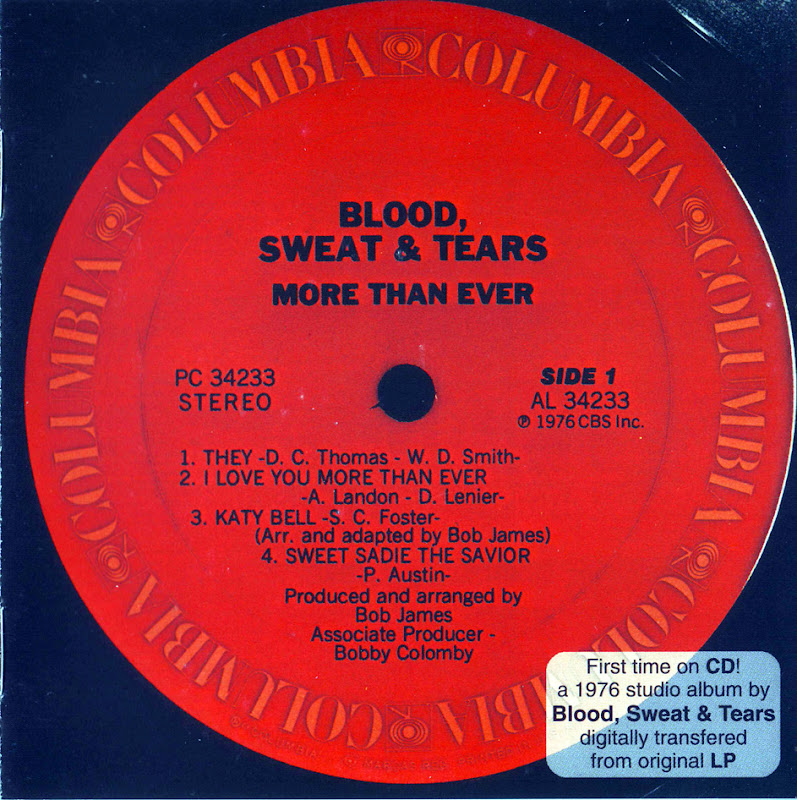
More Than Ever was the last studio effort by the re-formed, reconstituted Blood, Sweat & Tears, with David Clayton-Thomas back in the lineup and the whole group invigorated after coming off of a successful international tour. For the first time since its second album, the group -- with only drummer Bobby Colomby left from the original lineup and Bob James producing -- sounds bold, enthused, and fully positive in its approach.
The sound is a little more R&B oriented and less rocking than the older lineup, which actually makes a better fit overall -- Thomas' singing style is a bit dated, from a tradition of '60s blue-eyed soul that seems fine, but which was really out-of-place amid the disco boom of the second half of the '70s. The group's obvious enthusiasm -- there's not a lot here that sounds like it wasn't played with joy -- and the smooth mix of R&B, jazz, and gospel influences coupled with the larger-than-life sound of the production (the ten-man band is joined by 13 guest musicians and eight backup singers, among them Patti Austin and Gwen Guthrie) helps put over some very solid material. "They," "I Love You More Than Ever," "You're the One," and the soaring, haunting "Heavy Blue" are highlights of a pretty strong album.
Nothing here is remotely as revelatory as anything on Child Is Father to the Man or as startlingly fresh in a pop vein as the Blood, Sweat & Tears album, but it's a good 40 minutes of listening. The pity is that the Columbia Records art department couldn't muster as much inspiration on its end as the musicians did on theirs -- one can only wonder who got paid for coming up with the "idea" of using an enlarged copy of the album label as the front cover art. But bad art aside, this record is not only one worth finding -- it's one worth keeping.
by Bruce Eder
Tracks
1. They (Clayton-Thomas, Smith) - 6:29
2. I Love More Than Ever (Landon, Lenier) - 5:28
3. Katy Bell (Foster, James) - 4:29
4. Sweet Sadie The Savior (Austin) - 4:24
5. Hollywood (Clayton-Thomas, Modeliste, Nesmith, Neville, Nocentelli, Porter, Reid, Smith) - 3:36
6. You're The One (Clayton-Thomas, Lennon, Ono, Smith) - 4:56
7. Heavy Blue (Willis) - 5:26
8. Saved By The Grace Of Your Love (Palmer, Smith) - 4:20
9. (Bonus tracks: Medley, Recorded live, Oct 12, 1980 at the Street Scene - Downtown, LA) God Bless The Child (Arthur Herzog Jr., Billie Holiday) - 2:58
10.Lucretia Mac Evil (David Clayton-Thomas) - 1:11
11.Hi-De Ho (Carole King, Gerald Goffin) - 5:32
12.And When I Die (Laura Nyro) - 1:35
13.Spinning Wheel (David Clayton-Thomas) - 1:11
14.You're Made Me So Very Happy (Berry Gordy Jr., Brenda Holloway, Patrice Holloway, Frank Wilson) - 3:02
Autumn '66 was the third album from the Spencer Davis Group. It includes the chart-topping Somebody Help Me which had reached number one in the UK charts in the Spring of 1966. At this stage, the group was not writing much original material. However, the seventh single When I Come Home marked the songwriting debut (with Jackie Edwards) of Steve Winwood, the outstanding talent in the band.
Many of the songs on Autumn '66 are covers of standards. Take This Hurt Off Me was also covered by The Small Faces, When a Man Loves a Woman is the Percy Sledge song and is ideally suited to Steve Winwood's soulful voice. Indeed Steve Winwood shows that he ranks alongside Steve Marriott and the Action's Reggie King as England's top soul singers at the time.
Autumn '66 is another transitional album like Revolver, the Small Faces (Immediate) or Aftermath in that it represents a crossroads in the career of the band. In this case, it represents a move away from the band's roots in blues towards a more commercial sound as shown in the single Somebody Help Me. There is also a move away from the blues harmonica towards more tracks featuring Steve Winwood's Organ playing. What is clear though is that the band enjoyed making this record.
Midnight Special is a standard that Spencer Davis used to play on street corners across Europe during his days as a student. On the Green Light is a studio improvisation, the green light being the recording light. Together 'Til The End of Time starts the album on a slow note and it represents an excellent showcase for Winwood's vocals. Dust My Blues is another standard and there is also a Yardbirds version of this.
The album finishes with the single Somebody Help Me. This helps to confirm the fact that the Spencer Davis Group made some excellent singles. It ranks alongside Gimme Some Lovin' and Keep on Running.