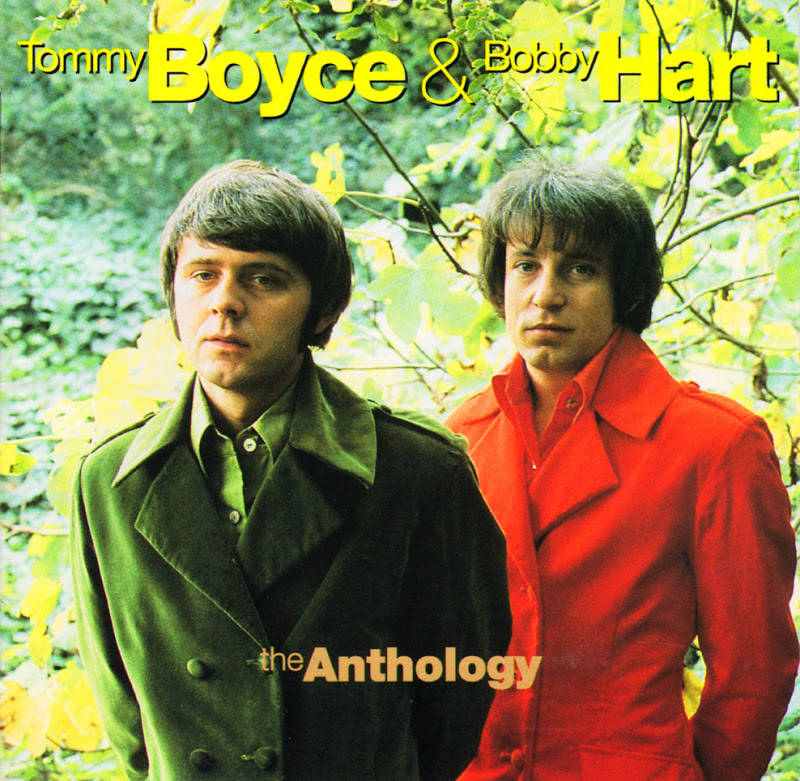
It might be cute to say that Boyce & Hart were the hand inside the Monkees' puppet head, if not for the fact that the Monkees had legitimate talent and have already caught enough grief over their prefabricated origins. Boyce & Hart had yet more talent, though, and not only plied the Monkees with hit songs but, in some cases, performed them, too.
Tommy Boyce enjoyed minor teen idol success as a solo act with "I'll Remember Carol" in 1962 before teaming up with Bobby Hart to produce one Top Ten hit ("I Wonder What She's Doing Tonite") and a handful of lesser chart entries. This Australian anthology, simply titled The Anthology, contains two of Boyce's solo recordings (including his hit), 18 A&M recordings from Boyce & Hart's prime (including all of their hits), and five songs the duo cut with the Monkees' Davy Jones and Micky Dolenz in the '70s. The Boyce & Hart recordings are the highlights, especially the bubblegum pop of songs such as "I Wonder What She's Doing Tonite" and "The Countess."
Listeners already familiar with the Monkees' albums will experience deja vu throughout as Boyce & Hart demonstrate again and again the extent to which they were the architects of the Monkees' sound. Even the Monkees' detours into pop psychedelia are matched by Boyce & Hart on a trippy rendition of "Jumpin' Jack Flash." The theme song from the 1967 spy film The Ambushers (complete with gunshot sound effects) is campy fun, as are the mid-'70s cover versions of "Teenager in Love" and the Beach Boys' "Sail on Sailor," provided one doesn't approach them with high expectations.
For those who want only the Boyce & Hart recordings, a more recent compilation on Rev-Ola titled I Wonder What She's Doing Tonite: The Best of Boyce & Hart limits its focus to recordings from the pair's late-'60s heyday.
by Greg Adams
Tracks
1. I'll Remember Carol (T. Boyce) - 2:27
2. Sunday, The Day Before Monday - 2:19
3. Out And About - 2:30
4. I Should Be Going Home - 3:00
5. For Baby - 3:48
6. Sometimes She's A Little Girl - 2:55
7. I Wonder What She's Doing Tonite - 2:43
8. The Ambushers (H. Monetnegro, H. Baker) - 2:15
9. I'm Digging You Digging Me - 2:37
10. I Wanna Be Free - 2:25
11. Teardrop City - 2:22
12. Love Every Day - 2:50
13. The Countless - 2:28
14. Goodbye, Baby - 3:59
15. Where Angels Go, Trouble Follows (Shifrin, Boyce, Hart)- 2:06
16. Alice Long - 2:52
17. P.O. Box 9847 - 3:01
18. Abracadabra (Shelton, Lewis, Gallie) - 1:52
19. Jumpin' Jack Flash (Jagger, Richards) - 4:08
20. Standing In The Shadows Of Love (Holland, Dozier, Holland) - 4:29
21. I Love You - 3:10
22. A Teenager In Love (Pomus, Shuman) - 3:00
23. Sail On Sailor (D. Trevor) - 3:40
24. I Remember The Feeling - 3:25
25. It Always Hurts Most In The Morning - 3:28
All songs by Tommy Boyce And Bobby Hart unless as else stated
*Tommy Boyce - Guitar. Vocals
*Bobby Hart - Vocals, Piano
Lee Clayton was born on October 29th, 1942 in Russellville, Alabama. He grew up in Oak Ridge, Tennessee, and learned to play harmonica and guitar around the age of seven. As Clayton told the UK magazine Omaha Rainbow way back when: "I've always known music was important - when my dad knew he'd got uptight, and the world got too much for him. he would break out his bourbon and play Red Foley and Jimmie Rodgers records and tell war stories and drink whisky.
I can remember trying to figure out when I was a little boy what .-.as going on; why everybody would sit there and get drunk and cry. I figured anything could evoke that kind of emotion had to be pretty strong". At the age of nine, he was given a steel guitar, and like many of his contemporaries, turned onto Country music as heard on the many specialist radio stations in the Southern States. Apparently, Clayton had been given a choice of instruments - guitar or accordion - and, probably surmising (given his relatively tender years, maybe it was just a hunch he had) that the guitar was a better method of attracting the attention of young ladies took up the string option. However, when he professed boredom and the formal music lessons that his dad was paying for, Clayton senior promptly sold the guitar. This proved to be a temporary hiatus from Clayton's musical ventures, however; Clayton took up music again in his mid-teens.
As time went by, Clayton got married, and acquired a Porsche sports car - he has said elsewhere that the limit of his ambitions at the time was to fly aeroplanes, play music now ambitions, and, in his own words: "One day, something went 'click' and I turned round and went back home, quit the job and started trying to get in the air force". Clayton spent several years in the US Air Force; having been drawn to the fly boys when taking a friend to undergo basic training as a pilot. Whilst in the USAF, he piloted the infamous Voodoo 101 fighter, nicknamed the 'Widowmaker' by his fellow pilots because of the plane's unfortunate propensity to become uncontrollable at high speeds.
Having had his fill of that, Clayton left the services to pursue a potential career as a singer-songwriter. In the aforementioned interview, Clayton recalled his attempts to find a way in to the Nashville singer-songwriting circle: "I was living in Louisville, Kentucky, and I'd.... spend three or four days a week in Nashville. (When) people would say to me 'What are you doing?', I'd say Tm a poet and songwriter'. Within six months, my money started to go and they took my credit cards away from me and I was on the street. Sold my Porsche and I had an old beat-up Volkswagen. I went from then until I got some money from the record company when I signed the deal in early 73. (Before that) it was out on the street, sleeping on the floor time".
His first major success came with the song that gave 'Outlaw1 country its name, Ladies Love Outlaws, originally recorded by The Everly Brothers on their 1972 album, Pass The Chicken And Listen, and taken into the US Billboard Country singles chart by Waylon Jennings in the same year. Ironically enough, Jennings didn't even want the song (or the album it came from) released; it ended up giving its name to a movement in which he would become one its icons.
Indeed, it's probably by far Clayton's best known number - artists such as Tom Rush, Confederate Railroad (on the soundtrack of the movie Maverick, which starred Jodie Foster and Mr 'Hi there sugar tits' himself, Mel Gibson) and Jimmy Rabbit have tendered their own take on record over the years. Such success and notoriety saw Clayton score a record deal with the MCA label. MCA had broadened their musical horizons in the early 1970s, signing the future giants of 'Southern Rock', Lynyrd Skynyrd, and also started feeling out talent in other musical genres. The first fruit of the liaison was the album you're hopefully playing now, simply entitled Lee Clayton. From the cover on in, it's apparent that Clayton had been around a bit, done his fair share of dues paying before he set foot in a recording studio.
The cover features a long-haired, somewhat careworn individual, in a country setting, looking more like a drifting hitch-hiker than a Nudie Cohen-suited 'hat' act from the Nashville production line. A cursory introduction to the album's musical content reveals that Clayton is possessed of a voice that is similarly rough around the edges - but a perfect vehicle for his intimate, ruminative and pleasingly melancholy songs. Indeed, melancholy is the overall mood that permeates the album in an emotive and appealing way.
It's not, however, the kind of melancholia of a Hank Williams or a Ray Price; no, what Clayton parlays is a contemporary take on Romantic desolation. Whereas Hank would've contrasted the existential hillbilly longing of / Can't Help It If I'm Still In Love With You with up-tempo hee-hawing like Settin' The Woods On Fire, Clayton's songs are more urban, and negotiate a different emotive register - equally as affecting, mark you, but firmly rooted in the here and now, at least the here and now of the early 1970s. Also (and you couldn't ask for more from a debut album), Clayton's debut is a bunch of well-crafted, melodically strong and considered collection of songs that showed great promise.
Lee Clayton was produced by Chip Young - his career has seen him provide like services on albums Billy Swan, Joe Ely, Mickey Newbury and Delbert McClinton amongst many others. The album also contains musical contributions from a talented bunch of session musicians, whose names will be familiar to fans of the music that's emanated from Nashville over the last thirty years. These include such Music Row luminaries as Tim Drummond (bass), Mickey McGee (drums), and Buddy Spicher (fiddle). Bonnie Bramlett also gets to provide some backing vocals, too.
There's also a personal dedication from Clayton to Waylon (Jennings), Kris (Kristofferson), and Billy Joe (Shaver) - a nice acknowledgement from one talented singersongwriter to his influential contemporaries - Clayton would latterly have more reasons to thank Jennings and Kristofferson, as we shall see. The centrepiece of the album is the composite New York City Suite 409. In the space of its six minutes plus duration, Clayton skilfully elides two songs together - Lord She Don't Belong In New York City, and Don't You Think It's Time To Come Home.
The first part finds Clayton in thoughtfully sombre mood, yearning for his lover who's in far off NYC, and his skilful description of the missing main squeeze's homespun ways paints a vivid mental picture. It's also obvious a concurrent strand running through the piece is the notion that she's not coming back, which makes the second half of the song all the more poignant, Clayton's lyrical and vocal understatement only adding considerably to the emotive sucker punch that the song ultimately delivers.
To me, this illustrates Clayton's songwriting talents brilliantly; a complex emotional range put across simply and effectively. Your attention is drawn to the female vocal in this song that adds a pleasingly femme ying to Clayton's masculine yang - it's supplied by none other than Carly Simon, whom, one surmises, is likely the subject of Clayton's credit on the original album jacket: "Special thanks to a lovely lady from New York City".
I'm duty bound to point out the presence on bass on this track of one Dennis Linde - often erroneously credited as the composer of the dreamy sixties folkie hit Elusive Butterfly (that was actually Bob Lind - Dennis will be best-known to you as the composer of arguably Elvis Presley's best latter-day record, Burning Love, as well as composer of songs recorded by Garth Brooks (Callin' Baton Rouge), Mark Chesnutt (Bubba Shot The Juke Box), George W Bush's favourite Country act, The Dixie Chicks (Goodbye Earl) and even our very own Dr Feelgood (No Mo Do Yakamo).
Elsewhere, Clayton turns his attention to the Country staples of drinking (Bottles of Booze), and the wooing of women (Mama, Spend The Night With Me) - I'm not sure how successful Clayton was with the lady in the latter, but at least he achieved a modicum of artistic success in crafting a fine contemporary Country seduction song. Clayton, somewhat inevitably, perhaps, chooses to end the album with his most famous song (up until then), Ladies Love Outlaws, and his version, whilst not the definitive item, serves to illustrate the depth and range of his songwriting skills - it's not the best track herein, but would still be a standout item on most singer-songwriters' albums.
Lee Clayton - the album, was not a huge sales success, even if its artistic success justified MCA's signing him in the first place. Interviewed a few years later, Clayton was philosophical about it's commercial failure: "I think at some point in time people will understand what I've been trying to do. At the time, it was a very well kept secret. What happened to it was... who knows what happens? It's just one of those things. I had a shot, I rolled my dice and was fortunate enough and worked to a point where I could make a record album. It didn't sell a whole bunch, but that's just part of it. It knocked me out at the time that somebody thought enough about me that I could even put it down on plastic".
He continued with the following overview of the year in which MCA signed him: "The start of 73, I had no money; got some money; made a record; spent a lot of money; end of '73 broke; off the label; back on the streets again all in one year. I lived in a motel room in California most of 74, then went to the desert in December of '74 - out in the Mojave Desert and lived there with this woman. Didn't do a whole lot. the truth is, just sat around and looked at things. Watched a lot of sundowns and sunrises, thought a lot, climbed the mountain and one day figured it was time for me to go at it again". Lee Clayton signed to the Capitol label in the late 1970s, and cut two more albums – Border Affair (1979) and Naked Child, which were well regarded at the time, critically, if again underwhelming in the sales department.
Border Affair contained his own versions of songs such as Silver Stallion and If You Can Touch Her At All, the former of which was a signature track by that infamous quartet of Country Gargantuans, The Highwaymen - that's Johnny Cash, Waylon Jennings, Kris Kristofferson and Willie Nelson. Willie Nelson also recorded the latter in solo mode. Despite Clayton's apparent obscurity, it's clear that his music has exerted a palpable influence on successive generations of artists; there's a lot of Clayton in Steve Earle and Ryan Adams, to these ears, and even Bono, vocalist with U2, once said: "There's only one Country singer who has influenced me, and he's an unknown feller called Lee Clayton." Since the early 80s, Clayton has sporadically put his head over the parapet - a live album here, tour of Scandinavia there, nut nothing really sustained.
One surmises that Clayton likes it that way. So what's Lee Clayton up to these days? Well according to EMI publishing's Bruce Burch, he is living about an hour's drive outside of Nashville, and is still writing great songs. One hopes that there's more to come from this talented individual.
by Alan Robinson, October 2006
Tracks
1. Carnival Balloon -3:23
2. Bottles Of Booze - 4:48
3. Henry McCarty - 3:29
4. New York City Suite 409 - 6:38
…a. Lord She Don't Belong In New York City
…b. Don't You Think It's Time To Come Home
5. Mama, Spend The Night With Me - 3:07
6. Red Dancing Dress - 4:77
7. Danger - 2:52
8. Lonesome Whiskey - 2:45
9. Ladies Love Outlaws - 2:42
All songs written by Lee Clayton
Musicians
*Lee Clayton - Lead Vocals, Guitar
*Bobby Woods - Piano
*Reggie Young - Electric Guitar
*Kenny Malone – Drums, Percussion
*Johnny Christopher - Rhythm Guitar
*Lloyd Green - Pedal Steel Guitar
*Shane Kestler - Moog
*Bobby Thompson - Banjo
*Mike Leech - Bass
*Tim Drummond - Bass
*Dennis Linde - Bass
*Richard Bowden - Electric Guitar
*Ed Black - Pedal Steel Guitar
*Mickey McGee - Drums
*Bobby Ogden - Organ
*Chip Young - Rhythm Guitar
*Jerry Shook - Harmonica
*Buddy Spicher - Fiddle
One of the seminal live albums of the late '60s, Live Adventures of Al Kooper and Mike Bloomfield was a natural, organic offshoot of the hugely successful Super Session album from 1968, which contained performances by both of these groundbreaking musicians, as well as Stephen Stills.
The idea of musical spontaneity both in live performance and in the recording studio had reached a certain apex in 1968, and spontaneous excursions by musicians such as Jimi Hendrix, Steve Winwood, and the Southern California musical covenant that eventually became Crosby, Stills, Nash 'n' Young, as well as a host of others, were indeed a sign of the times. But it was the union of Bloomfield and Kooper that can truly claim an origination of the phenomenon, and this album takes it to another level entirely.
Utilizing a fine and tight rhythm section of John Kahn and Skip Prokop, the two musicians duel and embrace each other on such cuts as the accurately named "Her Holy Modal Highness" and a great, revamped rock/soul re-working of Paul Simon's "Feelin' Groovy," which is buttressed by a guest studio vocal overdub by the author himself. The album's high point may be Bloomfield's rendering of Albert King's epic "Don't Throw Your Love on Me So Strong," which may indeed also be one of his finest career recordings.
Like the Super Session album, history repeated itself, as Bloomfield's chronic insomnia caught up with him by the morning of the second night of the two-night gig, rendering him unavailable. Kooper enlisted the help of Steve Miller and a practically unknown Carlos Santana (himself a Bloomfield devotee) for several tracks, particularly a loose and free version of "Dear Mr. Fantasy," which sort of embodies the whole affair and era. Undoubtedly a necessity from the period, the record has been remastered for CD, and the results are truly glorious, and do this legendary album justice.
by Matthew Greenwald
Tracks
Disc One
1. Opening Speech (Mike Bloomfield) - 1:30
2. The 59th Street Bridge Song (Feelin' Groovy) (Paul Simon) - 5:38
3. I Wonder Who (Ray Charles) - 6:04
4. Her Holy Modal Highness (Al Kooper, Mike Bloomfield) - 9:08
5. The Weight (Robbie Robertson) - 4:00
6. Mary Ann (Ray Charles) - 5:19
7. Together 'Til The End Of Time (Frank Wilson) - 4:15
8. That's All Right (Arthur Crudup) - 3:28
9. Green Onions (Booker T. Jones, Steve Cropper, Al Jackson, Jr., Lewie Steinberg) - 5:26
Disc Two
1. Opening Speech (Al Kooper) - 1:28
2. Sonny Boy Williamson (Jack Bruce, Paul Jones) - 6:04
3. No More Lonely Nights (Sonny Boy Williamson) - 12:27
4. Dear Mr. Fantasy (Jim Capaldi, Stevie Winwood, Chris Wood) - 8:04
5. Don't Throw Your Love On Me So Strong (Albert King) - 10:56
6. Finale-Refugee (Al Kooper, Mike Bloomfield) - 2:04
Musicians
*Al Kooper - Organ, Piano, Vocals
*Mike Bloomfield - Guitar, Vocals
*John Kahn - Bass Guitar
*Skip Prokop - Drums
*Carlos Santana - Guitar
*Elvin Bishop - Guitar
Steve Miller and Dave Brown had also volunteered their services but if they performed, their contributions do not appear (at least credited) on the album
Here’s an unusual jewel, released on Mercury Records in 1971. The band Taos was actually a quintet pieced together by a group of young men who had moved to the legendary Taos commune in the early 1970s, namely: Jeff Baker on guitar and vocals, Steve Oppenheim on keyboards and vocals, Albie Ciappa on drums, Burt Levine on guitar and banjo, and Kit Bedford on bass, with the occasional intermixing of instruments going on in between cuts. If the band’s commune connection leads you into expecting some sort of stoned, improvisational musical meanderings, however, you’re in for a surprise: their sole, self-titled record is pop music all the way.
Indeed, the band itself is surprisingly together, tempering mildly eccentric diversions into psychedelia and country music with a solid foundation in 1960s rock and roll. If there’s one band to which Taos owes its biggest debt, I’d say it would have to be The Beatles. Kit Bedford’s warm, melodic bass work channels Paul McCartney all the way, while the group’s vocal harmonies show a tendency to lean more towards the ragged schoolboy charm of the Four than the choirboy constructions of American groups such as the Byrds, or the Mamas and Papas. This influence is not to say that Taos lacks an identity of its own, however. On the contrary, they manage to take this influence in surprising directions, whether it’s the lonesome cosmic cowboy pastiche “After So Long” or the phased psychedelic boogie of “Twenty Thousand Miles In the Air Again”.
Despite the general cohesiveness of the album, however, there are the occasional faults, such as the unnecessary, repeating theme “The Day Begins,” which should have simply been turned into a full-fledged song rather than left as fragmentary interruptions in the tracklist. Every now and again the musicians also reveal a slight weakness in the vocal department, as the slightly squirrely lead on “Morning Sun” illustrates. Lastly, the song lyrics aren’t really worth shedding too much ink over – there’s certainly no metaphysical contemplation or social commentary going on here, whatever other Sixties sensibilities the record may boast.
These latter complaints border on quibbling, though, because the music here is almost too much fun to criticize. Again, this is pop music, and should be enjoyed for what it is. I think that Taos is certainly consistent enough that, if you’re digging the tracks below, you’re gonna like what you hear the rest of the way through.
Tracks
1. Space Bird - 2:44
2. Think I'll Wait - 3:53
3. Morning Sun - 2:17
4. 20,000 Miles In The Air (Again) - 2:51
5. All My Life - 2:42
6. Everybody's Movin' (In The Sunshine) - 3:21
7. Love's Face - 2:46
8. Putting My Faith In You - 4:59
9. On The Way Down - 0:42
10.Climbing Up The Mountain - 3:22
11.Take Good Care - 1:55
12.After So Long (So Long) - 3:21
Cold Sun from Austin, Texas was recorded in 1970 in the legendary Sonobeat studios, where the Mariani and Johnny Winter first LPs were produced. The Cold Sun band are considered contemporaries of Velvet Underground and The Fugs, often listed as being in a similar vein but inspirations for this unique piece actually go back to the desperated, haunted Joe Meek.
All songs lyrically express dark, mystic poetry with the true 60s psychedelic floating/distorted fuzz spirit presented in short compact mini-epics along with several mind blowing long tunes, such as "Ra-Ma" (11 min), "Here In The Year" (9 min) and "Fall" (7 min). Discovered by Rockadelic Records of Dallas, Texas in 1991, the Dark Shadows album saw the light of day the next year as a limited LP version, to become today one of the most important and revered US psychedelic underground albums from the early 70s.
(Rockadelic heard it in the form of an old scratchy acetate that one of the Cold Sun band members had made in order to be able to play the recording at friends` parties on their turntables. The acetate only contained 2/3 of the songs but so greatly impressed them that Rockadelic managed together with bandleader Bill Miller to release the complete sessions from mastertape.)--- Autoharp wizard Miller eventually spearheaded Roky Erickson`s international debut as the Cold Sun band joined forces with Roky in 1974 and became BliebAlien, later evolved into The Aliens and backed Roky on his famous albums and historical concerts.
Carefully remastered from the mastertapes, this album will bring new rewarding listening experiences in expanded fidelity, plus 2 unreleased non-album songs, authentic Live/Concert recordings of "Live Again"(10 min) and "Mind Aura"(7 min). The fidelity of these reel to reel Live recordings is also remarkable. The CD and Vinyl issues will both have an extended booklet with liner notes by Jello Biafra plus rare photos and other surprises. The Vinyl issue is packaged in a luxury foldout cardboard cover as Dragonwyck, Phantasia or Mystic Siva and contains an extra 10" bonus record.
Tracks
1. South Texas - 5:17
2. Twisted Flower - 3:04
3. Here In The Year - 8:50
4. For Ever - 4:35
5. See What You Cause - 3:40
6. Fall (Billy Miller, Herman M. Nelson, Winston Taylor) - 7:20
7. Ra-Ma (Billy Miller, Tom McGarrigle) - 11:20
8. Live Again - 10:20
9. Mind Aura (Tom McGarrigle) - 7:38
Music and Lyrics by Billy Miller except ehere noted.
Let's see if I have this straight---Sony/Columbia Legacy saw fit to let two of these performances ("It Takes Time" and the incandescent "Carmelita Skiffle") turn up to round off their excellent Michael Bloomfield overview ("Don't Say That I Ain't Your Man," in 1998) but not to let the entire original album (released in 1969), plus the performances that were saved for Nick Gravenites' "My Labours," see the light of day once more.
Leaving it to Australia's Raven label to do what should have been done long enough ago. Considering Legacy's diligence in its "Roots 'n' Blues" series and with much of the Bloomfield canon from his Columbia years, that omission should be considered a crime. That said, thank Raven for its own diligence and for producing a set that presents everything Columbia recorded (save "Winter Country Blues," omitted for space reasons but still alive and well on the reissued "My Labours") the 1969 weekend Bloomfield, Nick Gravenites, and a few of their regular musical partners (including Bloomfield's former Butterfield Blues Band teammate Mark Naftalin on piano, his "Live Adventures" bassist John Kahn, his soon-to-be-frequent drummer Bob Jones, and erstwhile Electric Flag baritone saxophonist Snooky Flowers) commandeered the Fillmore West for some freewheeling blues and soul jamming.
Concede the point that this isn't exactly "Super Session Mk III" (and not just because organist Ira Kamin is no Al Kooper, though he's quite tasteful and sinuous in his own right), and you have one of the most powerful documents in the Bloomfield catalog. The horns and the Gravenites voice may deceive you into thinking this was a kind of projection of what Bloomfield ultimately wished the Electric Flag to have been, but this music is far more tightly grounded in blues and soul than the eclectic (and ill-fated) Flag, and these musicians, whatever their individual inclinations, are most at home in those two neighbourhoods.
Gravenites has rarely been heard in better or more soulful voice, even when it cracks now and then; Kahn, Jones, and conga player Dino Andino play as though they'd been welded together for years; Naftalin and Kamin are as supple a keyboard team as you could ask without stepping on each other's corns; and the horns---Flowers, Gerald Oshita (baritone sax), Noel Jewkis (tenor sax), and John Wilmeth (trumpet)---sound as buttery and exuberant as the tightest sessions of the Memphis Horns.
And Bloomfield? He gives more than enough evidence of what Al Kooper hoped to isolate with "Super Session" in the first place: catching him when he could just forget everything except playing his heart out, from the kickoff lick to "It Takes Time" (boy, did he never forget what Otis Rush among the other Chicago masters taught him as a teenager hanging around the classic southside blues clubs) to the last notes of "Moon Tune." And just about all points in between. If you missed out hearing it on "Don't Say I Ain't Your Man: Essential Blues, 1964-69" (it's since gone out of print), here's "Carmelita Skiffle"---the original vinyl release closer---and Bloomfield plain rollicking, practically squeezing everything he'd learned about and felt about the blues into one incendiarily melodious solo, before handing it off to Jewkis for a smooth saxophone break and Kamin for a soaring organ solo, before returning with an exclamation point of a coda.
In between? "Oh, Mama" is a Bloomfield composition, the kind of soul he'd begun exploring in the Electric Flag, and while the music is exquisite Bloomfield as a singer was a virtuoso guitarist. With Gravenites extending his breather, Jones takes a surprisingly solid vocal on the Arthur Conley chestnut "Love Got Me" (and you thought all Conley was good for was "Sweet Soul Music"). With Gravenites returning, "Blues on a Westside" lives up to its mini-legend as a wrenching jam, with Bloomfield absolutely soaring. Taj Mahal joins up for a throbbing "One More Mile," and Gravenites' "It's About Time" could be said to live up to its title, working blues into a James Brown-like groove in a more freewheeling style, guitar and piano wrestling each other's chords deftly and riding the rhythm smoothly, Bloomfield firing off a few horn-like bursts to set up his solo statement.
And the "My Labours" additions? All of them Gravenites compositions, the one that's most likely to stick in your head is "Gypsy Good Time," what they used to call funky blues, punctuated sweatily by Willmeth's trumpet phrases and Andino's rolling secondary rhythm, with the full band cutting a deep and wide groove over which Gravenites sings exuberantly and Bloomfield peels off a fiery, melodious solo.
It's a shame the compilers found no room for "Winter Country Blues" but chose to fill out the available space with "Mary Ann," a quartet performance (and a good one) from "The Live Adventures of Mike Bloomfield and Al Kooper," which is actually a good introduction to that set if you don't have it yet. Just why the new compilers saw fit to include that as a bonus track isn't made clear. But it shouldn't distract you from the power of the main attraction.
Blues-Duke
Tracks
1. It Takes Time - Vocals: Nick Gravenites (Otis Rush, Willie Oixon) - 4:27
2. Oh Mama - Vocals: Michael Bloomfield (Michael Bloomfield) - 2:59
3. Love Got Me - Vocals: Bob Jones (Arthur Conley) - 2:37
4. Blues On West Side - Vocals: Nick Gravenites (Nick Gravenites) - 15:18
5. One More Mile To Go - Vocals: Taj Mahal (Joseph Cotton) - 10:35
6. It's About Time - Vocals: Nick Gravenites (Nick Gravenites) - 7:00
7. Carmelita Skiffle - Instrumental (M. Bloomfield, N. Gravenites, B. T. Jones, M. Naftalin) - 5:11
8. Killing My Love - Vocals: Nick Gravenites (Nick Gravenites) - 5:18
9. Gypsy Good Time - Vocals: Nick Gravenites (Nick Gravenites) - 4:30
10. Holy Moly - Vocals: Nick Gravenites (Nick Gravenites) - 3:54
11. Moon Tune - Vocals: Nick Gravenites (Nick Gravenites) - 8:32
12. Mary Ann - Vocals: Michael Bloomfield (Ray Charles) - 5:28 Tracks 1-7 from the Columbia album Live At Bill Graham's Fillmore West
Tracks 8-11 from the Nick Gravenites Columbia album My Labors (featuring Mike Bloomfield)
Track 12 from the Columbia album The Live Adventures of Mike Bloomfield andAI Kooper Musicians
*Michael Bloomfield - Guitar, vocals
*Nick Gravenites - Vocals, guitar
*Mark Naftalin - Piano
*Ira Kamin - Organ
*John Kahn - Bass
*Bob Jones - Drums, vocals
*Dino Andino - Conga
*Noel Jewkis - Tenor sax
*Gerald Oshita - Baritone sax
*Snooky Flowers - Baritone sax
*John Wilmeth - Trumpet
*Taj Mahal - Vocals Bonus Track
*Michael Bloomfield - Guitar, vocals
*Al Kooper - Organ, vocals
*John Kahn - Bass
*Skip Prokop - Drums Mike Bloomfield's tapestry 1966-68 Strawberry Jam (with Paul Butterfield's Blues Band) 1976 Live at the Old Waldorf 1976 KGB
If the 20 tracks collected on this, the fourth installment, are anything to go by, the splendid Piccadilly Sunshine series is still in its zenith. As the gray streets of late-‘60s Britain magically blossomed into a lysergic Edwardian wonderland of the imagination, Jago Simms tells his toy town tale about a “Conventional Fella” who liked to get nude after a hard day’s accounting so he could become “just as free as any bird or bee”, while lazy trumpets, tinkling harpsichords, shimmying Mod-psych organ and glorious guitar fuzz herald such forgotten classics as The Laurels’ “Rainmaker”, Keith Field’s “Stop! Thief” and the Now’s foray into early prog on “The Hands On my Clock Stand Still”. Simply amazing stuff!
by Alan Brown 22 March 2011
Artists - Tracks
1. Samurai - Temple Of Gold - 2:15
2. The Running Jumping Standing Still Band - Ayeo - 2:18
3. Sight And Sound - Alley Alley - 2:45
4. Washington Dc’s- 32nd Floor - 2:29
5. Laurels Sunshine - Thursday - 2:40
6. Jago Simms - In Too Deep - 2:25
7. Oedipus Complex - Empty Highway - 3:02
8. Wayne Fontana - In My World - 3:01
9. Nocturnes - Look At Me - 3:15
10.John Bryant - Columbine - 2:36
11.Sweet Thursday - Cobwebs - 3:22
12.Seymour Kelly - Indian Scene - 2:32
13.Tony Rivers And The Castaways - Pantomime - 3:46
14.Watch Committee - Now I Think The Other Way - 2:02
15.Merlin Q - The Secret - 2:45
16.Roger Denison - Running Out Of Time - 2:10
17.Ian Whitcomb - Groovy Day - 2:23
18.Roulettes - Airport People - 2:38
19.Sounds Bob Rogers - Dream With Me - 2:06
20.Toyshop - Say Goodbye To Yesterday - 3:21
'Tracks' is a collection of rare versions of some of Wishbone Ash's best loved work, along with some seldom heard gems and surprises. The revolving Wishbone line-up is well presented with all the usual suspects. The music selected for this album treats the listener to exciting live versions of classic songs that have contributed to a legacy, that is uniquely 'Wishbone'.
The airing of this archive material, gives us a backstage pass, shedding a new light on a great British band's stage performances, both from years gone by, right up to the year 2001. Raw and unadulterated, check out the inimitable twin lead sound that blazed a trail for many others, who have often tried, but never improved on the original blueprint laid down by this British original in late 1969.
Tracks
Disc 1
1. Tangible Evidence - 4:05
2. Front Page News - 5:32
3. Lifeline - 7:00
4. Living Proof - 5:53
5. Anger In Harmony - 4:33
6. Queen Of Torture - 3:13
7. Insomnia - 6:50
8. Wings Of Desire - 3:34
9. Ballad Of The Beacon - 4:10
10. Strange Affair - 5:13
11. Outward Bound - 3:45
12. Warrior - 5:34
13. Keeper Of The Light - 4:09
14. Why Don't We - 7:47
Disc 2
1. In The Skin - 5:51
2. The King Will Come - 6:58
3. Persephone - 3:41
4. Standing In The Rain - 6:49
5. Throw Down The Sword - 6:01
6. Way Of The World - 10:23
7. You See Red - 6:16
8. Number The Brave - 5:44
9. Everybody Needs A Friend - 6:03
10. Master Of Disguise - 3:42
11. The Ring - 4:37
12. No More Lonely Nights - 6:23
Now a highly regarded release among the collectors of early 70’s U.S. rock, Dryewater’s Southpaw album was privately released to little fanfare on the J.T.B. label in 1974. The North Carolina based four piece pressed just 500 copies of the album (fewer still with actual covers!) and the rarity value of this initial release has since increased as it’s since become known that the band destroyed the copies they failed to sell at the time! Maybe they had higher expectations for the album, and this is justifiable, as in hindsight the ten original compositions show a very confident release by an obviously proficient line up.
Strong rhythm guitar work forms the basis of most of the songs, but also evident is some melodic, perhaps slightly progressive keyboard work, that both underpins the occasional acid lead guitar solos and maintains the overall momentum of each performance. With a tight rhythm section and strong vocals too, this all makes for a rockin’ rollercoaster ride. A fine example of the harder West Coast sound of the time. Check out the melodic Don’t Let Her Sleep Too Long, the riff - heavy track 2, and rolling rhythms of track10,
Dryewater were certainly overlooked at the time A limited vinyl run released by Void Records in 1996 briefly led to a renewed interest in the band.
Tracks
1. Winterground - 3:02
2. Trouble - 4:07
3. Give Yourself Time To Live - 3:24
4. Don’t Let Her Sleep Too Long - 2:58
5. Let Me Take You - 3:31
6. Thunder - 2:57
7. See Them Run - 2:02
8. Revelation - 2:23
9. Set Out On The River - 2:49
10. After All - 6:30
According to ancient Druidic and Celtic legend, King Arthur will return in this age of Aquarius to sustain us. And man, he's going to blow a mean blues; according to merlin Bond! Long before the recent spate of black magic involvement by some groups, Graham has been involved in white, or as he prefers to call it - holy magick. In order to help the word and perhaps gain a little more understanding he has devoted his latest album "to the true seekers of light".
The lyrics are mainly incantations and chants in Egyptian and Atlean. Stonehenge is photographed on the sleeve with Graham and his wife Diane Stewart raising their arms in supplication. If you can't take the magick however, there is a lot of wailing music to enjoy. Graham sings with his usual pre-Joe Cocker intensity, and plays organ, piano and sax. Keith Bailey is a storm on drums, and other musicians involved are Victor Brox, Big Pete Bailey, Aliki Ashman, John Gross, Alex Dmochowski, Godfrey McLean and John Morsehead. They are at their best on slow tempo blues like "The Judgement".
And even if you don't want an astral temple constructed around you, playing side one, should help contact the "higher forces", according to Bond. At least we can invent a new category - Rockult!
by Chris Welch, January 2, 1971
Holy Magick opens with a fantastic trippy Jam, "Meditation". A 23-minute
insane song, full of references to the 'Dark Side', and with some very
good instrumental lines. The Female-Vocals, are particularly
interesting, and so is trying to understand the weird words he is
singing. The Saxophone has some great lines, the Organ work is also very
cool. "Return Of Arthur" has a strong Blues sonority, with Joe
Cocker-like Vocals and an astonishing Guitar Solo.
In the beginning it
may sound weird and unpleasant, but it will turn into a very enjoyable
listen, after the first minute. "The Magician", again with some blasting
Saxophone work, this song is full of energy and power, probably due to
the Bass line. The Screaming Vocals, by Bond, are the cheery at the top
of the cake. "The Judgement" is completely different from the other
songs, calm, without any sort of insane Instrumental solo. The
Back-Vocals are pretty good on this one, sounding as if they were
answering the Lead-Vocals. "My Archangel" is the lest song. It is quite
weak, not much to say about it except that it i a feel-good song,
without much interest.
The Cover-Art was photographed in Stonehenge,
featuring Graham Bond and his wife, performing a strange ritual. This
Album was not well received by the critics, but it is nonetheless a
fantastic Album.
by Adamus67
Tracks
1. Holy Magick Suite (Graham Bond) - 23:09
...a.Meditation Aumgn
...b.The Qabilistic Cross
...c.The Word Of The Aeon
...d.Invocation To The Light
...e.The Pentagram Ritual
...f .Qabalistic Cross
...g.Hymn Of Praise
...h.12 Gates To The City
...i.The Holy Words Iao Sabao (These Are The Words)
...j.Aquarius Mantra (In Egyptian)
...k.Enochian (Atlantean) Call
...l.Abragadabra The Word Of The Aeon
...m.Praise "City Of Light"
...n.The Qabalistic Cross, Aumgn
2. Return Of Arthur (Graham Bond) - 5:06
3. The Magician (Graham Bond) - 4:04
4. The Judgement (Diane Stewart) - 4:45
5. My Archangel Mikael (Diane Stewart) - 4:09
6. Water Water (Single Version) (Graham Bond, Diane Stewart) - 3:46
7. 12 Gates To The City (Single Version) (Graham Bond) - 3:40
Musicians
*Alex Dmochowski - Bass Guitar
*Rick Gretch - Bass Guitar
*Jerry Salisbury - Cornet
*Godfrey McLean, Keith Bailey - Drums
*John Morsehead, Kevin Stacey - Guitar
*Big Pete Bailey - Percussion
*John Gross - Tenor Saxophone
*Aliki Ashman , Annette Brox - Vocals
*Victor Brox - Vocals, Electric Piano, Piano, Vocals
*Diane Stewart - Vocals, Gong
*Graham Bond - Vocals, Alto Electric, Acoustic Saxophone
Carolyn Hester is a noted Folk Singer from the 60's Greenwich Village Folk Scene. She appeared on the cover of the "Saturday Evening Post" in the May 30th, 1964 issue and has been remembered in many books including "Chronicles", Bob Dylan's autobiography, as being the person who was most instrumental in Dylan's signing to Columbia records - the label that took an unknown singer-songwriter and elevated him to super-stardom.
Hester is known for her angelic voice and her repertoire of traditional English ballads mixed with an original selection of contemporary folk. She has recorded more than fifteen albums in her fifty years of performing. She was signed to the Decca/Coral label in 1957 by her manager-producer, Norman Petty. Also under Petty's influence at that time, was a hip entertainer and friend of Hester's, Buddy Holly. Throughout the '60s, Hester was well-established in the Greenwhich Village folk scene where she met a young, Bob Dylan.
In the late 60’s Carolyn released two albums as The Carolyn Hester Coalition, their second “Magazine” originally issued in 1970 by the Metromedia label. Magazine is slightly more moody and not as sunshiney as the first record, but it is still fairly light, approachable West Coast-ish psych/folk/pop. There are some covers on this record, mixed with originals that hold up next to any other record of its ilk from the era. Hester's crystalline, sweet voice is backed by some hauntingly deep and melodic fuzz, proving that Hester wasn't just any Texas songbird.
Tracks
1. Rise Like Phoenix (Carolyn Hester, Dave Blume) - 3:18
2. Dedicated (Steve Wolfe) - 3:04
3. Plant The Crops In The Garden (D. Newburge, Dave Blume) - 3:00
4. Beadmaker (Carolyn Hester) - 2:51
5. St. James Infirmary (Joe Primrose) - 5:22
6. Just Follow Me (Tim Moore, Steve Wolfe, Dave Blume) - 5:14
7. (Sittin On The) Dock Of The Bay (Otis Redding, Steve Cropper) - 3:50
8. Sir Robert, The Lost Knight (C. Parisi, Dave Blume) - 3:43
If there is one Australian band that deserves the oft-overused adjective "legendary", then that band would be Chain. As has been stated many times, the name Chain is synonymous with blues of the highest order and integrity. Originally formed in 1968, and except for a gap between 1974 and 1982, the band has continued in one form or another to this day.
The five key figures in the saga of Chain are Warren Morgan, Phil Manning, Matt Taylor, the late Barry 'Big Goose' Sullivan and Barry 'Little Goose' Harvey but there have been numerous musicians who have passed through the ranks. Morgan, Manning and Taylor each assumed leadership at one lime or another, with the two Gooses comprising the best rhythm section the band has ever known. Inevitably, at any given time the fundamental nature of Chain has been shaped by the particular musicians present. Still, with all the comings and goings, there is one thing of which we can be sure: Chain "the whole" will always be greater than the sum of its parts.
This portion of the story covers the years 1968 up to the end of 1970, the period preceding the release of thc landmark Australian blues album Toward The Blues and thc enduring hit single 'Black and Blue”. Specifically, we'll focus on the Live Chain version of the band, headed by Morgan and Manning. This is thc first reissue of the album since its original release (Festival SFL-933926) in October 1970. With three bonus tracks added for good measure it makes for compelling listening.
Tracks
1. The World is Wailing (Morgan, Manning, Sullivan, Harvey) -12:11
2. Black and White (Warren Morgan) -12:30
3. Pilgrimage (Harvey, Sullivan, Mason, Morgan, Manning) - 8:40
4. Gen rude Street Blues (Phil Manning) - 6:01
5. Chaser (Sullivan, Mason, Harvey, Morgan, Manning) - 7:13
6. On The Road Again (Glyn Mason) - 4:34
7. Show Me Home (Phil Manning) - 3:27
8. Mr. Time (Warren Morgan) - 4:55 Tracks 1-6 recorded live at Caesar's Palace, Sydney. July 1970 Tracks 7 and 8 Single Festival FK-3331, October 1969
Five Live Yardbirds was the first important -- indeed, essential -- live album to come out of the 1960s British rock & roll boom. In terms of the performance captured and the recording quality, it was also the best such live record of the entire middle of the decade.
Cut at a Marquee Club show in 1964 , Five Live Yardbirds was a popular album, especially once Eric Clapton's fame began to spread after leaving the band. Although the album didn't appear officially in the United States until its CD release by Rhino in the late 1980s, four of its tracks -- "Smokestack Lightning," "Respectable," "I'm a Man," and "Here 'Tis" -- made up one side of their classic U.S. album Having a Rave Up, and the British EMI LP became a very popular import during the early 1970s as a showcase for both the band and the playing of Eric Clapton.
That album had astonishingly good sound, which was not the case with any of the reissues that followed, on vinyl or CD -- even Rhino's compact disc suffered from blurry textures and noise, though it was an improvement over any release since the original EMI LP. The 1999 Repertoire Records reissue is the first CD that matches the clarity and sharpness of the original LP, and along with that improvement, their original concert has been very sensibly expanded with a half-dozen live cuts from roughly the same period, recorded at the Crawdaddy Club.
Among them is a killer live version of the Billy Boy Arnold classic "I Wish You Would."There's also a pair of live tracks from German television in 1967 -- "I'm a Man" and "Shapes of Things"; the two, in a flash, make up for what they lack in perfect fidelity.
by Bruce Eder
Tracks
1.Too Much Monkey Business (C. Berry) - 3.52
2. I Got Love If You Want It (Moore) - 2.40
3. Smokestack Lightning (C. Burnett) - 5.35
4. Good Morning Little Schoolgirl (Demarais) - 2.44
5. Respectable (Isley, Isley, Isley) - 5.35
6. Five Long Years (E. Boyd) - 5.21
7. Pretty Girl (E. McDaniels) - 3.00
8. Louise (John Lee Hooker) - 3.43
9. I'm A Man (E. McDaniels) - 4.33
10. Here'tis(E. McDaniels) - 5.10
11. Smokestack Lightning (C. Burnett) - 6.47
12. You Can't Judge A Book By Looking At The Cover (W. Dixon) - 2.55
13. Let It Rock (C. Berry) - 2.17
14. I Wish You Would (B. Arnold) - 5.53
15. Who Do You Love (E. McDaniels) - 2.17
16. Honey In Your Hips (K. Relf) - 5.53
17. I'm A Man (E. McDaniels) - 4.13
18. Shapes Of Things (Samwell-Smith , Relf , McCarty) - 2.27
On the fourth volume of this interesting series devoted to songwriters who were under contract to Apple Publishing, the connection to the more public face of Apple -- namely, Apple Records, home to the Beatles and artists like Badfinger and Mary Hopkin -- can be pretty tenuous. Most of these artists did not release music on the Apple label, and some of these songs weren't even published by Apple, although in those cases the writers and/or composers did at least have some Apple connection on their resumes.
Unless that kind of thing easily upsets you, however, you'll find this quite an interesting collection of rarities from the poppier side of British pop-psychedelia, several of which were previously unreleased. With the exception of Merseybeat band the Fourmost (represented by three late-'60s tracks from long after their brief commercial peak, including a 1969 single, "Rosetta," produced by Paul McCartney), none of the artists were hitmakers.
Some did have notable careers or connections, including folk guitarist Stefan Grossman; Brute Force (represented by the notorious naughty novelty "King of Fuh" and his version of "Nobody Knows," which was a minor hit for the Chiffons); Andy Ellison (formerly of John's Children); Timon, the future Tymon Dogg; and Lon & Derrek Van Eaton, who did manage to release a 1972 LP on Apple. Quite a few of the others failed to make the slightest of commercial dents, though a few of them were able to record songs by notable Apple-published songwriters. Marilyn Powell's "Something to Hold on To," for example, was written by Benny Gallagher and Graham Lyle, and the tracks here by Marzipan, Moving Finer, and Ellison were penned by George Alexander of Grapefruit. Based on these 19 songs, Apple's publishing division was largely on the lookout for Beatlesque pop that was more mainstream than the Beatles and fairly commercial.
While none of these cuts seem like obvious hits, they are quite pleasant, and usually quite well-produced, representative samples of British pop-psych that avoid the over-sweetness into which the genre was apt to lapse. Lilting, pleasing harmonies are also to the fore on much of the material, with Promise's demo of "Not Sarah" (one of the highlights) using the Beatles' own Mellotron. the Fourmost sound a bit like an updated Unit 4+2 or hipper Seekers on the folk-poppish "Just Like Before"; Marilyn Powell offers a bit of female pop-soul on "Something to Hold on To," and the Eatons are represented by a demo version of their nice, harmony pop-folk-rock, 1972 George Harrison-produced single "Sweet Music."
by Richie Unterberger
Artists - Tracks - Composer
1. Andy Ellison - Fool From Upper Eden (George Alexander) - 2:51
2. Focal Point - Far Away From Forever (D. Rhodes, P. Tennant) - 3:40
3. Promise - Not Sarah (Alan Morgan, Steve Webber) - 3:02
4. Fourmost - Do I Know You (Brian O'Hara) - 2:22
5. Moving Finger - Jeremy The Lamp (George Alexander) - 2:41
6. Contact - Lovers From The Sky (Trevor Bannister) - 2:40
7. Brute Force - King Of Fuh (Stephen Friedland) - 3:03
8. Fourmost - Just Like Before (Brian O'Hara) - 2:26
9. Stefan Grossman - Not You, Or I, My Dear (Grossman) - 2:28
10.Timon - Now She Says She's Young (Tymon Dogg) - 3:05
11.Promise - Where Love's Concerned (A. Morgan, S. Webber) - 2:15
12.Marilyn Powell - Something To Hold On To (B. Gallagher, G. Lyle) - 2:53
13.Focal Point - Lonely Woman (D. Rhodes, P.l Tennant) - 3:27
14.Brute Force - Nobody Knows (Stephen Friedland) - 2:59
15.Contact - Round And Round (Trevor Bannister) - 3:51
16.Focal Point - Tales From The GPO Files (D. Rhodes, P. Tennant) - 2:19
17.Fourmost - Rosetta (Earl Hines, Henri Woode) - 2:11
18.Marzipan - Sweet Water Mary (George Alexander) - 3:14
19.Lon, Derrek Van Eaton - Sweet Music (D. Van Eaton, L. Van Eaton) - 2:17