Live In Toronto (1969 us, wonderful brass jazz rock with psych tinges, japan edition)
In The Land Of FREE we still Keep on Rockin'
It's Not Dark Yet
Music gives soul to universe, wings to mind, flight to imagination, charm to sadness, and life to everything.
Plato
Tuesday, February 21, 2012
Ashton, Gardner And Dyke - The Worst Of (1970 uk, fantastic progressive groovy jazzy rock)
In 1970 Ashton was among the many musicians appearing on George Harrison's latest solo album, the triple-disc All Things Must Pass, contributing keyboards to "Isn't It a Pity." For whatever reason, he wasn't credited on the album, but Harrison repaid him generously, teaming up with Eric Clapton to join Ashton, Gardner & Dyke as they set to work on their sophomore album. Jim Price and Bobby Keys, fellow stars of the Delaney & Bonnie outing, were already aboard; under the not especially mysterious pseudonyms of George O'Hara Smith and Sir Cedric Clayton, Harrison and Clapton appear on the track "I'm Your Spiritual Breadman."
Originally scheduled to be the band's next single, the song was ultimately passed over in favor of "Resurrection Shuffle" ("Breadman" was relegated to the American B-side), a smart move that resulted in a worldwide hit. A gritty, horn-laden R&B shouter, "Resurrection Shuffle" went to number three in the U.K. in January 1971, followed by a Top 40 berth in the U.S., and even landed a punchy cover version by Tom Jones. An album, titled after the hit, followed and, though it climbed no higher than number 185, it remains a period favorite, both among students of early-'70s rock and with Harrison and Clapton fans. British pressings of the album, incidentally, were retitled The Worst of Ashton, Gardner & Dyke, a wryly self-effacing name that might explain its chart failure.
In the wake of the hit, the trio embarked on a period of solid gigging -- one excellent show from this period is captured on the posthumous Let It Roll Live album. Unfortunately, although "Resurrection Shuffle" raised the trio's profile immeasurably, it also crippled the group completely. Audiences wanted more of the same; the band wanted to push ahead. "The hit backfired on us," Ashton mourned years later. "We wanted to be an album band, but once you've got a big hit, you're in the pop league." It was early 1973 before the trio finally released a follow-up single, "Can You Get It," and few observers -- themselves included -- were surprised that it did little. A similar fate awaited the band's third album, What a Bloody Long Day It's Been, and by mid-1973 the band had broken up.
Ashton and Dyke immediately reconvened the Remo 4 for a one-off reunion, cutting a new album, Attention, for release in Germany. (A second reunion occurred in 1997.) Dyke then formed Badger with Yes founder Tony Kaye, cutting one album before recruiting both Gardner and another artist with strong Harrison connections, former Apple star Jackie Lomax. When Badger split, Dyke moved into session work with the likes of Chris Barber, Cafe Society, and Pat Travers, before moving to Germany, where he now lives. Lomax and Gardner remained together in a new group named after Badger's final album, White Lady. That project swiftly fizzled out, and Gardner relocated to the U.S., where his subsequent session credentials included the Dwight Twilley Band. Later, he opened the renowned Cat & Fiddle British-style pub in Hollywood and made only infrequent returns to music (including a late-'90s collaboration with Mitch Mitchell). Gardner died from cancer on October 26, 2001.
Ashton moved into session work, playing with Family, Jerry Lee Lewis, Third World War, Tucky Buzzard, Ian Dury, and Kenny Ball, among others, and becoming a crucial branch of the Deep Purple family tree. Ashton, too, was claimed by cancer, on May 28, 2001.
by Dave ThompsonTracks
1. Let It Roll (Kim Gardner, Roy Dyke, Tony Ashton) - 4:23
2. I'm Your Spiritual Breadman - 3:13
3. Hymn To Everyone - 3:43
4. Mention My Name - 3:58
5. Don't Want No War No More - 3:07
6. Momma's Getting Married (Kim Gardner, Roy Dyke, Tony Ashton) - 3:37
7. Paper Head, Paper Mind - 4:48
8. Oh Lord - 3:42
9. Sweet Patti O'Hara Smith - 2:56
10.Mister Freako - 4:17
All Songs written by Tony Ashton except where noted.
Musicians
*Eric Clapton - Guitar
*George Harrison - Guitar
*Tony Ashton - Piano, Organ, Vocals
*Kim Gardner - Bass
*Roy Dyke - Drums
*Jim Price - Trumpet
*Bobby Keys - Sax
Other Ashton Gardner & Dyke releases
1971 Let It Rill (Live)
Just Paste
Free Text
Text Host
Monday, February 20, 2012
Brandywine - Aged (1970 us, fine classic rock with Ed Stasium, 2005 reissue)
'Aged' is another one of those terrific late 60's albums that seemed to fall from the sky like colored rain back in the day and yet so few heard. The critics loved Brandywine - still do and these days their only album is rightly considered a cult classic. Formed by Albert Miller, a onetime member of The Critters; a smart New Jersey pop combo who scored two hits with 'Younger Girl' which was an even bigger single for The Lovin' Spoonful and The Beach Boys influenced 'Mr. Dieingly Sad'. With the end of The Critters, Miller moved on to form a band and secure a development deal with an MGM subsidiary as Men Working. At least one single followed as well as concert dates with The Cowsills, The Lemon Pipers and The Rascals but the relationship didn't last. With a name change to Brandywine, the group signed to Brunswick Records releasing just one album before breaking up in 1972.
I don't want to say something cringe worthy to the effect 'like a fine wine this album has 'aged' well' but hey, it really has. From the acoustic opener 'Stay Here' to the rocking 'Ridin' Through The Rain' which reminds me a lot of The Who by the way, this is one cool piece of plastic. I like the spacey flute on The Band styled 'Somebody', but it's the kick ass guitar work from Edward Stasium that separates Brandywine from the usual fuzzy, blues based guitar bands of the day. Yes, there is some of that Woodstock folksy hippie vibe that crept into so much music back then but these guys were no Creedence Clearwater Revival, owing much to the British which can be heard on The Kinks influenced 'Mr. Johnson' and again picking up on The Who sound with album closer 'True To You'. I've no doubt that if 'Aged' was released a couple years later, Brandywine would have shown the slew of Beatles and Badfinger copyists the door in no time.
Following the dissolution of Brandywine Albert Miller would go in to commercial and film work while Edward Stasium would become an in demand engineer/producer with his name appearing on several melodic rock albums from Ratt and Burning Rome to Morse Code, Sharp Edges and Face To Face as well as more popular titles from Mick Jagger and The Ramones. In case you were wondering there was a Spanish bootleg on CD released a few years back but nothing official. Be patient - something this good can't remain hidden for long!
by Eric "GloryDaze"
Tracks
1. Stay Here - 3:1
2. Ridin' Through The Rain - 3:54
3. Somebody - 4:52
Brandywine
*Mike Caruso - Bass
*Chip Miles - Drums, Percussion
*Albert Miller - Keyboards, Vocals
*Ed Stasium - Guitar, Vocals
Additional Musicians
*Pasquale Salerne - Trumpet
*Billy Howell - Trombone
Just Paste
Free Text
Text Host1. Stay Here - 3:1
2. Ridin' Through The Rain - 3:54
3. Somebody - 4:52
4. Happiness Won't Buy A Bed (Ed Stasium, Leonard Schiavi) - 3:32
5. Look Around (Albert Miller, Ed Stasium, Ernest Miles) - 3:53
6. Searchin' (Jerry Leiber, Mike Stoller) - 5:14
7. Mr. Johnson (Albert Miller, Ed Stasium, Ernest Miles) - 5:12
8. Humble John (Ed Stasium) - 4:18
9. True To Me - 5:32
All songs by Albert Miller except where noted
Brandywine
*Mike Caruso - Bass
*Chip Miles - Drums, Percussion
*Albert Miller - Keyboards, Vocals
*Ed Stasium - Guitar, Vocals
Additional Musicians
*Pasquale Salerne - Trumpet
*Billy Howell - Trombone
Just Paste
Free Text
Sunday, February 19, 2012
Saturday, February 18, 2012
Black Oak Arkansas - The Complete Raunch 'N' Roll (1973 us, great southern rock, double disc live set)
It can't quite be said that 1973's Raunch 'N' Roll Live is the album that made Black Oak Arkansas -- it did not chart as highly as records that immediately followed it, nor did it have a hit; in fact, it was released a year before they had their first hit single in "Jim Dandy" -- but it is the definitive BOA album, the one that is widely regarded to capture the essence of the band.
That's because it did what all good live albums should do: it boiled the group's erratic studio albums down to the best songs, and then it presented the band in full flight. And Black Oak Arkansas was always a band known for its live shows, due as much to the antics of proto-David Lee Roth frontman Jim Dandy Mangrum as due to the group's dirty Southern boogie. It wasn't to everybody's taste -- some loved the sleaze the group spit out, some thought Jim Dandy was jive, some just wished they were as nasty as they wanted to be -- but Raunch 'N' Roll Live was the place to decide whether you liked the band or not.
The same could be said of Rhino Handmade's 2007 expanded double-disc reissue of the album, but this deluxe set, now titled The Complete Raunch 'N' Roll Live, ain't for neophytes, it's for those who have loved the album for decades and want to hear some more of where that came from. And that's what this set provides: it contains the entirety of the two gigs -- a show in Portland, OR, on December 1, 1972, and a show in Seattle the following night (oddly enough, both concerts were given at venues called the Paramount Theatre) -- that provided the raw material for the initial single LP, which is a whole lot of boogie.
This kind of sprawl takes away from one of the chief appeals of the original Raunch 'N' Roll Live -- namely, that it was a lean-and-mean, down-and-dirty LP. Now, it takes its time, with more booze and blooze and Jim Dandy patter, which may wind up having the effect of wearing out all but the most ardent fan. But for those fans, this is sure to be something close to a dream come true.
by Stephen Thomas Erlewine
Over Here
1. Gettin' Kinda Cocky - 4:04
2. Fever in My Mind - 4:04
3. Uncle Lijiah - 4:11
4. Keep the Faith - 3:58
5. Mutants of the Monster - 6:08
6. Hot Rod - 3:21
7. Lord Have Mercy on My Soul - 5:45
8. Full Moon Ride - 4:19
9. When Electricity Came to Arkansas - 5:28
10.Dixie (Traditional) - 4:00
11.Hot and Nasty - 4:34
12.Up - 15:27
13.Movin' - 5:35
Way Over Yonder
1. Gettin' Kinda Cocky - 3:552. Fever in My Mind - 4:04
3. Uncle Lijiah - 3:27
4. Gigolo - 3:49
5. Mutants of the Monster - 6:26
6. Hot Rod - 5:41
7. Movin' - 4:37
8. Full Moon Ride - 4:09
9. When Electricity Came to Arkansas - 8:34
10.Hot and Nasty - 4:27
11.Up - 12:23
All songs by Black Oak Arkansas except track (from Disc-1) #10.Dixie.
*Tommy Aldridge - Drums
*Jim Dandy - Scrubboard, Vocals
*Pat Daugherty - Bass, Vocals
*Harvey Jett - Lead Guitar, Vocals
*Rick Reynolds - 12 String Guitar, Vocals
*Stanley Knight - Lead Guitar, Vocals
1971 Black Oak Arkansas
1973 High On The Hog
1976 Balls Of Fire
Free Text
Friday, February 17, 2012
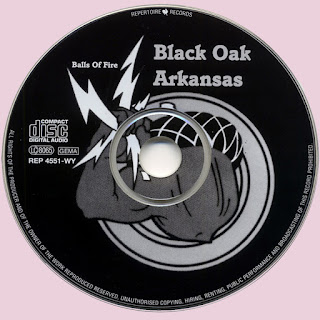
Black Oak Arkansas - Balls Of Fire (1976 us, fine hard southern boogie rock)
Black Oak Arkansas won a loyal and dedicated following for their good time music during the early Seventies. Although they enjoyed some album success, the American southern boogie band built its reputation on hard gigging, and constant touring. They offered a cheerful alternative to progressive rock and their music was rooted in American blues and gospel with a hint of hillbilly.
Certainly they had a strong personality up front. Jim 'Dandy' Mangrtim, their long haired lead singer, who danced around in a white fringed buckskin jacket, scraping furiously on a washboard. He also had a throaty voice that sounded like it had been burned dry with jugs of corn whisky. Jim remained a figure head for the band throughout its long career, even though it went through quite a few personnel changes. The original line up included Stanley 'Goober' Knight (lead & steel guitar, organ, vocals), Rickie 'Ricochet* Reynolds (12 string rhythm guitar, vocals), Pat 'Dirty' Daugherty (bass guitar, vocals), Harvey 'Burley' Jett (lead guitar, banjo, piano, vocals), and Wayne 'Squeezebox' Evans (drums). Together with Jim Dandy, they were featured on the band's eponymously titled debut album, released on Atco in 1971.
This included such down home titles as 'Uncle Lijiah', The Hills Of Arkansas', and 'When Electricity Came To Arkansas'. In case you hadn't guessed, the band came from the small town of Black Oak, Arkansas, where Jim Dandy was born on March 30, 1948. The rest of the band were born in nearby towns like Manilan, Jonesboro and Little Rock. As they grew up together, they formed a local gang that shared both a house, and strong musical ambitions. They got together a band called Knowbody Else, went to Los Angeles and recorded an album for the Stax label in 1969.
In 1971 they changed their name to Black Oak Arkansas, and signed to Atco. The debut album did quite well on the U.S. charts and gained them some attention in Europe. They went on to record some ten albums between 1971 and 1976, with 'High On The Hog', (1973) proving one of their most successful. This included a Top 30 hit song 'Jim Dandy', although it was actually sung by girl vocalist Ruby Starr, and not Mr. Mangrum. By the time the band recorded its third album If An Angel Came To See You, Would You Make Her Feel At Home? drummer Wayne Evans had been replaced by Tommy Aldridge, from Jackson, Mississippi.
Aldridge would become a much respected heavy rock drummer, who worked with Pat Travers, Gary Moore and Ozzy Osbourne. Aldridge first met Ozzy when Black Oak Arkansas made their first U.K. tour supporting Black Sabbath, in 1974. There was more changes within the band when guitarist Harvey Jett quit in 1975, to be replaced by Jimmy Henderson also from Jackson, Mississippi, who had previously been with the band Bloodrock.
The same year the band switched from Atco to MCA to record 'Ain't Life Grand followed by 'X-Rated' (1975). “Balls Of Fire” came in 1976 and armed with their new guitarist they kept up the Black Oak
tradition of playtng rock 'n' roll with fire and exuberance. Most of the tunes on the album now re-issued j on this CD, are Black Oak originals, although they cover Bob Seger's 'Ramblln' Gamblin" and offer a spirited version of the classic 'Great Balls Of Fire'. Out on the road, Black Oak added by Starr to the line up together with Hot Buttered Soul, a four girl vocal group, which introduced a black gospel sound.
The band later signed to Capricorn Records and recorded two more albums “Race With The Devil” (1977) and “I'd Rather Be Sailing” (1978). Only Jim Dandy now remained from the original line up. Jim kept the Black Oak name alive with different versions of the band on the road during the 1980's and in 1984 recorded a solo album 'Randy As Hell'. Further record success eluded the singer but at least Jim Dandy and heavy friends had succeeded in putting the name of Black Oak on the Rock 'n' Roll map of the world.
by Chris Welch, London 1995
Tracks
1. Ramblin' Gamblin' Man (Bob Seger) - 2:47
2. Fistful of Love - 3:19
3. Make That Scene - 2:17
4. I Can Feel Forever - 3:11
5. Rock 'N' Roll - 3:45
6. Great Balls of Fire (Otis Blackwell, Jack Hammer) - 2:26
7. Just to Fall in Love - 3:55
8. Leather Angel - 3:02
9. Storm of Passion - 4:36
10.All My Troubles - 3:55
All tracks written by Black Oak Arkansas except where noted.
Black Oak Arkansas
*Tommy Aldridge - Drums
*Jim "Dandy" Mangrum - Vocals
*Pat Daugherty - Bass
*James Henderson - Guitar
*Stan Knight - Guitar
Certainly they had a strong personality up front. Jim 'Dandy' Mangrtim, their long haired lead singer, who danced around in a white fringed buckskin jacket, scraping furiously on a washboard. He also had a throaty voice that sounded like it had been burned dry with jugs of corn whisky. Jim remained a figure head for the band throughout its long career, even though it went through quite a few personnel changes. The original line up included Stanley 'Goober' Knight (lead & steel guitar, organ, vocals), Rickie 'Ricochet* Reynolds (12 string rhythm guitar, vocals), Pat 'Dirty' Daugherty (bass guitar, vocals), Harvey 'Burley' Jett (lead guitar, banjo, piano, vocals), and Wayne 'Squeezebox' Evans (drums). Together with Jim Dandy, they were featured on the band's eponymously titled debut album, released on Atco in 1971.
This included such down home titles as 'Uncle Lijiah', The Hills Of Arkansas', and 'When Electricity Came To Arkansas'. In case you hadn't guessed, the band came from the small town of Black Oak, Arkansas, where Jim Dandy was born on March 30, 1948. The rest of the band were born in nearby towns like Manilan, Jonesboro and Little Rock. As they grew up together, they formed a local gang that shared both a house, and strong musical ambitions. They got together a band called Knowbody Else, went to Los Angeles and recorded an album for the Stax label in 1969.
In 1971 they changed their name to Black Oak Arkansas, and signed to Atco. The debut album did quite well on the U.S. charts and gained them some attention in Europe. They went on to record some ten albums between 1971 and 1976, with 'High On The Hog', (1973) proving one of their most successful. This included a Top 30 hit song 'Jim Dandy', although it was actually sung by girl vocalist Ruby Starr, and not Mr. Mangrum. By the time the band recorded its third album If An Angel Came To See You, Would You Make Her Feel At Home? drummer Wayne Evans had been replaced by Tommy Aldridge, from Jackson, Mississippi.
Aldridge would become a much respected heavy rock drummer, who worked with Pat Travers, Gary Moore and Ozzy Osbourne. Aldridge first met Ozzy when Black Oak Arkansas made their first U.K. tour supporting Black Sabbath, in 1974. There was more changes within the band when guitarist Harvey Jett quit in 1975, to be replaced by Jimmy Henderson also from Jackson, Mississippi, who had previously been with the band Bloodrock.
The same year the band switched from Atco to MCA to record 'Ain't Life Grand followed by 'X-Rated' (1975). “Balls Of Fire” came in 1976 and armed with their new guitarist they kept up the Black Oak
tradition of playtng rock 'n' roll with fire and exuberance. Most of the tunes on the album now re-issued j on this CD, are Black Oak originals, although they cover Bob Seger's 'Ramblln' Gamblin" and offer a spirited version of the classic 'Great Balls Of Fire'. Out on the road, Black Oak added by Starr to the line up together with Hot Buttered Soul, a four girl vocal group, which introduced a black gospel sound.
The band later signed to Capricorn Records and recorded two more albums “Race With The Devil” (1977) and “I'd Rather Be Sailing” (1978). Only Jim Dandy now remained from the original line up. Jim kept the Black Oak name alive with different versions of the band on the road during the 1980's and in 1984 recorded a solo album 'Randy As Hell'. Further record success eluded the singer but at least Jim Dandy and heavy friends had succeeded in putting the name of Black Oak on the Rock 'n' Roll map of the world.
by Chris Welch, London 1995
Tracks
1. Ramblin' Gamblin' Man (Bob Seger) - 2:47
2. Fistful of Love - 3:19
3. Make That Scene - 2:17
4. I Can Feel Forever - 3:11
5. Rock 'N' Roll - 3:45
6. Great Balls of Fire (Otis Blackwell, Jack Hammer) - 2:26
7. Just to Fall in Love - 3:55
8. Leather Angel - 3:02
9. Storm of Passion - 4:36
10.All My Troubles - 3:55
All tracks written by Black Oak Arkansas except where noted.
Black Oak Arkansas
*Tommy Aldridge - Drums
*Jim "Dandy" Mangrum - Vocals
*Pat Daugherty - Bass
*James Henderson - Guitar
*Stan Knight - Guitar
With
*Ruby Starr - Vocals
*Marius Penczner - Keyboards
Black Oak Arkansas selected discography:
1971 Black Oak Arkansas
1973 High On The Hog
Free Text
*Ruby Starr - Vocals
*Marius Penczner - Keyboards
Black Oak Arkansas selected discography:
1971 Black Oak Arkansas
1973 High On The Hog
Free Text
Thursday, February 16, 2012
Family - Music in a Doll's House/Family Entertainment (1967-69 uk, superb psychedelic jazzy experimental folk)
The non-LP single "Scene Through the Eye of a Lens" b/w "Gypsy Woman" not withstanding, Music in a Doll's House (1968) is the debut full-length release from the earliest incarnation of Family, featuring Roger Chapman (harmonica/tenor sax/vocals), Rick Grech (violin/ cello/bass guitar/vocals), Rob Townsend (percussion/drums), John "Charlie" Whitney (guitar/pedal steel guitar/keyboards), and Jim King (harmonica/keyboards/soprano sax/tenor sax/vocals).
Their highly original sound has often been compared to Traffic, which may be in part due to the production skills of Jimmy Miller and Dave Mason, the latter also contributing the organic and rootsy rocker "Never Like This." Additionally, neither band was overtly psychedelic or progressive, contrasting them from the other burgeoning combos such as Soft Machine, Pink Floyd, and Caravan. Family's deceptively involved arrangements are coupled with an equally unique blend of Chapman's commanding vocals driving through the jazz and folk-rooted tunes.
"The Chase" is a spirited opener that immediately establishes their unmistakable vibe, which is furthered on the sides "Old Songs for New Songs" and the aggressive rocker "Peace of Mind." The antithesis can be heard on the rural-flavored "Mellowing Grey" and "Winter," or perhaps the almost blatantly trippy "See Through Windows." In 1996, See for Miles issued Music in a Doll's House along with Family Entertainment (1969) on a double-disc anthology, including the previously mentioned pre-LP 7" "Scene Through the Eye of a Lens" b/w "Gypsy Woman," both of which have been released on compact disc for the first time here.
Family Entertainment followed on the heels of Family's Music in a Doll's House with the band's first incarnation. While not totally dismissing their psychedelic leanings, much of the material bears a stronger acoustic influence, in much the same manner as Fairport Convention and Traffic were also exploring. The jazzy sitar lead of "Face in the Cloud" and the even more prominent Eastern-flavored "Summer '67" somewhat date the affair, and are contrasted by the beautifully noir and trippy "How-Hi-the-Li" (which may have been the impetus for Chicago's "Wishing You Were Here") and the upbeat "Hung Up Down," sporting Grech's unmistakable violin as it wafts over the rural and slightly surreal lyrics.
These sides are set against the edgy "Weaver's Answer," which immediately establishes a broader spectrum of styles, most notably given Chapman's commanding if not slightly intimidating vocals. Whitney's blistering fretwork yields bite to the Grech-penned "Second Generation Woman," while "Emotions," another full-tilt rocker, is infused with an apparent R&B homage. Interested parties should note that Family Entertainment and Music in a Doll's House were issued in a double-disc package featuring a commendable 24-bit digital remastering rendering all other versions useless -- especially the early-'90s pressing on the German Line label.
Not only are both LPs included, but the 45s "Scene Through the Eye of a Lens" and "Gypsy Woman" are finally brought into the digital domain. The accompanying 40-page liner booklet is likewise a feast for the eyes.
by Lindsay Planer
Tracks
1968 Music in a Doll's House
1. Scene Through the Eye of a Lens - 2:52
2. Gypsy Woman - 3:30
3. The Chase - 2:13
4. Mellowing Grey - 2:48
5. Never Like This (D. Mason) - 2:18
6. Me My Friend - 2:00
7. Variation on a Theme of Hey Mr. Policeman - 0:23
8. Winter - 2:25
9. Old Songs for New Songs - 4:17
10.Variation on a Theme of the Breeze - 0:40
11.Hey Mr. Policeman - 3:13
12.See Through Windows - 3:43
13.Variation on a Theme of Me My Friend - 0:22
14.Peace of Mind - 2:22
15.Voyage - 3:35
16.The Breeze - 2:50
17.3 X Time - 3:48
1969 Family Entertainment
1. The Weaver's Answer - 4:56
2. Observations From a Hill - 3:11
3. Hung Up Down - 3:12
4. Summer '67 (Whitney) - 3:19
5. How-Hi-the-Li (Grech) - 4:56
6. Second Generation Woman (Grech) - 3:13
7. From Past Archives - 3:21
8. Dim - 2:31
9. Processions (Whitney) - 2:48
10. Face in the Cloud (Grech) - 2:53
11. Emotions (Chapman, Grech, Whitney) - 5:09
All compositions by John Whitney and Roger Chapman except where indicated.
Family
*Roger Chapman - Harmonica, Percussion, Tenor Sax, Vocals
*Rick Grech - Cello, Bass, Violin, Vocals
*Jim King - Harmonica, Piano, Soprano, Tenor Saxophone
*Rob Townsend - Drums, Percussion
*John "Charlie" Whitney - Guitar, Steel Guitar, Organ, Piano
Additional Musicians
*Dave Mason - Mellotron
*Nicky Hopkins - Piano
Free Text
Text Host
Wednesday, February 15, 2012
Bakery - Momento (1971 aussie / new zealand, remarkable guitar driving progressive rock)
Formed in Perth in 1970, this progressive rock outfit is generally regarded as one of the best of Australia’s early ‘70s underground bands. Bakery included ex-New Zealand Avengers’ rhythm section of Hank Davis (drums) and Eddie McDonald (bass) in their line-up, and their music blended hard rock and country with jazz, using complex arrangements.
Their main strength was the variety of their music that could switch from gentle acoustic passages to booming heavy progressive assaults on the senses within the same song. Momento, which was released in 1971 on Australia’s Astor label (ALPS 1035) was the group’s second album, following the bizarre Rock Mass For Love (ALPS 1032), a live recording captured in a church. Rock journalist Ian McFarlane, writing in Freedom Train magazine, described the album as a European-influenced recording full of sprawling, moody progressive rock cuts like Faith To Sing A Song, the jazzy Living With A Memory and Holocaust.
The track which really kills off any remaining brain cells isThe Gift, an eight-minute barrage of bombastic riffs written by guitarist Peter Walker, which also features some arse-kicking solos and swirling hammond organ in the vein of Deep Purple and Leafhound. For an underground band, Bakery actually achieved fairly reasonable success. Both their 45s were minor hits, and their Rock Mass For Love narrowly missed the Australian Top 20, and on the strength of this, was subsequently released by Decca in the US.
Their main strength was the variety of their music that could switch from gentle acoustic passages to booming heavy progressive assaults on the senses within the same song. Momento, which was released in 1971 on Australia’s Astor label (ALPS 1035) was the group’s second album, following the bizarre Rock Mass For Love (ALPS 1032), a live recording captured in a church. Rock journalist Ian McFarlane, writing in Freedom Train magazine, described the album as a European-influenced recording full of sprawling, moody progressive rock cuts like Faith To Sing A Song, the jazzy Living With A Memory and Holocaust.
The track which really kills off any remaining brain cells isThe Gift, an eight-minute barrage of bombastic riffs written by guitarist Peter Walker, which also features some arse-kicking solos and swirling hammond organ in the vein of Deep Purple and Leafhound. For an underground band, Bakery actually achieved fairly reasonable success. Both their 45s were minor hits, and their Rock Mass For Love narrowly missed the Australian Top 20, and on the strength of this, was subsequently released by Decca in the US.
1. Holocaust - 9:24
2. Pete For Jennie - 1:30
3. Living With A Memory - 8:52
4. S.S. Bounce - 4:19
5. The Gift - 7:59
6. When I'm Feeling - 2:19
7. Faith To Sing A Song - 7:25
Bakery
*Peter Walker - Guitars, Harp, Vocals
*Mark Verschuer - Vocals
*Eddie McDonald - Bass
*Rex Bullen - Organ, Piano, Vocals
*Hank Davis - Drums
Guest Musicians
*John Worrall - Vocals, Flute
*Bruce - Saxophone
Free Text
Just Paste
Tuesday, February 14, 2012
Morgan - The Sleeper Wakes (1973 uk, progressive rock with classical overtones, Angel Air issue)
Morgan was the band formed by keyboardist Morgan Fisher in 1971 from the ashes of Love Affair (who has had a #1 hit in 1968 with Everlasting Love). The intent was to explore new musical avenues, but it wasn't until they recruited Tim Staffell that the live-up was complete. Tim had previously been in a band called Smile, which featured Brian May and Roger Taylor. They, of course, would find world-wide fame with Queen, while Morgan would find fame with Mott The Hoople.
In the meantime, Tim ended up writing the lyrics while Morgan composed the music. Shunned in the UK, they ended up recording two albums for RCA in Italy and this is their second album, released on CD for the first time. This album was originally titled Brown Out - a technical term for a kind of power glitch.
Considering the success prog-rock bands such as King Crimson, Pink Floyd and yes enjoyed, I find it surprising Morgan were ignored in the UK, as the music is certainly in that mould. The tracks are lengthy, especially What Is - Is What, allowing the talents of each band member to be demonstrated. I'm tempted to say "Concept Album" (not a dirty word at the time), as tracks 2 and 3 are inspired by the Cyril M Kornbluth short story The Marching Morons, which tells of an apparently utopian society which, on closer examination, has made no progress at all
Musically, this album is far removed from both Mott and Queen - if you think Yes' Tales From Topographic Oceans you'd be close. There are distinct similarities between Staffell's and Jon Anderson's styles, and between Fisher's and Rick Wakeman's. Musically complex (some would say 'inaccessible'), I find it strangely compelling. Yes, this is a CD I will be returing to when the mood suits.
Fisher's playing complements the songs very well without ever being intrusive. His use of the then-new VCS3 synthesiser is clever, showing his ability to utilise the latest technology to achieve the sound he wanted.
Angel Air CDs are always well-packaged, and this CD comes with a 12-page booklet, with lyrics, track notes and band history written by Morgan. There's a hilarious tale of the band's own interpretation of the title Brown Out which unwisely they saved for the album photo-shoot, eventually resulting in their untimely demise.
Hunter-Mott-com
Tracks
1. Fire In The Head - 5:01
2. The Sleeper Wakes - 6:07
3. The Right - 9:38
4. What Is - Is What - 19:56
Music by Morgan Fisher, lyrics by Tim Staffell.
Musicians
*Morgan Fisher - Keyboards
*Tim Staffell - Vocals, Acoustic Guitar
*Bob Sapsed - Fretless Bass
*Maurice Bacon - Drums, Percussion
1972 Morgan - Nova Solis (2009 remaster)
Free Text
Just Paste
Roland Kovac New Set - The Master Said (1971 austria/swiss/germany, great prog jazz rock with experimental mood and space rock shades, 2002 remaster)
Roland Kovac New Set was the name of a Munich group of studio musicians who recorded several LPs of instrumental music on the Selected Sound label from Hamburg. The second and third of these LPs, "The master said" (Selected Sound 9028) of 1971 and "Love that" (Selected Sound 9030) of 1972, full of playful guitar riffs and complex in structure, are representative of good progressive rock of the early seventies.
The name Roland Kovac New Set might suggest the previous existence of a Roland Kovac Set, but this is not the case as the band, for unknown reasons, started right away as New Set. The line-up on "The master said" features top musicians: Roland Kovac himself (born in Vienna on November 7th, 1927), whose mother was a concert pianist in a family of well-known musicians, joined The Vienna Choir Boys in the 1930s, a sign of musical excellence considering the fact that at the time only one applicant of up to twenty highly gifted talents was selected.
In the course of time he worked with Wilhelm Furtwangler and Otto Klemperer and received a doctorate in music in 1952 with a paper on "Harmonik in der Musik des Spatbarock" (Harmonies in the music of the late barock). He was a renowned composer of numerous classical works and soundtracks for films. In the early 1970s he lived in Munich where he recorded the present LP playing keyboards. He also contributed to countless other LPs on the same label, mostly under another name.
As a good friend of owner Peter Majewski, he played an important role in establishing the Selected Sound label. By the way, his name Kovac (blacksmith) is of Slovenian origin, which means that the final "c" is pronounced as in "chatter". His very melodic speech gives evidence of how much he is rooted and living in music. Guitarist Siegfried "Sigi" Schwab, of course, is a world-famous musician, especially in the fields of jazz and new-age. As a member of The Vampires' Sound Incorporation ("Psychedelic dance party"), of Wolfgang Dauners Et Cetera and of Embryo, he was at the beginning of his career. Swiss jazz drummer Charly Antolini, on the other hand, had already released his first records in the mid-1960s.
His probably most famous work is the LP "Knock out" (D 1980: Jeton 100.3304 - as CD: D 1988: Jeton 112), the final blow to many loudspeakers. He is still a top musician today and, together with Sigi Schwab, responsible for the jazzy touch on the LP. Bass player Franz Loffler, who died in the 1970s, is probably the least known of these musicians, but he had already recorded several LPs featuring guitar music in the 1960s and was a master of his craft. It would be impossible to list all the releases of these musicians in this booklet. In 1971, these four masters recorded "The master said" in the Munich Trixi Studios, produced by Willy Schmidt.
All titles are written by master Kovac himself except for "David's dance", composed by Pietro Leguani. Although no detailed information is available today, the LP must have had a circulation of 1000 to 2000 copies, a large number of which was sent to radio stations all over the world, where the record was played frequently, mostly as background music. This was its original purpose, which is why the cover is characterised by uniform simplicity, with black writing against a copper-metallic glossy background.
The music of this LP was used in many films and also sold in the retail trade, but that was secondary. The record was pressed by RPM in Hamburg. ALCO Records, also from Hamburg, were responsible for distribution in Germany, with Brull Records, whose stickers were fixed to the label and the back cover, handling Great Britain. Publishing rights have always been with Maya Music, owned by Roland Kovac himself. Some tracks of "The master said" and "Love that" have subsequently been included in LP and CD compilations but the albums have never been released again as a unit.
M. Thurn
Tracks
1. The Master Said - 17:32
2. Birth Of A Saint - 10:37
3. Eternal Dimension - 3:03
4. David's Dance (Pietro Leguani) - 3:29
All compositions by Roland Kovac, except where indicated.
Musicians
*Roland Kovac - Keyboards
*Siegfried "Sigi" Schwab - Guitar
*Charliy Antolini - Drums
*Franz Loffler - Bass
The name Roland Kovac New Set might suggest the previous existence of a Roland Kovac Set, but this is not the case as the band, for unknown reasons, started right away as New Set. The line-up on "The master said" features top musicians: Roland Kovac himself (born in Vienna on November 7th, 1927), whose mother was a concert pianist in a family of well-known musicians, joined The Vienna Choir Boys in the 1930s, a sign of musical excellence considering the fact that at the time only one applicant of up to twenty highly gifted talents was selected.
In the course of time he worked with Wilhelm Furtwangler and Otto Klemperer and received a doctorate in music in 1952 with a paper on "Harmonik in der Musik des Spatbarock" (Harmonies in the music of the late barock). He was a renowned composer of numerous classical works and soundtracks for films. In the early 1970s he lived in Munich where he recorded the present LP playing keyboards. He also contributed to countless other LPs on the same label, mostly under another name.
As a good friend of owner Peter Majewski, he played an important role in establishing the Selected Sound label. By the way, his name Kovac (blacksmith) is of Slovenian origin, which means that the final "c" is pronounced as in "chatter". His very melodic speech gives evidence of how much he is rooted and living in music. Guitarist Siegfried "Sigi" Schwab, of course, is a world-famous musician, especially in the fields of jazz and new-age. As a member of The Vampires' Sound Incorporation ("Psychedelic dance party"), of Wolfgang Dauners Et Cetera and of Embryo, he was at the beginning of his career. Swiss jazz drummer Charly Antolini, on the other hand, had already released his first records in the mid-1960s.
His probably most famous work is the LP "Knock out" (D 1980: Jeton 100.3304 - as CD: D 1988: Jeton 112), the final blow to many loudspeakers. He is still a top musician today and, together with Sigi Schwab, responsible for the jazzy touch on the LP. Bass player Franz Loffler, who died in the 1970s, is probably the least known of these musicians, but he had already recorded several LPs featuring guitar music in the 1960s and was a master of his craft. It would be impossible to list all the releases of these musicians in this booklet. In 1971, these four masters recorded "The master said" in the Munich Trixi Studios, produced by Willy Schmidt.
All titles are written by master Kovac himself except for "David's dance", composed by Pietro Leguani. Although no detailed information is available today, the LP must have had a circulation of 1000 to 2000 copies, a large number of which was sent to radio stations all over the world, where the record was played frequently, mostly as background music. This was its original purpose, which is why the cover is characterised by uniform simplicity, with black writing against a copper-metallic glossy background.
The music of this LP was used in many films and also sold in the retail trade, but that was secondary. The record was pressed by RPM in Hamburg. ALCO Records, also from Hamburg, were responsible for distribution in Germany, with Brull Records, whose stickers were fixed to the label and the back cover, handling Great Britain. Publishing rights have always been with Maya Music, owned by Roland Kovac himself. Some tracks of "The master said" and "Love that" have subsequently been included in LP and CD compilations but the albums have never been released again as a unit.
M. Thurn
1. The Master Said - 17:32
2. Birth Of A Saint - 10:37
3. Eternal Dimension - 3:03
4. David's Dance (Pietro Leguani) - 3:29
All compositions by Roland Kovac, except where indicated.
Musicians
*Roland Kovac - Keyboards
*Siegfried "Sigi" Schwab - Guitar
*Charliy Antolini - Drums
*Franz Loffler - Bass
Monday, February 13, 2012
Morgan - Nova Solis (1972 uk, incredible progressive rock with glam and space rock touches, 2009 remaster)
This 1972 release is very obscure, even amongst proggers, and I am not quite sure why - this stuff is amazing. The musicians on this album are incredible and include bandleader Morgan Fisher (VCS3, Hammond organ, acoustic piano, and mellotron), Bob Sapsed (fretless bass), Maurice Bacon (drums/percussion), and Tim Staffell (vocals, acoustic/electric guitars).
The performances are excellent and there is some fairly intricate ensemble work - just the type of thing that one would expect from high quality English prog. Tim Staffell has a very good and high pitched voice that is occasionally altered by running his voice through the VCS3 synthesizer. The four tracks on the album range in length from 5'17" (Tim Staffell's haunting piece Alone), to the mammoth, 20'17" suite and prog extravaganza Nova Solis. Morgan is an excellent composer and arranger, and all of the tracks flow along nicely.
Melodies and harmonies are also highly developed and dynamic contrasts are used effectively. I guess it's worth noting that sections of Jupiter from Gustav Holst's Planets were worked into the Nova Solis suite only after lengthy negotiations with Imogen Holst (his daughter). Although Morgan is an incredible keyboardist, I have to single out Bob Sapsed. He is an excellent player, thoroughly contrapuntal, and the tone and texture of his fretless bass (he uses glissandos very well) adds great depth to this music.
The album was recorded at the then "state of the art" RCA recording studios in Rome, Italy and the sound quality is excellent. There are abundant and recent commentaries from Morgan both in a general sense and in track by track comments. The lyrics have also been reproduced and there are several photos of the band taken during the recording process (with some pretty funny captions). This is an unfairly neglected prog rock album that is simply excellent and very highly recommended.
by Jeffrey J. Park
Tracks
1. Samarkhand The Golden - 8:05
2. Alone - 5:20
3. War Games - 7:05
4. Nova Solis - 20:24
Music by Morgan Fisher, lyrics by Tim Staffell.
Musicians
*Morgan Fisher - Keyboards
*Tim Staffell - Vocals, Acoustic Guitar
*Bob Sapsed - Fretless Bass
*Maurice Bacon - Drums, Percussion
1973 Morgan - The Sleeper Wakes
Free Text
Just Paste
Sunday, February 12, 2012
Frank Marino And Mahogany Rush - Live (1978 canada, fine guitar hard blues rock, 2017 xpanded and remaster)
Frank Marino was born in Canada in 1954. He began playing guitar at the age of 13 after having played drums for three years. Very soon after changing instruments, Marino had formed his band Mahogany Rush. By 1971, three years later, the group had developed quite a following. At the age of 17, his first album, MAXOOM, was released and the group quickly started generating a larger and larger following and more albums. In all, by the year 2001, Marino had released 11 albums with Mahogany Rush. He also did two solo albums, 1986's Full Circle, and From the Hip, which came out in 1991. Adding to his credits are also appearances on recordings by April Wine and Brian Lee.
by Gary Hill
Mahogany Rush wasn't as huge a name in 1970s, but the power trio commanded a loyal, good-sized following and provided its share of five-star albums. One of them is this live album, which was recorded during a U.S. tour in late 1977 and came out on vinyl the following year. Mahogany knew how to burn on stage, and this excellent LP really captures the vitality of its 1970s concerts. No one who is seriously into hard rock and metal should be deprived of hearing singer/guitarist Frank Marino let loose on live versions of "Dragonfly," "Electric Reflections of War," and "The Answer." The band is equally captivating on sweaty performances of Jimi Hendrix's "Purple Haze," Chuck Berry's "Johnny B. Goode," and Muddy Waters' "I'm a King Bee."
Some fans were disappointed because Live is a single LP instead of a two-LP set -- many of the gems that Mahogany performed on-stage in 1977 were omitted. The band cites space limitations as the reason, although one suspects that licensing restrictions had something to do with what was and wasn't included. The 1978 "Live" of Mahogany Rush, it is consistently rewarding and is enthusiastically.
by Alex HendersonTracks
1. Introduction - 0:28
2. The Answer - 5:01
3. Dragonfly - 5:27
4. I'm a King Bee (Slim Harpo) - 5:58
5. Excerpt from "Back Door Man" (Willie Dixon) - 2:56
6. A New Rock 'n' Roll - 4:19
7. Johnny B. Goode (Chuck Berry) - 5:16
8. Talkin' 'Bout a Feelin' - 3:58
9. Excerpt from "Who Do Ya Love" (Ellas McDaniel) - 1:32
10.Electric Reflections of War - 3:04
11.The World Anthem - 3:38
12.Purple Haze (Jimi Hendrix) - 4:01
Songs 2,3,6,8,10,11 written by Frank Marino
2017 Bonus Tracks ecorded live in California; 1978
13.I'm A King Bee (Slim Harpo) - 6:43
14.Johnny B. Goode (Chuck Berry) - 8:19
Musicians
*Jimmy Ayoub - Drums, Percussion
*Paul Harwood - Bass
*Frank Marino - Guitar, Vocals
Just Paste
Free Text
Text Host
John Cale And Terry Riley - Church Of Anthrax (1971 uk, great avantgarde experimental art rock, Wounded Bird issue)
Leaving the Velvet Underground after being a major force on their first two seminal albums, Welsh multi-instrumentalist John Cale forged a collaborative relationship with the band's sometime-frontwoman Nico, resulting in two of her keystone albums, The Marble Index and Desertshore. In 1970, Cale launched his own solo career on Columbia Records with a collection of art-pop songs entitled Vintage Violence. His next for Columbia would be this collaborative album, enlisting master loopist Terry Riley, who was on the roster of Columbia's parent, CBS records.
Many years ago, I once talked with Terry Riley after one of his shows. In our conversation, I mentioned "the album with John Cale," in a sly attempt to elicit some recollections or impressions. His response: "Yes! Church of Anthrax! [half-mirthful, half-exasperated laughter]" That was all.
Despite this inscrutable reaction, Church of Anthrax is a fairly straightforward meeting of the two artists' worlds. The extended instrumentals are easily the best thing about this one. The title track, my own personal favorite, starts off like a jam in the tradition of the VU, with Cale's gruff bass lines prominent in the mix. Over this base, Riley enters with some funky, psychedelic organ that after about a minute and a half, starts going into conniptions, notes jittering like marbles spilling out on a floor every which way. As the piece builds, sax enters flirting with the organ lines and everything gets looser and looser.
The drum work, by the way, adds quite a bit to this track with a jazzy energy and blending with Riley's organ spasms. Another great piece, "The Hall of Mirrors in the Palace at Versailles" places Cale behind the keys, pounding out block chords on piano. To this Riley adds spacey, trilly sax in the A Rainbow in Curved Air vein, one track in each channel, giving the impression of a ritual call between two animals.
Finally, "Ides of March" is a good though somewhat overlong jam split-channeling the duo's keyboard styles. Riley plays treated piano in the left speaker, flittering obsessively and polyrhythmically among certain note cycles. Cale again plonks out alongside this with rhythm piano in the right speaker. Each channel is backed by separate drumming. Written by Cale alone, "The Soul of Patrick Lee" interestingly features an outside vocalist, although the song has Cale's sound stamped all over it in the lyrics and melody, so that you can easily envision him singing it. It's clearly placed in that era of his songwriting, sounding like a decent holdover from Vintage Violence, and also holding the lantern up to Paris 1919.
This strikes me as a pretty interesting pairing of two fellow avant-garders with two quite different personas: Riley, the convivial cosmic explorer of Eastern music; and Cale, the moody mercenary of violence-in-sound. While probably not the best from either artist, it's good for what it is: two legends at work and fairly early in their careers, too.
by Joe McGlinchey
Tracks
1. Church Of Anthrax - 9:05
2. The Hall Of Mirrors In The Palace At Versailles - 7:59
3. The Soul Of Patrick Lee (John Cale) - 2:49
4. Ides Of March - 11:03
5. The Protege - 2:52
All tracks by John Cale and Terry Riley, except where noted.
Musicians
*John Cale - Keyboards, Bass Guitar, Harpsichord, Piano, Guitar, Viola, Organ
*Terry Riley - Piano, Organ, Soprano Saxophone
*Adam Miller - Vocals On "The Soul Of Patrick Lee"
*Bobby Colomby - Drums
*Bobby Gregg - Drums
More John Cale work here:
Saturday, February 11, 2012
Thursday, February 9, 2012
B.F.Trike - B.F.Trike (1971 us, superb heavy garage psych)
B.F. Trike formed when three members of late 60’s psyche band Hickory Wind decamped to Nashville in 1971 and started work on an album for RCA Records. Eschewing the psychedelic style of their previous band the trio turned up the fuzz guitar and produced ten tracks of great heavy rock.
The tapes were then shelved for eighteen years until Rockadelic issued them in 1989 in a limited edition of 100 vinyl copies as well as on CD. The vinyl is now long gone and fetches astronomical sums at auction, so if you want to hear the album then you will have to go for the CD. The question is, therefore, is it worth it. Well, in this case it might well be, as the songs are catchy, well played and sung, they have great fuzz guitar solos, the rhythm section is restrained where it needs to be and upfront on the heavy rockers, and the whole album hangs together extremely well.
It opens with a re-recording of one of their Hickory Wind songs ‘Time And Changes’, done in a much heavier style and with some fine guitar-work. ‘For Sale Or Lease’ is slightly slower, but still as heavy, with a crisper guitar sound and some good riffing. ‘Lovely Lady’ is a mixture of commercial hook overlaid with stunning fuzz guitar, making it catchy and accessible while at the same time raw and powerful. ‘Sunshine’ lets you catch your breath after the onslaught of ‘Lovely Lady’, being an upbeat acoustic number, while ‘Bench Of Wood’ has a distinct Hawkwind feel to the vocals and heavy riffing.
They keep the style for ‘Six O’Clock Sleeper’ and manage to pull it off by giving it more of a groove and throwing in some nifty guitar-work. ‘Magic Makin Music Man’ is another one of their catchy heavy rockers, and the album ends with ‘Be Free’, which combines the ubiquitous fuzz guitar with some inventive percussion and a staccato chorus which lifts it above the average.
Why RCA refused to issue this at the time Heaven knows, but be thankful that we can hear it now.
PeterJolly
Tracks
1. Time And Changes - 2:44
2. For Sale Or Lease - 3:03
3. Wait And See - 2:38
4. Lovely Lady - 3:08
5. Sunshine - 4:51
6. Bench Of Wood - 3:31
7. Three Piece Music - 2:39
8. 6 O'Clock Sleeper - 4:15
9. Magic Makin' Music Man - 2:13
10. Be Free - 3:42
B.F.Trike
*Bobby Strehl - Vocals, Drums
*Mike McGuyer - Vocals, Guitar
*Alan Jones - Bass
Free Text
Text Host
Tuesday, February 7, 2012
Giles Giles And Fripp - The Cheerful Insanity (1968 uk, inspired music, pre-King Crimson, japan SHM-CD remaster, 2010 edition with bonus tracks)
This pre-King Crimson aggregate involves the talents of Michael Giles (drums/vocals), Peter Giles (bass/vocals), and Robert Fripp (guitar/vocals) accompanied by a plethora of studio musicians -- most notably keyboardist Nicky Hopkins and backing vocalists the Breakaways. By any standards The Cheerful Insanity of Giles, Giles & Fripp is one of the more eclectic albums to have been issued during the psychedelic rock movement of the late '60s.
The album was initially issued in September of 1968 on the Decca Records subsidiary Deram -- whose releases were aimed specifically at the alternative or progressive rock market. That said, this disc is a far cry from the type of material that other artists on the label such as the Moody Blues, Caravan, or Pacific Drift were concurrently issuing.
The original record album was divided into two sections: "The Saga of Rodney Toady" and "Just George," which were named after the respective spoken word pieces that link the musical works on the A- and B-sides. Musically, Giles, Giles & Fripp are wholly unlike anything before or since. Drawing upon folk, classical, pop, and even sacred music, each track brings a fresh listening experience. Among the highlights is the leadoff track, "North Meadow," which features some stunning fretwork from Fripp. Likewise, "Call Tomorrow" is a trippy noir tale involving an ambiguous practical joke.
The classically influenced instrumental "Suite No. 1," as well as another one of Fripp's more esoteric compositions, "Erudite Eyes," likewise bear some semblance of sounds to come from the trio. While not everyone's cup of tea, there is a tremendous amount to enjoy on The Cheerful Insanity of Giles, Giles & Fripp for those whose expectations are not of King Crimson, but rather of lighthearted and decidedly folksy English tales.
Parties interested in this disc should likewise be advised of The Brondesbury Tapes, which is a collection of semiprofessional demos made by this trio and original Fairport Convention vocalist Judy Dyble (vocals) and soon-to-be King Crimson member Ian McDonald (flute/sax).
by Lindsay Planer
Tracks
1. The Saga Of Rodney Toady: North Meadow (P. Giles) - 2:59
2. The Saga Of Rodney Toady: Newly-Weds (P. Giles) - 2:33
3. The Saga Of Rodney Toady: One Ina Million (M. Giles) - 2:43
4. The Saga Of Rodney Toady: Call Tomorrow (P. Giles) - 2:57
5. The Saga Of Rodney Toady: Digging My Lawn (P. Giles) - 2:05
6. The Saga Of Rodney Toady: Littlechildren (R. Fripp) - 2:49
7. The Saga Of Rodney Toady: The Crukster (M. Giles) - 1:35
8. The Saga Of Rodney Toady: Thursday Morning (M. Giles) - 2:51
9. Just George: How Do They Known (M. Giles) - 2:26
10.Just George: Elephant Song (M. Giles) - 3:25
11.Just George: The Sun Is Shinging (M. Giles) - 3:19
12.Just George: Suite No. 1 (R. Fripp) - 5:46
13.Just George: Erudite Eyes (R. Fripp) - 5:06
14.She Is Loaded (P. Giles) - 3:12
15.Thursday Morning (Stereo Single Version) (M. Giles) - 2:54
16.Under The Sky (R. Fripp) - 3:59
17.One In A Million (Mono Single Version) (M. Giles) - 2:27
18.Newly-Weds (Single Version) (P. Giles) - 2:45
19.Thursday Morning (Stereo Single Version) (M. Giles) - 2:51
20.She Is Loaded (P. Giles) - 3:18
21.Just George, Pt. 2 (M. Giles) - 0:10
22.Just George, Pt. 3 (M. Giles) - 0:13
23.Just George, Pt. 4 (M. Giles) - 0:13
24.Under the Sky (R. Fripp) - 4:03
25.One in a Million (Mono Single Version) (M. Giles) - 2:30
26.Newly-Weds (Mono Single Version) (P. Giles) - 2:51
27.Thursday Morning (Mono Single Version) (M. Giles) - 3:02
28.Thursday Morning (Stereo Single Version) (M. Giles) - 2:53
Giles, Giles And Fripp
* Robert Fripp - Guitars
* Peter Giles - Bass
* Michael Giles - Drums, Percussion
Guest Musicians
* Ted Barker, Cliff Hardy - Trombone
* R. Cohen, G. Fields, K. Isaccs, B. Pecker, W. Reid, G. Salisbury - Violin
* John Coulling, Rebecca Patten - Viola
* A. Ford, Charles Tunnell - Cello
* Ivor Raymonde - String Arrangements
* The Breakaways - Backing Vocals
* Mike Hill, Nicky Hopkins - Keyboards
Free Text
Text Bin
Monday, February 6, 2012
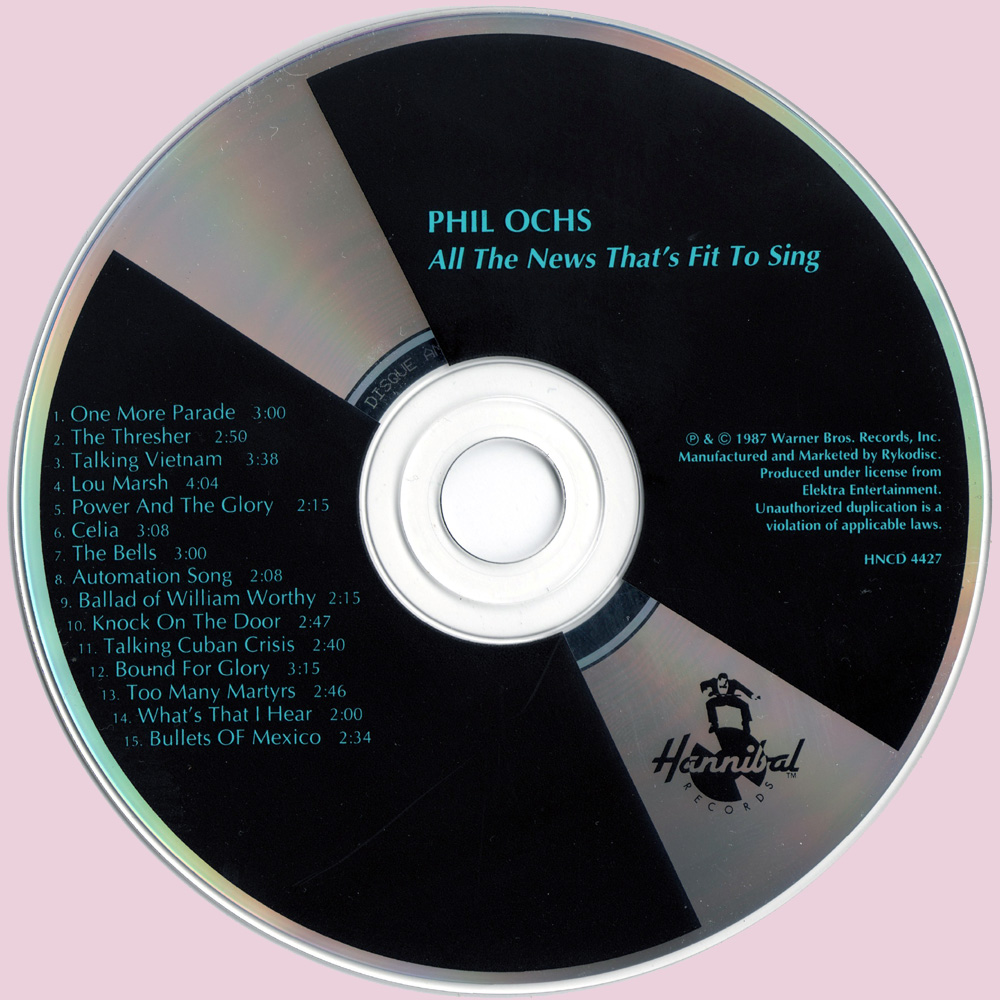
Phil Ochs - All The News That's Fit To Sing (1964 us, innovative protest folk)
All the News That's Fit to Sing was a fit title for the debut album by a 1960s folk protest singer who some liked to call a "singing journalist." Recorded and released in early 1964, it was done at a time when Ochs's generation of young adults was getting more socially conscious and politicized. The Cold War had almost brought the world to the brink of nuclear war in the Cuban missile crisis, the Civil Rights Movement was heating up, and American military intervention in Vietnam was starting to rise from a grumble to a roar. Ochs addressed all these subjects and more on his first LP, which immediately established him as one of the foremost authors of topical song in American folk music.
Although this was Ochs's first album, it was not the first time he had recorded. Around late 1963, he had cut a song, "The Ballad of William Worthy" (also done for his debut album shortly afterward), for the Broadside Ballads Vol. 1 compilation, which is most famous for including tracks by Bob Dylan that were credited to the pseudonym of Blind Boy Grunt. It's also been reported that Phil sings on the Campers' rare Cameo-Parkway LP Camp Favorites, a collection of -- as if you couldn't tell from the title -- campfire folk songs, released in 1962 or 1963. A couple songs that Ochs performed at the 1963 Newport Folk Festival were recorded, although these did not appear until the following year on the Newport Broadside compilation.
There were other recordings dating roughly from the era of the first album sessions, though the exact dates haven't been pinpointed. Producer Elliot Mazer recalls doing an unreleased demo with Phil for Cameo-Parkway around 1964, and the 1980s compilation A Toast to Those Are Gone presented previously unissued early demos, most or all of which sound as if they come from Ochs's very early career. Five tracks (including an early version of one of his most famous compositions, "There But For Fortune") landed on the 1964 Vanguard compilation New Folks, a couple of outtakes from those sessions surfacing on a 2000 CD anthology.
Several dozen of his compositions had already appeared in the influential folk magazine Broadside prior to All the News That's Fit to Sing, and the singer informally taped dozens of songs for the publication in his early days in New York, a good many of these recordings finding release after the 1960s. Too, his songs were already starting to get covered by other artists, the Modern Folk Quartet interpreting Phil's adaptation of Edgar Allan Poe's "The Bells," and the Four Seasons doing an unlikely version of "New Town" (which Ochs never put out himself) on their folk album Born to Wander in early 1964.
It's probably never going to be known exactly how much Ochs had recorded before cutting All the News That's Fit to Sing for Elektra in February 1964. What the existence of all this early stuff makes clear, however, is that Ochs was already a prolific songwriter, with way too much material to fit onto a single LP. It also seems that, although he apparently at least skirted the wavelength of several different record labels, there was no serious rival for his services when he signed with Elektra around the end of 1963, after A&R man Paul Rothchild saw him playing live at the Gaslight in Greenwich Village. Rothchild would be credited as "recording director" on the album, with Elektra founder and president Jac Holzman acting as "production supervisor."
The Beatles had just invaded America around the time the album was recorded, and it was way too soon for recorded folk music to feel the effect of the British Invasion. Accordingly, All the News That's Fit to Sing was, like a great many folk albums of its times by both new and established artists, recorded with nothing but acoustic guitar as accompaniment. "He was a topical singer," explains Holzman today. "The more uncluttered you present a topical song, the better it is, I think. So [the production] was something that we discussed for about a minute and a half. We just went and recorded 'em, pretty much the way he would have performed 'em at a club."
Elektra did, however, enlist the services of a second guitarist, Danny Kalb, who'd become most known for his subsequent stint in the rock band the Blues Project. Kalb had more recording experience prior to the Blues Project than many realize, however, playing on folk recordings by Judy Collins, the New Strangers, the Folk Stringers, and the True Endeavor Jug Band, and also contributing a couple of tracks to the 1964 Elektra compilation LP The Blues Project under his own name.
Contributing in a non-musical capacity were friends and Broadside editors Agnes "Sis" Cunningham and Gordon Friesen, who wrote the liner notes (Cunningham penning the principal essay and Friesen offering detailed comments on each track). "We've printed about 30 or 40 Ochs songs," Cunningham remarked, "and probably have as many others scattered around simply because we haven't had the room for them or the manpower even to prepare them for the mimeograph machine."
Not much more than a dozen such songs could fit onto one LP, however, and likely Ochs and Elektra zeroed in on the stronger ones in his young repertoire. While very specific issue-driven compositions (particularly on "Talking Vietnam" and "Talking Cuban Crisis") were present, Ochs was already branching out into more general observations and critiques of military force ("One More Parade") and injustice ("Too Many Martyrs"), both of them written in collaboration with veteran Elektra folkie Bob Gibson. Another highlight was Phil's musical adaptation of the classic Edgar Allan Poe poem "The Bells," perhaps as an early indicator of his future explorations into poetic expression not tied to current events.
All of the other selections were penned by Ochs alone, including "Power and the Glory," which he likely considered among the more enduring of his early works, as he recorded an updated version a decade later for a 1974 single. Arguably the finest of the tunes was "Bound for Glory," a Woody Guthrie tribute that again proved that Phil's horizons were broader than what could be read in the day's newspapers.
by Richie Unterberger
Tracks
1. One More Parade (P. Ochs, B. Gibson) - 3:00
2. The Thresher - 2:50
3. Talkin' Vietnam - 3:38
4. Lou Marsh - 4:04
5. Power And The Glory - 2:15
6. Celia - 3:08
7. The Bells (E. A. Poe, With Musical Adaptation By P. Ochs) - 3:00
8. Automation Song - 2:08
9. Ballad Of William Worthy - 2:15
10.Knock On The Door - 2:47
11.Talkin' Cuban Crisis - 2:40
12.Bound For Glory - 3:15
13.Too Many Martyrs (Ochs, Gibson) - 2:46
14.What's That I Hear - 2:00
15.Bullets Of Mexico - 2:34
Words and Music by Phil Ochs except where noted.
Musicians
*Phil Ochs - First Guitar, Vocals
*Danny Kalb - Second Guitar
*John Sebastian - Harmonica On "Bound For Glory"
Free Text
Just Paste
Sunday, February 5, 2012
Thirsty Moon - You'll Never Come Back (1973 germany, spectacular prog jazz krautrock, 2006 bonus track remaster)
Thirsty Moon uses the elements of jazz as a means of spontaneous expression and melts them together with the aggressiveness and rhythm of rock. They play only their own compositions, connecting voices with instrumental parts and utilizing all electronic possibilities. In spite of all their variety Thirsty Moon has a remarkable sound. Every member of the group knows his instrument perfectly. Everyone is a individualist who adds characteristic features to the group. The basis of the music is the precise playing together of the bass and drums and the Afro sounds of the four congas which connects the hard beat with the Latin American rhythms. The electric piano and the guitar combine to form another important element to the sound.
The saxophonist is an experienced jazz musician who gives the group the exquisite spontaneity of jazz. Unlike many German groups, Thirsty Moon’s lyrics are an essential part of their sound. They reflect the impulses of their surroundings. Thirsty Moon is not a typical German group and they do not want to be one. The texts are English. The musical influences are from various cultures in the music world.
Thirsty Moon do not follow any particular trend and they do not wish to be commercial. Thirsty Moon has a sort of ultimate versatility which does not rely on overused, accepted riffs and styles. Their versatility, on the contrary, comes from a whole array of lines which have not even been used yet! “Yellow Sunshine” has pieces that are so completely phased that the listener cannot tell what instruments are playing the phased lines. “Trash Man” has horn parts resembling The Grand Wazoo in perfection and complexity, but the horns overlay Santana-like rhythms instead of the “old-timey” jazz tones of Zappa’s recording.
This is not to say that Thirsty Moon has the traditional copied sounds of the successful groups. Nobody sounds like Thirsty Moon. No other band has so completely captured the elusive phenomena inherent in acid rock and placed it so effectively in a jazz-rock format. Thirsty Moon’s sound is a mirror ball of images surrounding the listener.
Translation: Dr. Martina Häusler (originally taken from Skylab review)
Tracks
1. I See You - 7:18
2. Trash Man - 14:27
3. Tune In - 5:00
4. You'll Never Come Back - 12:34
5. Das Fest Der Volker - 5:05
6. Music (Bonus Track) - 12:00
Words and Music by Thirsty Moon
Thirsty Moon
*Jurgen Drogies - Guitar, Percussion
*Norbert Drogies- Drums
*Michael Kobs - Keyboards
*Harald Konietzko - Bass, Acoustic Guitar, Vocals
*Erwin Noack - Percussion
*Willi Pape - Woodwinds
1972 Thirsty Moon - Thirsty Moon
Free Text
the Free Text
Saturday, February 4, 2012
Thirsty Moon - Thirsty Moon (1972 germany, outstanding progressive jazz, krautrock)
Thirsty Moon were one of the many German jazz-rock progressive groups in the early '70s that put their own unique spin to their fusion-based music, especially on their first two records, which are rightly considered classics in the Krautrock genre. Thirsty Moon was created in Bremen, in northern Germany, in the summer of 1971 when several groups merged. One of these was the Drogies Rock Project, more commonly known as DRP, fronted by two brothers, drummer Norbert Drogies and guitarist Jurgen Drogies.
They brought with them DRP organist Hans Wener Ranwig, and joined up with Harald Konietzko from the group Tomorrow Too, and Michael Kobs, Willi Pape, and Erwin Noack from the jazz-soul band the Shakespeares, to form the seven-piece Thirsty Moon. Inspired by the brass rock of Chicago, the early fusion of Emergency, and early, jazzy Krautrock like Xhol Caravan, Kollektiv, and Organisation, Thirsty Moon threw everything from horns to congas into their blend of jazz, progressive, and psychedelic music.
At the time, the Brain label was signing progressive rock bands with a jazzy edge, and in 1972 Brain released Thirsty Moon's self-titled debut, which showcased the band's eccentric song structures and highly original sound. Ranwig left the band sometime after the record came out, and was replaced by Siegfried Pisalla, Konietzko's former bandmate in Tomorrow Too, and in July of 1973 this group went into the studio to record their second LP. You'll Never Come Back, released by Brain later that year, was as creative and dynamic as the first record. By 1975, everyone except the Norbert and Jurgen Drogies had left the group.
Their third record, Blitz, released by Brain in 1976, was an all-instrumental album, a bit more lightweight and conventional than the earlier material. Coming out the next year, the LP Real Good Time, quite frankly, was not that much of a good time, as the brothers and a bunch of new recruits churned out conventional pop music. Thirsty Moon broke up at this point, but at the beginning of the '80s, after Brain released the compilation Yellow Sunshine with tracks taken from the first four albums, the brothers re-formed the group with original member Ranwig, as well Junior Weerasingle from the Real Good Time sessions on drums.
The album Starchaser, recorded and released by the Sky label in 1981, saw the group falling flat on their faces with a synthy disco record that had both fans and critics shaking their heads with dismay. Thirsty Moon called it quits again, this time for good. It was unfortunate that Thirsty Moon's quality diminished with each release after You'll Never Come Back, and that they never recaptured the energy and sheer over-the-top creativity exhibited on those first two records.
by Rolf Semprebon
Tracks
1. Morning Sun - 5:24
2. Love Me - 3:54
3. Rooms Behind Your Mind - 3:18
4. Big City - 8:31
5. Yellow Sunshine - 21:30
6. Life Is A Joke - 5:44
Lyrics and Music by N. Drogies, E. Noack, E. Pape, H. Konietzko, H.W. Ranwig and J. Drogies
Thirsty Moon
*Jürgen Drogies - Guitar, Percussion
*Norbert Drogies - Drums, Percussion
*Michael Kobs - Electric Piano
*Harald Konietzko - Bass, 12-String-Guitar, Percussion, Vocals
*Erwin Noack - Congas, Percussion
*Willi Pape - Saxophone, Clarinet, Flute, Percussion
*Hans Werner Ranwig - Organ, Percussion, Vocals
Free Text
the Free Text
Subscribe to:
Posts (Atom)