In The Land Of FREE we still Keep on Rockin'

It's Not Dark Yet

Plain and Fancy

Music gives soul to universe, wings to mind, flight to imagination, charm to sadness, and life to everything.

Plato

Sunday, December 14, 2014

Watchpocket - Watchpocket (1972 us, impressive guitar rock with blues and folk shades, feat Steve Cropper, 2011 korean remaster)


Watchpocket started out as a solo effort by former Gants frontman Sid Herring. When The Gants called it quits in 1971 Herring relocated to Memphis where he quickly found friends at Jerry Williams and Steve Cropper's TMI Studio.

Credited to Watchpocket, the 1972 single 'Mammy Blue' b/w 'Who Will It Be' (TMI catalog ZS7 9005) attracted considerable local attention, leading TMI to finance a supporting album.

Co-produced by Ron Capone, Cropper, and Williams, 1972's cleverly-titled "Watchpocket" served to showcase Herring's impressive soulful growling voice (if there was ever a young white guy who sounded like a 70 year old blues singer it was Herring), as well as the considerable talents of the TMI studio players. Largely penned by Herring with support from former Gants drummer Don Taylor-Wood the collection literally dripped with blue-eyed soul. Imagine The Gants had they been allowed to record more original material and you'd know what to expect here. With the exception of the bland MOR ballad 'Who'll Take Care of Me', there literally was not a bad song on the album.

Boasting an infectious hook and memorable chorus, 'People All Around Me' was the perfect early-1970s sensitive sing-along. A great mandolin song for people who don't like mandolins. As good as Herring's vocals were on 'Four Walls' the real highlights came from Steve Cropper's blazing guitar. Cropper's always been known for his tasteful and economic runs, and while this one reflected both of those traits, this time out he cut lose. Fantastic performance and my only complaint is that the song faded out just as Cropper was going into overdrive.

Had it been released a couple of years earlier, 'Love Shine' would have given The Box Tops a run for their money. One of the most commercial tracks on the album, but it already sounded somewhat old school at this point. Great support from The Memphis Horns.

'Good Time Tomorrow' was the song The Black Crowes were always trying to write. Blazing Memphis rocker with a hook that won't let go of your mind. J.A. Spell provided the killer keyboards. If you just have to wonder why this one was tapped as a single.I've always loved the opening guitar chords on this one; anyone know how they got the effect? Kind of a bluesy swamp-rocker this one was the perfect for Herring.

Side two opened up with the one misstep; in this case 'Who'll Take Care of Me' was an MOR ballad that was clearly written with a ear to radio play. Tom Jones should have picked it up. Co-written with Cropper, the mid tempo rocker 'Back Porch of My Mind' was the album's standout performance. This one had everything going for it including a great melody, Herring at his most soulful, fantastic backing performances, and another dazzling display by Cropper. Once again the only complaint was that the song faded out just as Cropper was starting to roll.

Ah, 'Love Will Be the Answer' found Herring tuning in his best Otis Redding imitation. The album's lone stab at old school soul, complete with prominent Hammond B3, and Gospel chorus, the results were wonderful.

The album closer 'On the Run' was a complete mystery to me. Written and sung by Bill Hodges, the song had a distinctive mid-1960s garage feel that was unlike anything else on the collection. Different style, different singer, different feel it almost sounded like it was an old Gants track. It almost appeared that TMI tacked it on to ensure the album had sufficient running time, though you were left to wonder why they didn't just add the precursor 'Mammy Blue' single. That's not to say the song wasn't good ... fantastic lead guitar credited to Herring.

Unfortunately for some reason, TMI elected not to include the earlier single 'Mammy Blue' on the album. Combined with RCA's lukewarm support for the collection, the end result was little in the way of sales. Herring actually put together a touring version of Watchpocket, but outside of the local area the band did little and within a year he'd walked away from the project, returning to his native Mississippi. 
by Scott Blackerby


Tracks
1. People All Around Me (Sid Herring, Don Taylor-Wood) - 2:52
2. Four Walls (Mary V. Williams, Sid Herring, Don Taylor-Wood) - 4:18
3. Love Shine (Dan Sullivan, Gale Harris) - 3:30
4. Good Time Tomorrow (Sid Herring, Steve Cropper) - 2:29
5. Bad Water (Jackie DeShannon, Jimmy holiday, Randy Meyers) - 3:26
6. Who'll Take Care Of Me (Sid Herring, Betty Cropper, Don Taylor-Wood) - 3:08
7. Back Porch Of My Mind (Mary V. Williams, Sid Herring, Don Taylor-Wood) - 3:24
8. Love Will Be The Answer (Steve Cropper, Sid Herring) - 6:15
9. On The Run (Bill Hodges) - 3:01

Personnel
*Sid Herring  - Lead Vocals, Guitar
*Bill Hodges - Vocals
*Steve Cropper - Guitar
*Paul Cannon - Guitar
*Jimm Johnson - Bass
*Danny Jones - Bass,Vocals
*Richie Simpson - Drums
*Don Taylor-Wood - Drums
*J.A. Spell - Piano
*David Beaver - Electric Piano,  Vocals
*David Mayo - Back-up Vocals
*Pat Taylor - Back-up Vocals
*Sarah Fulcher - Back-up Vocals
*Susan Dotson - Back-up Vocals
*Lynn Pyron - Back-up Vocals
*Dee McMinn - Back-up Vocals
*The Memphis Horns

Just Paste
Free Text 
Text Host

Friday, December 12, 2014

Mike Bloomfield, Al Kooper, Steve Stills - The Super Sessions (1968 us, psych blues jazz rock masterpiece, 2014 Hybrid Multichannel SACD 24/88)


In the space of mere months, the soundscape of rock shifted radically from two- and three-minute danceable pop songs to comparatively longer works with more attention to technical and musical subtleties. Enter the unlikely all-star triumvirate of Al Kooper (piano/organ/ondioline/vocals/guitars), Mike Bloomfield (guitar), and Stephen Stills (guitar) -- all of whom were concurrently "on hiatus" from their most recent engagements. Kooper had just split after masterminding the definitive and groundbreaking Child Is Father of the Man (1968) version of Blood, Sweat & Tears. Bloomfield was fresh from a brief stint with the likewise brass-driven Electric Flag, while Stills was late of Buffalo Springfield and still a few weeks away from a more or less full-time commitment to David Crosby and Graham Nash. 

Although the trio never actually performed together, the long-player was notable for idiosyncratically featuring one side led by the team of Kooper/Bloomfield and the other by Kooper/Stills. The band is ably fleshed out with the powerful rhythm section of Harvey Brooks (bass) and Eddie Hoh (drums) as well as Barry Goldberg (electric piano) on "Albert's Shuffle" and "Stop." The heavy Chicago blues contingency of Bloomfield, Brooks, and Goldberg provide a perfect outlet for the three Kooper/Bloomfield originals -- the first of which commences the project with the languid and groovy "Albert's Shuffle." The guitarist's thin tone cascades with empathetic fluidity over the propelling rhythms. Kooper's frisky organ solo alternately bops and scats along as he nudges the melody forward. The same can be said of the funky interpretation of "Stop," which had originally been a minor R&B hit for Howard Tate. Curtis Mayfield's "Man's Temptation" is given a brass-fuelled soulful reading that might have worked equally well as a Blood, Sweat & Tears cover. 

At over nine minutes in spin time, "His Holy Modal Majesty" is a fun trippy waltz and includes one of the most extended jams on the Kooper/Bloomfield side. The track also features the distinct hurdy-gurdy and Eastern-influenced sound of Kooper's small electric keyboard-manipulated ondioline, which has a slightly atonal and reedy timbre much like that of John Coltrane's tenor sax. Because of some physical health issues, Bloomfield was unable to complete the recording sessions and Kooper contacted Stills. Immediately his decidedly West Coast sound -- which alternated from a chiming Rickenbacker intonation to a faux pedal steel -- can be heard on the upbeat version of Bob Dylan's "It Takes a Lot to Laugh, It Takes a Train to Cry." One of the album's highlights is the churning and scintillating cover of "Season of the Witch." 

There is an undeniable synergy between Kooper and Stills, whose energies seems to aurally drive the other into providing some inspired interaction. Updating the blues standard "You Don't Love Me" allows Stills to sport some heavily amplified and distorted licks, which come off sounding like Jimi Hendrix. This is one of those albums that seems to get better with age and that gets the full reissue treatment every time a new audio format comes out. 
This is a super session indeed.
by Lindsay Planer


Tracks
1. Albert's Shuffle  (Al Kooper, Mike Bloomfield) - 6:43
2. Stop  (James Ragavoy, Mort Shuman) - 4:23
3. Man's Temptation   (Curtis Mayfield) - 3:25
4. His Holy Modal Majesty (Al Kooper, Mike Bloomfield) - 9:13
5. Really  (Al Kooper, Mike Bloomfield) - 5:29
6. It Takes A Lot To Laugh It Takes A Train To Cry  (Bob Dylan) - 3:30
7. Season Of The Witch (Donovan) - 11:07
8. You Don't Love Me   (Willie Cobb) - 4:12
9. Harvey's Tune  (Harvey Brooks) - 2:09

Personnel
*Mike Bloomfield - Electric Guitar (Side 1 Only)
*Al Kooper - Piano, Organ, Ondioline, Vocals, 12-String Guitar, Electric Guitar, Horn Arrangements
*Harvey Brooks - Bass
*Eddie Hoh - Drums
*Steve Stills - Electric Guitar (Side 2 Only)
*Barry Goldberg - Electric Piano
*Joey Scott - Horn Arrangements

Al Kooper
1968-69  I Stand Alone / You Never Know Who Your Friends Are
1969  The Kooper Sessions With Shuggie Otis
1970  Easy Does It 
1973  Naked Songs ( Japan remaster)
with Blues Project
1966  Live At The Cafe Au Go Go (2013 Japan SHM double disc set)
1966  Projections (2013 Japan SHM two disc set)
1967   Live At Town Hall (Japan SHM edition)
1973  Reunion In Central Park (Japan SHM edition)
with Blood, Sweat And Tears
1968  Child Is Father To The Man

Mike Bloomfield's tapestry
1964  The Original Lost Elektra Sessions
1965  The Paul Butterfield Blues Band
1966  East West
1966  The Butterfield Blues Band - East-West (2014 Hybrid SACD limited adition) 
1966-68  Strawberry Jam
1967  Electric Flag - The Trip
1968-69  Electric Flag - An American Music Band / A Long Time Comin'  
196?-7?  The Electric Flag - Live
1968  Al Kooper, Mike Bloomfield - The Lost Concert Tapes, Filmore East
1969  Mike Bloomfield And Al Kooper - The Live Adventures
1969  Michael Bloomfield with Nick Gravenites And Friends - Live At Bill Graham's Fillmore West
1969  Nick Gravenites - My Labors
1973  Bloomfield, Hammond, Dr.John - Triumvirate (Japan remaster)
1976  KGB - KGB
1976-77  Michael Bloomfield - Live at the Old Waldorf
1977  Prescription For The Blues

Steve Stills
1970  Stephen Stills - Stephen Stills (debut album, 2008 japan SHM remaster)
1972  Stephen Stills - Manassas (2006 HDCD)
1971-73  Manassas - Pieces (2009 release)
1975-76/78  Stephen Stills - Stills / Illegal Stills / Thoroughfare Gap
1976  The Stills Young Band - Long May You Run

Free Text 
Text Host

Thursday, December 11, 2014

Randy Newman - 12 Songs (1970 us, outstanding blend of jazz blues and country rock, 2010 Audio Fidelity HDCD)


A complete change from his debut, '12 Songs' was a 'back to roots' album of sorts, following the mixed critical reception afforded his debut. Randy had worked with one of his heroes and influences, Fats Domino, in 1969 also contributing the arrangement to Peggy Lee's 'Is That All There Is' hit song. If 'Randy Newman Creates Something New Under The Sun' had featured literally dozens of music players, he chose a core group of musicians to assist him with his sophomore project. 

Ry Cooder contributes guitar, Clarence White and Gene Parsons of The Byrds add their talents. Session ace Jim Gordon assists on drums, Lyle Ritz plays bass. I can't help but get the feeling however that Randy simply didn't have an abundance of songs at this time. The material here isn't quite as strong or 'cover friendly' as the debut, although this still remains a strong album and selection of material. 'Have You Seen My Baby' is a nice shuffling horn led country rock thing, and very listenable. 'Let's Burn Down The Cornfield' makes good use of Ry Cooder and his bottleneck, very atmospheric stuff with Randy speaking/singing/whispering through the introduction. 

A lazy, laid back and most attractive feel permeates this. 'Mama Told Me Not To Come' is the most covered song of the set, 'Three Dog Night' being possibly the first to have a hit with the song. Tom Jones had a hit with 'Mama Told Me Not To Come' more recently. This is happy, Piano led stuff with Randy in fine voice - absolutely tons of catchy melody and well played guitar parts abound. 'Suzanne' sounds like the kind of song that might have appeared on his debut, only there is no orchestra here. It does sound pretty bare, but the Piano patterns are strangely hypnotic and Randy sings is his characteristic and distinctive way, wrapping himself around the words. 'Lovers Prayer' is a happy, bouncy little thing with great lyrics, 'Lucinda' a little blues thing.

'Underneath The Harlem Moon' is quite gorgeous, I absolutely adore the simple yet beautiful Piano parts, and once more Randy caresses the words, sings with absolute feeling for the song, and this is a highlight of the set. 'Yellow Moon' is another bluesy piece with that voice, and the character of Randy absolutely everywhere in a little story-telling thing. 'Old Kentucky Home' has delightful country guitar picking. Randy goes country, and it's no problem at all. 

The man can do all things! Well, maybe not hard rock..... ooooh! I love the chorus of 'Old Kentucky Home' and this has to be Clarence White on guitar on this song. Clarence was a much underrated and now sadly missed, talent. 'Rosemary' has a little swing about it, a strong rhythm section, Piano, a few brass parts. Another happy, life-affirming piece. This is another excellent album, what was I saying earlier? Not as good as the debut? Well, no. For me, those orchestrations and the ballads on the Randy Newman debut, you know, something like 'I Think It's Going To Rain Today' are such special things, and there is nothing quite like that here. Pretty much everything that is here is good, even if a song like 'If You Need Oil' is a little weak by Randy Newman standards, and mere filler, even though it still works in the context of the album. 

'Uncle Bob's Midnight Blues' is funny, very humorous. Randy once said in an interview that a song-writer should be able to write any kind of song to order. You can believe that he could do that, listening to this album here. I'm very tempted to give this a '9' but it falls just short. There are plenty of fun songs here, but not enough great, awe-inspiring songs for me, to tip this over the edge. Still damn fine, though. 
by Adrian Denning


Tracks
1. Have You Seen My Baby? - 2:34
2. Let's Burn Down The Cornfield - 3:05
3. Mama Told Me Not To Come - 2:12
4. Suzanne - 3:11
5. Lover's Prayer - 1:58
6. Lucinda - 2:44
7. Underneath The Harlem Moon (Mack Gordon, Harry Revel) - 1:57
8. Yellow Man - 2:23
9. Old Kentucky Home - 2:39
10.Rosemary - 2:10
11.If You Need Oil - 2:59
12.Uncle Bob's Midnight Blues - 2:05
Words and Music by Randy Newman excpet where indicated.

Personnel
*Randy Newman - Vocals, Piano
*Clarence White - Guitar
*Ron Elliott - Guitar
*Ry Cooder - Slide Guitar
*Lyle Ritz - Bass
*Gene Parsons - Drums
*Jim Gordon - Drums
*Roy Harte - Percussion
*Al McKibbon - Bass
*Milt Holland - Percussion

Thursday, December 4, 2014

Andy Armstrong - Perspective Works (1972 aussie, excellent acid folk rock, 2011 korean remaster)


Andy Armstrong was a teenager in Adelaide when he cut his first LP At Last in 1969. While working with the band Loveday Carter in 1970 he met Gary Saunders and Daryl Webb and asked if they'd be interested in working with him on some of his own songs. The result was Perspective Works, which came out in 1972 and is chock full of beautiful musicianship and poetic lyrics. Over and Over is probable summed up best in the LP's liner notes 'Let this take you to a warm riverbank where the water flows slowly and love has time to breath'. Armstrong cut one further LP in 1979 titled Before I Forget and in more recent years has been playing as a duo with Marta Bayly.
by Jordie Kilby and David Kilby

Originally released privately in 1972, 'Perspective Works' has been demanded by many collectors for decades and now it is available on CD for the first time. The album is a superb mixture of folk and acoustic blues with slight flavor of legendary Davy Graham. 


Tracks
1. Big Girl Now - 2:42
2. Farewell To No One - 2:15
3. People Are Rising - 1:44
4. Margaret Smiles Again - 3:19
5. To Other Men - 4:55
6. Before I Get To Saying Goodbye - 1:46
7. Feather - 3:03
8. Over And Over - 3:28
9. A Way With Me - 3:16
10.Riverboat - 2:58
11.Never Had A Woman - 2:40
12.My Last Page - 1:07
Words and Music by Andy Armstrong

Personnel
*Andy Armstrong - Vocals, Guitar, Keyboards
*Daryl Webb - Drums, Flute
*Gary Saunders - Bass

Monday, December 1, 2014

Daylight - Daylight (1971 uk, marvelous folk rock with prog shades and male female vocals harmonies, 2006 remaster)


Daylight formed in Cornwall from Mike Silver, Steve Hatton and Chrissy Quaye but they would soon relocate to a London, finding themselves a flat on Ealing Broadway.The trio were very nearly homeless however when they fell victim of an unscrupulous con artists who had also promised the flat to somebody else, who arrived unannounced expecting to also move in. Thankfully they had got there first and remained in situ. With the landlord having done a bunk they also enjoyed the delights on rent free living for a while.

The three piece of Steve, Chrissy and Mike began writing and rehearsing songs and putting together what would eventually become the Daylight LP. Tim Sharman had been managing Daddy Longlegs and just returned to England after a year off in France after the break up of the band. On his return to the UK the band had worked up a number of songs and Steve invited Tim around to their new flat in Earl’s Court to hear some of the songs. Tim was impressed enough with the band to take them managerial duties for the band and began to hustle for gigs and a record deal.

The band were passionate and serious about what they were doing, so understandably had some slight concerns over who they would work and how much control they would be allowed. After recording a demo tape a deal was secured with RCA and with sufficient material ready a producer was sourced in the form of Tony Cox. Tony had previously worked Family, Caravan, Fotheringay and Tir Na Nog, so had excellent folk rock credentials. Recording sessions were lined up in Sound Techniques in Chelsea. Sound Techniques was an old converted dairy farm just off the King’s Road and had already recorded folk rock royalty such as Nick Drake, Fairport Convention, Incredible String Band and Pentangle, amongst many others, so was an obvious choice.

The three piece unit of Daylight require further instrumentation to bolster their sound on both record and in a live setting, so Spike Heatley and Tony Carr were brought in to the band. Spike was a well renowned jazz bassist who was an in demand session musician, as well as having played with Alexis Korner's Blues Incorporated and Tom Paxton. Tony had a similar background to Spike, having played in sessions as well as being a part of the CCS collective as well as playing on a world tour with Donovan. Both Spike and Tony were rooted in Jazz and at the time were looking to join bands rather than just undertaking session work. Spike and Tony either came to the attention of the band through Tony Cox’s contacts with session musicians or through Tim Sharman’s contacts in the jazz business, where both musicians regularly played.

The core of the band was the original three piece, with Spike and Tony bolstering the sound for studio and live work. Lyn Dobs (ex Soft Machine and Keef Hartley Band) was also brought in to provide flute on the opening track. Producer Tony Cox also contributed to the album, playing piano on ‘King of Trees’

Mike Silver was the main songwriter in the band and wrote the bulk of the material on the LP, much of which was written prior to forming the band. Chrissy would also provide the beautiful “How It Feels To Fall”, on which she also played guitar. It was a democratic process with each band member bringing their own songs, to be selected by goup agreement. The LP featured many influences ranging from folk, rock, Latin and was beautifully recorded with a Mike and Chrissy’s vocals blending well together. Steve would contribute two songs, Yes and Never Say Never as well as the funky Carry Me, which was a joint composition with Mike.

Overall the album had a great laid back feel, at times delicate, funky and folky. It clearly wasn’t rock enough to be folk rock, but was also too rocky to be classed as folk, something which perhaps didn’t help in finding a market. Long drum solos were becoming de rigour in rock at the time, but the one on Troubled Times sounds somewhat out of sorts with the rest of the album. Being a jazz man Tony Carr wanted to include a solo on the album and it cause some friction mostly with usually laid back Steve Hayton who didn't want it included. Some of the others in the band liked it, seeing it as an unexpected departure from the style of the rest of the LP. 

Tony had a wild temper and as the argument with Steve go more heated pinned him up against the wall. Everybody was shocked by the outcome, but Tony's temper was also quick to relent and soon everything was back to normal. The drum solo was kept it, but it was clear to all that even Tony didn't know quite where he was going with it and an edit can be heard just before the band comes back in.

While Spike was very laid back and professional, offering some good suggestions on how to work up the material, Tony could often been found trying to drive the project, despite not being an official member of the group.

Released around October of 1971 (RCA SF8194) The LP came housed in a foldout gatefold sleeve, designed by fashionable designers Hypgnosis. The sleeve itself found the designers, along with Chrissy, in a field with numerous mirrors that had been hired from Harrod's department store. A day which Chrissy remembers as being a complete nightmare! 

The LP was well received, but did not set the world alight. Record Mirror commented that “Some of the guitar is very good, but the vocals don’t seem to blend with the music very well. Certainly not a fantastic album”. However Sounds were more complementary said the band were “Possibly the best anonymous band in Britain at the moment” and that “you should make an effort to her this new band”. 

The band wouldn’t continue for a while through 1971, but without the support of the record label and the lucky break they became fed up and called it a day, after being active for less than two years. Chrissy and Steve were in a relationship, and while this didn't impact on the demise of the band the pair drifted off doing their own thing. 


Tracks
1. Lady Of St. Clare - 3:09
2. How It Feels To Fall (Chrissie Quayle) - 3:42
3. Journey In Time - 3:21
4. Troubled Times - 8:19
5. Ain't It Right - 2:43
6. King Of Trees - 3:18
7. Yes (Steve Hayton) - 2:28
8. Hallo - 3:31
9. Never Say Never (Steve Hayton) - 3:18
10.Pretty Ladies - 4:33
11.Song - 3:02
12.Carry Me (Steve Hayton) - 4:18
All songs by Mike Silver except where indicated.

Daylight
*Tony Carr - Drums
*Lyn Dobson - Wind
*Steve Hatton - Guitar, Mandolin, Vocals
*Spike Heatley - Bass
*Chrissie Quaye - Guitar
*Mike Silver - Guitar, Vocals

Free Text
Just Paste

Saturday, November 29, 2014

Judee Sill - Heart Food (1973 us, wondrous folk with baroque and prog touches, 2013 japan remaster)


Judee Sill was a singer-songwriter from the West Coast, who recorded two remarkable albums in the early 1970s, before drifting off into obscurity and dying of drug use in 1979. Her output was necessarily limited: Judee Sill was released in 1971, followed by Heart Food in 1973. 

Still’s most famous song undoubtedly is “Jesus Was a Crossmaker,” a mysterious tale about sweet silver angels hovering over the sea while our Lord is hunting the Devil with a pistol by his side. Apart from the imaginative lyrics, the song also shows Sill’s ear for striking melodies, with unexpected leaps in pitch that somehow manage to make perfect sense.

There’s a strong religious strain in Sill’s music. Part of a long tradition that stretches from the Song of Solomon to Dante to Leonard Cohen, Sill blends religious with romantic images. Perhaps her most beautiful song, “The Kiss,” is a good example, with its focus on the “sweet communion of a kiss.” “The Kiss” also shows how daring she could be harmonically, with a stunning modulation in the bridges.

Some have compared Judee Sill to Nick Drake. Maybe there’s a resemblance in their understated singing style (Sill never uses vibrato), gently flowing tunes with poetic lyrics, and finger-picking/piano music accompanied by orchestral instruments. Yet it seems to me that Nick Drake was always reaching further inward, whereas Sill is desperately trying, sometimes failing, sometimes gloriously succeeding, to reach out.

Heart Food fittingly concludes with “The Donor,” a stunning tapestry of interwoven voices. Beginning with a simple piano melody, an angelic choir of voices soon takes over, with vocal lines branching out in all directions. Sill has the rare ability to turn great sorrow and despair into music of a transcendent beauty. Her final requiem climaxes in an outcry that sums up the religious intensity of her brief but unforgettable career in music: “Kyrie eleison! (Lord have mercy!).”
by Kasper Nijsen


Tracks
1. There's A Rugged Road - 3:44
2. The Kiss - 4:36
3. The Pearl - 1:55
4. Down Where The Valleys Are Low - 3:52
5. The Vigilante - 3:50
6. Soldier Of The Heart - 3:34
7. The Phoenix - 2:37
8. When The Bridegroom Comes (lyrics David Omer Bearden) - 4:14
9. The Donor - 9:12
All compositions by Judee Sill 

Musicians
*Judee Sill - Vocals, Guitar, Piano
*David Bearden
*Lynn Blessing
*Gene Cipriano
*Vincent Derosa
*Doug Dillard
*Oma Drake
*Assa Drori
*Jesse Ehrlich
*Buddy Emmons
*Chris Ethridge
*Ronald Folsom
*Harris Goldman
*James Gordon
*Jim Gordon
*Bobbye Hall
*Gloria Jones
*Ray Kelly
*Bill Kurasch
*Leonard Malarsky
*Spooner Oldham
*Richard Perissi
*Bill Plummer
*Emil Richards
*Ralph Schaeffer
*David Schwartz
*Louie Shekton
*Carolyn Willis
*Tibor Zelig

1971  Judee Sill - Judee Sill (2013 Japan remaster) 
1969-74  Tommy Peltier Feat. Judee Sill - Chariot Of Astral Light

Free Text
Text Host

Friday, November 21, 2014

Open Road - Windy Daze (1971-72 uk, fantastic folk soft rock with prog shades, japan remaster and expanded)


This short-lived quartet took their name from a 1970 album by singer-songwriter Donovan. When the group left Donovan for an independent career. Windy Daze continued the direction already pursued with their erstwhile mentor.

Produced by legendary rock producer, Tony Reeves (ex-Colosseum bassist), Open Road were the very first progressive group to be signed to the Greenwich Gramophone Company (a subsidiary of Chapter One Records) in 1971. 

Their music reflects feelings of anti-establishment prevalent amongst the young at that time, and was quite visionary in its approach. The members of the band consist of 'Candy' John Carr - Drums, Percussion and Vocals. Barry Husband - Acoustic and Lead Guitar, Bass and Vocals. Simon Lanzon - Keyboards, Piano, Accordion and Vocals and Mike Thomson - Bass, 12 String Guitar and Vocals. 

Tracks
1. Mother Earth (John Carr) - 5:13
2. Secret Of Life (Barry Husband) - 4:33
3. She's My Sister (Mike Thompson) - 2:46
4. Mystic Woman (John Carr) - 5:28
5. Sweet Liquor Woman (Mike Thompson) - 3:59
6. Waterwheel (Barry Husband, Simon Lanzon) - 3:56
7. Boy, You've Got The Sun In Your Eyes (Barry Husband) - 5:21
8. Shimmers Of Sound (Barry Husband, G. Griffith, Simon Lanzon) - 6:52
9. Swamp Fever (John Carr) - 3:40
10.Lost And Found (John Carr) - 4:17

Open Road
*Mike Thompson - Bass, 12 String Guitar, Vocals
*John Carr - Drums, Percussion, Vocals
*Barry Husband - Lead Guitar, Bass, Acoustic Guitar, Vocals
*Simon Lanzon - Keyboards, Piano, Accordion, Vocals

Free Text
Text Host

Tuesday, November 18, 2014

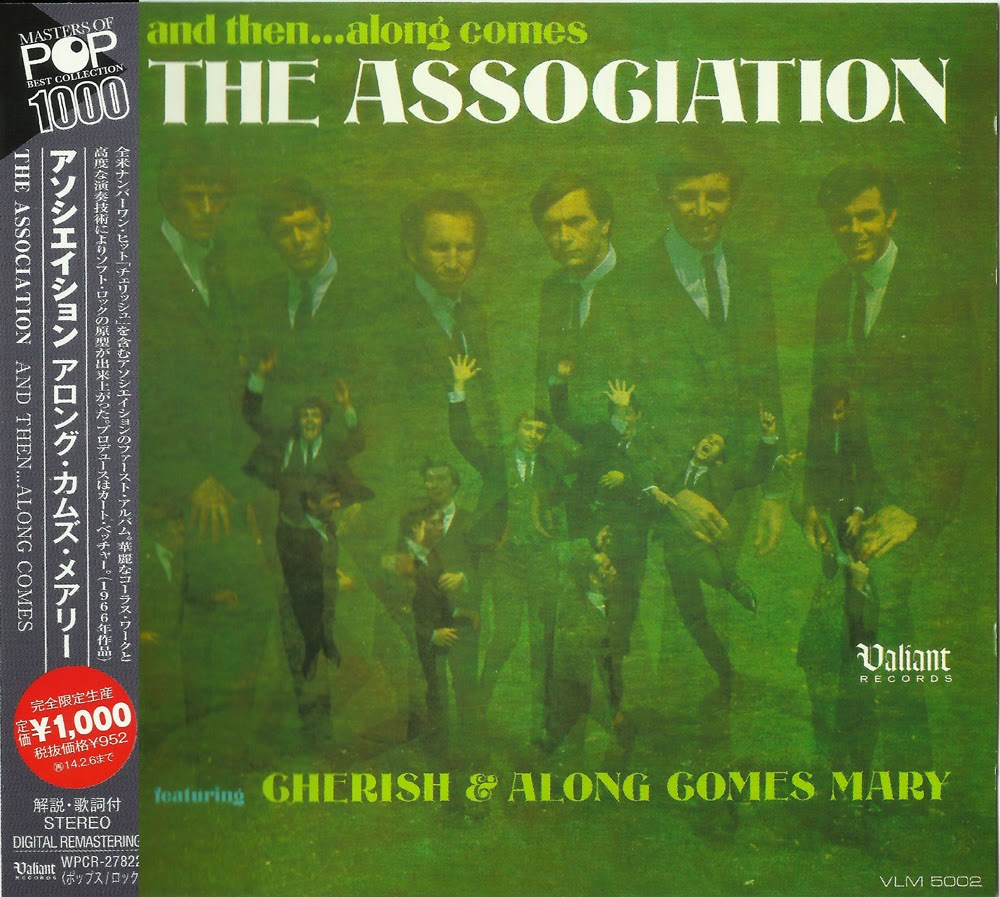
The Association - And Then...Along Comes (1966 us, beautiful sunny psych with folk tinges, 2013 japan remaster)


With the two smashes "Along Comes Mary" and "Cherish," the Association became one of the hottest new bands of 1966, the singles charting at #7 and #1 respectively. It was no surprise that their debut album, featuring both of those songs, was also a big success, rising to #5 and remaining their highest-charting LP ever, with the exception of their Greatest Hits compilation. The record also gave the Association the chance to showcase their versatility on material penned by both group members and outside songwriters, their complex multi-part vocal harmonies being the greatest unifying factor.

And Then...Along Comes the Association was actually preceded by a few singles as the group struggled to establish themselves as a commercial force. Covers of "Babe I'm Gonna Leave You" and Bob Dylan's "One Too Many Mornings," both in 1965, were very much in the folk-rock style that had become a craze with the emergence of the Byrds and their chart-topping cover of Dylan's "Mr. Tambourine Man" in the middle of that year. With "Along Comes Mary," the group moved toward a more pop-rock sound, aided by a dynamite tune from non-member Tandyn Almer, and a new producer, Curt Boettcher.

Boettcher was himself making a transition from the folk scene, in which he'd performed as part of the Goldebriars (who released a couple of albums on Epic), to pop-rock. He was already familiar with the Association when he played on a demo of "Along Comes Mary" with the group's lead guitarist, Jules Alexander, who enthusiastically pitched the song to the rest of the band. "When we first started, Jules was not officially designated, but he was more or less the musical director," remembers rhythm guitarist and keyboardist Jim Yester. "'Cause he had been in a couple rock bands before, he had a lot better handle on harmonic structure, and was obviously the best guitar player. He, a lot of times, would line out vocal parts. He'd sit down and figure it out on the guitar and say, 'Okay, you sing this, you sing that.' And then we'd adapt it, and somebody'd say, 'Well, listen. How about this note instead?' But basically things started with Jules."

When Alexander brought a tape of the demo of "Along Comes Mary" home, Jim continues, "He says, 'Listen to this song, we gotta try this.' And he said, 'Jim, why don't you sing it?' It was very casual. 'We need a high voice.' 'Cause on the demo, Curt sang it, and Curt's a real high tenor as well. I think the only thing that was roughly the same was that vamp line -- that was Tandyn's whole trip. That and the chord changes. But it was just one single voice."

With its dynamic interplay between Yester's lead and the rest of the band's vocal harmonies, as well as an intriguing lyric that jammed about as many syllables as were possible to fit into individual lines of a pop song in 1966, the song took a few months to catch on nationally. By the time it did break into the Top Ten in the summer, And Then...Along Comes the Association was ready to capitalize on it. In fact, however, work on the tracks that ended up on the LP had begun some time before, when Boettcher produced five cuts with the group in Gary Paxton's Homewood Studios. Aside from "Along Comes Mary," these sessions yielded its B-side, "Your Own Love," and two other tracks that ended up on the album, "Remember" and "I'll Be Your Man" (the fifth, "Better Times," remained unissued until 2002).

The Association's "One Too Many Mornings" single had been produced by Barry DeVorzon, the president of their label, Valiant Records. But as Yester explains, "After the thing with Barry producing didn't work out, we begged him to let our friend Curt produce us. And he finally condescended, but with the stipulation that we use some studio musicians. So we did a combination of studio musicians and us. But they did the basic tracks, and then we did a lot of the sweetening and the lead guitar stuff, things like that."

As the Association's harmonies were along the lines of the sophisticated vocal arrangements used by Boettcher's former group the Goldebriars, and his future ensemble the Millennium, "it was a good match in that respect," concurs Jim. "We were very harmonically involved, and Curt was too. Also, he was very aware of the MFQ [the Modern Folk Quartet], which was my brother's [Jerry's] group. We were all into the MFQ; a lot of groups went to school on the MFQ in L.A. Everybody else made it, and they didn't. It's very bizarre." (Both 1960s albums by the Modern Folk Quartet, who also used sophisticated harmonies blending elements of pop, folk, and jazz, have also been reissued on CD by Collectors' Choice Music.)

The decision to make "Along Comes Mary" the single was, in a sense, ordained. "There was three or four of us that were involved with [the religious faith] Subud at that time," says Yester. "Roger McGuinn was also in it, [and] Cyrus Faryar from the MFQ. We convinced the record company that we were gonna take the five songs we recorded, and the elders of Subud did this thing called testing, where you would tell them the name of a song, and then they would kind of meditate and tell you yay or nay. We did that, and the two strongest reactions we got were from 'Along Comes Mary' and 'Your Own Love.' Actually, 'Your Own Love' got the strongest reaction from them. That song I wrote after I was in Subud for a while, that's kind of where it was coming from, so for me, that's why that reaction was [so positive]. But that's why those two songs were the first release. Then we went back to the record company and said, 'Okay, these are the two.' And they said, 'Okay.'"

To fill out the album, the group would record more material in a different studio, which like the first was run by noted producer, engineer, performer, songwriter, and general musical jack-of-all-trades Gary Paxton. "The first one [Homewood Studios], where we did the basics, the studio was an old garage, and the booth was in an old Greyhound bus," laughs Yester. "His second studio [G.S.P.], the studio was the downstairs, like the living room and dining room of a house, and the studio was in a bathroom upstairs. Very bizarre. But it had great sound." In addition, vocals were recorded at a more traditional Hollywood facility, Columbia Recording Studios.

Among the top sessions musicians in the support cast were guitarist Mike Deasy (who'd go on to play on other Association albums, as well as writing a song on their Insight Out LP), bassist Jerry Scheff, and percussionists Jim Troxel and Toxey French, with Boettcher contributing tone generator/oscillator. "Curt was very into a lot of outside instruments, and we were very up for experimentation, so we used a lot of different things," remarks Yester. "In fact, we were one of the first to sync two four-tracks  together to make an eight-track, using a VSO, variable speed oscillator, to match the speeds of the two tape machines. But by the time we went to finish the first album, Scully came out with the eight-track. When we were working at Columbia Studio A, that's what we were using."

As for the material selected for the album, as Yester notes, "most of those songs we'd been doing in concert for about a year or so anyway."  The Association LPs would feature a remarkably even spread of songwriting credits among the members, and all six save Brian Cole wrote or co-wrote material on And Then...Along Comes the Association. At this point Jules Alexander (then still performing under the name Gary Alexander, as he would until 1968) and singer-multi-instrumentalist Terry Kirkman "were probably a little more prolific," adds Jim. "But most of the time everybody had at least one or two songs on the album. We tried to have everybody included. We had a publishing deal where everybody shared in everybody else's publishing. It was very clever. We actually had [a] publishing deal before we had a record deal. Because we auditioned for Capitol, and they didn't sign us, but they wouldn't let us out of the building until we gave them a meeting with [the] head of their publishing. 'Cause they couldn't believe a group with six guys, and everybody wrote. And they were pretty decent songs."

The group did cover a couple of songs from outside sources on the album. "Don't Blame It on Me" was written by brothers Don and Dick Addrisi, who penned the massive 1967 Association hit "Never My Love." "Blistered" (later a hit for Johnny Cash) came from Billy Ed Wheeler, also known for writing the folk-rock classic "High Flying Bird," co-writing the Kingston Trio's hit "The Reverend Mr. Black," and co-writing "Jackson" (hit duets for the teams of Johnny Cash & June Carter and Nancy Sinatra & Lee Hazelwood), as well as scoring a big country hit on his own with "Ode to the Little Brown Shack Out Back." The second big hit off the LP, however, would be a Terry Kirkman original, though it wasn't even planned as the follow-up to "Along Comes Mary."

As Yester tells it, "We were going to release 'Enter the Young.' The version that I remember was a DJ from Ohio started playing 'Cherish' off of the album, and it went right up the charts in his area. Either the record company said, 'wait a minute, let's rethink this,' or the other version is, [Association manager Patrick] Colecchio convinced the record company to release 'Cherish' instead." It was a wise decision; on September 24, 1966, the single began a three-week run as the #1 song in the nation.
by Richie Unterberger


Tracks
1. Enter the Young (Terry Kirkman) - 2:04
2. Your Own Love (Jules Alexander, Jim Yester) - 2:02
3. Don't Blame It on Me (Don Addrisi, Dick Addrisi) - 2:03
4. Blistered (Billy Edd Wheeler) - 1:05
5. I'll Be Your Man (Russ Giguere) - 2:04
6. Along Comes Mary (Tandyn Almer) - 2:05
7. Cherish (Terry Kirkman) - 3:02
8. Standing Still (Ted Bluechel) - 2:04
9. Message of Our Love (Tandyn Almer, Curt Boettcher) - 4:00
10.Round Again (Jules Alexander) - 1:05
11.Remember (Jules Alexander) - 2:03
12.Changes (Jules Alexander) - 2:03

The Association
*Russ Giguere - Vocals, Guitar
*Brian Cole - Vocals, Bass
*Terry Kirkman - Vocals, Brass, Woodwinds
*Jim Yester - Vocals, Guitar, Keyboards
*Gary Alexander - Vocals, Guitar
*Ted Bluechel Jr - Vocals, Drums
With
*Jerry Scheff - Bass

1968  The Association - Birthday (2013 Japan remaster) 
Related Artist
1966  Tandyn Almer - Along Comes Tandyn (2013 digipack release)

Free Text
Just Paste

Saturday, November 15, 2014

The Bossmen - Personally Yours The Complete Anthology (1965-66 us, fantastic garage beat psych, 2014 release)


A treasure trove of rare mid 60s garage rock from the state of Michigan – the complete anthology of local legends The Bossmen! MI was soon to become a breeding ground for some of the most revolutionary rock of the 60s – and while The Bossmen aren't best remembered rockers of the region all these decades later – they really helped lay the groundwork! There's a raw edge, but a melodic style here that's quintessential 60s rock, if you ask us. Guitarist Dick Wagner would go on to play with fellow Michigan rock trailblazer Alice Cooper and other legends, but this earlier work with The Bossmen is really solid, and sounds great all these years later.
Dusty Groove

“I look back on the days of The Bossmen with a sort of reverence. These were my first days of recording my own original songs, entering the concert scene and learning the basic trials of making it in the music business. I get chills even today just thinking back on the two or three block line that formed every time we played our home town venue, Daniel’s Den. The Bossmen were the heroes and purveyors of the primal Rock energy for that angelic group of screaming youth. MAN… those were the days!” —Your Boss man, Dick Wagner
Dick Wagner (R.I.P. December 14, 1942 – July 30, 2014)


Tracks
1. Take A Look - 1:58
2. It's A Shame (Warren Keith) - 2:39
3. Thanks To You (Lanny Roenicke) - 2:44
4. Help Me Baby - 2:47
5. Here's Congratulations - 2:50
6. Bad Girl - 2:27
7. Wait And See - 2:46
8. You're The Girl For Me - 2:04
9. On The Road - 2:45
10.Tina Maria - 2:41
11.Baby Boy - 2:11
12.You And I - 2:08
13.Rainy Day - 2:59
14.Sunshine (Dick Wagner, Ray Wagner) - 3:16
15.Little Girl - 2:25
16.Easy Way Out (Lanny Roenicke) - 2:14
17.I Cannot Stop You - 2:44
18.Listen My Girl - 2:30
All songs by Dick Wagner except where indicated

The Bossmen
*Dick Wagner - Lead Guitar, Vocals
*Lanny Roenicke - Bass Guitar, Vocals, Trumpet
*Warren Keith - Piano, Vocals
*Pete Woodman - Drums

1969  The Frost - Frost Music
1969  The Frost - Live At The Grande Ballroom! (2019 Wounded Bird)
1970  The Frost - Through The Eyes Of Love (2019 Wounded Bird)

Just Paste
Free Text

Thursday, November 13, 2014

Fat Water - Fat Water (1969 us, fine psych with west coast breeze)


From Chicago, a mix of psych and heavy rock, with good organ and guitars plus the powerful voice of their singer, who was probably influenced by Janis Joplin. This outfit reportedly evolved out of The One Eyed Jacks from Champaign, Illinois.

The vocals are very much of the San Francisco scene of that time and bring the Airplane's Grace Slick immediately to mind. Musically, the vocals are matched with acoustic guitars and swirling organ which gives a country rock feel that flows easily from full tilt boogie to slow blues.
Stephane Rebeschini, Max Waller, Nick Kontogouris


Tracks
1. I Can Be Happy (Lance Massey) - 2:51
2. Joshua (Steve Sperry) - 4:18
3. Amalynda Guinevere (Lance Massey) - 2:03
4. Gimme Your Sweet (Boris Schneider) - 2:20
5. Guitar Store Song (Lance Massey) - 0:56
6. Only For The Moment (Boris Schneider) - 3:11
7. It’s Not The Same (Lance Massey) - 3:10
8. Wayback (Lance Massey) - 1:31
9. Waiting For Mary (Boris Schneider) - 4:10
10.Mistress De Charmaign (Boris Schneider) - 3:05
11.Santa Anna Speed Queen (Boris Schneider) - 2:07
12.Gotta Get Together (Lance Massey) - 3:19

Fat Water
*Boris Schneider - Bass, Vocals
*Eve – Keyboards
*Lance Massey - Guitar, Vocals
*Pete Millio - Drums, Vocals
*Vicki Hubley - Vocalss

Free Text
Text Host

Tuesday, November 11, 2014

The Edwards Hand - Edwards Hand (1968 uk, elegant psychedelic baroque pop, with direction by George Martin)


In 1968 CBS abandoned the idea of a follow up album for the Picadilly Line and looked instead g for commercial success through singles. When the singles also failed to hit the charts CBS started to lose interest in the band and in the process they lost their direction, innocence and artistic drive. 

Adding a girl singer had confused things further and Roger Hand left the band in despair.  Rod Edwards soldiered on and the group went to Switzerland for an extended period to work and to get their act together. Unfortunately the hoped for new enthusiasm that was to be generated by the excursion did not materialise and a demoralised Picadilly Line returned to England before falling apart.

Sometimes, when all is lost, fate just steps in. The band's manager and friend Jon Miller had been working for Spencer Davis Management and on meeting American manager Lennie Poncher had given him a copy of the Picadilly Line album.  Rod and Roger were out of contract with CBS and since Lennie was looking for English acts he was immediately drawn to the band. 

Lennie not only offered them a US management deal but also immediately secured a record contract with CRT records, a new operation set up by the tape manufacturing conglomerate. Lennie was not typical of American managers. He was honest! He was also well respected in the business - with offices in both Los Angeles and New York .  He was a musician, he cared for music and had worked with a wide range of artists, including the US garage psych-pop legends The Electric Prunes and hip arranger David Axel rod (most notably on the infamous and highly ambitious Mass in F Minor and Release of an Oath albums). 

However he had also represented Tom Jones, Englebert Humperdink, Jethro Tull, Ten Years After and Donovan. Immaculately dressed, witty and gregarious whilst just oozing credibility, he was the man with connections that Rod and Roger needed. Rod recalls a particularly hilarious time with Lennie in London "Lennie took us out to lunch at the Londonderry Hotel on Park Lane to discuss our future. 

After fifteen minutes when the waiter still hadn't appeared to take our order, Lennie took hold of the edge of the table cloth and with one swift action pulled it from the table so that cutlery, glass and plates went flying everywhere. Immediately a waiter came rushing over to see what the problem was and when he arrived at our table Lennie just calmly pointed at the menu and ordered the meal!" 

Lennie was only interested in the best and through the force of his personality secured the services of George Martin to produce Rod and Roger's new album. This was a unique scenario as they were to be the first group produced by George after the Beatles.  George must have been impressed by the songs as he immediately made the commitment to produce the band whilst he was still involved with recording the Beatles' White Album.

To their utter amazement, Rod and Roger found themselves scheduled at EMI studios in Abbey Road, St. Johns Wood under their new name Edwards Hand, a simple combination of their surnames.  As stated on the sleeve of their eponymous album 'musical direction1 was supplied by George Martin and as musical director George worked closely with the duo planning, pruning, orchestrating, recording and mixing the material. 

Rod Edwards described George Martin's involvement as crucial to the recordings "The album was very much a transition from the softer Picadilly Line material to a bigger orchestral George Martin sound.  At the time he was working on The Beatles' White Album - a lengthy sporadic process - and although he was very discreet he did play a rough mix from a work in progress tape of 'Dear Prudence". In addition to George Martin's involvement Edwards Hand were also fortunate to have the services of legendary engineer Geoff Emerick whose name was synonymous with all the Beatles' recordings. 

Rod described him as a consummate engineer "Recording the Beatles was just part of his repertoire. He had done everything, been everywhere and moreover had come from that peculiarly British school of excellent technical sound balance engineers.  He knew about sound and how to achieve it. You have to remember at that time you didn't just press a button and out comes the New York Philharmonic! 

The album was recorded on a four track machine which really focuses your mind!" Like The Picadilly Line album Edwards Hand's first vinyl output featured a dazzling array of musicians.  Not only had the duo managed to secure the most famous producer and arranger in the world they also attracted the cream of the UK session musicians. 

A veritable who's who of hip sidemen included Barry Morgan and Ronnie Verrall on drums, Danny Thompson on string bass, Vic Flick, Big Jim Sullivan, Colin Green and Alan Parker on guitars, Nicky Hopkins, Roger Coulam, Alan Hawkshaw and Mike Moran on Keyboards and Harry Stoneham on Organ. 

Such a wealth of talent under the direction of George Martin promised at the very least an album of the highest quality and unsurprisingly both Rod and Roger were overawed at the prospect of such an array of top class musical ability performing their compositions.
The album was recorded at Abbey Road Studios in the summer of 1969 and was released shortly afterwards on the fledging GRT label in the USA, Despite the ificfedible team behind it and the seeming commercial invincibility of the project the choice of label proved to be its Achilles heel.  The reviews were excellent and a buzz was in the air but GRT had moved too soon too fast and they lacked the depth of experience of a major label.

They did not have the promotion, the organisation or quite simply the men hitting the radio stations. Edwards Hand was an album truly deserving of exposure to a wider audience. In today's ipod world 'baroque pop' might well be the closest label of categorization for the duo's debut putting it on play lists alongside albums such as Kaleidoscope's Faintly Blowing, Fairfield Parlour's From Home To Home The Strawbs Dragonfly or Nirvana's All Of Us , Whilst not sharing any creative ideas with those contemporaries what it does share is an English cosy warmth and familiarity that breathes the fresh air of an earlier,  innocent and more carefree musical age. 

Sweeping pastoral string arrangements perfectly counterbalance a pop sensibility adding a certain air of mystery and romanticism.  At times the blend of pop orchestration and melancholy harmony gives the record a Franco-continental feel most evident on the opening 'Banjo Pier' - with its keyboard flourishes and swelling strings -and the haunting elegiac 'Days of Our Life'. At other moments, for example in 'Magic Car1, a harder edge struggles to break through the dense harmonies. 

Whilst the roots of the duo's music can be followed back to the twee beginnings of The Picadilly Line - most evident on 'Characters No. 1',  an infuriatingly catchy piece of swinging mockney - Rod and Roger's music seems to have evolved into a creation totally of it's time whilst also remaining I enchantingly timeless. 'If I Thought You'd Ever Change Your Mind' is the only non-original composition on the record and is a beautiful song,  written and arranged by John Cameron, who had previously produced The Picadilly Line. 

The song has proven to be a particularly poignant footnote to Edward Hand's musical history.  Once again produced by George Martin it was to be a huge hit for Cilia Black in 1969 (and an even bigger one many years later for Agnetha Faltskog of Abba) yet tie irony is that Cilia's label EMI had an option to release the Edwards Hand alburn and the single but failed to do so, giving Cilia a clear run with her version.

Despite the fact that lyrically it works better from the male perspective, EMI could see that Cilia had the advantage of previous hits and a well known UK TV show to propel her recording into the public ear. In retrospect it is evident that the Edwards Hand version is by far superior.  Who knows what might have happened had it gained wider exposure? Unfortunately although Edwards Hand's album garnered critical acclaim in the USA, the GRT label folded almost immediately after release of the alburn taking the band's first steps at a career with it.  Edwards Hand missed their moment and the duos debut failed to even secure a European release. 


Tracks
1. Banjo Pier - 2:46
2. Friday Hill - 2:37
3. Episodes, Being The First Part - 3:54
4. Close My Eyes - 3:15
5. House Of Cards - 2:13
6. If I thought You'd Ever Change Your Mind (by John Cameron) - 2:39
7. Characters Number One - 3:54
8. Orange Peel - 2:51
9. Sing Along With The Singer - 2:11
10.Magic Car - 3:15
11.Days Of Our Life - 5:37
12.Outta My Mind - 2:34
13.Last Night's Girl - 2:48
14.Loves A Game For One - 2:53
15.Goodbye Girl - 2:31
All songs by Rod Edwards. Roger Hand
Bonus tracks 12-15 recorded as The Handed Down in 1968, direct to acetate.

Edward Hand
*Rod Edwards - Vocals, Keyboards
*Roger Hand - Vocals, Acoustic Guitar
Guest Musicians
*Barry Morgan, Ronnie Verrall, Clem Cattini - Drums
*Danny Thompson V - String Bass
*Herbie Flowers, Mo Foster, Brian Hodges - Bass
*Vic Flick, Big Jim Sullivan, Colin Green, Alan Parker - Guitars
*Nicky Hopkins, Roger Coulam, Alan Hawkshaw, Mike Moran - Keyboards
*Harry Stoneham - Organ
Musical Direction by George Martin
Produced by George Martin

1967  Picadilly Line - The Huge World Of Emily Small
1970  Edwards Hand - Stranded (Japan remaster edition)

Free Text
Just Paste

Friday, November 7, 2014

Memphis Slim And Canned Heat With Memphis Horns - Memphis Heat (1970/73 us, outstanding electric blues rock, 2004 digi pack extra tracks issue)


Memphis Heat documents Chicago blues piano legend Memphis Slim's studio collaborations with the rock group Canned Heat in France on September 18, 1970, and July 11, 1973. The results are tasty indeed. Slim's voice and piano are well matched by Henry Vestine's electric guitar, Canned Heat's rockin' rhythm section, and (on six out of 13 tracks) the Memphis Horns, a solid wind quintet of trumpet, trombone, two tenors, and a baritone sax. Memphis Slim tried on a lot of different styles and instrumental combinations during the 1970s. 

His Canned Heat sessions have been both praised and panned over the years, a state of affairs that often revealed more about the reviewers than the music itself. A fair assessment should take into account the blues and rock scene of the early '70s, the pianist's artistic intentions as he capped a long and eventful career, and perhaps most importantly the positive effect that this music is likely to have upon any listener who loves a good jumpin' electric blues band. 


by Arwulf
Tracks
1. When I Were Young - 2:43
2. Whizzle - 1:44
3. Boogie Duo - 3:01
4. Black Cat - 3:04
5. Down That Big Road - 3:02
6. Mr Longfinger - 7:03
7. Mother Earth - 3:15
8. You Dont Know My Mind - 6:29
9. Five Long Years (Eddie Boyd) - 5:05
10.Trouble Everwhere I Go - 3:50
11.Paris - 2:14
12.Five Long Years (Eddie Boyd) - 7:29
13.Menphis Heat - 3:55
All songs by Peter Chatman except where stated.

Musicians
*Memphis Slim - Vocals, Piano
*Richard Hite - Bass
*Alfredo De La Barreta - Bass
*Adolfo "Pito" De La Parra - Drums
*Henry Vestine - Guitar
*James Shane - Guitar
*Joel Scott Hill - Vocals, Guitar
*Andrew Love - Tenor Saxophone
*Ed Logan - Tenor Saxophone
*Jack Hale - Trombone
*James Mitchell - Baritone Saxophone
*Wayne Jackson - Trumpet

1967-73  Canned Heat - The Very Best Of
1968  Canned Heat - Livin The Blues (2003 edition)
1971  John Lee Hooker And Canned Heat - Hooker 'N' Heat

Just Paste

Saturday, November 1, 2014

Paul Butterfield's Better Days - Live At Winterland Ballroom (1973 us, superb tight blues rock, 2014 issue)


Heady work from Paul Butterfield's second great group – his mighty Better Days ensemble, heard here in a nicely unbridled live set from the early 70s! Paul himself is mighty great on vocals and harmonica – but the group's a very cohesive unit, too – with additional vocals and guitar from Amos Garrett and Geoff Muldaur, organ and piano from Ronnie Barron, and some mighty heavy drums from Billy Rich! The music seems to have even more punch than on some of Butterfield's studio sessions – blues rock, but with a little something extra
Dusty-Groove


Tracks
1. (Stuck In The) Countryside - 8:10
2. Buried Alive In The Blues (Nick Gravenites) - 3:48
3. Small Town Talk (Bobby Charles, Rick Danko) - 5:21
4. New Walkin Blues (Robert Johnson) - 6:18
5. Broke My Baby's Heart (Ronnie Barron) - 7:18
6. Highway 28 (Rod Hicks) - 4:41
7. Please Send Me Someone To Love (Percy Mayfield) - 5:21
8. He's Got All The Whiskey (Bobby Charles) - 14:11
9. Nobody's Fault But Mine (Nina Simone) - 7:57

Better Days
*Paul Butterfield - Vocals, Harmonica, Keyboards
*Geoff Muldaur - Vocals, Guitar, Keyboards
*Amos Garrett - Electric Guitar, Vocal
*Ronnie Barron - Vocals, Piano, Organ
*Billy Rich - Bass
*Christopher Parker - Drums

Paul Butterfield's mosaic
1964  The Original Lost Elektra Sessions
1965  The Paul Butterfield Blues Band
1966  East West
1966  East-West  (2014 Audio Fidelity Hybrid SACD) 
1966-68  Strawberry Jam
1967  The Resurrection Of The Pigboy Crabshaw
1968  In My Own Dream
1969  Keep On Moving
1970  Live 
1970  Live Vol.2 
1971  Sometimes I Just Feel Like Smilin' (2015 Release)
1973  Paul Butterfield's Better Days
1973  It All Comes Back (Japan Edition)
1976  Put It In Your Ear (2015 Edition)

Free Text
Text Host