East Coast singer-songwriter Peter Kelley made two superb albums. His second effort "Dealin' Blues" is an acoustic blues with an outlaw vibe and some surprising and effective use of moog., An atmospheric blend of bluesy downer folk and psychedelia.
Quietude and an unvarnished approach sistinguish this set of twelve blues oriented songs. Kelly writes all of his material and sings in a very straight forward fashion which is effective. Presence of moog synthesizers on several cuts does much to enhance the proceedings and "Death Is Not A Sad Word" and "I Been Told" are among the highlights of the album.
Wendell Ing was raised as a classical pianist, then began playing in bands in the early 70's, notably Small Time Leroy, a blues band out of Brooklyn, Illusion, a folk rock group in Honolulu which made famous his environmental protest song "The Lake", and Hawaiian pop group Cecilio & Kapono (who recorded Ing's "Easy On My Mind").
Illusion recorded only one selftitled album, released through Sinergia record label. A pretty mix of soft country and folk rock with jazz and clasical elements and beautiful harmony. Ing currently teaches music at Hilo High School in Hilo, Hawaii where he directs the Ambassadors, singing group of Hilo High, teaches music classes and waves a baton around for the yearly musicals by PALC, the Hawaii Performing Arts Learning Center.
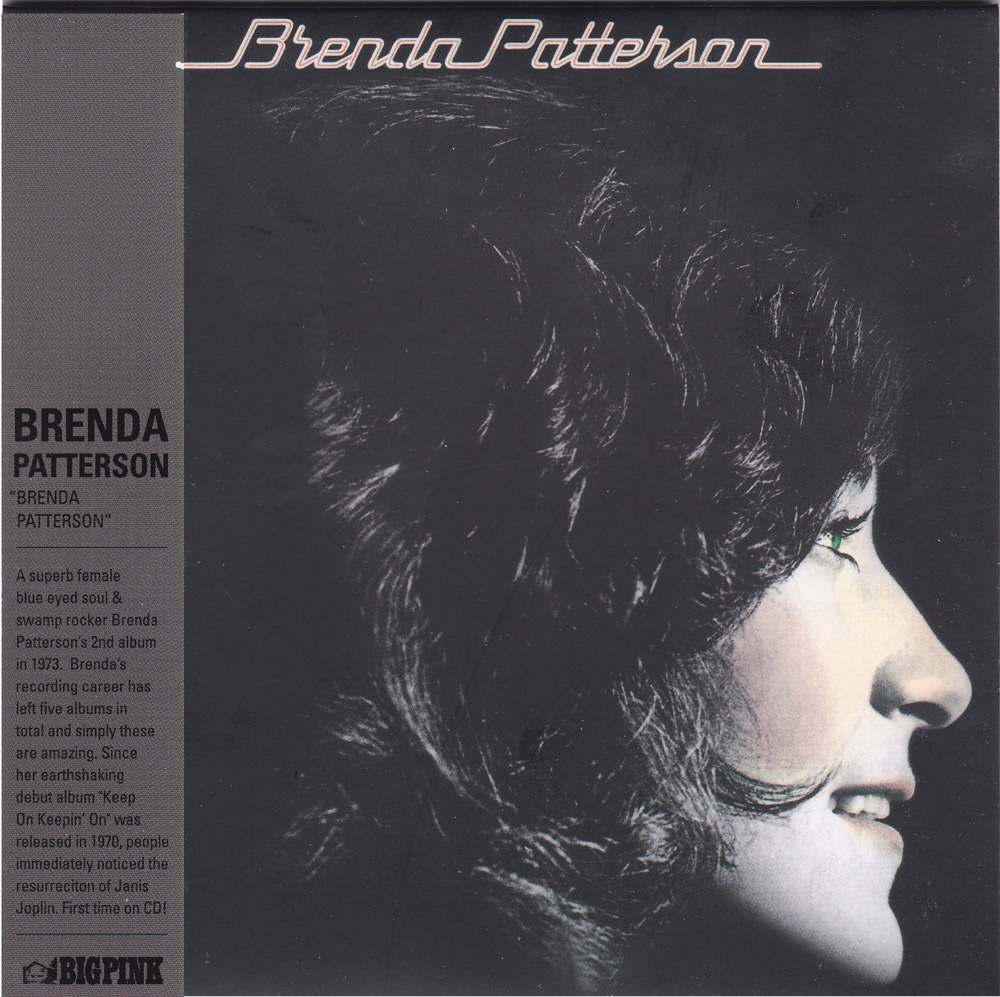
Brenda Patterson is the self titled album by Brenda Patterson, released in 1973. A rock-roots crossover set, with soul-tinged vocals and a bunch of hard-rocking cover tunes. Ry Cooder, Chris Ethridge and Rusty Young represent the more country side of the studio crew, though this is more of a "rock" record, it certainly deserves mention.
Full of heart-wrenching vocals plus, an amazing version of Paul Simon’s, “Congratulations”, arranged by Jim Dickinson. Roaring version of Etta James’ “Dance With Me Henry”. Pieces of the album may be heard here. Maybe it was because she went from Columbia Records to Playboy Records, the latter being a label associated with the magazine, and a label that came and went rather quickly.
Tracks
1. Dance With Me Henry (Johnny Otis) - 2:40
2. The Crippled Crow (Donna Weiss) - 2:32
3. Hold An Old Friend`s Hand (Donna Weiss) - 3:33
4. Southern Brown (Ed Simmons, Ronnie Wilkins) - 3:24
5. Hope He`ll Be Happier With Her (Bill Withers) - 4:01
The love of his fiancée led Jim Spencer to move from his native Kentucky to Milwaukee. The South’s loss became a boon to the Cream City from the late 1960s to the early ‘80s. A cultural polymath of eclectic and esoteric interests, Spencer published an underground newspaper and chapbooks of his own poetry and operated an antique store, among other pursuits. Decades after his death in 1983, however, it’s his music that has given him the following beyond his adopted hometown that eluded him in life.
2nd Look retains some of the rural charm that gave its predecessor potential appeal to a mass audience (it’s fun to think that Spencer could have developed into a mainstream country music outlier). However, providing tension against that middle of the road are the way his psychedelic adjacency morphs into prog rock experimental atonality; what were once relatively unadorned melodies are endowed with choral and string arrangements recalling English madrigals. Even Spencer’s singing sounds fuller and more impassioned. What remains constant from his first to second sets is his lyrical navigation through what sounds like contentment to warier emotional terrains of paranoia and despair.
by Jamie Lee Rake, May 13, 2020
Jim Spencer was always looking for a stairway to success beyond, but Milwaukee was a Mobius loop he could not escape. He played many roles with grace; he was a musician, songwriter, poet, magus, and congenial salesman of ideas. He was a dealer in rare books, antiquities, and fantasies. He was a D.I.Y. publisher and indie recording artist at a time when circulating self-produced poetry and music beyond one’s hometown was a challenge on par with swimming the English Channel. He was Milwaukee famous—at least to anyone who cared about music and poetry. He was not much known elsewhere.
He released three albums under his own name and one as Major Arcana, a band-persona that enabled him to escape his singer-songwriter image. All were issued under the imprimatur of cryptically-monikered labels: Thoth, Akashic, and Castalia Records. “He had forbidden books in his basement,” said frequent collaborator Sigmund Snopek, a classically trained progressive rock keyboardist. “He was fascinated by other cultures and religions and incorporated some of that into his music.”
1974’s 2nd Look, his second LP, finds Jim Spencer in a deeper, darker place. The ten song album was assisted by Milwaukee scene star Sigmund Snopek III on keyboards and flute, and features a pair of songs written by and with Anonymous’s Ron Matelic.
Tracks
1. Second Look (Mike Pageant) - 4:30
2. No Place To Land (Jim Spencer, Mike Pageant) - 3:22
3. There Comes A Time - 3:40
4. What Am I Doing Here? - 7:31
5. Just A Little Time With You - 2:32
6. Laura Fair (Ron Matelic) - 2:40
7. Interlude (John Nebi) - 0:57
8. Lament - 2:52
9. Next To You - 2:38
10.The Devil Is A Fat Man - 6:37
Lyrics and Music by Jim Spencer except where noted
Frijid Pink's self-titled debut album is a slashing, seriously soulful example of late-'60s Detroit rock near its best. Although they never registered with critics or rock historians the way MC5 or the Stooges did, Frijid Pink had obviously learned something in the course of two years on the road, and with Mike Valvano producing, they were able to channel the excitement of their work onto the grooves of this album very neatly.
Those who bought the number seven single "House of the Rising Sun" weren't disappointed with the bluesy boogie sound of "I'm on My Way" or the slowed-down Yardbirds approach of "Drivin' Blues" (somehow, when Kelly Green sang "My woman loves me" it seemed to matter), and even if "Tell Me Why" was a tuneless mess, Gary Thompson made up for it with a fuzz-out guitar performance that sounded like speaker burnout in slow motion.
They were back in form on the next number, the crunchy, pumping rocker "End of the Line," where Green, (Gary Ray Thompson, and company move into Led Zeppelin territory very effectively (you can just imagine them switching gear into "Black Dog" in a jam to this song on-stage), with a killer performance by Rich Stevers on the drums. And that was all leading up to "House of the Rising Sun." "Boozin' Blues," which closed the original LP, is a blues workout reminiscent of Cream's version of Willie Dixon's "Spoonful"; a virtuoso effort by Thompson and Green, it shows off a more reflective and studied side of the band's sound.
This reissue includes the singles "Heartbreak Hotel" and "Music for the People" (which features a gorgeous and perfectly appropriate gospel chorus), House Of The Rising Sun (Single Edit), Sing A Song For Freedom (Mono Single Mix) and "End Of The Line" (Mono Single Mix) as bonus tracks.
by Bruce Eder
Tracks
1. God Gave Me You - 3:35
2. Crying Shame (Michael Valvano) - 3:11
3. I'm On My Way - 4:34
4. Drivin' Blues - 3:14
5. Tell Me Why - 2:50
6. End Of The Line - 4:07
7. House of the Rising Sun (Traditional, arr. Frijid Pink) - 4:44
8. I Want To Be Your Lover (Gary Ray Thompson, Tom Beaudry, Michael Valvano) - 7:30
9. Boozin' Blues - 6:01
10.Heartbreak Hotel (Mae Boren Axton, Tommy Durden, Elvis Presley) - 2:49
11.Music For The People - 2:54
12.House Of The Rising Sun (Traditional) - 3:54
13.Sing A Song For Freedom (Tom Beaudry, Gary Ray Thompson, Richard Stevers) - 3:02
14.End Of The Line - 4:09
All songs by Gary Ray Thompson, Tom Beaudry except where noted
When you can call on the likes of Deep Purple members Ian Paice and Roger Glover, Elton John Band bassist Dee Murray and famed session musicians like B. J. Cole, Mo Foster and Henry Spinetti to help you out on the recording of your second solo LP then you must be one hell of a talent, and keyboardist/vocalist Eddie Hardin is definitely that.
Born on February 9th, 1949 in South London, Hardin's first big break came in 1967 when, aged just 18, he joined the legendary Spencer Davis Group. Dubbed 'the singing keyboard wunderkind', Hardin soon made his presence felt in this mega star-outfit and appeared on the UK hit singles "Time Seller" (No. 30) and "Mr. Second Class" (No. 35). By mid-1968, and with the band's star on the descent, Hardin left with the group's drummer Pete York to form the duo, Hardin & York. Signing to Bell Records, the pair released the album, "Tomorrow Today" and undertook numerous tours of mainland Europe, and in particular Germany, where they regularly filled medium-sized venues and also supported the likes of The Nice and Deep Purple. Two further Hardin & York LPs followed: "Smallest Big Band In The World" (SELL SBLL 136,1970) and "For The World" (DECCA SKL 5095,1971 ) before the pair decided to go their separate ways and pursue solo ventures.
Hardin's solo career kicked off with November 1971's "Driving"/"Where I'm Going To SleepTonight" single "DECCA F13252) which was swiftly followed by the 1972 LP "Home Is Where You Find It" (DECCA TXS 106) and another single, "Why Does Everybody Put Me Down"/"Spend Your Money Honey" (DECCA F13307). He then put his solo attempts on hold when he took part in the 1973 reformation of the Spencer Davis Group where he was again reunited with Pete York. The reunion lasted for just two LP's "Gluggo" and "Living In R Back Street", before the band again split up. Hardin along with York and bassist Charlie McCracken then formed Hardin-York-McCracken and released one critically acclaimed self-titled LP, in 1974, for Vertigo Records (6360622).
Following this, Hardin worked with Roger Glover on "Butterfly Ball" and "Wizards Convention" LPs before again attempting a solo career with the singles "S'Easy"/"Strange Times" (Mercury 6008008) and "Summer Days"/"Seems I'm Always Going To Love You" (GTO GT24) and the album "You Cant Teach An Old Dog New Tricks" (ATTIC LAT 1023). Beetween 1979 and 1981, he led Axispoint, who also featured bassist Charlie McCracken, drummer Rob Townsend and guitarist John 'Charlie' Whitney, and who released two LP's "Axispoint" (RCA PL30039) and "Boast Of The Town" (RCA PL25277). Following the demise of Axispoint, Hardin stayed with RCA for 1982's "Circumstantial Evidence" LP (PL 30101) and then teamed up with Zak Starkey to work on a musical version of "Wind In The Willows" which also featured Donovan and John Entwistle.
Since then, he has released a couple of 'New Age' style albums for Coda Records, "Dawn Til Dusk" (830509, 1986) and "Survival" (834142,1980), overseen the re-issuing of Hardin & York's old recordings and took part in occasional reformations of the Spencer Davis Group. And with plans for a new, more rock-influenced LP, there's no doubt this old dog will be teaching us all a few new tricks in the near future.
by Mark Brennan, 1994
Tracks
1. Oh What A Day It's Been - 3:09
2. Strange Times - 3:27
3. Drinking (Eddie Hardin, Ray Fenwick) - 3:03
4. Glad To Be Home (Eddie Hardin, Ray Fenwick) - 3:44
5. Moving - 4:48
6. S.'easy - 3:08
7. Give Me Freedon - 4:55
8. Think L'll Wait Another Day (Eddie Hardin, Ray Fenwick) - 3:39
Brenda Patterson has a fantastic voice, a Memphis based blues rock singer recorded three albums in early 70’s.“Like Good Wine” was her third, released in 1974 on Discreet Records, a label owned in part by Frank Zappa, you'd think that this was going to be a rock album as well as her two previous, well not exactly. Produced by Snuff Garrett, who was also Cher's producer at the time, in the early 70's, but the formula he worked out for Cher did not do Brenda Patterson justice, he gave her soft production, with backing vocalists and strings.
Couple of songs were written by John Durrill (who also worked with Cher), but the best songs are Bill Anderson's “Slippin' Away” a nice upbeat, Ray Price's “I'll Be There (If You Ever Want Me)”, which illustrates the power of Brenda's voice best as she sings accapella on several lines, and probably the best song here “Sweet Amarillo”, first surfacing as a short jam on the outtakes of Dylan’s 1973 Pat Garrett & Billy the Kid sessions, the song was completed a year later by songwriter Donna Weiss, the impromptu track on Dylan’s session was polished for pop splendor with a faster beat, a catchy hook, and a bell-bottom clad Patterson singing “Sweet Amarillo/ You stole my pillow/ You stole my pillow/ Hun, you ruined my mind/ Sweet Amarillo/ Like the wind and the willow/ I never will know/ Just how much you lied.”
The album has some good cuts, but it's very short, with the songs all running around 2 and 3 minutes. Thankfully, she would continue to record, joining The Coon Elder Band.
Tracks
1. Mr. Guitar (John Durrill) - 3:17
2. This I Find Beautiful (Larry Weiss, Mack David) - 2:40
3. Slippin' Away (Larry Weiss, Mack David) - 2:24
4. Blessed Be The Love (Gloria Sklerov, Harry Lloyd) - 2:03
5. Bring Your Good Wine (John Durrill) - 2:40
6. You Can't Have Your Cake And Eat It Too (Molly Ann Leikin, Yutaka Yokokura) - 3:12
7. I'll Be There (If You Ever Want Me) (Ray Price, Rusty Gabbard) - 2:40
8. Crazy (Willie Nelson) - 2:59
9. Sweet Amarillo (Donna Weiss) - 2:46
10.I've Never Been A Fool Like This Before (Lori Jacobs) - 2:38
Subway was a duo, consisting of an American and an UK- guy, who released their only album in France as 200 vinyls in 1971. There they lived and played both for some time as street musicians, who played their compositons even at Parisien subway, hence the bandname. Unfortunately the album fell through, so the unsold vinyls were melted, as usual in France at this time.The band presented a phantastic psych- folk music with prog- rock- elements. An absolutely top- album, which hopefully now will reach a bigger audience, as the original LP is very rare.
Alias I, Dirk Hamilton's sophomore set, opens with a quite appalling scene -- "I saw a dog in a trash can chewin' on a cat" -- but worse is to come, as "In the Eyes of the Night"'s dystopian vision unfolds. It's a stunningly modern view of the world, seemingly ripped from the rhyme book of rappers or hardcore headbangers, but Alias I was originally released back in 1977, and musically it is a chasm away from the fury-firing punks across the sea. The album was Hamilton's follow-up to the previous year's You Can Sing on the Left or Bark on the Right, a deliriously derivative set that hit virtually every musical touchstone of '70s soft rock. Hamilton plundered freely from his idols musically, but his lyrics were breathtakingly unique, dizzying vignettes of poetic splendor.
Alias I picks up where its predecessor left off, but this time the songs are not such obvious rips. Sure "The Ballad of Dicky Pferd" pays tribute to Elton John's "Rocket Man," "The Classic Sweat Poze" tips a hat to Traffic, and "Joanna Ree" nods to the Rolling Stones, but there are unexpected stylings as well. "Los Gatos," for example, is Latin-tinged, while "The Light of Love" has a distinctly Spanish flavor. Elsewhere, bluesier elements come to the fore. The aforementioned "Night" defiantly crosses soul with rock, and tosses in some distinctly Stax-esque brass. "Joanna Ree," Stonesy as it is, is the Stones in their bluesiest mode, with wisps of gospel flicking through the gorgeous guitar work.
"Big Boo Hoo" echoes the Stones circa Black and Blue, with its emphatic rhythm snapping around the sliding lead guitar. Even the Traffic-stopping "Sweat Poze" emphasizes that band's R&B roots. These numbers give the set a dirtier and darker sound than Bark, which dovetails nicely with a clutch of love-lost or world-gone-mad numbers. But salvation can be found, be it in the sweet pace of life in "Los Gatos," in the memories of young romance, or brought by the angel of the morning who hovers over "The Light of Love." And if Hamilton's own prayers are answered, he'll be living large as a rock star striking "The Classic Sweat Poze" on the album's most hilariously ironic song. In an age of singer/songwriters, Hamilton should have seen that dream fulfilled, but his songs were too disconcerting -- so familiar yet lyrically so alien that only the critics sang his praises.
Today, with a more modern soundtrack, these songs could rule the world, but for now he remains trapped in '70s nostalgia. This reissue adds two equally stellar bonus tracks, the aforementioned "Big Boo" and the billowing ballad "As a Matter of Fact."
Born in Hammersmith, London, Andy was in the thick of things even as a boy. He was shot in the left eye with an arrow, his right eye with an airgun and since he enjoyed climbing trees and jumping out of them, he eventually knocked himself out when he landed having jumped from some incredible height.
During the early 60’s Andy had trials with Arsenal Football Club. Also back then, a lot of youngsters used to carry a harmonica in their pocket. It was an ‘in-thing’. Andy was one of these youngsters (listen to “No Russians In Russia” on Radio Stars second album) and after meeting up with his old mates Chris Townson and Louis Grooner from Box Hill Boarding School at an old boy’s re-union, he was quickly invited to meet the rest of the band his mates had formed. He joined up with them shortly afterwards. Dubbed The Clockwork Onions by guitarist Geoff McClelland, Andy joined vocalist Louis at the front of the stage for their debut gig at St. Georges Hall in Ashtead. But since Louis, who was hating the experience more and more with every passing minute – would repeatedly stop the band and start shouting through the microphone at ‘some bloke in the audience who was chatting up his bird’ left the band immediately after the gig. Andy was promoted to vocalist, doubling up on harmonica until someone else could be recruited into the line-up. Finally the search ended when Chris Townson brought along a large East End mod whom he had met at art school called Martin Sheller. Martin later went onto play in the Regents who had a hit single with “7teen” in 1979.
A change of name to The Few during 1965 soon followed and the band started to perform around three gigs every month. These were at village halls, art schools, but best of all was a small pub in Guildford called the Harvest Moon. Then Martin Sheller decided he wanted to leave and Chris Dawsett also decided that he wanted to give up playing bass and concentrate on playing keyboards. The band agreed and that was the cue Geoff McClelland had been waiting for. He brought along John Hewlett, who he had met earlier. John claiming that he knew various prominent members of the local music fraternity as well as pointing out his talents on the instrument. All this wasn’t true of course, it was just John wanting to be in a band. Shortly after John’s arrival, Chris Dawsett’s parents forced him to leave. This paid off as Chris eventually became a Professor of Art at Oxford. His departure coincided with a change of name to The Silence. After building up a good local following, acquiring Simon Napier Bell as their manager, the band changed their name again, this time to John’s Children.
Two singles were released on Columbia Records during 1966 and 1967. Their debut release – “Smashed Blocked” became a minor hit in America and an album was recorded during 1966 for the American market only. But sadly it got shelved at the time and wasn’t released over there until 1970. Guitarist Geoff McClelland was replaced by Marc Bolan during March 1967 and the band also moved to Track Records where they released four singles. “Midsummer Night’s Scene” though was withdrawn shortly after it’s release and now sells for anything around £6,000+. During April, the band was thrown off a German tour with The Who because of their wild stage antics and Marc left the band around June. Along the way they did manage to film three promotional video’s. But after a tour of the South West the band split up.
Still managed by Simon Napier Bell, Andy studied mime and acrobatics, continuing in a solo vain and releasing three singles in six months – “It’s Been A Long Time” from the film ‘Here We Go Round The Mulberry Bush’, “Fool From Upper Eden” and The Beatles “You Can’t Do That”. Lack of publicity helped them to become collector’s items.
Having had enough of the music business for a while, Andy left the country to persue adventures in Europe. But returned during 1973 and the following year joined up with his old mate Chris Townson and ex-Sparks bassist Martin Gordon to form Jet. The band signed to CBS Records and released two singles and an album during 1975, as well as toured with Hunter-Ronson. By 1976 they had been released from their contract.
All was not lost though, as Andy got Ted Carroll at Chiswick Records interested in Jet’s final demo’s and come 1977 Radio Stars were born. Six singles, two albums, numerous gigs, a few TV appearances and a hit single – “Nervous Wreck” happened over a two year period. Andy was even insured for £250,000 in case of injury to any member of the audience. But during 1979 the band were forced into splitting up as funds had run out and they received no support from the record company. The band did reform for a short time during 1982 and released a single on Martin’s own Snat label. Andy revived the band during 1988 and a few years later during 1992 until 1996. Chiswick issued a compilation album of old songs and unreleased songs during 1992 titled “Somewhere There’s A Place For Us”.
During the early 80’s Andy wrote quite a few songs and “To The Beat Of A Different Drummer” was eventually released on a cassette album many years later during 1991. A new version of the John’s Children song “Desdemona” was recorded in 1988 with Boz Boorer and this appeared on a Marc Bolan compilation album during the same year.
1992 saw John’s Children return to the stage making their debut in Darmstadt, Germany 25 years after their last gig. The band have done quite a few gigs since playing in and around London as well as in America, Ireland, Spain, Italy and Germany again.
Andy was involved in the ‘Nothing To Do With Us Tour’ of London, Berlin and Amsterdam during 2000 promoting the re-release of Jet’s album from 1975. The band featuring Chris Townson, Martin Gordon, Ian MacLeod and Trevor White who performed songs by Radio Stars, Jet and John’s Children. Boz Boorer was a guest on the night of the London gig and a live album was released during 2001.
Jane Getz made a strong but brief impression while playing in New York in the mid- to late '60s, and then seemed to disappear until she emerged in Los Angeles in the mid-'90s. The truth is that she never left music, but took a long hiatus from jazz. Considered a prodigy as a child, Getz switched from classical music to jazz when she was nine. She lived in Los Angeles and San Francisco and then at the age of 15, dropped out of high school and traveled to New York City, where within hours she was playing with Pony Poindexter.
Getz worked with a who's who of jazz during her eight years in New York, most notably with Charles Mingus, Stan Getz (unrelated), Rahsaan Roland Kirk, Charles Lloyd, and Pharoah Sanders (with whom she recorded for ESP). In the early '70s, Getz moved back to L.A. and became a studio musician. She was signed to RCA under the name Mother Hen and played country music, in addition to appearing on many rock and pop albums (including with Ringo Starr, Harry Nilsson, and John Lennon). After 20 years outside of jazz, Getz started playing jazz gigs in Los Angeles, often teaming up with Dale Fielder, where it was obvious that her improvising skills were still very much intact. In 1996, she finally recorded her first jazz album as a leader.
by Scott Yanow
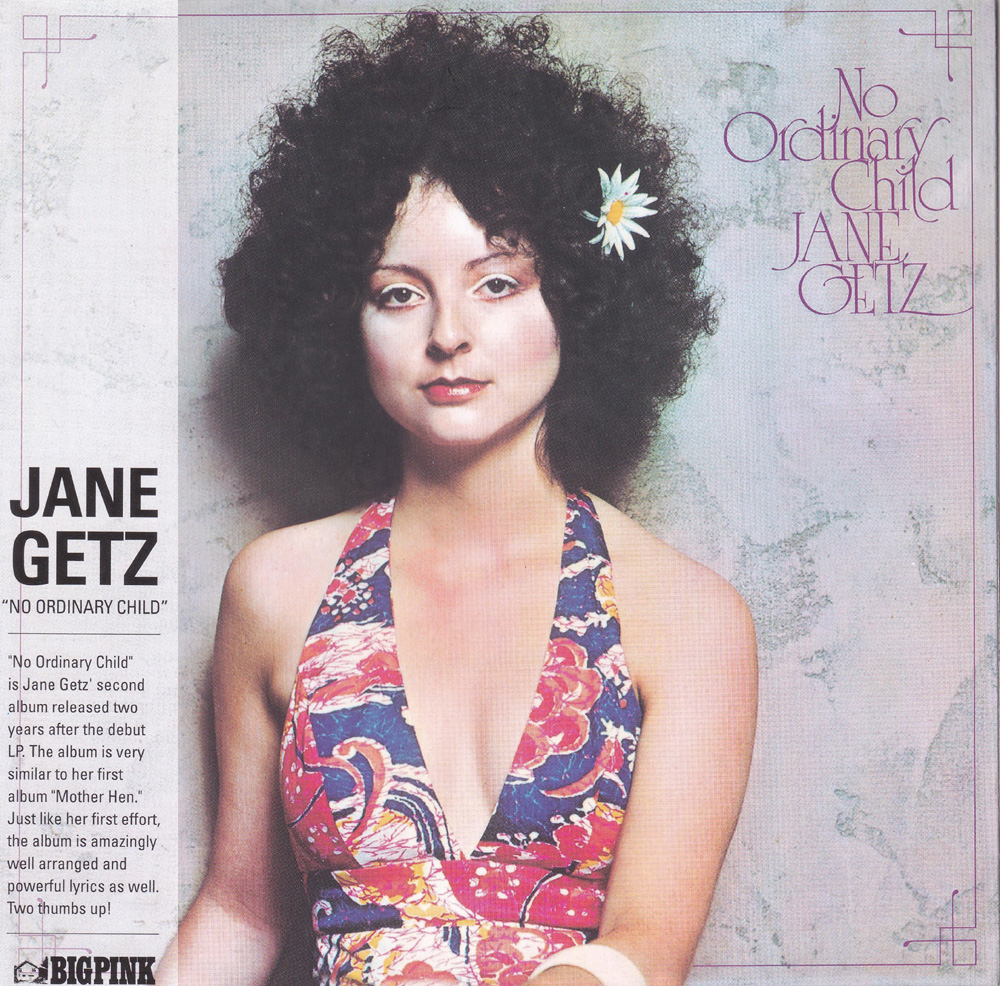
“Jane Getz’s 1973 solo album No Ordinary Child is a really unique record more people should know about,” muses. “Getz is a talented pianist, producer and songwriter who did a fair amount of session work in the 70’s playing on albums by Harry Nilsson & John Lennon, Jimmie Spheeris and the Bee Gees, to name just a few. Getz grew up on the West Coast, a child prodigy on the piano, memorizing Mozart pieces at the age of 6. She traveled East in her teens, moving to New York and an early career playing jazz with Pharaoh Sanders, Mingus, Stan Getz and other luminaries. (She wrote a book about her travels in the jazz world called Runnin’ With The Big Dogs) Her songwriting first surfaced with a group she led called Mother Hen and a great album they recorded in 1971. Featuring a stellar cast of heavy cats like Clarence White, Danny Kortchmar, Lee Sklar, Russ Kunkel and Sneeky Pete, Mother Hen introduced Getz’ striking voice and song stylings to the pop world.”
“Sneeky" Pete returns and plays on a lot of No Ordinary Child along with Jim Keltner, John Seiter and an extended cast of LA session players. There’s even a mariachi band on one tune! There are elements of country, boogie woogie, blues, ballads, Broadway; a wide range of sounds and styles that feel easily connected by Getz’ piano and vocals. Everything comes together here with a focus and depth that make the songs feel related, as vignettes in a larger tale. Part of the shimmer of the album includes the lovely arrangements by Nick DeCaro, an incredible talent who was an in-house arranger for A&M Records as well as a musician and performer on his own. His solo album Italian Graffiti is another overlooked gem and a big favorite of mine.
This is one of those entries that solidifies the feature for me. I’d never heard Getz’ name before, let alone this ’73 gem she’s given to the world. The record proves an entrancing listen. This one isn’t in print on LP, but its pretty cheap to pick up second hand. I’d recommend giving it a listen and letting it into your life.
by Andy Cabic
Tracks
1. No Ordinary Child - 4:22
2. Organ-Grinder Music In My Ear - 4:20
3. On The Shores Of Okinawa - 3:40
4. I Shall Build This House Again - 4:22
5. St. John Of The Highway - 2:39
6. Here Comes The Captain - 3:48
7. Gonna See If The Madam`s In - 4:31
8. If The Lady In The Song Had Been Your Mother - 4:06
Fiend's, Friend's, Friend was the second album by British art-rock band Audience, and first for Charisma Records. Now remastered by Cherry Red Records along with a host of bonus material, this sophomore release can now be discovered by those who might not have indulged in the bands eclectic and under-appreciated style back in 1970. Once again, the line-up of Howard Werth (lead vocals, electric classical guitar, banjo), Keith Gemmell (sax, clarinet, flute), Tony Connor (drums, percussion, piano) and Trevor Williams (bass, vocals) remained from the self-title debut, and the true sound of Audience seemed to be emerging in full force.
Williams' huge bass grooves kick off "Nothing You Do", as Werth's devilish vocal delivery (sounding a lot like Axel Rose) and Gemmell's jazzy tenor sax drive home the main melodies. A real fun tune follows, the folk based "Belladonna Moonshine", complete with a hook laden chorus and irresistible country-rock arrangements, while the near 9-minute "The Raid" sees the band launching into epic prog-rock territory for the very first time. Hints of Soft Machine, Van Der Graaf Generator, and early Yes pop up on this adventurous number, complete with rumbling rhythms, scorching sax, a lovely acoustic guitar interlude, and powerful vocals. "Right On Their Side" is a catchy pop/rock number, again featuring Gemmell's robust sax and Werth's gorgeous electrified classical guitar, and the instrumental "Ebony Variations" takes a quirkier, more classical approach (think Gryphon meets Gentle Giant), as soaring clarinet weaves around nimble guitar lines. The darker "Priestess" again hints at prog, and bonus cut "The Big Spell" sees the band in full rock mode for some scorching arrangements. The remainder of the bonus tracks are 1971 remixes of songs from the album, worth a listen but not overly different from their 1970 counterparts.
Cherry Red's remaster sounds great, and the CD booklet contains lyrics, artwork, photos, and info on the band & album. For those who might have missed out on the unique magic of Audience back in the early '70s, this is a good place to start investigating the band.
by Pete Pardo, August 31st 2015
Tracks
1. Nothing You Do - 4:39
2. Belladonna Moonshine - 2:44
3. It Brings A Tear - 2:55
4. The Raid - 8:47
5. Right On Their Side - 5:28
6. Ebony Variations - 5:28
7. Priestess - 6:23
8. Friend's, Friend's, Friend - 3:33
9. The Big Spell - 3:05
10.Nothing You Do - 4:39
11.Belladonna Moonshine - 2:41
12.It Brings A Tear - 2:55
13.The Raid (Keith Gemmell, Tony Connor) - 8:44
14.Ebony Variations (Howard Werth, Trevor Williams, Keith Gemmell, Tony Connor) - 5:29
15.Priestess (Keith Gemmell, Tony Connor) - 6:14
All Music and Lyrics by Howard Werth, Trevor Williams except where indicated
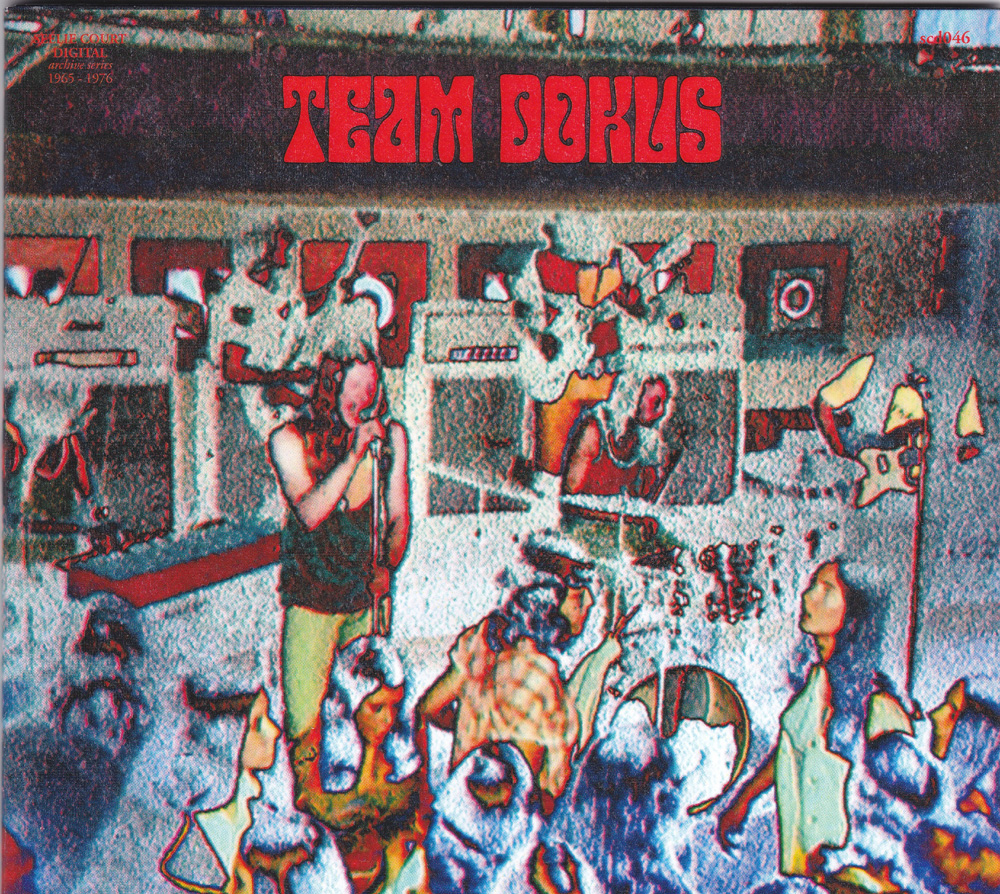
When Blandford Forum resident and vocalist Roger ‘Dokus’ Hope was edged out of local band The Room in favour of Jane Kevern in February 1969, he was approached by former members of The Push, guitarists Stephen Hall and Fred Fry, bassist Terry Lowe and keyboard player Phil Bridle to form their own outfit with eventual drummer Royston ‘Roy’ Stockley. The name they chose for this new band, Team Dokus, was a fusion of Roger’s nickname ‘Dokus’, given to him by Stephen Hall from the TV cartoon character ‘Diplodocus’ and the Formula one racing team Lotus. Managed by Graham Cole of the J. C. Theatrical Agency based in Weymouth, the band honed their repertoire of Black Sabbath, Fleetwood Mac, Deep Purple, Status Quo and Ten Years After covers, plus a smattering of originals, at local venues such as the Chequers Inn in Lytchett Matravers, the Old Harry pub in Poole High Street and the George Hotel, also in Poole.
By 1971, they were making headway on the national college and club circuit and recorded four tracks at Wessex Studios in Highbury New Park, Islington on 15th February. Two of the songs, “Tomorrow May Not Come” and “I Feel Your Fire” turned up years later on their sole album, while “My Name is Death” and “Feel a Little Higher”, have never been released.
Six months later, on 18th September, the band recorded an ambitious concept album with a nuclear holocaust theme set during World War 3 for the miniscule Sphere label, a subsidiary of CBS Records. Sandwiched between dates with Nazareth at The Temple in Wardour Street and Genesis at the Potters Bar Youth Club, the ten songs were hurriedly taped in a matter of hours, leaving no time for overdubs, refinements or corrections. On the day of recording, Terry and Roger were suffering from severe bouts of flu and were promised a chance to return at a later date to re-record their vocal parts, but the opportunity never materialised.
A couple of months later over two Saturdays in October, the band decamped to Regent Sound Studios in Denmark Street to record shorter versions of two songs from the album, “Fifty Million Megaton Sunset” and “Tomorrow May Not Come”, for a single. A small amount were released in London and it was picked up by John Peel who played it on his radio show, but the record never reached the shops nationally.
In 1972, Team Dokus entered the southern area final of the inaugural ‘Melody Maker National Rock and Folk Contest’ (as opposed to the ‘Melody Maker Search’ contest that Roger’s former band Room entered in 1970). Held at the Chelsea Village in Glen Fern Road, they beat off the opposition and progressed to the final held at the Roundhouse in Chalk Farm on Saturday 4th June 1972. The band missed out on a top three places and the chance of a recording contract because they were already signed to Sphere. The blues artist Lloyd Watson came out top in the solo category and the Anglo / American jazz rock outfit Listen was deemed to be the best band, while Team Dokus settled with fourth position. They received a consolation pat on the back from John Peel, plus a brand new Fender bass for Terry Lowe. Later, in 1972, the band broke up and returned to a quiet life in rural Dorset, becoming just another blip in the annals of rock history.
Vangelis, the Greek composer and musician whose synth-driven work brought huge drama to film soundtracks including Blade Runner and Chariots of Fire, has died aged 79. His representatives said he died in hospital in France where he was being treated.
Born Evángelos Odysséas Papathanassíou in 1943, Vangelis won an Oscar for his 1981 Chariots of Fire soundtrack. Its uplifting piano motif became world-renowned, and reached No 1 in the US charts, as did the accompanying soundtrack album.
Mostly self-taught in music, Vangelis grew up in Athens and formed his first band in 1963, called the Forminx, playing the pop music of the time: uptempo rock’n’roll, sweeping ballads and Beatles cover versions, with Vangelis supplying organ lines.
They split in 1966, and Vangelis became a writer and producer for hire, working for other musicians and contributing scores for Greek films. Two years later, he struck out for Paris to further his career, where he formed the prog rock quartet Aphrodite’s Child with Greek expats including Demis Roussos. Their single Rain and Tears was a hit across Europe, topping the French, Belgian and Italian charts and reaching the UK Top 30.
After they split – Vangelis deeming the world of commercial pop “very boring” – he returned to scoring film and TV. Turning down an invitation to replace Rick Wakeman on keyboards in Yes, he moved to London and signed a solo deal with RCA Records: his LPs Heaven and Hell (1975) and Albedo 0.39 (1976) each reached the UK Top 40, the former also used to soundtrack Carl Sagan’s popular TV series Cosmos. The connection with Yes was finally completed later in the decade, when he teamed with the band’s Jon Anderson for the duo Jon and Vangelis, whose debut album went Top 5.
Vangelis had continued his film score work throughout the 1970s, but it was in the 1980s that this reached its commercial heights. Chariots of Fire became inextricable from Vangelis’s timeless theme, and the music became synonymous with slow-motion sporting montages. “My music does not try to evoke emotions like joy, love, or pain from the audience. It just goes with the image, because I work in the moment,” he later explained.
His score to Blade Runner is equally celebrated for its evocation of a sinister future version of Los Angeles, where robots and humans live awkwardly alongside one another, through the use of long, malevolent synth notes; saxophones and lush ambient passages enhance the film’s romantic and poignant moments. “It has turned out to be a very prophetic film – we’re living in a kind of Blade Runner world now,” he said in 2005.
Later in the decade he scored the Palme d’Or-winning Costa-Gavras political drama Missing, starring Jack Lemmon; the Mel Gibson and Anthony Hopkins drama The Bounty; and the Mickey Rourke-starring Francesco. He worked again with the Blade Runner director, Ridley Scott, on 1992 film 1492: Conquest of Paradise, and elsewhere during the 1990s, soundtracked Roman Polanski’s Bitter Moon and documentaries by Jacques Cousteau.
Vangelis drew on Greek instrumentation alongside the typical orchestras used in film scoring on Oliver Stone’s 2004 classical epic, Alexander.
His most recent score is for El Greco, a 2007 Greek biopic of the Renaissance painter. The Greek artist, who moved to Spain and acquired his nickname there, was much admired by Vangelis, who composed albums in 1995 and 1998 that were inspired by and named after him.
Continually celebrated for his evocative Chariots of Fire theme, Vangelis was also commissioned by sporting bodies to soundtrack major events, including the 2000 Olympic Games in Sydney, the 2002 World Cup in Japan and South Korea, and the 2004 Olympics in Athens. He also wrote ballet scores and music for stage productions of Medea, The Tempest and other plays.
Solo releases remained steady alongside his commissioned work, and occasionally included collaborations with vocalists such as Paul Young.
A fascination with outer space found voice in 2016’s Rosetta, dedicated to the space probe of the same name, and Nasa appointed his 1993 piece Mythodea (which he claimed to have written in an hour) as the official music of the Mars Odyssey mission of 2001. His final album, 2021’s Juno to Jupiter, was inspired by the Nasa probe Juno and featured recordings of its launch and the workings of the probe itself in outer space.
"Someone" was an album from Axis, a band with Greek musicians who based in Paris. They played archetypical heavy progressive rock with great organ and electric guitars, with couple of tracks were even in line with the british mellotron-rock.
Axis disbanded in 1974, after the release of their third album. Like their more illustrious compatriots (Aphrodite's Child) they succeeded in breaking into the hit lists, with a Greek traditional called Ela Ela. Axis was also the backing band for the early recotdings by Demis Roussos, after the Aphrodite's Child split.
The last two songs are propably the best on the album, with prog experimentalism that included multi instrumental jams, Keyboard heavy with quirky sounds. One of the listenable obscurities this is worth the spin. Cool album cover.