This British cult band with Mod leanings, The Mickey Finn only put out a handful of singles, and it’s the first time that these (plus a couple of previously unavailable demos) have all been collected together. They were arguably the first British band to try their hands at ska- with their cover version of Bo Diddley’s Pills, included here. A very different interpretation to the rock & roll version by New York Dolls a few years later, this is also the band’s true debut, credited to Mickey Finn and The Blue Men, and also featuring a pre-Zeppelin Jimmy Page on harmonica on both sides of the single. (Although Page played some live dates with the band and was photographed with them, he was never an official member).
Before it was abbreviated, the same band name was also used for their false debut, the instrumental Tom Hark, another ska number (which was made famous a decade and half later by Piranhas, who added lyrics to it). It’s false because the band claim they had no involvement in the making of this record. Despite this, it is still included in the collection, probably because their name is on the original record. Elsewhere we have the R&B stomp that is I Still Want You, the cracking Mod-psych banger that’s the title track of this set, and my personal highlight, the freakbeat head-spinner, Time To Start Loving You.
The Mickey Finn covered a lot of musical ground in their short-lived career, and despite their modest vinyl output. It’s a shame they didn’t record more. An album would have been nice, but they never got around to actually making one: so in the absence of this, it’s good to have the singles all in one place. And the sleeve notes feature an insightful interview with the surviving members of the band.
by Arash Torabi
Tracks
1. Pills (Ellas McDaniel) - 2:37
2. I Still Want you (Mickey Waller, Alan Mark) - 2:28
3. Garden Of My Mind (Mickey Waller, Alan Mark, Bernard Jory) - 2:32
4. Night Comes Down (Shel Talmy, Jon Mark) - 2:12
5. Hush Your Mouth (Jimmy Reed) - 2:38
6. Time To Start Loving You (Mickey Waller, Alan Mark, Bernard Jory, Richard Brand, Fluff Cooke) - 2:41
7. Ain't Necessarily So (Ira Gershwin, George Gershwin, DuBose Heyward) - 3:19
8. If I Had You Baby (Lori Burton, Pam Sawyer) - 1:51
9. The Sporting Life (Chris Radmall, Shel Talmy) - 2:32
10.Because I Love you (Mis-Credited As I Do Loveyou) (Billy Stewart) - 2:09
11.Reelin' And A'Rockin' (Chuck Berry) - 2:23
12.Stagger Lee (Lloyd Price, Harold Logan) - 2:28
13.Poverty (Dave Clark, Pearl Woods) - 3:20
14.Miss Jane (Bernard Jory) - 2:59
15.God Bless The Child (Billie Holiday, Arthur Herzog) - 2:32
16.Tom Hark (Rupert Bopape) - 2:20
17.Please Love Me (Alan Hawkshaw) - 2:19
Old West dreams meet Southern memories in the tracks of Searchin' for a Rainbow, The Marshall Tucker Band's fourth album. Released in 1975, this song collection found the group refining its multifaceted sound into an appealing country rock essence. Still present were the jazz and blues-based elements that had always made Marshall Tucker a distinctive unit. By dressing up their music in Western garb, the band found a way to reach a huge new audience-all it took was a little "Fire On The Mountain" to light the way. "We'd found a bit more direction on how to design songs for a record," says lead singer Doug Gray. "Our record company Capricorn had always said, 'Try to give us something that would work on the radio.' We tried to do that, and at the same time please each other. We were known as a jamming band. This was the first time we really tried to give them Marshall Tucker's interpretation of what a hit song was."
Some three years of near-constant touring and steady recording brought the band to this point. Formed in Spartanburg, SC in 1972, the group united lead guitarist Toy Caldwell, vocalist Doug Gray, bassist Tommy Caldwell, rhythm guitarist George McCorkle, drummer Paul Riddle and reed player Jerry Eubanks in a unique musical partnership. Named for a local piano tuner, the band established itself on the road (often sharing the bill with the Allman Brothers) as a formidable live act. Marshall Tucker's compelling mix of rock, country, blues and jazz set them apart from their peers and ensured them a rabid following in the Southern States and beyond.
At the core of the band's sound was Toy Caldwell's guitar virtuosity and heart felt way with a song. By all accounts, he was constantly working on his music. "Toy was a compulsive songwriter," Paul Riddle says. "At times, music would just pour out of him. I remember one time we were on the road-Toy had just written a verse for 'Searchin' For A Rainbow.' We stopped at a truck stop and I went in to get him a cheese sandwich. By the time I came back, he had the tune finished in less than 10 minutes. It was amazing."
Toy's growing skill on the pedal steel guitar was a factor in the band's move towards a more countrified approach. He developed a jazz-influenced style that was a cut above the typical twanging sounds most players coaxed out of the instrument. "I think it was a challenge for him," says Doug. "The first night he got his pedal steel guitar in Atlanta, he sat there playing it for two or three hours before we started our show. He really developed his own way of playing it."
Searchin' for a Rainbow also reflected The Marshall Tucker Band's growing acceptance among mainstream country musicians. Waylon Jennings, for instance, went on to score a hit single on the country charts with a cover of "Can't You See," a track from the band's first album. Hank Williams, Jr. performed with them at shows in Birmingham. Some in the Nashville music establishment still thought Marshall Tucker was too rock 'n' roll to fit into country radio formats. Eventually, though, hit-makers like Alabama lead singer Randy Owens would acknowledge the group as a key influence. Helping to spur things on was "Fire On The Mountain," the lead track off Searchin' for a Rainbow. Released as a single in the fall of 75, the tune reached #38 on the pop charts. A vivid, Old West, lyric-storyline combined with bluegrass tinged instrumental licks and an ear-grabbing chorus brought Marshall Tucker its first Top 40 hit.
"Fire On The Mountain" was written by George McCorkle, his first composition to be recorded by the band. Doug remembers seeing its potential from the start: "George called me over and had me sing a little bit of it. I said “Man th is going to be a great song.'" Coincidentally, Charlie Daniels (who contributed fiddle to numerous Marshall Tucker albums, including Searchin' for a Rainbow) released an album by the same name around this time, causing a degree of confusion. Before "Fire ...," Marshall Tucker had primarily been heard on FM radio. The song served to introduce the band to a whole new crowd of listeners. Doug says, "At first, we just had the cool people coming to our shows. Then all of a sudden, we had this hit and these teenyboppers started coming out to see us. I remember all these young guys who were sporting cowboy hats and boots—it was a whole new world for them. We noticed that we were drawing a younger crowd, and we started playing more venues that people under 21 could come to." Those new fans who picked up Searchin' for a Rainbow discovered that Marshall Tucker was much more than a singles band. The album ranks among the group's best work, sonically rooted in Southern traditional styles while displaying an individual edge
As with previous albums, Toy Caldwell contributed most of the songs. Lyrically, he delves into Western scenarios in "Virginia" and the title track, contrasting the hunger for gold with the need for faithful love. The pleasures of Southern country life are celebrated in "Bob Away My Blues," while "Bound And Determined" is a bluesy look at a troubled romance. Musically, the album stretches from old-time country to steamy R’n’B and toe-tapping jazz. Toy's pedal steel playing swoops and swoons on "Bob Away My Blues" (invoking memories of Bob Wills and his Texas Playboys) and adds a gentle caress to "Keeps Me From All Wrong" (written by brother Tommy). Doug proves his vocalist mettle throughout, veering from honky-tonk testifying to blues belting as the songs require. Jerry Eubanks particularly shines on "Walkin" And Talkin'," a joyfully swinging number. Several guest players are worthy of note. Allman Brothers guitarist Dickie Betts and keyboardist Chuck Leavell contribute their signature touches to the title track and "Bound And Determined," respectively. As on earlier Marshall Tucker albums, producer Paul Hornsby adds dashes of New Orleans piano and gospel-drenched organ here and there.
Rounding out Searchin' ... is a live recording of "Can't You See," taken from a July 1974 show in Milwaukee. This smoldering treatment of the tune-first heard in studio form on the group's debut album-reaffirms Marshall Tucker's status as one of rock's premier jam bands. There's a wrinkle in his playing, Paul Riddle points out: "Listen to the intro-the song is in half-time, but something compelled me to play the first eight beats in double time. Tommy got so tickled, I swear we were about to stop the song. It's an absolute hoot!" Searchin' for a Rainbow brought the band another gold album and eventually 'went platinum as well. "Fire On The Mountain" helped pave the way for even greater success on radio with the 1977 hit "Heard It In A Love Song." Enduring personal tragedy and weathering line-up changes, The Marshall Tucker Band has continued on into the present day. Their creative fires continue to burn bright.
by Barry Alfonso
Tracks
1. Fire On The Mountain (George McCorkle) - 3:56
2. Searchin' For A Rainbow - 3:52
3. Walkin', Talkin' - 2:31
4. Virginia - 4:54
5. Bob Away My Blues - 2:47
6. Keeps Me From All Wrong (Tommy Caldwell) - 4:17
7. Bound, Determined - 4:24
8. Can't You See (Live) - 6:31
9. It Takes Time (Live) - 3:44
All songs by Toy Caldwell except where indicated
The Marshall Tucker Band
*Toy Caldwell - Vocals, Electric, Acoustic, Steel Guitars
*Tommy Caldwell - Vocals, Bass Guitar
*George McCorkle - Electric, Acoustic Guitars
*Doug Gray - Vocals, Percussion
*Jerry Eubanks - Saxes, Flute, Vocals
*Paul Riddle - Drums Guests Friends
*Richard Betts - Guitar Solo On "Searchin' For A Rainbow"
*Paul Homsby - Piano, Organ
*Charlie Daniels - Fiddle
*Chuck Leavell - Electric Piano
*Jerome Joseph - Congas
*Al McDonald - Mandolin
*Leo LaBranche - Trumpet, Horn Section Arrangements
Rare or previously unissued psychedelic gems from late 1960s San Francisco, produced at Leo Kulka’s studio, Golden State Recorders.
When it opened for business in the autumn of 1965, Golden State Recorders was the first large Hollywood-style studio inSan Francisco, with a brand new solid-state board and an expansive main room, perfect for replicating the ambience of the psychedelic ballrooms. Indeed, founder and chief engineer Leo de Gar Kulka had begun offering his services right as the Bay Area witnessed the explosion of its own well-documented rock scene, and thus during its first few years Golden State was the local independent recording venue most frequently visited by the city’s new breed of musician, along with the hordes of attendant A&R men hopeful for the next big thing.
Golden State hosted some of the most genuinely trippy and experimental rock recording sessions held in San Francisco in the late 1960s, but Kulka could not keep his large facility going on bookings alone, and so he also used the studio to attract talent that could be secured to a contract and sold on to labels. Reflecting the prevailing atmosphere in the Bay Area, much of what Golden State recorded under its own production umbrella had a frisson of psychedelic fancy, and at this juncture some 50 years hence, recordings deemed failures at the time are now collectors items, or certainly worthy of a second look, as “Golden State Psychedelia” amply demonstrates.
Some of the earliest and best-loved releases in Big Beat’s “Nuggets From The Golden State” series were based on repertoire from Golden State Recorders. This latest instalment continues to celebrate the studio’s legacy, restoring material from deleted volumes, as well as exhuming more psychedelic gems from the GSR vault. Since Ace Records acquired the catalogue in 2006, we have had the opportunity to revisit the tapes, this time with a fine-toothed comb.
Therefore, aside from rare singles by the Tow-Away Zone and Seventh Dawn, “Golden State Psychedelia” is comprised wholly of material that did not see release at the time, and was all recorded between 1966 and 1971. Highlights include the commercial pop-psych stylings of the Bristol Boxkite, Carnival and Ticket Agents, the punkadelic Goody Box and Immediate Family, and some outrageous studio experiments by Magician and the Gants. With full details on the participants contained in the liner notes, “Golden State Psychedelia” is a package no fan of this entrancing genre will want to miss.
by Alec Palao
Artist - Track
1. The Goody Box - Blow Up (Norman Hadsell) - 2:37
2. The Carnival - Meditorium - 2:19
3. The Tow-Away Zone - Shab'd (Joan Cutting, Phil Franks, Randy Molitor) - 2:58
4. The Bristol Boxkite - Sunless Night (Bill Ellis, Sandra White) - 3:03
5. The Immediate Family - Rubaiyat (Kriss Kovacs, Omar Khayyam) - 2:38
6. The Ticket Agents - Black Diamonds (David Salk) - 2:04
7. The Short Yellow - Highway Highway (Gary Thorp) - 2:21
8. Celestial Hysteria - Speed (Harold Greer, John Allan, John Barsotti, Mark Buvelot, Mary Hazlewood) - 2:38
9. Magician - Fuck For Peace - 3:58
10.The Carnival - Infinitation - 2:16
11.The Bristol Boxkite - Mad Rush World (Bill Ellis) - 2:44
12.The Seventh Dawn - Don't Worry Me (Darius Phillips, Sue Phillips, Tom Noyer) - 2:37
13.Just Slightly Richer - My Kind Of People (Dan Talbot) - 3:01
14.The Tow-Away Zone - Daddy's Zoo (Bill deHaan, Phil Franks, Randy Molitor, Ray McCarty) - 3:45
15.The Short Yellow - Hand Full (Gary Thorp) - 2:43
16.The Goody Box - Ah Gee (Norman Hadsell) - 2:31
17.The Immediate Family - Wet Chant (Kriss Kovacs) - 5:36
18.The Bristol Boxkite - Chasing Rainbows (Frederic Chopin, Harry Carroll, Joseph McCarth) - 2:22
19.Celestial Hysteria - New Song Aka Going Home (Harold Greer, John Allan, John Barsotti, Mark Buvelot, Mary Hazlewood) - 2:57
20.The Carnival - Years Have Passed Away - 2:13
21.Just Slightly Richer - Solitude (Al Roberts, Dan Talbot, Larry Goldberg, Robert Sanders, Steve Allyn) - 2:51
22.The Bristol Boxkite - Who Are We (Bill Ellis) - 2:27
23.The Short Yellow - Start Seeing (Gary Thorp) - 2:29
24.The Royal Family - Love Is The Greatest Thing (The Royal Family) - 2:48
25.The Gants - Sunday At The Lotus Parlor (Brian Johnson, Dennis Battaglia, Kim Edwards, Tim Grand) - 2:51
Indian Summer were formed in the summer of 1969 by keyboardist Bob Jackson, guitarist/vocalist Colin Williams, drummer Paul Hooper and bassist Malcolm Harker. Based in Coventry they toured the local universities and colleges in their native Midlands before being spotted by manager Jim Simpson who also looked after Black Sabbath and Bakerloo amongst others.
In fact, they often filled in for Sabbath when they were too poor to be able to afford to get to the gigs they were booked to play! Ex-Vertigo Records manager Olav Wyper had been employed by RCA to head its progressive Neon Records label and, after a recommendation from Simpson, he signed the band after witnessing them go down a storm at Henry's Blues House in Birmingham. Teaming them with producer Rodger Bain, who'd produced Black Sabbath's self titled debut album, he put them into London's legendary Trident Studios to record their debut album.Indian Summerwas released in early 1971 (NE3) though a proposed single "Walking On Water" failed to see the light of day.
Immediately after the album's release, Harker left to take over his father's engineering firm (he currently lives in America). His replacement was Wez Price, ex-The Sorrows, who undertook the promotional duties required of the band, including dates in Switzerland. However, on returning from a gig in early 1972 with no money (and a bag of chips between them!) the band felt that something was wrong and decided to call it a day.
Colin Williams retired totally from the music industry to take up employment in the motor industry. Paul Hooper played in various Midlands based bands before teaming up with Bob Jackson in The Dodgers for 1978's Love On The Rebound album, and is currently a member of The Fortunes.
After extracting himself from his contract with Jim Simpson, Bob Jackson teamed up with ex-John Entwhistle vocalist Alan Ross for two LPs and numerous tours. He then joined Moon on their Too Close For Comfort LP of 1976 before passing an audition for Badfinger who he stayed with for nearly three years. He then formed the Dodgers with Paul Hooper before joining ex-Uriah Heep vocalist David Byron for theOn The RocksLP. Since then he's played with the likes of The Motors, The Searchers, Jeff Beck, Jack Bruce and Pete Brown and still plays in local bands as well as teaching music.
by Mark Brennan - Special thanks to Bob Jackson
Tracks
1. God is the Dog - 6:37
2. Emotions on Man - 5:44
3. Glimpse - 6:44
4. Half change Again - 6:26
5. Balck Sunshine - 5:25
6. From the film of the Same name - 5:52
7. Secret reflects - 6:46
8. Another Three will Grow - 6:06
All compositions by Indian Summer
IF was a seminal jazz-rock band formed in 1969 as Britain's answer to the pioneering US bands Blood, Sweat and Tears and Chicago. The main difference was that IF did not have a trumpet or trombone player and featured two saxes instead. Essentially a live band, true to its strong jazz influences IF was probably the only jazz-rock group, both then and now, to feature solos by all the band members, not just by the lead instruments.
The definitive seven-piece line-up was J.W. Hodkinson on lead vocals, John Mealing on keyboards, Jim Richardson on electric bass, Dennis Eliott on drums, with Dave Quincy on alto and tenor saxes, Terry Smith on guitars, and Dick Morrissey on tenor and soprano saxes and flute. IF finally broke up in 1975.
These sessions were recorded in London between December 1970 and July 1972, the band is in great shape and sound is much more than good.
Tracks
1. Your City Is Falling (Dave Quincy) - 3:57
2. I Couldn't Write And Tell You (Dave Quincy) - 7:07
3. Sunday Sad (Dick Morrissey) - 6:55
4. Tarmac T. Pirate And The Lonesome Nymphomaniac (John Mealing, Trevor Preston) - 3:10
5. Upstairs (B. Morrissey, Dick Morrissey) - 3:49
6. Sweet January (Dave Quincy, Trevor Preston) - 5:31
7. Forgotten Roads (Dave Quincy, Trevor Preston) - 3:58
8. Fibonacci's Number (Dave Quincy) - 7:52
9. Seldom Seen Sam (Terry Smith, J.W. Hodkinson) - 4:33
10.Far Beyond (John Mealing, Trevor Preston) - 4:57
11.The Light Still Shines (Live) (Dave Quincy) - 6:36
12.What Did I Say About The Fox, Jack? (Live) (Dick Morrissey) - 8:18
13.Waterfall (Live) (Dick Morrissey, B. Morrissey) - 5:39
14.Seldom Seen Sam (Live) (Terry Smith, J.W. Hodkinson) - 7:19
Of the many psychedelic groups who recorded unreleased material in the 1960s that didn't get issued until decades later, Canterbury Glass was one of the more unusual and interesting. The tracks they recorded for a prospective album in 1968 mixed classical religious music and psychedelic-progressive rock not as a gimmick, but with reasonable dignity and creativity. While only four of the six tracks from these sessions could be retrieved when Canterbury Glass material was finally released on CD in 2007, these added up to 40 minutes of well-recorded music, providing a reasonable facsimile of what might have appeared had the band landed a recording contract.
Canterbury Glass' origins lay in the mid-'60s London folk-blues duo of Malcolm Ironton and Michael Wimbleton, who as Mick & Malcolm recorded a couple of singles for Pye. Forming a band after their Pye days ended with drummer Dave Dowle and bassist Tony Proto, Ironton eventually turned to a more psychedelic direction under the influence of bands like Pink Floyd and the Moody Blues. Ironton and Proto began writing material, sometimes sung in Latin, that drew on the classical-flavored music sung and played in cathedrals. Adding keyboardist/guitarist Mike Hall (whose organ would give the group's material much of its classical/religious flavor) and singer Valeri Watson (who also played flute), Canterbury Glass played in London venues like Middle Earth and Eel Pie Island.
London arranger Harry Roberts heard a two-song demo, and with his partner, Olympic Studios owner Cliff Adams, arranged for the group to record an album's worth of material at Olympic. The six tracks, which fused guitar-based psychedelia with choral harmony vocals and heavily classical-influenced melodies and keyboards, were designed to draw a deal from bigger labels, but Polydor and CBS both passed on the band after showing some interest. The band broke up soon afterward, though not before future Genesis guitarist Steve Hackett, who'd played on one track on the sessions, joined as guitarist for a short time. Drummer Dave Dowle joined Brian Auger's Trinity in 1969, and quite a while later, he turned up in Whitesnake.
In 1968, Canterbury Glass recorded six tracks in London for an album that went unreleased at the time, the group disbanding after interest from a couple record labels fell through. Nearly 40 years later, many of the tapes were rediscovered and issued on this CD. This isn't quite the original album; two of the six tracks couldn't be found, and the "bonus" cut, a demo of one of the two missing songs, apparently bears no resemblance to the version recorded for the album. Still, since all four of the tracks retrieved from the original album sessions last around ten minutes, the CD does offer what would have been a healthy-sized LP by 1968 standards. Unlike many such relics to see the light of day in the CD age, it's not a run-of-the-mill psychedelic outing in terms of either style or quality. With the religious tones of both the music and lyrics (some of which are sung in Latin), it's a little like hearing the Electric Prunes' late-'60s pseudo-religious concept LPs, but as done by a British band whose members were playing it straight, rather than because some producers and arrangers foisted a gimmick upon them.
There's a consciously cathedral-music-goes-rock flavor to the proceedings, the standard psychedelic guitar rock being augmented by churchy organ, harpsichord, flute, and male-female choral harmonies. In some respects, the blend resembles psychedelic-early progressive rock crossover bands like Procol Harum and Caravan, the difference being that while those groups used classical-religious influences as a prominent shading, Canterbury Glass employ them as driving forces. While there's an earnest naïveté to the proceedings that might either charm or turn off listeners depending on their tastes, it's also haunting and unusual, and not nearly as explicitly derivative as many such unsigned bands of the era. It's a worthwhile curiosity for those who want to hear what was briefly called "God rock" done with accomplished integrity, though the bluesy demo of "We're Going to Beat It (Battle Hymn)" isn't nearly up to the standards of the rest of the material.
by Richie Unterberger
Tracks
1. Kyrie - 9:50
2. Nunc Dimittis - 8:31
3. Battle Hymn - 4:32
4. Prologue - 8:54
5. The Roman Head Of A Marble Man - 5:41
6. Gloria - 10:11
7. We're Going To Beat It (Battle Hymn Demo) - 5:11
All compositions by Malcolm Ironton, Tony Proto
Originally released in 1979 this same-titled from Louisiana's Potliquor. By 1979, the band had undergone noticable changes both with an overhaul of the entire lineup (minus bassist Guy Schaeffer) and the band's musical direction. Where Potliquor's style first was drenched in gospel influenced southern rock, this reborn lineup rather aimed for Allman Brothers territory.
Along with a lineup change, the band also found a new home at Capitol Records, which presented greater career possibilities than their previous contract with the smaller Janus label. Whether this change prompted mass resistance is not known, but surely fans were divided when the singles from this effort hit the airwaves later that year. It is known that the band toured for a year or so before collapsing. Members went on to work in various bands as well as pursuing other interests outside of the business.
Tracks
1. Right Street-Wrong Direction (Jerry Amoroso, Steve Gunter) - 4:05
2. Red Stick 3:47
3. Misery 3:02
4. Mr. President (Randy Newman) - 2:17
5. Hey Mama 4:40
6. Boy Oh Boy 3:43
7. Life Should Be A Laugh 3:54
8. Liar (David Craig, Jerry Amoroso) - 2:30
9. Louisiana Lady (Harry Vanda, George Young) - 3:39
10.Oh So Long 4:20
All songs by Jerry Amoroso except where stated
Louisiana Rock 'n' Roll wriggle out from the muddy swamps of Potliquor's home state and straddled the line between country, blues, southern rock and hard rock...all the while throwing in horns just to keep things fresh. With a powerful singer in George Ratzlaff, Potliquor were able to muster some pretty inspired moments on vinyl. "Pot Liquor was a top regional touring act.
Like many great bands, they never sold records like they should have. But they did tour, and expose many young southerners to what amounts to some of the first "southern rock" bands. Some of the best music, ever! And, the best name ever for a southern rock band! As for "Louisiana Rock and Roll", it rocks! From the opening of "You Can't get there form Here, to the closing track, "Guitar Boogie", this is one of the finest rock and roll records.
Tracks
1. You Can't Get There From Here (Casey Kelly) - 3:15
2. Waitin' For Me At The River (George Ratzlaff) - 4:21
3. Taj And Jimmy's Blues (Taj Mahal, Jimmy Reed) - 5:38
4. Rip It Up (Les Wallace, Loretta Wallace) - 2:34
5. H (Les Wallace, Loretta Wallace) - 4:48
6. Louisiana Rock & Roll (George Ratzlaff) - 3:20
7. St. Jude's Blues (Jerry Amoroso) - 2:57
8. Born Under A Bad Sign (William Bell, Booker T. Jones) - 5:20
9. Guitar Boogie (George Ratzlaff) - 3:36
10.For You (Les Wallace) - 4:33
The Potliquor
*Jerry Amoroso - Drums, Percussion, Vocals
*Les Wallace - Guitar, Vocals
*George Ratzlaff - Keyboards, Guitar, Vocals
*Leon Medica - Bass, Vocals
*Guy Schaeffer - Bass, Vocals Additional Musicians
*Glenn Spreen - Moog Synthesizer
*Cy Frost - Strings, Clavinet, Piano
*Unkle Back Wood - Fiddle
*Lee Fortier, Art DeCesare, Bud Brasher - Strings
*Peter Verbois, Bill Ludwig, Nic Rousse, Charlie Deruy - Strings
Mason Proffit were an unknown country-rock band that released 5 good albums between 1969 to 1973. They originally formed out of the ashes of Sounds Unlimited, a hard edged Chicago garage band with a good sense of melody and song structure. Mason Proffit had strong elements of blue grass and folk in their sound but could also rock hard when the mood suited them. They were all excellent musicians and wrote poetic lyrics that occasionally reflected the times (war, protest, and religion).
Wanted was one of the first country-rock records, released off the Happy Tiger label (Dunwich) in 1969. Terry (guitar and vocals) and Johnny Talbot (guitar and vocals) were the foundation of Mason Proffit and often sang beautiful tenor harmonies. Wanted should really be up there with the country rock innovators but many feel that Mason Proffit lacked notoriety because their records were released off small independent labels. It’s an ambitious album to say the least and similar to latter period Byrd gems The Ballad of Easy Rider (1969) and Untitled (1970).
Two Hangmen is a folk-rock song that received lots a radio exposure back in the late 60’s and is now considered a folk-rock classic. It’s by far the most popular song on this record that has many more impressive moments throughout its 30 minutes plus running time. Some songs have sweeping orchestrations, such as the excellent country-rocker, You’ve Finally Found Your Love and a sensitive banjo ballad, Till The Sun’s Gone. Other tracks such as Voice of Change and Rectangle Picture are tuneful, quality songs that skillfully integrate political views and protest the current Vietnam War. A personal favorite is Sweet Lady Love, a pounding bayou rocker with pedal steel guitar and a great acid fuzz solo towards the end. It almost sounds like a great lost Creedence Clearwater Revival track and justifies purchasing this album alone.
For many years Wanted was unavailable but in 2006 the Water record label gave this great album a new lease on life. Mason Proffit would go on to make 4 other fine records though Last Night I Had The Strangest Dream (1971) is often quoted as their masterpiece.
by Jason Nardelli
Tracks
1. Voice Of Change - 2:55
2. A Rectangle Picture - 2:22
3. You Finally Found Your Love - 4:23
4. Sweet Lady Love - 3:53
5. Stewball (Traditional) - 3:32
6. Two Hangmen - 5:01
7. Buffalo - 2:04
8. Walk On Down The Road - 2:57
9. It's All Right - 2:33
10.Till The Sun's Gone Down - 3:26
11.Johnny's Tune - 1:16
All songs by John Talbot, Terry Talbot except track #5
Playing a well behaved version of San Francisco west coast and Midwestern hippie rock with slight progressive moves, 'Miracle Licks' will appeal to those who long for the hazy days of Grand Funk Railroad, early REO Speedwagon and more importantly Quicksilver Messenger Service. 'Honey I Do' is standard '70s good time rock, pleasant enough blue-jean boogie and the type of thing that backed-up clogged airwaves in the early part of the decade, but it's the final track on this side that wins points for creativity. 'The Sun Keep Right On Shining' with its well placed use of Mellotron and haunting melody makes searching for this record all the more worthwhile.
As shamefully post-Woodstock a title as 'Everybody's Got to Have A Song' is, you would be forgiven for expecting the worse but it's actually a very good tune with excellent vocals from John Micaleff who shines on much of the record. 'Never Felt Better' sounds like an REO Speedwagon/ Neal Doughty styled rocker featuring a prairie burning organ solo and barroom piano with 'Take A Look At Yourself' closing out the album along similar lines making for a slightly above average album of groovy Midwest rock- New York style.
Thirty Days Out bass player Monte Melnick ended up as tour manager for New York punk darlings The Ramones, but trying to find much else on this east coast band is next to impossible. The group released a self-titled album in 1971 sent to record stores not in shrink wrap, but housed in a poster of a Steamliner. A novel idea and it received a lot of attention from store owners and record buyers, but the band's second album 'Miracle Lick' didn't fare quite as well and the band folded shortly thereafter.
Tracks
1. Honey I Do (Jack Malken, John Micallef) - 3:54
2. I Need You - 3:23
3. Any Other Day (Phil Lowe) - 3:14
4. Tupelo (Jack Malken, John Micallef) - 2:53
5. The Sun Keeps Right On Shining - 5:40
6. Everybody's Got to Have A Song - 5:25
7. Phoenix - 2:49
8. Never Felt Better - 4:11
9. Take A Look At Yourself - 6:08
All compositions by John Micallef except where stated
Thirty Days Out
*Phil Lowe - Drums, Vocals
*Jack Malken - Lead Guitar, Vocals
*Monte Melnick - Bass, Keyboards, Vocals
*John Micaleff - Vocals, Guitar
*Nicky Harrison - strings
*Bing McCoy, Teddy Taylor - keyboards, mellotron
*Madeleine Bell, Doris Troy, Lisa Strike, Christine Ohlman - background vocals
The beginning of Sitting Bull is closely linked to the musical history of bandleader Bernd Zamulo. Bernd Zamulo grew up near Bremen where he played with a few local bands. At a Lords concert in 1965 he met the band and they clicked from the start and at another gig Bernd was invited to play bass with them. It was a perfect performance and he sung the classic "Boom Boom". Later on that year the Lords bassist, Lord Knut, had a bad accident and was unable to continue playing so they asked Bernd to take his place for the rest of the tour. In the autumn of 1965 Bernd left his band Rhythm Brothers, and joined the Lords. With his other talents as a pianist, guitarist and singer he was quite a find for the Lords.
The following years saw the Lords produce many hit singles arid albums making a lot of money in the process. Bernd was getting restless though and wanted to leave the mainstream and take a change towards more progressive music. He was in a quandary though as he was good friends with the other band members but could not realize his musical ambitions with them.
In the beginning of 1971 he made his decision and left the Lords which in turn led to the break-up of the band who in fact reformed years later. The break-up of the Lords created a furor in press but could not hold Bernd back from his decision and he went looking for new musicians, which didn't take long. Bernd's interest in American Indians led to the group being called Sitting Bull. His past career with the Lords put him in good stead with the music industry making it easier to find a record deal.
To avoid record company influence the band decided to produce their record themselves but this was a costly matter and the money had to come from somewhere. Although Bernd made a lot of money with the Lords he also lived well and his lifestyle had to change, lie moved away from the costly Dusseldorf and moved to a hunting cottage in Oldendorf outside Bremen and sold off some of his luxurious possessions that he accumulated with the Lords.
With a record company advance from CBS Sitting Bull moved into Hamburg's Windrose studio to record their debut LR The band were able to use the excellent facilities and were able to emulate their contemporizes from Britain and America and record whenever they felt like it. They were able to do exactly what they wanted in this top studio and were not bothered about making their music commercial, the love of music was enough. As the sessions were lengthy and costly the band had to move out of their hotel and into an empty house.
When the LP finally arrived CBS took two songs for a single and arranged a promotion tour which proved impossible to finish because the band's lifestyle was so chaotic they were not even able to turn up for some of the dates! The record company was not too pleased about this and the band broke up after being together for nearly two years. With a changed line-up they recorded two singles for Philips. Two titles we have chosen as bonus tracks.
Bernd Zamulo decided to take a break and in 1975 joined up with his former colleagues from the newly reformed Lords where he has stayed until today. Compared with other German bands the Sitting Bull album was a success and entered the LP charts accumulating positive press critique on the way. The autonomy of the music was praised especially the long improvised epic Krautrock songs.
The title song of the album. "Trip Away'' was over ten minutes long and showed the clear structural and musical abilities of the band. Untypical for German bands of the time Sitting Bull were influenced by West Coast music which when given the German treatment was a special experience.
by Manfred Steinheuer
Many thanks to B. Zamulo for his kind help.Translation: Trevor Wilson
Tracks
1. Trip Away (Pit Schimkat, Sabine Schöffler) - 10:19
2. Song Of Junk (Bernd Zamulo, Pit Schimkat, Sabine Schöffler) - 3:51
3. Every Time (Pit Schimkat, Sabine Schöffler) - 3:17
4. Indian Fate (Pit Schimkat, Sabine Schöffler) - 3:55
5. Hopeless Love (Bernd Zamulo, Pit Schimkat, Sabine Schöffler) - 2:50
6. Too Many Stops (Jochen Jaschinski) - 4:24
7. For Me For You (Jochen Jaschinski) - 4:26
8. Business Woman (Pit Schimkat, Sabine Schöffler) - 3:47
9. Lonely Lover (Bernd Zamulo, Pit Schimkat, Sabine Schöffler) - 3:57
10.Clean Survival (Bernd Zamulo, Jochen Jaschinski) - 4:01
11.Motorcycle Mama - 2:07
12.Your Lovin' Man - 1:47
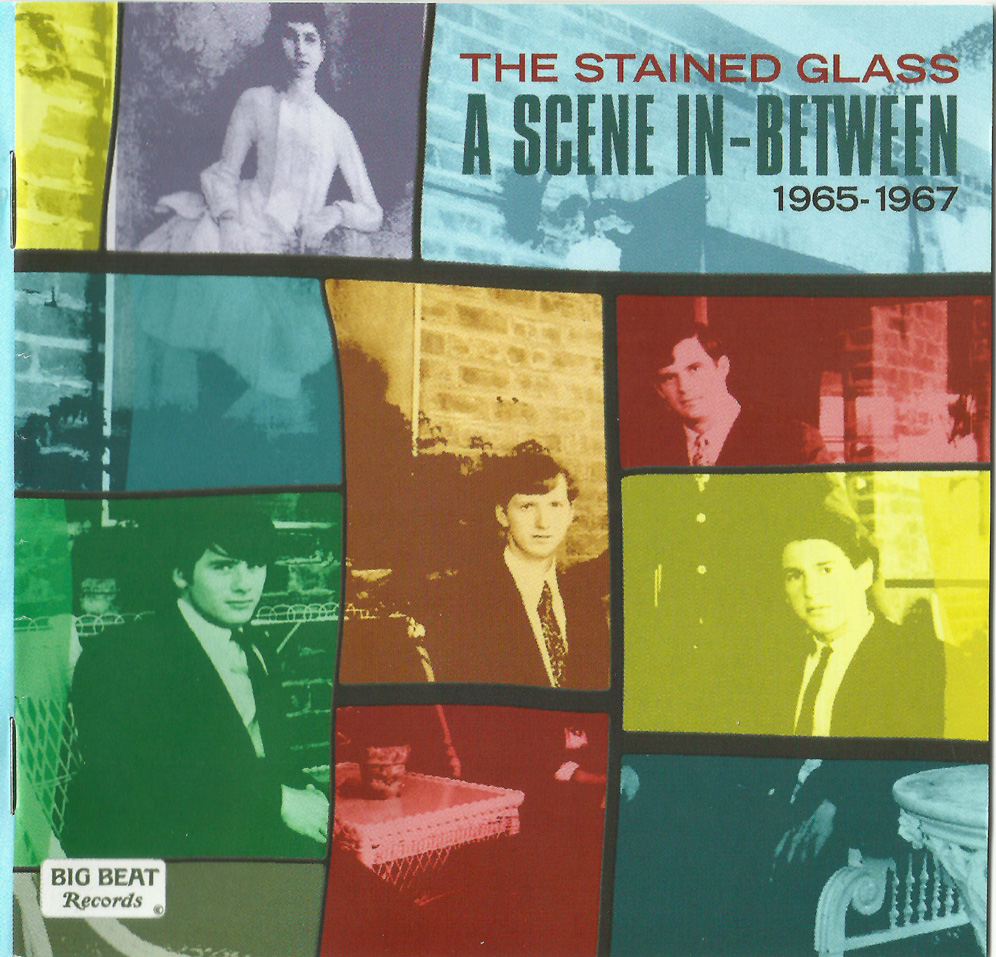
“A Scene In-Between” is the story of a group who fell through the cracks.An act with the Stained Glass’s capabilities should have been huge.Mid-60s San Jose, California had a thriving music scene, but was overshadowed by that of neighbouring San Francisco.
Compared to the garage stylings of the Chocolate Watchband or Count Five, the Glass boasted a quirky and melodic demeanour, one which captured the European beat group zeitgeist better than other local groups.
They had progressive and innovative material, the product of the fertile imagination of bass player Jim McPherson.A singular talent quite without compare on the local scene, McPherson threw musical curveballs that caught the ear, and pollinated each lyric with an intriguing worldview.These were not the thought processes of the typical garage band.
Jim’s songs also benefited enormously from the assistance of drummer Dennis Carrasco and guitarist Bob Rominger.The pair’s superlative vocal and instrumental capabilities drew out the melodic possibilities of the arrangements.Just as important was the founding member of the Stained Glass, Roger Hedge; without his drive the band’s repertoire may never have reached the general public.
The quartet began as the Trolls in 1964, issuing the fantastic punk item ‘Walkin’ Shoes’ themselves before a run of singles on RCA which included the pop-psych gems ‘My Buddy Sin’ and ‘A Scene In-Between’.Although the Glass later signed to Capitol for two albums, including 1968’s acclaimed “Crazy Horse Roads”, our collection focuses on their first incarnation, and presents the best of their released tracks from then, along with a swathe of exceptional unissued recordings that reveal their smart songwriting and innovative sound.Highlights include several sides cut as the Trolls; the rocking out-takes ‘Broken Man’ and ‘Bubble Machine’; intriguing demos such as ‘Second Day’ and ‘Revenge Is Sweet’; and some raw live tracks that further showcase their abilities.All songs are from master tape, and the heavily-illustrated booklet delves into the Stained Glass’ career with great detail.
There are some projects I have toiled at for years, waiting patiently for a break in which to move forward.This particular set has been in my mental In Box ever since I found a copy of ‘Walkin’ Shoes’ in an Oakland disc emporium, not long after moving to the Bay Area over a quarter-century ago.I subsequently located the other Stained Glass records, all of a high standard, but it wasn’t until I investigated their unreleased material some years later that I appreciated how special they were.As each year dragged on, patiently waiting for the various permissions required, I got to know the various parties: Jim McPherson’s supportive widow Evy, the affable Mr Carrasco and the erudite Mr Rominger.Then, as we moved into the home stretch, as if by magic the enigmatic Roger Hedge materialized from the ether.He not only handed me the long-thought-lost Trolls master tapes, but also spun tales of his days when he was a national badminton champion.
Thus with the release of “A Scene In-Between”, this long, strange trip has a most satisfying resolution.Jim McPherson’s aptitude was evident, confirmed by his later association with local SF rock heavies which included John Cipollina’s Copperhead and a successful writing career for others such as Jefferson Starship.His work with the Stained Glass was viewed largely as an apprenticeship, his “baby pictures”, if you will.But the short few years documented on this collection reveal his one-of-a-kind talent was in full flower even at that early stage.And to a man, his fellow travelers: Dennis Carrasco, Bob Rominger and Roger Hedge brought that talent to life with their essential contributions.Any musician should be proud of baby pictures such as these.
by Alec Palao
Tracks The Trolls
1. Walkin' Shoes - 2:08
2. She's Not Right - 2:17
3. How Do You Expect Me To Trust You? - 2:51
4. No Rhyme Or Reason (Roger Hedge) - 2:21
5. Sweeter Than Life - 2:27
6. Such Good Friends - 1:46 The Stained Glass
7. Broken Man - 2:38
8. Lonely Am I (Bob Rominger) - 2:25
9. If I Needed Someone (George Harrison) - 2:12
10.My Buddy Sin - 2:55
11.Vanity Fair - 3:01
12.Revenge Is Sweet (Bob Rominger) - 2:07
13.We Got A Long Way To Go (Barry Mann, Cynthia Weil) - 2:34
14.Inside Ouch - 2:14
15.Too Fit To Be Tied (Demo) - 3:39
16.Dollar Sign Friends (Demo) (Bob Rominger) - 2:18
17.Second Day (Demo) - 2:44
18.Bubble Machine - 2:55
19.Mediocre Me - 2:45
20.A Scene In-Between - 2:38
21.Mr Martyr - 2:21
22.You Keep Me Hangin' On (Live) (Brian Holland, Lamont Dozier, Eddie Holland) - 2:54
23.My Flash On You Live (Arthur Lee) - 3:00
24.2120 S.Michigan Avenue (Live) (Mick Jagger, Brian Jones, Keith Richards, Charlie Watts, Bill Wyman) - 5:28
All Tracks written by Jim McPherson except where noted
In the 1970’s radio was playing great talent on the air as part of the CanCon requirements, and one such group was Toronto’s Dr. Music. An eclectic freeform jazzy R&B group, they fluctuated between 7 and 15 members. Dr. Music was truly the creation and dream of noted arranger/keyboardist Doug Riley.
Riley’s music experience had started years before, when he was recruited to get musicians for CTV’S ‘The Ray Stevens Show’ for season 1969-1970. That was the birth of Dr. Music. When the show was cancelled, Dr. Music decided to stay together, release recordings and tour to support their music.
The first release under the Dr. Music moniker was "I'd Like To Teach The World To Sing" on RCA Records, a split single with The Laurie Bower Singers for a Canadian version of the international Coca-Cola jingle.
This led to a partnership with British engineer/producer Terry Brown and the duo of Brown and Riley led to the their collaboration to form Toronto Sound Recording studio for jingle production. It also included working with then a new Canadian label, GRT Records. Having previously released his solo album 'Foxy Lady' (featuring vocalist Terry Black) on GRT, Riley was able to get the label's backing to release Dr. Music's self-titled debut LP featuring the first single, "Try A Little Harder", and its hit follow-up "Sun Goes By" (both written by Motherlode's Steve Kennedy) in 1972. Dr. Music disbanded at this point as Doug Riley was immersed in his new studio position, and the struggle to do both ventures well led to this decision.
Doug Riley died suddenly on August 28, 2007 of heart failure Doug Riley was at the Calgary airport on route to his home in Little Pond, P.E.I, at that time he was 62 years old.
by Sandy Graham
Tracks
1. Rollin' Home (Doug Riley) - 6:16
2. Sun Goes By (Steve Kennedy) - 3:50
3. One More Mountain To Climb (Neil Sedaka, Howard Greenfield) - 3:16
4. Find Me Some Wine (Wingfat) - 3:31
5. When You Believe (Steve Kennedy) - 4:53
6. Glory Glory (Brian Russell) - 4:20
7. Try A Little Harder (Doug Riley) - 2:48
8. Dreams (Brenda A. Gordon) - 3:53
9. Don't Wait Too Long (Doug Riley) - 4:16
10.Road To Love (Steve Kennedy) - 6:08
Personnel
*Don Thompson - Bass, Vibes, Percussion
*Doug Riley - Organ Bass, Keyboards
*Kenny Marco - Guitars
*Doug Mallory - Guitars
*Terry Bush - Guitars
*Michael Kennedy - Congas
*Dick Smith - Congas
*Terry Black - Harmonica
*Bruce Cassidy - Trumpet, Flugelhorn
*Barm Tollman - Trombone
*Steve Kennedy - Tenor Sax, Flute
*Gary Morgan - Baritone Sax, Alto Flute, Clarinet
*Terry Clark – Drums
*Mouse Johnson - Drums
*Rhonda Silver - Vocals
*Brenda Cordon - Vocals
*Laurel Ward - Vocals
*Terry Black - Vocals
*Steve Kennedy - Vocals
*Brian Russell - Vocals
*Michael Kennedy- Vocals
Howard Werth kick-started his music career with The Lloyd Alexander Blues Band in the sixties (and he doesn't remember it because he was there!), playing a range of music covering the r'n'b / soul / Motown / psychedelia spectrum, and gigging round the circuit at that time, which included such West End all-night haunts as the Flamingo and the Whiskey A (Jo-Go (later to become The Wag Club), as well as thriving suburban venues such as the Blue Opera Clubs. These places all attracted the Motown mods, the art school blues and psychedelic crowds that dominated what was the burgeoning underground scene of that time.
The Lloyd Alexander Blues Band supported U.S. blues legends such as Jimmy Reed, and were the house band at the Uppercut Club in Fast London at a time when artists such as Otis Redding and Jimi Hendrix played there (Hendrix wrote Purple Haze in the dressing room).
Howard was searching for a new set of cultural references and musical triggers to draw from, which culminated in him forming Audience in 1 969. After a debut album for Polydor (reissued on CD by RPM Records). Audience recorded three more great albums for Charisma (now available through Virgin, along with a compilation). At the end of a very productive and hard working four years - w h i c h saw Audience play extensively around Britain, Europe and America (supporting Rod Stewart and The Faces in 1971) - the band were exhausted and in need of new impetus, and split up.
It was at this point that Howard began to work on his first solo album "King Brilliant". Gus Dudgeon produced and the core of the Elton John band provided the hacking, with the help of Bob Weston, fresh from his lime with Fleetwood Mac. The first two tracks to be laid down were ''Lucinda", a single that received a lot of airplay , and "Fading Star", which were recorded with members of Kokomo plus Davey Johnstone from Elton's band. Because of the limitations of vinyl , the track "Mechanical Dream", recorded during the sessions, had to be left off- and this hidden gem (which had never even been mixed) appears here for the very first time. A haunting, atmospheric piece, it sits perfectly with the rest of the material.
It was during the making of this album that Howard was approached by The Doors and asked to fill the space left by Jim Morrison. The Doors flew to England, and Howard spent some time rehearsing with them, but after some agonizing and deliberation, Ray Manzarek decided against The Doors reforming and the project floundered.
However Howard was later to reunite with Ray in Hollywood, where they worked together extensively on Howard's songs, some of which would later be re-worked to form the basis of the album "Six Of One", which was originally released on Howard's own METABop! label.
Howard has stayed involved with music and following the reissue of these two classic solo albums, will be issuing a brand new recording on Luminous shortly. He is also planning to go back on the road playing selected gigs. He will also he contributing to an upcoming Doors tribute album at the request of Ray Manzarek....
Liner-Notes
Tracks
1. Cocktail Shake - 2:59
2. Got To Unwind - 4:50
3. The Embezzler - 4:28
4. A Human Note - 2:47
5. Ugly Water - 6:03
6. Midnight Flyer - 4:12
7. Fading Star - 3:03
8. Dear Joan - 3:12
9. Roulette - 3:28
10.The Aleph - 5:48
11.Lucinda - 3:07
12.Mechanical Dream - 4:21
All songs by Howard Werth
Marc Ellis and William H. Yergin were high school friends, In the fall of 1967, Ellis told him about a friend from Suffern, N.Y., on the Hudson River, who was looking for other band members. So, that summer, Yergin and five others jammed together. Halfway through the summer, they auditioned in New York City at the same theater used by Ed Sullivan.
The band subsequently logged its first contract in middle of the summer of 1968. The recording company, Mr. G, was a division of Audio Fidelity Records, Inc., which was the first company nationally to release a true stereo record, a revelation in the mono-heavy time. Cashbox and Record World magazines, which featured industry news, named Rainbow Press picks of the week. The band’s record company wanted a second album, “Sunday Funnies,” which was recorded around Christmas 1968 and released in the spring of 1969.
“There's A War On” is excellent late '60s soft rock with more than just a touch of psychedelia about it. The ten well-crafted songs are all original, and are delivered smoothly by a tight 6-piece band dominated by Groff's superb vocals. The album's name and the eponymous track are as close as we get to political posturing, which is a great relief as the lack of prosletising let's the strength of the song writing and the band's performance shine through. There are loads of tight vocal harmonies, and plenty of fuzz guitar liberally dispensed throughout this polished and very enjoyable record."
The second LP "Sunday Funnies" was recorded during Christmas vacation at the 8 track studio A&R in NYC. It was released in the Spring of 1969, with the release of the single "Great White Whale". The Rainbow Press was truly a studio band, never going on the road to perform as the Rainbow Press. The group went its separate ways that summer. Yergin went to Case Western Reserve University and became a dentist. Marc and Larry are still in the music industry, Dave uses his musical abilities in his career.
Tracks There's A War On 1968
1. Step Aboard (Marc Ellis) - 3:10
2. A Simple Way (Marc Ellis) - 2:33
3. Cyclic Epic (The Song Of The Barnegat Mosquito) (Larry Milton) - 4:10
4. Better Way (Marc Ellis) - 2:38
5. The Girl That Cannot Love (Marc Ellis) - 4:49
6. There's A War On (Marc Ellis) - 4:20
7. Lightning Streak (Larry Milton) - 2:41
8. I've Found Someone (Larry Milton, Dave Troup, Joe Graff) - 3:14
9. Our Country's Still O.K. (Marc Ellis) - 3:51
10.No One Follows The Daytime (Larry Milton) - 3:38 Sunday Funnies 1969
11.Sightseeing (Marc Ellis) - 3:15
12.Great White Whale (Marc Ellis) - 2:35
13.The Lost Platoon (Ellis, Milton) - 4:30
14.I'll Cry Instead (John Lennon, Paul Mccartney) - 3:28
15.You Warmed Up My Life (Marc Ellis) - 3:45
16.As I Went Out One Morning (Bob Dylan) - 3:44
17.Have You Ever (Larry Milton) - 3:11
18.Sing Your Song (Larry Milton) - 3:22
19.Definitions (Larry Milton) - 3:59
20.Smitty's Rainfall (Larry Milton, Siegal) - 3:41
The Rainbow Press
*Dave Troup - Electric Bass
*Larry Milton - Electric Piano, 12 String Guitar
*Joe Groff – Tambourine, Maracas
*Marc Ellis - Guitar
*Charlie Osborne - Organ
*Bill Yergin - Percussion
The first album from Swallow was produced by Jean Paul Salvatori, who put together the excellent Bootleg Him! double LP of Alexis Korner material this same year, 1972. Jeff "Skunk" Baxter of Ultimate Spinach, later with Steely Dan and the Doobie Brothers, appears on "Come Home Woman," an original from bassist Vern Miller Jr., who was part of the band who opened for the Beatles in 1966, the legendary Barry & the Remains. Miller's presence adds collectability to this debut. "Come Home Woman" would have been perfect for Alexis Korner, come to think of it, a bluesy lament which begins with Baxter's wonderful guitar work and picks up steam, letting George Leh open up and battle the horns -- the voice and instruments stir things up so fine.
"Aches and Pains" is one of the four Vern Miller Jr./George Leh co-writes, and it is gospel-tinged blues which spills over onto "Common Man." There's real personality here, music perhaps a little too earthy for the Blood, Sweat & Tears crowd, but authentic to the max. Recorded and mixed where Aerosmith cut "Dream On" and where Jonathan Edwards of Orphan tracked "Sunshine," "Out of the Nest" is post-Bosstown serious singing and playing. When it is all instrumental, as on pianist/tenor saxman David Woodford's "Shuffle," Boston veteran Parker Wheeler gets a chance to give a counterpoint to J. Geils Band harp player Magic Dick.
The harmonica on "Shuffle" admirably replaces George Leh's distinctive vocal. Leh's got that Nick Gravenites gravel growl on "Something Started Happening," a tune with charging dynamics, perhaps this band's strong suit. Miller's "Brown Eyed Baby Boy" is a plea for love with a solid hook that would work well for the Remains since that group started recording again in the new millennium. The Staple Singers' composition "Why Am I Treated So Bad," also covered by Cannonball Adderley and the Sweet Inspirations, adds another dimension to the mix, the organ of Bob Camacho getting to have its say. Mick Aranda's creative drumming is also worthy of note. Out of the Nest is an excellent document of early-'70s Boston roots rock/blues music with just a touch of jazz. This would make a nice two-fer with its follow-up, 1973's self-titled Swallow.
by Joe Viglione
Tracks
1. Something Started Happening (V. MIller, G. Leh) - 3:35
2. Brown Eyed Baby Boy (V. Miller) - 4:44
3. Jason (V. Miller, G. Leh) - 2:43
4. Why Am I Treated So Bad (K. Staples) - 7:02
5. Confusion, Sadness, Trouble (V. Miller, G. Leh) - 4:48
6. Come Home Woman (V. Miller) - 5:05
7. Aches And Pains (V. Miller, G. Leh) - 4:08
8. Common Man (V. Miller, G. Leh) - 3:02
9. Shuffle (D.Woodford) - 3:22
Swallow
*George Leh - Lead Vocals
*Parker Wheeler - Vocals, Harp
*Vern Miller Jr - Bass, Guitar, Vocals
*David Woodford - Tenor Sax
*Phil Green - Guitar
*Mick Aranda - Drums
*Bob Camacho - Keyboards
*Jay Dewald - Trumpet
*Andy Harp - Trumpet
*Kerry Blount - Sax
*Gordan Kennedy - Trombone
*Jeff Baxter - Steel Guitar On "Come Home Woman"