“Nador” maintains a high level of Rock’n’Roll, showing Variations were a unit in sync with their sound and themselves. Joe “O.J.” Leb has a ballistic set of pipes and he’s given to great stressing in verse and freaking out into caterwauling excess to drive the point home. Both un-operatic and hyperactive, he’s intently aware of all the musical flashpoints and underscores them all with great wail, warp and woof. Despite the fact Leb sings all but one track on “Nador” in English, the lyrics aren’t discernable 100% of the time but the constant use of bedrock’n’roll phrases that punctuate throughout communicate everything.
Guitarist Marc Tobaly is a greatly skilled quarryman of hard rock and hooks up a mighty linking vessel via his roaring Gibson SG between Leb’s vocals and the engine room that is Jacques Grande on bass and Jacky Bitton’s powerhouse drumming. Tobaly wrote practically all of the material on “Nador,” so natch the arrangements allow for ample riffage to smash through consecutive windows of opportunity over and over and over again. Hefty rhythm/lead guitar overdubs sear continuously throughout, scored as they are with Tobaly’s stockpiled riffs and solos which all are recorded and produced to be nowhere but in the forefront at all times. The end result is high definition, robust rock’n’roll played by four Gauls with a whole lotta balls with a fire lit underneath their collective derrières at all times.
“Nador” is a supremely confident debut album where Variations came, saw, then Rocked. And then Rocked some more. For “Nador” was where they let one go and it was slick, greasy, on fire and yeah: a crystallisation of Rock’n’Roll.
Tracks
1. What A Mess Again (J. Leb, M. Tobaly) - 3:14
2. Waiting For The Pope (J. Leb, M. Tobaly) - 3:37
3. Nador - 2:41
4. We Gonna Find The Way - 4:25
5. Generations - 3:07
6. Free Me - 3:41
7. Completely Free (J. Bitton, M. Tobaly) - 5:38
8. Mississipi Woman (M. Fowley) - 3:08
9. But It's Allright (J. Bitton) - 4:27
10.Come Along - 3:29
11.Promises - 2:42
12.What's Happening - 3:22
13.Magda - 3:20
14.Down The Road - 2:56
15.Love Me (J. Bitton, M. Tobaly) - 2:43
16.Come Along (Version Alternative) - 3:55
All songs written by Marc Tobaly except where stated
Bonus Tracks 10-16
The Box Tops are a ground breaking 1960s group made up of five friends from Memphis Tennessee who first charted in 1967 with a song called 'The Letter,' which like most of their other songs from the 1960s was recorded at Chips Moman's "American" recording studio and was produced by Dan Penn. In fact they were the first Memphis artists to record in Memphis and have a number one record! During 1967-69, the group released 4 albums (excluding their "Super Hits" album) and 10 singles. 'The Letter' remained at the top of Billboard's chart for four weeks in 1967; their third single, 'Cry Like A Baby,' hit the number two position for two weeks in 1968. Both records went gold at initial release, with 'The Letter' selling over four million copies and 'Cry Like A Baby' over two million.
The original members (Alex Chilton, Bill Cunningham, John Evans, Danny Smythe, and Gary Talley) were members of a local band called The Devilles, but changed the group name at the time of the release of 'The Letter,' because it was discovered that other groups had released records under that name and member changes had taken the group in new musical directions. "No American group since the Righteous Brothers had looked whiter and sung blacker than the Box Tops on that sensational first single in 1967, 'The Letter.' Alex Chilton's voice had more Memphis grit than was considered entirely proper for a white gentleman. But he learned to sing in Memphis, where lots of people sing that way, and got his musicians from a town where musicians are pretty heavy whatever their color."
By January 1968 the line up had changed. John Evans and Danny Smythe returned to school and were replaced by Rick Allen (from the Gentrys) and Tom Boggs (from the Board of Directors). This line up remained the same until Bill Cunningham left to return to school in August 1969, although Jerry Riley substituted for Gary Talley at live performances in 1968 for a couple of weeks while Gary was ill. Harold Cloud replaced Bill in September of 1969. During the following months there were a number of group member changes, and in February 1970 the group disbanded.
3. Trains And Boats And Planes (Burt Bacharach, Hal David) - 3:45
4. Break My Mind (John D. Loudermilk) - 2:29
5. Whiter Shade Of Pale (K. Reid, G. Brooker, M. Fisher) - 4:34
6. Everything I Am (Dan Penn, Spooner Oldham) - 2:18
7. Neon Rainbow (Wayne Carson Thompson) - 3:03
8. People Make The World (Bobby Womack) - 2:30
9. I'm Your Puppet (Dan Penn, Spooner Oldham) - 2:53
10.Happy Times (Dan Penn, Spooner Oldham) - 1:45
11.Gonna Find Somebody (Bobby Womack) - 3:01
12.I Pray For Rain (Dan Penn, Spooner Oldham) - 2:23
Cry Like A Baby 1968
13.Cry Like A Baby (Dan Penn, Spooner Oldham) - 2:34
14.Deep In Kentucky (Bill Davidson) - 2:10
15.I'm The One For You (H. Thomas, L. Jones) - 3:05
16.Weeping Analeah (D. Folger, M. Newbury) - 3:04
17.Every Time (Dan Penn, Spooner Oldham) - 2:34
18.Fields Of Clover (Dan Penn, Spooner Oldham) - 2:52
19.Trouble With Sam (Daniel Pennington) - 2:16
20.Lost (Mark James, Glen D.Spreen) - 2:29
21.Good Morning Dear (Mickey Newbury) - 3:40
22.727 (Dan Penn, Spooner Oldham) - 2:18
23.You Keep Me Hanging On (E. Holland, L. Dozier, B. Holland) - 3:42
Bonus Tracks, Single Versions
24.The Letter (Wayne Carson Thompson) - 1:58
25.Cry Like A Baby (Dan Penn, Spooner Oldham) - 2:34
26.I See Only Sunshine (Alex Chilton) - 2:14
27.You Keep Tightening Up On Me (Wayne Carson Thompson) - 2:53
28.Come On Honey (Alex Chilton) - 3:23
Disc 2 Non Stop 1968
1. Choo Choo Train (Donnie Fritts, Eddie Hinton) - 2:52
2. I'm Movin' On (Clarence E. Snow) - 3:47
3. Sandman (Wayne Carson Thompson) - 2:57
4. She Shot A Hole In My Soul (Mac Gayden, L. Neese) - 2:43
5. People Gonna Talk (Dan Penn, Spooner Oldham) - 4:10
6. I Met Her In Church (D. Penn, S. Oldham) - 2:43
7. Rock Me Baby (Riley B. King, Joe Bihari) - 3:48
8. Rollin' In My Sleep (Paul Davis) - 3:15
9. I Can Dig It (Alex Chilton) - 2:24
10.Yesterday Where's My Mind (John Reed) - 3:27
11.If I Had Let You In (Donnie Fritts, Eddie Hinton) - 3:17 Dimensions 1969
12. Soul Deep (Wayne Carson Thompson) - 2:29
13. I Shall Be Released (Bob Dylan) - 2:48
14. Midnight Angel (Mark James, Glen D. Spreen) - 3:20
15. Together (Alex Chilton) - 3:24
16. I'll Hold Out My Hand (Chip Taylor, Ai Gorgoni) - 3:25
17. I Must Be The Devil (Alex Chilton) - 3:36
18. Sweet Cream Ladies, Forward March (B.Weinstein, Jon Stroll) - 2:16
19. (The) Happy Song (Alex Chilton) - 1:57
20. Ain't No Way (Neil Diamond) - 3:03
21. Rock Me Baby (Riley B. King, Joe Bihari) - 9:13 Bonus Tracks, Single Versions
22. Since I Been Gone (Alex Chilton) - 3:14
23. Lay Your Shine On Me (Curtis Arcenaux, Richard Mainegra) - 2:34
A strange netherworld filled with rattling bongos, slick strings, wall wall-infused rhythms and searing guitar solos. The original sleeve of Mandingo's fourth album, 1977's 'Savage Rite' reveals little. Other than an image of a scantily clad Afro-sporting female looking into the middle distance, there's little to go on. Track names summon up the exotic but apart from an associate producer credit for Gil King and the line "A Supertunes Production for EMI, produced by Norman Newell", there arc no details at all. The reverse sleeve image smoulders and rereading the song titles; 'Jungle Juice', 'Rebellion' and 'Requiem For A Warrior' merely adds to the intrigue. Who was this strange band and where did they come from?
Sought after on vinyl and commanding a heavy price if you can find it, the album is a real oddity. From the opening bars of 'Manhunter' with its filmic strings, pounding bongos and funky rhythm section, it sounds like a lost piece of Afro-beat-inspired disco, a souped-up version of 'Bongolia' with a scorching guitar rolling out around the two-minute mark. Tags on the internet mention all genres and the sleeve suggests some level of authenticity, but the sound is unique, it's not from some long lost tribe, the moves are too well rounded, the riffs too well organized, the sound just too perfect.
'Wild Man" continues the groove with a 'Shaft'-styled wah wah underpinning an almost Bond-esque sound while that guitar tears into proceedings again. Indeed it's that 007 sound that permeates this whole album that makes it so exciting. It's a larger than life drama played out over pounding drums and exotic percussion from vibraslap to maraca, all held together with a pin sharp funk rhythm. A hint of disco, for sure, but this is a big production.
Side one closer 'Requiem For A Warrior' adds tribal African drums, a fistful of electronic swirls and a brass sound that's more Chicago Transit Authority than Fela Kuti. And, side two's opener 'The Man From Takoradi” continues the sleuth-some sound, while 'Jackal' sounds like a backing track from a Motown ballad with layers of jazz funk strangeness unevenly placed on top with more than a nod to David Axelrod.
'Jungle Juice' turns up the heat in a neo-strip erotica fashion and the closing title track sounds like the chase scene from Live And Let Die. There's voodoo in those rhythms and heady funk in the finish. There's flutes, there's odd noises, it has everything.
Before I came across 'Savage Rite', I'd heard Mandingo's 'Black Rite' on the compilation 'The Sounds Of Monsterism Island' a fantasy collection by artist Pete Fowler that also included Millennium, Martin Denny, The United States Of America, The West Coast Pop Art Experimental Band, Silver Apples, Eden Ahbez and Dead Meadow among others. Heady company to be in for sure. But, who were Mandingo? I had to find out more. It seems that, at a time when Osibisa had carved a small niche for themselves in the UK with their funky African rhythms and Roots was being screened on TV, Mandingo were created in an EMI studio to cash in on the interest in African culture, some time around the early 1970s. Knowingly removed from the real thing, Mandingo possessed a contemporary orchestral sound and clever arrangements that were navigated by seasoned composer and bandleader Geoff Love.
A staple'of the easy listening circuit in the 1960s, Love had provided the music for everyone from Shirley Bassey and Mrs Mills to Max Bygraves, while taking a leaf from Mantovani's book by recording a series of albums as Manuel And The Music Of The Mountains. A gifted songwriter and seeming workaholic, Love also made a string of instrumental albums that featured great themes from TV series to movies. And, in doing so, he had the best players at his command. So, when the concept of Mandingo came along they were allowed to break free a little, to flourish on four albums that began with 'The Primeval Rhythm Of Life' in 1973.
By 1977, the concept was in closure but their final hurrah, 'Savage Rite' was to be their masterpiece. The brief had been relaxed somewhat and the juxtaposition of sounds and styles took them to a new place. Just listen to 'The Man From Takoradi' if proof were needed. As punk was exploding, Mandingo were on a wild flyer, making bongo-powered funk that was far removed from the original source idea but no less exotic.
by Dave Henderson, MOJO magazine, 2012
Tracks
1. Manhunter (Mike Vickers) - 3:17
2. Wild Man (Roger Webb) - 3:04
3. Arachnid (Brian Fahey) - 2:39
4. King Of The Jungle (Mike Vickers) - 2:56
5. Requiem For A Warrior (Roger Webb) - 4:22
6. The Man From Takoradi (Roger Webb) - 4:05
7. Jackal (Brian Fahey) - 2:49
8. Rebellion (Mike Vickers) - 2:37
9. Jungle Juice (Roger Webb) - 4:17
10.Savage Rite (Mike Vickers) - 2:39
Damon was born in Rochester, New York. His parents owned a beauty shop with living quarters atop, and they squirreled away funds enough to buy a small bowling alley. When Damon was eight, his parents sold their building and business, packed Damon and brothers Ken and Gerald and their belongings into a car, and moved to Alhambra, California. It was the beginning of what he now regards as his "predestined life as a gypsy," as his parents moved constantly within Los Angeles city limits first to the northeast, then to Westchester, then "to a city here and a town there" and finally to Inglewood, where Damon spent his high school years.
Theirs was a tight knit Italian American family: communal suppers were a must and all three boys sat dutifully at the table and focused on "family first," talking about school, community and their parents' business and property management at least until their parents began private conversations in Italian. In 1960 his high school sweetheart Katy told him she was pregnant. She was sixteen, he was nineteen. They married, and their union bore him his three girls.
Beginning in the seventh grade, when he picked up the clarinet after falling in love with the music of Benny Goodman, he had dreamt of becoming a musician. As his high school years came to a close, he tried anything that felt natural. He was an avid surfer so, in late 1960, newlywed and "bit by the recording bug," he wrote and recorded "The Lonely Surfer" (groovy, if standard surf rock) and cut to wax his first stab at "Don't Cry" (blue-eyed doo-wop).
He was backed by a group he picked up at the Hermosa Biltmore Hotel named The Crossfires but dubbed The Castaways for their Merri Records release; this band would later become SoCal mainstays The Turtles. He then moved on to the even more obscure Harmony Records for the "Twisf'-inspired "Bowling Alley Jane" and his second version of "Don't Cry," this time called "Don't Cry Davy." After a detour with Associated Artists - "Little Things Mean a Lot /The Glory of Love" feature only his backing vocals, but were inexplicably released under his name - he founded his own Del Con label and issued promotional and commercial versions of "A Face In A Crowd" and "I Lie," the latter establishing his preference for garage-rocking soul.
Damon's Song Of A Gypsy was a key album in the revisionist narrative put forth by the psychedelic record collectors who searched out the rarest of the rare privately pressed American albums in the early 1990s. In this dogmatic view, the likes of Jefferson Airplane and The Doors mattered quite less than those they influenced.
The psychedelic experience, went the argument, was stronger on the periphery, and the outsiders who populated the rim created quirky masterpieces that deserved space in an already overflowing canon. Song of a Gypsy was quickly included, the scant original copies that existed were suddenly very in demand, and, even then, in the days before eBay, exchanging hands for thousands of dollars.
But these were pontificating record collectors after all, conversing with each other. So Damon's musings on love, longing, questing and sorrow became spiritual fodder for a few; those fortunate enough to hear of Song of a Gypsy's existence but not quite fortunate enough to own a copy of the album had to imagine the music contained within the original Ankh Records' textured, gatefold sleeve. Confounding descriptions such as "tranced out gypsy Arabian acid fuzz crooner psych with deep mysterious vocals, an amazing soundscape and excellent songwriting" (from Acid Archives' - the Lonely Planet of psychedelic record collecting review of the album) didn't help matters. And the shoddy bootlegs that came about in the early '90s only spread Damon's music - none of the backstory that afforded this singular album came into view.
Thus, those looking for connections found many, as anything was plausible. Was there a kinship with John Arcesi and his Johnny Greek produced Reachin' Arcesia album on the tiny Los Angeles imprint Alpha? Was there a connection between this album and fellow Southern Californian psychedelic hero Darius's self-titled 1968 album? Over the years, however, Song of a Gypsy remained high on its own plateau: out of reach and indescribable. It seemed that this homespun, funky psychedelic monument borrowed from nothing and sprung from nowhere. To follow our previous examples: Darius's album is a bit too polished, and sounds as if it could have emerged from Capitol's Studio A; Arcesi's album, as intriguing as it is, is a psychedelic novelty, and Arcesi's performance borrows a bit too much from the over-the-top vocal style of the black-tied '40s and '50s crooners that he'd once considered peers.
To the contrary, Damon's album leapt from the tortured mind of its curious creator at the perfect time. Damon's unique, introspective songwriting and nuanced voice, the interplay between he and lead guitarist Charlie Carey and an atmosphere that so perfectly captured the last bloom of the flower power era as it decayed into the dark haze of the '70s underground could only have arisen from a spark of auspicious genius.
by Eothen Alapatt, Los Angeles, April 2013
Tracks
Disc 1
1. Song Of A Gypsy - 2:18
2. Poor Poor Genie - 2:54
3. Don't You Feel Me - 2:34
4. Did You Ever - 3:01
5. Funky Funky Blues - 2:59
6. Do You - 3:10
7. The Night - 2:05
8. I Feel Your Love - 2:16
9. Birds Fly So High - 3:03
10.The Road Of Life - 2:47
11.Oh What A Good Boy Am I - 2:27
12.Song Of A Gypsy (45 Version) - 2:18
13.Song Of A Gypsy (Demo Version) - 2:12
14.Poor Poor Genie (Demo Version) - 2:51
Disc 2
1. The Lonely Surfer - 1:47
2. Don't Cry - 2:00
3. Bowlin' Alley Jane - 2:23
4. Don't Cry Davy - 2:10
5. A Face In The Crowd - 2:27
6. I Lie - 2:31
7. Cry - 2:36
8. I've Got My Pride - 2:34
9. Lovin' Man - 2:15
10.They Call Me A Fool - 2:05
11.The Battle Hymn (Of The Republic) - 2:17
12.Everything Is Alright - 2:01
13.The Little White Cloud That Cried - 2:00
14.I Wonder Why - 2:10
15.Seems Like I Traveled - 3:13
16.Dirty Daddy Blues - 3:06
All songs by David Del Conte
Originally released in 1974. First band album without John Gladwin and along a more commercial line. Long sought after.
With the departure of John Gladwin in 1973, Eddie Baird and Terry Wincott decided to continue The Amazing Blondel. Eddie took up writing most of the material and whilst it was still of an acoustic-folk base it now had a slightly more commercial bent.
'Mulgrave Street' came out to critical acclaim and set up the band for a further three albums. Certain tracks within the album became standards like "Mulgrave Street", "Love must be the best time of your life" and "Sad to see you go".
Continuing to tour extensively the new brand of Amazing Blondel soon became established with a large fan-base to which this album will appeal. And since it has never had a CD release all Folk/Amazing Blondel fans will be sure to seek out this album.
Eddie and Terry are looking to do some gigs later in the year to help promote the release of the long missing Amazing Blondel albums.
Proper-Music
Tracks
1. Mulgrave Street - 2:28
2. Iron And Steel - 4:55
3. Leader Of The Band (Terry Wincott) - 4:19
4. Light Your Light - 3:00
5. Hole In The Head - 2:16
6. Help Us Get Along - 3:45
7. See Em Shining - 2:35
8. Love Must Be The Best Time Of Your Life - 2:34
9. All I Can Do - 2:41
10.Goodbye Our Friends (Terry Wincott) - 3:16
11.Sad To See You Go - 3:29
12.Runaway - 3:24
13.Little Darling - 3:13
Lyrics and Music by Eddie Baird unless as else stated
Back in the mid '60s there were lots of garage/psychedelic bands, that only released one or two singles and among them there were kids that apparently found out about psilocybin very soon. Children Of The Mushroom formed in Thousand Oaks, California, which is a small town near Los Angeles. First they were called The Captives and around the summer of love they became Children Of The Mushroom.
The band consisted of Jerry McMillen (guitar, vocals, flute), Bob Holland (organ), Al Pisciotta (bass), Dennis Christensen (drums) and Paul Gabrinetti (guitar, vocals). The band was inspired by The Doors, Iron Butterfly and similar groups, which appeared around the L.A area. In 1968 the Soho label out of Hollywood released their incredible single.
The A-side, 'August Mademoiselle', was written by Holland while the B-side, 'You Can't Erase A Mirror', was written by McMillen and Holland. 'August Mademoiselle' is one of the best garage/psych singles of all time in our opinion and consists of wicked Vox organ playing, huge amount of fuzz and the haunting atmosphere with crazy fast tempo that really blows your brains out.
'You Can't Erase A Mirror' is just the opposite; slow but again a very haunting number from the band. It's easy to say that the band represents the true garage spirit of the late '60s when there were tons of bands with one or two singles out. Some of them were good, some of them just OK, but the Mushroom people released one the most celebrated ones, which is a must to any psych/garage collector.
by Klemen Brezinkar
Tracks
1. August Mademoiselle (Bob Holland) - 2:27
2. You Can't Erase Α Mirror (Bob Holland, Jerry McMillen) - 3:02
3. Blade - 6:11
4. It Won't Be Enough - 4:08
5. Vortex - 5:05
6. Care for Me - 4:09
7. Exordium (The Mushroom Theme) (Bob Holland, Jerry McMillen) - 7:17
Music by Children Of The Mushroom, Lyrics by Jerry McMillen except where stated
The Children Of The Mushroom
*Jerry McMillen - Lead Guitar, Vocals
*Dennis Christensen Swanson - Ludwig Drums
*Al Pisciotta - Fender Bass
*Paul Gabrinetti - Fender Guitar, Vocals
*Bob Holland - Vox Organ, Vocals
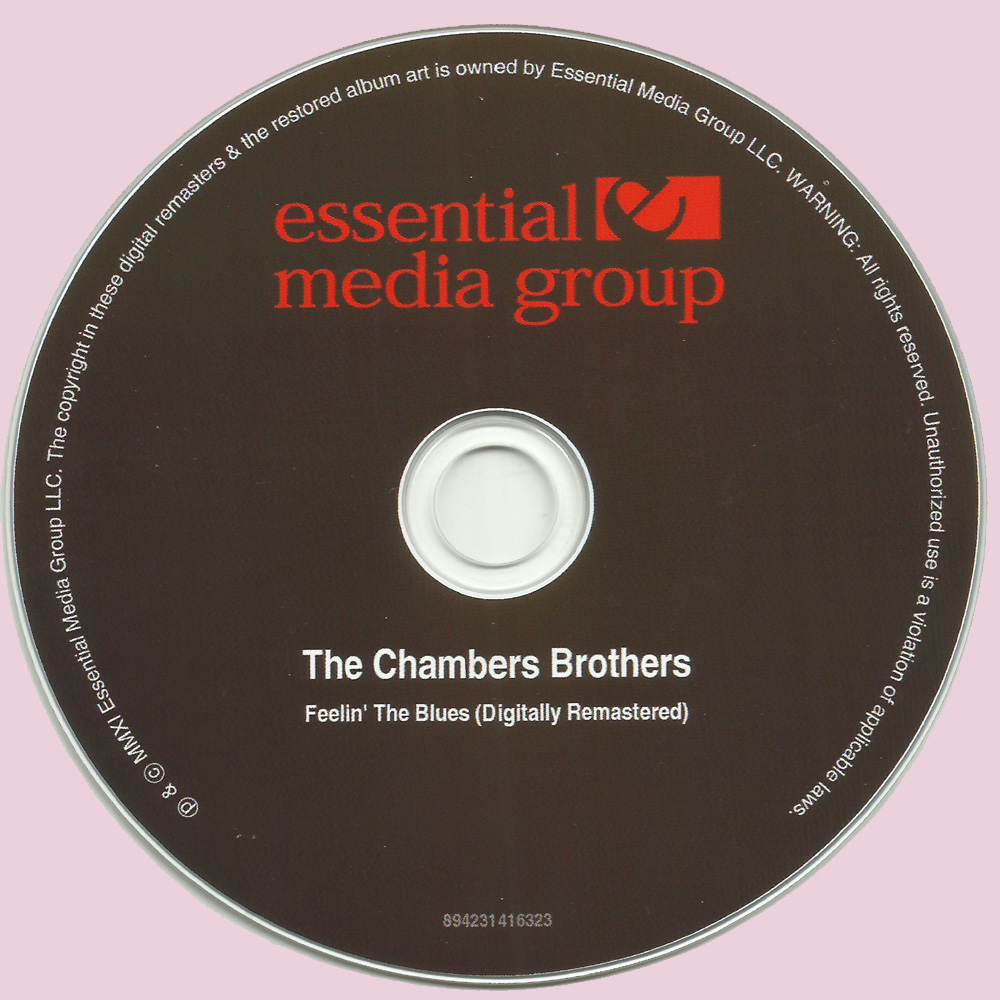
Musical siblings George Chambers (bass/vocals), Willie Chambers (guitar/vocals), Lester Chambers (harmonica/vocals), and Joe Chambers (guitar/vocals) were raised on rural gospel in their native Mississippi before switching over to folk and then soulful blues and R'n';B-fueled rock. The Chambers Brothers' recordings issued by the Los Angeles-based Vault label were nearly four years old when Feelin' the Blues hit the streets in 1970.
The band's style had changed quite drastically from old-school blues, soul, and pop to the longer psychedelic jams heard on their international hit "Time Has Come Today." Although the mixture of live and studio selections gives the collection an odds-and-sods vibe, several of the performances are among the best of the Vault Records-era material. Somewhat contrasting with the album's title, the Chambers actually cover a wide spectrum of music on Feelin' the Blues. Their roots can be heard throughout the flawless interpretation of the sacred standards "Just a Closer Walk with Thee" and the excellent "Travel on My Way." Similarly, the midtempo reading of Ray Charles' "I Got a Woman" offers the Chambers an opportunity to subtly return to their gospel origins with call-and-response backing harmonies.
The proceedings are far from being pious, however, as the quartet harmonizes the chorus of "Too Fat Polka" during one of the instrumental breaks. Perhaps wishing to remove some of the sting from the real storyline, the reworking of "House of the Rising Sun" -- according to the spoken introduction -- is told from the point of view of the receptionist (huh?) at the infamous bordello. Had The Chambers Brothers decided on a more straightforward translation, the song could easily have been one of the album's best. Other tunes worth spinning include a version of Bobby Parker's "Blues Get Off My Shoulder" -- in a longer form than on 1968's The Chambers Brothers Shout! -- and the comparatively brief but effective update of the jazzy "Undecided."
by Lindsay Planer
Tracks
1. Girls, We Love You (Lester Chambers) - 3:25
2. I Got A Woman (Ray Charles) - 6:35
3. House Of The Rising Sun (Traditional) - 6:05
4. Don't Lose Your Cool (Joe Chambers) - 1:48
5. Just A Closer Walk With Thee (P.D.) - 5:230
6. Blues Get Off My Shoulder (B. Parker) - 3:18
7. Travel On My Way - 4:05
8. Undecided (C. Shavers, S. Robin) - 3:06
Circus was originally formed in 1969 as "Sound Street" in Stevens Point, Wisconsin. They played bars and college dances in Central Wisconsin, specializing in their own particular variety ot blues and rock. Sound Street included Fred Omernik on keyboards. Wayne Kostroski on bass, Gary Konkol on guitar. Randy Glodowski on guitar, and Al Crowe on drums.
Their blend of four-part vocal harmonies and double guitar leads were a featured attraction of the band In 1970. Circus signed with North Central Productions, later known as McMillan and Clary Talent. Circus hired Ray Cyr to replace Al Crowe on drums and moved to Madison. Wisconsin to expand their territory and investigate a recording career.
Soon the band was playing regularly at Madison bars such as Snoopy's Dewey's, and the Church Key. at times opening for regional and national acts such as The James Gang, Rotary Connection, Ben Sidran, the Siegel- Schwall Band, Ted Nugent, and Muddy Waters Circus played at the lola Rock Fest in 1971. which was Wisconsin's version of Woodstock, also referred to as "Woodtick Nation." Circus shared the stage at the lola Rock Fest with such national and international acts as: Ravi Shankar, Buddy Rich, Iggy Pop. Terry Reid, and Siegel Schwall Circus was also one of the first bands to consistently play at Milwaukee's Summerfest.
As their popularity grew. Circus began traveling to such locales as Florida, Colorado, Massachusetts, Maine, Georgia,. Tennessee and the entire Midwest. Their venues included bars, colleges, military academies, band shells, a river boat, and auditoriums. In 1972 disaster struck when guitar player/singer Gary Konkol was diagnosed with a rare form of terminal cancer, and Circus reluctantly had to replace him His death in 1973 left both an emotional and musical hole in the group Respected Wisconsin blues man Mike Richson joined the group in 1973, and Circus once again began their almost constant travels.
Rocker Gunnar Antell replaced Mike Richson for a short period of time, as the band searched for the perfect musical combination Circus hired versatile Brett Peterson on guitar and recorded an album in 1973 at American Music Studios in Sauk City with Corky Siegel as a producer. The album was mixed down at Paragon Studios in Chicago, and was released in 1974. The band toured the country in support of the album, where it was well received in the South, West, and Northeast Jim Ash replaced Ray Cyr on drums in 1974, and Terry Knoll replaced Brett Peterson on guitar in 1975.
With the new lineup Circus recorded a single at a studio in Schaumburg Illinois with the plan that the two original songs would form the basis for a second album The band continued writing originals and toured extensively A demo was recorded with an eye towards a second album At that same time. Circus continued opening for such groups as Styxx. B.B. King. Ted Nugent and the Amboy Dukes, Eric Carmen and the Raspberries. Hot Tuna. John Sebastian. Firefall. Bonnie Bramlett, and the Amazing Rhythm Aces
By 1976, Circus had been touring almost constantly for seven years. By this time, the band was managing and booking itself. Although some contacts were made, no one appeared immediately interested in backing a second album tor the band In November of 1976, the band decided to call it quits and played their last gigs at the University of Wisconsin and the Bronco Bar in Chanhassen. Minnesota.
Although the early lineup of Circus used guitar/organ based instrumentation, they began to experiment with synthesized sound in the early 1970's. They were one of the first Madison bands to add strings and brass to their arrangements, and their distinctive sound is still fondly remembered by many of their fans. From the sounds of the B3. Circus moved on to the Clavinet and the Moog. Their excellent vocals, high quality guitar and keyboards, ability to write both love songs and songs with humor and insight, and great stage presence ensured crowds wherever they played Virtually all of the songs you hear on this album were performed live by the band between 1973 through 1976.
It is difficult to comprehend a twenty-minute version of "Old Age" unless one is standing in the crowd. Nevertheless, it was an experience, to say the least! "Fat Boogie Mama" was another crowd favorite, and served as an excellent counterpoint to Ray Davies' "Skin and Bones." Circus was a force to be reckoned with in the late 1960's and early 1970's. The national music scene didn't extend all the way to Madison, Wisconsin, however. But Circus played to enough audiences during their 300 gig/year, seven year career to touch many fans. Whether it was a bar full of 250 revelers or an auditorium with several thousand fans. Circus got their message across.
by Randy Glowdowski,Oregon, Wisconsin, December, 2000
Tracks
1. Fat Boogie Mama (Fred Omernik) - 4:09
2. You to Me (Wayne Kostroski) - 4:21
3. Let Me Tell You (Randy Glodowksi) - 4:12
4. Skin and Bones (Ray Davies) - 3:53
5. Arrow (Randy Glodowksi) - 3:31
6. Travlin' Blues (Randy Glodowksi) - 2:45
7. Old Age (Larry Leishman, Duke Edwards) - 12:58
8. C'mon If You're Comin' (Brownie McGhee)
9. I'm Walkin' (Fred Omernik) - 3:19
10.Bar Room Wiggy (Randy Glodowksi) - 3:39
Of all the band's on Phil Walden's Capricorn label during the heyday of Southern rock in the 1970s, The Marshall Tucker Band came closest to The Allman Brothers in its ability to write memorable material and improvise with a real sense of adventure. Way Out West: Live in San Francisco 1973, forcefully illustrates the band's virtues.
MTB distinguished itself even further from its forebears by its eclectic mix of influences. Blues was no more or less important than country music, as evinced in the opening "Hillbilly Band," or traditional jazz, motifs of which become most apparent when Jerry Eubanks is playing flute or saxophone, as he does on "24 Hours at a Time." Vocalist/songwriter Toy Caldwell's lead guitar style mixed all those elements when he takes the spotlight as on "Every Day I Have the Blues" or when the group jams as a unit.
And it's these latter moments, here best exemplified by the way the sextet stretches out on "Take the Highway" and "Can't You See," that Marshall Tucker truly excels. Granted the group's interplay isn't as sophisticated as The Allmans—holding, as it does, too closely to chord change repetition—but its grasp of dynamics, grounded in the splendid rhythm section comprised of drummer Paul Riddle and bassist Tommy Caldwell (sibling of Toy), is impeccable. And the drive of MTB's collective motion never flags, thanks as well to George McCorkle's insistent rhythm guitar work.
As demonstrated on "Another Cruel Love," vocalist Doug Gray's voice is as much an attraction in the MTB sound as the songs and the jams. He not only adds a gospel element to this heady mix, as on "Ramblin,'" but his full-throated singing is no mere precursor or mere afterthought to the improvisational interludes; instead, it's a bona fide attention-getter on its own terms.
Recorded at famed rock impresario Bill Graham's Winterland, Way Out West was compiled and produced by Gray, who leads a realigned ensemble under the Marshall Tucker name today. It contains the bulk of MTB's debut album plus the highlights of the second album, A New Life (Capricorn, 1974), yet to be released at the time of this concert and, bereft of the sometimes superfluous production touches, presenting the group with an aggressive edge in its playing that's missing from its more relaxed studio work. The sleek sound production features just enough definition to highlight the distinctive instrumental lineup individually and collectively.
The Marshall Tucker Band never descended into the generic Dixie rock, even later in its career after the death of bassist Caldwell, when its approach became more conventionally structured. Live in San Francisco 1973 is a brilliant document of the group's glory days that will gratify fans and may even alter the preconceptions about Southern rock for those not inclined to hear the genre with open ears.
by Doug Collette
Tracks
1. Hillbilly Band - 4:05
2. Another Cruel Love - 4:33
3. Take The Highway - 8:11
4. Can't You See - 6:29
5. See You Later, I'm Gone - 3:30
6. Ramblin' - 5:50
7. Everyday (I Have The Blues) (Peter Chatman) - 13:59
8. 24 Hours At A Time - 8:28
All compositions by Toy Caldwell except where stated
The Marshall Tucker Band
*Tommy Caldwell - Bass
*Toy Caldwell - Lead Guitar
*George McCorkle - Rhythm Guitar
*Paul Riddle - Drums
*Jerry Eubanks - Flute
*Doug Gray - Vocals
The classic early 70s String Driven Thing line up of Chris Adams guitar and vocals, Pauline Adams vocals and percussion, Colin Wilson bass, and Grahame Smith violin (Hamill/Van der Graaf) recorded on the Foxtrot Tour with Genesis. String Driven Thing were signed to Charisma Records 40 years ago in 1972 already having issued one album.
In fact, their second Charisma album ( and third release in historic terms) The Machine That Cried - originally released 1973- has since been acclaimed not, merely, String Driven Thing’s masterpiece, but one of the finest progressive rock albums of the entire era – its reissue a couple of years back on the British Ozit label was widely heralded as among the most intelligent re-releases of recent years. They are back again with this new CD 40 years later on the anniversary of them signing to Charisma.
On Dec 12th 1972, as Pauline Adams of String Driven Thing passed through customs at JFK Airport, in her suitcase was a full length orange dress. Nothing unusual in that, you might think, but the dress in question actually belonged to Peter Gabriel, to be worn at the climax of Genesis’ Foxtrot set which they were about to debut in New York’s Philharmonic Hall. For both bands, this was a first visit to the States, but whilst Genesis were classic Charisma Prog Rock, String Driven Thing were far harder to pigeonhole. Drummerless, and with a virtuoso lead violinist, they had just released their eponymous album to enthusiastic reviews and their first single “Circus” was already a turntable hit, so there was a real buzz in the city about both bands. On the night, the auditorium was packed and, unusually for a support band, the Thing were brought back for a rapturous encore.
Listening to this free blowing high octane set forty years on, it’s easy to see why. Fast forward six weeks, and the UK leg of the Foxtrot tour is due to start at London’s Rainbow, only in the interim, frontman Chris Adams has suffered a spontaneous pneumothorax (collapsed lung) and is rushed to hospital, where Doctors recommend that he take four weeks rest to let his lung reflate. But unwilling to drop out of the impending tour, Chris elects for the alternative treatment which, in his words involved “watching a brace and bit being used to drill a hole through my chest”.
14 days later, and against doctors’ advice, the band took to the Rainbow stage and, although understandably not being quite at their best, in the following gigs, including Manchester Free Trade Hall where this recently unearthed recording was made, the band performed sets with such stunning energy that multiple encores became the norm. Just listen to the 16 minute version of Jack Diamond and Graham Smith’s incredible virtuosity as he swoops and weaves around the hypnotic groove of Chris’ guitar, Pauline’s percussion and Colin Wilson’s subtly syncopated bass, and I think you’ll agree with me that Ozit has rediscovered a lost masterpiece.
Tracks
1. Let Me Down - 6:04
2. Then I Met The Lady - 6:21
3. My Real Hero - 4:13
4. Regent St Incident - 4:27
5. Circus - 7:57
6. Hooked On The Road - 4:49
7. Jack Diamond - 14:13
Music and Lyrics by Chris Adams
By the early 70’s Slovakia-born brothers Bystrik and Andy Brazda had relocated to Ontario, Canada in search of greener pastures. Shortly after settling down in their new home they began writing music together. Canadian owned Dominion Records released their first and only lp, The Brazda Brothers, in 1974. Rumour has it that the brothers laid the entire album to tape in a marathon six hour session at RCA Studios in Toronto. Marathon session or not, The Brazda Brothers is one of the finest psych-folk lps ever pressed to wax.
The first track, “Walking Into the Sun”, sets the warm and peaceful pace that permeates the album when a lightly strummed acoustic guitar gives way to a gentle soft-psych tune that comfortably slinks by–full of melodic, wistful vocals, crystal clear electric guitar, thumpy tubby drums, and a wonderful appearance by what sounds to be a calliope, but is credited as a Cordovox–the same keyboard that shows up frequently to add its unique touch to much of the record. Right off the bat it’s clear that the brothers had a vision to share and they do so in an innocent, heartfelt way. This homegrown feel sets their record apart from the pack, earning it a place at the table with other lost classics of the era.
“Share With Love” is an upbeat number that encourages the listener to consider the needs of their fellow brothers and sisters. With its reverb drenched guitar and minor key refrain this tune has an almost garage flavored folk-rock sound, and its slightly eerie vibe adds a different taste to the record and shows a different side of the brothers’ sound. Midway through the album the brothers turn the volume up a bit with “Gemini”. Complete with gloriously fuzzed-out electric guitar and an almost-boiling Hammond Organ that adds something exotic to the mix, this tune definitely delivers in the psych category and comes out as one of finest cuts on this collection. The entire song has a subtle Eastern-European vibe that becomes most apparent when the brothers harmonize on the refrain. On the next track, “Nature”, Andy dreams of a carefree life spent living in the country, singing “the sun will shine all day/Mother nature will be our neighbor”. Reminiscent of “Hello Sunshine” and other tunes off of the Relatively Clean Rivers lp, this song has a great late sixties soft-psych vibe as well as a catchy chorus, and continues the acid-rural-pastoral-folk vibe that begins with the album opener.
“Lonely Time” is a beautifully sad little gem that finds Andy again longing for the peace and serenity of a home surrounded by nature and the familiar faces of friends and loved ones. In 2008 Panda Bear of Animal Collective fame payed tribute to these Slovak brothers when he released a remix of The Notwist’s “Boneless” that uses the opening riff of “Lonely Time” to fine effect.
The only criticism of this album is that several of the songs, such as “My Little Girl” and “Nature” have a very similar sound. However, it’s hard for it to bother you when it’s such a great sound! In the end, the pure and honest nature of the album along with the wonderfull vibe trumps any criticism.
The Brazda Brothers is a great album that stands shoulder to shoulder with other similar sounding lost classics of the time such as Relatively Clean Rivers, Rodriguez’s Cold Fact, and Jim Sullivan’s UFO. With their laid-back attitude, sunny rural vibe, and unique voices, the brothers crafted the perfect album for a lazy summer afternoon full of good vibes. As you’ve already guessed, original copies are rare, and sell for a very pretty penny when they do pop up. Hallucination CDs out of New Jersey re-released the album on cd with a limited pressing of 1,000 copies, and Void Records has reissued the album on vinyl. Pick up a copy while they’re still available!
by D.A. Glasebrook
Tracks
1. Walking The Sun - 3:00
2. 20th Century - 4:07
3. Blooming Flowers - 4:11
4. Share With Love - 2:44
5. My Little Girl - 2:54
6. Calm River - 2:38
7. Gemini - 3:39
8. Nature - 3:05
9. Civilization - 2:58
10.Soldier In The Battleground - 2:28
11.Lonely Time - 2:11
12.Your Kingdom - 4:11
All songs by Brazda Brothers
US band formed and recorded their self titled album in New York City, musically the were a crossline between Byrds, Neil Young, Al Kooper, C. C. Revival and Steppenwolf.
Members were Kenny Pine (Fugs), Danny Mansolino and Mike Rosa (from The Myddle Class), Dave Palmer as vocalist who also played with The Myddle Class, he may have had the biggest success as an early vocalist with Steely Dan.
Jerry Burnham was band's fiddler he worked with acts like, The Strangers, James Taylor and the Flying Machine, Jake and the Family Jewels, The Fifth Ave. Band. Album included collaborations of some great session musicians such as Danny Kortchmar, Richard Greene among others.
Tracks
1. Try Me One More Time (David Bromberg) - 3:37
2. Look To Yourself (Danny Mansolino, David Palmer) - 3:43
3. Green Rolling Hills Of West Virginia (Bruce Phillips) - 4:08
4. Visions Of Johanna (Bob Dylan) - 4:34
5. Don't Take No (Danny Mansolino, Dave Palmer) - 3:34
6. Love Brings The Best Out In A Man (Gus Andrews) - 3:30
7. Don't Knock (Roebuck "Pops" Staples, Wesley Westbrook) - 2:46
8. Tell Me What You See From There (Danny Mansolino, David Palmer) - 6:19
9. Queequeg (Danny Mansolino, David Palmer) - 4:09
10.Falling Star (Danny Mansolino, David Palmer) - 5:54
"After three LPs, two singles and countless concerts in Germany and abroad German popfans' favorite child has gone at the age of almost three years. The cause of death were musical differences".
In an obituary the highly recommended rock band Frumpy said farewell in August 1972. But at the same time the musicians announced their comeback under a different name. And they kept their promise: Even before the last album "Frumpy live" was released, singer Inga Rumpf, keyboardist Jean-Jacques Kravetz and bassist Kart-Heinz Schott joined with drummer Curt Cress and guitarist Frank Diez. They founded a new band called Atlantis. In a letter to "Atlantis Scout" Inga Rumpf recalled the reasons for the new name.
"Dear Mr. Thorwald Franke, I have been very interested in the myth of the sunken continent. That is why I called my band Atlantis. I really believe that Atlantis lay near the Canary Islands in the Atlantic Ocean 'behind the columns of Hercules', as Plato wrote. The sea bottom is at risk of an earthquake, and it is possible that Atlantis sunk because of a disaster. All the best, Inga Rumpf." (www.atlantis-scout.de)
Indeed, the legendary sunken continent has inspired the fantasy of numerous artists, writers, painters and film directors from the ancient days to present. Just like the Greek philosopher Plato (427 to 347 B.C.) many other authors like E.T.A. Hoffmann, Michael Ende and even cartoonist Walter Moers wrote about Atlantis. In 1962 Atlantis was mentioned in an episode of the Perry Rhodan series. In 2001 the Disney production "The Lost Empire" was launched, including a new version of Donovan's hit "Atlantis", a world wide hit originally released in 1968.
With a well known name like this the quintet had to deal with high expectations, but Atlantis could not only take on Frumpy: The new band even outnumbered the success of the predecessor. After finishing the debut album the new band toured Great Britain as a support for Procol Harum and Traffic - "Let's Get On The Road Again" was one of their songs. In spite of the success the line-up changed for the second album: Frank Diez and Curt Cress left the band, and Dieter Bornschlegel and Ringo Funk replaced them on guitar and drums. "It's Getting Better" was a motto in 1973.
But while the popularity of the group increased, the struggles behind the scenes did not end. Jean-Jacques Kravetz left, Reiner Schnell joined for a short period and then Adrian Askew became the new keyboardist. Alex Conti replaced replaced Dieter Bornschlegel on guitar.
Surprisingly all those changes did not do any harm, Inga Rumpf stayed the undisputable centre of Atlantis. Looking back she says: "It was a continuous enhancement: In the beginning I played concerts in Germany with The City Preachers, with Frumpy I went to England and Atlantis toured America in 1975!".
The same year, on the peak of the career Atlantis released the double album "Live", recorded at the "Fabrik" in Inga's hometown Hamburg. The opening track is a kind of central thread for the music and the meaning: "Friends" was played ever since when Inga and her friends met again. This live recording proves brilliantly the development from the City Preacher to the "Rock 'n' Roll Preacher".
by Uli Kniep, December 2008
Tracks
1. Friends (Inga Rumpf) - 8:29
2. Ooh Baby (Alex Conti, Inga Rumpf) - 3:54
3. Somewhere (Adrian Askew, Alex Conti) - 5:51
4. It's getting Better (Inga Rumpf) - 6:52
5. Waiting And Longing (Inga Rumpf) - 3:41
6. Brother (Inga Rumpf) - 5:34
7. Rock'n' Roll Preacher (Frank Diez) - 4:09
8. New York City (Adrian Askew) - 3:58
9. Mr. Bigshot (Adrian Askew, Alex Conti) - 5:53
10.Mainline Florida (George Terry) - 6:21
11.Godfather (Adrian Askew, Alex Conti) - 3:33
12.Going To The Country (Inga Rumpf) - 5:14
13.Rock Me Baby (Traditional) - 4:38
14.Leave It To The Devil (Adrian Askew) - 4:09
Atlantis was not only the name of the legendary island, the famous Greek author Plato mentioned, but also the name of a band formed by ex-Frumpy musicians Inga Rumpf, Jean-Jacques Kravetz and Karl-Heinz Schott, in late Summer, 1972. The initial line-up included guitarist Frank Dietz and ex-Emergency drummer Curt Cress (later with Triumvirat, Passport).
The band played a few live gigs in Germany before they recorded their debut in London's Island Studios. The US magazine, Cash Box, compared Atlantis with the Doobie Brothers and praised Inga Rumpf's blues-tinged voice. Shortly before the group went on a four week tour of England with Procol Harum, Traffic, Vinegar Joe and the Sharks, Cress and Dietz left and were temporarily supplanted by Udo Lindenberg and George Meier. After the tour, Atlantis recruited Dieter Bornschlegel (ex-Traumtorte) on guitar and Ringo Funk (ex-Jeronimo) on drums as new permanent members.
Rumpf and Kravetz remained the artistical nucleus of the band. Said Kravetz: "Inga determines this band like Rod Stewart & the Faces, her voice makes our image." Atlantis' second album "It's Getting Better" was even more determined by Inga Rumpf's preference for black rhythms: "I always took a special liking in blues, jazz and soul music, and, since I'm writing most of the songs, this influence is decisive in our music." Melody Maker "recommended" the second album and Sounds attested the band to be "the most English of all German groups".
After the gig at the Paris' Olympia, Atlantis went, again, on a four week tour of England, which included a performance at the rock show, "Old Grey Whistle Test". During this tour, Kravetz left the band and had to be hastily replaced by Rainer Schnelle (ex-Family Tree).
At the end of 1973, Atlantis was among Germany's three most popular German rock groups, according to a Musikmarkt poll.
Half a year later, the line-up changed again. Schnelle and Bomschlegel were replaced by English keyboarder Adrian Askew and ex-Curly Curve guitarist Alex Conti.
Both were featured on the third LP "Ooh Baby". Seven of the ten songs were written by Askew/Conti, while Rumpf only had three of her compositions on the album. The result was a "spicy funk album" (Musik Express) with a "bunch of Germany's best soul" (Sounds).
Atlantis was at its best on stage, which was proved by a double album recorded live at the Hamburg Fabrik from 1973 - 1975.
In Summer 1975, Atlantis went on tour in the States, mostly as opener for Lynyrd Skynyrd. After the tour, guitarist Alex Conti was fired and went on to play with Lake. The new line-up was completed with former guitarist Frank Dietz and as second guitarist Rainer Marz.
The rockier American influence was noticable on Atlantis' fourth LP "Get On Board", but the LP and the following tour failed to have commercial success. Concequently, Inga Rumpf and Karl-Heinz Schott announced their departure in January 1976.
After the split, the album "Top Of The Bill" with unreleased studio recordings from December 1975 and March 1976 was released. On February 23, 1983, the original line-up reunited for a revival concert in the Hamburg Fabrik and received
Tracks
1.Get It Up (Inga Rumpf) - 5:24
2.Big Brother (Inga Rumpf) - 5:07
3.Rock 'n' Roll Preacher (Frank Diez) - 3:42
4.Maybe It's Useless (Jean Jacques Kravetz, Inga Rumpf) - 3:41
5.Let's Get on the Road Again (Inga Rumpf) - 3:33
6.Living at the End of Time (Frank Diez) - 9:07
7.Words of Love (Frank Diez, Inga Rumpf) - 4:52
8.Mainline Florida (Bonus Track) (George Terry) - 2:59