In The Land Of FREE we still Keep on Rockin'

It's Not Dark Yet

Plain and Fancy

Music gives soul to universe, wings to mind, flight to imagination, charm to sadness, and life to everything.

Plato

Wednesday, February 11, 2015

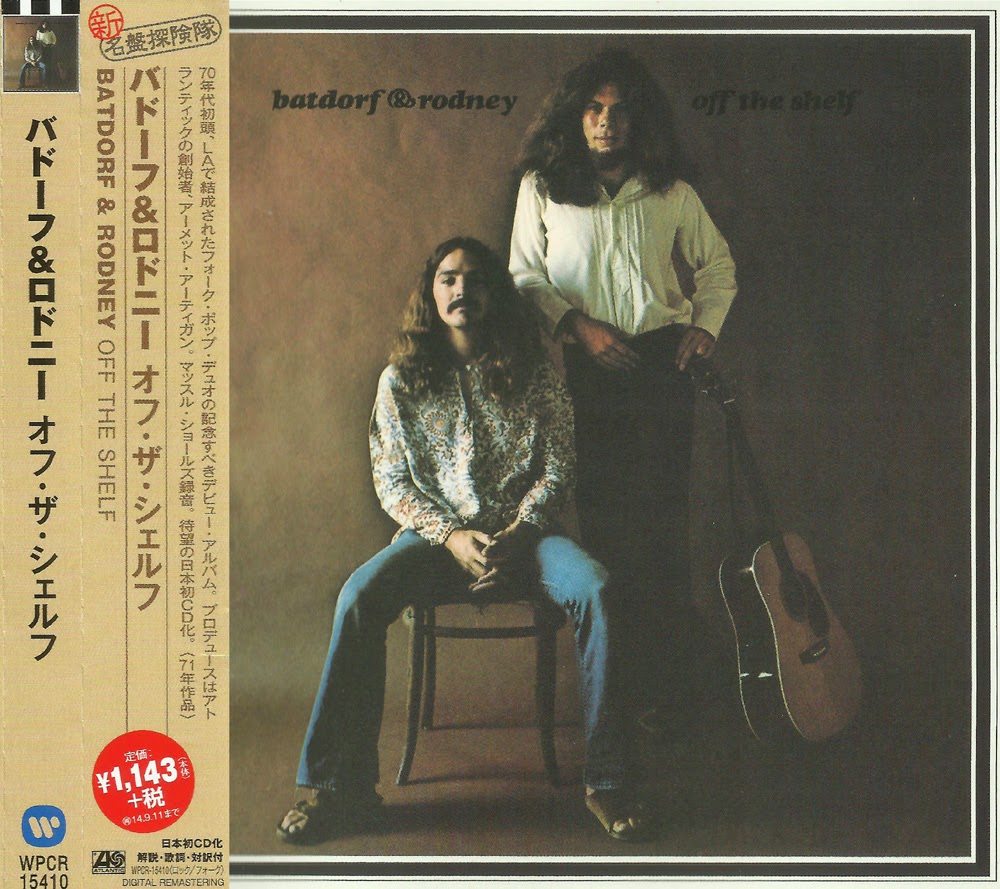
Batdorf And Rodney - Off The Shelf (1971 us, wonderful melodic folk rock, 2014 japan remaster)


In the summer of 1970 at the ripe old age of 18, my girl friend and I packed our bags and left our apartment in Hollywood for Las Vegas. It was time for a change of scenery, and it didn't hurt that her parents had a home there. They were devout Jehovah's Witnesses and I am sure they were thrilled to have a hippie musician who'd been shacking up with their runaway daughter in LA move into their home. But the power of music can never be underestimated. Once they heard me sing they warmed up to me and I used to do shows for them and their friends. (For the record, no pamphlets were distributed during the performances).

I soon found employment at the University of Las Vegas in a coffee house. Although I'd played music all my life I did have a few other marketable skills that helped me get the gig: I worked in the kitchen, served drinks, cleaned up the place, even worked the cash register. But singing was more fun. As with most coffee houses of that era, each night featured various singers and songwriters. Before long I became the headliner. I did two or three sets a night depending on the crowds. Then, as a special reward for packing 'em in I had the priviledge of cleaning up when the show was over. 

One night Mark Rodney's younger brother Jeff showed up and liked what he saw. He went home and told his brother that he HAD to go check out this guy at the coffee house. Apparently he told Mark my distinguising features were: "he sings really high like a girl and plays really cool original music." Mark showed up the next night and watched a set and was impressed. Although both of us had been from LA and actually went to the same High School, Mark had been living with his dad Red Rodney who owned a home in Vegas. Red was a famous Jazz trumpet player and I'm convinced he passed on that great musical feel to his son. 

Mark introduced himself during a break and asked if he could sit in on the next set and play some guitar. That was the first time Batdorf and Rodney played. I loved the way the guy found such cool and tasty guitar parts that took the songs to a better place. Oh yeah, and it was fun.

We decided to rehearse and see what would happen. We practiced everyday either at Red's house, the park, or up at Mt. Charleston. We got really excited about this sound that was happening as we played, and we weren't alone. Soon we were packing them in at the coffee house. The manager there was so into the sound and the potential that he took us to a College entertainment show in Fresno to show off what UNLV had going on campus. We were a big hit and before long we had people wanting to join us, manage us, promote us, you name it. We were getting the offers.

We were feeling really good about what we had to offer and wanted to record it. On October 24, 1970, Mark and I were joined by our roadie Dan Bisker and a few others and we went up to Mt. Charleston armed with our guitars, a stereo cassette deck and two mics. We played a set of originals and really liked what we heard. Mark and I decided that we wanted to go back to LA and see if we could get a record deal.

We eventually booked some more sessions but this time in LA at Elektra Studios. Ahmet hired John Barbata on drums and Chris Etheridge on bass. Our engineer was Ross Myering. The sessions went great and everyone was pleased. Unfortunately because Ahmet was such a busy guy, it was hard to track him down and pin point a release date so the weeks passed and still nothing. 

We hooked up with a manager, Harvey Kresky, who had managed Sonny and Cher among others and had a history with Ahmet. He got Atlantic to finally schedule a release date in late 1971 to the newly named duo Batdorf and Rodney, another good Ertegun idea. Off The Shelf Because the record sat on the shelf for so many months we appropriately named the record, " Off The Shelf". The album was finally out!!! We immediately got airplay everywhere. The playlists were not like today. AM radio actually played album cuts. A very famous DJ in LA at KRLA AM radio B. Mitchell Reid played many cuts and often. Mark and I went to the Beverly Hills Hotel on Thanksgiving to have dinner with Ahmet, David Geffen, Eve Babitz, Earl McGrath and a few others he invited. He had a boom box playing in the background and on came "Can You See Him". We all freaked and I told Ahmet, "Man we're going all the way, we're going platinum!!!" Ahmet said "Don't worry about that man, we made our mark," and he was right again. 

That album didn't quite go platinum or gold or any other color but we toured and people loved us! On the road I was busy trying to write new songs for what would be our second album.


Tracks
1. Oh My Surprise - 2:45
2. Me And My Guitar - 3:28
3. Can You See Him - 6:04
4. Workin' Man, Blind Man - 3:49
5. You Are The One - 3:37
6. Don't You Hear Me Callin' - 4:40
7. Where Were You And I - 2:21
8. Never See His Face Again - 2:53
9. One Day - 2:47
10.Farm (John Batdorf, Mark Rodney) - 1:55
11.Let Me Go - 5:24
All songs by John Batdorf except track #10

Musicians
*John Batdorf - Acoustic, Electric Guitars Lead, BG Vocals, Piano, B3
*Mark Rodney - Acoustic Guitars, BG Vocals
*Roger Hawkins - Drums
*David Hood - Bass
*Barry Beckett - Piano, Rhodes, Vibes
*Chris Etheridge - Bass
*John Barbata - Drums

Free Text 
Text Host

Friday, February 6, 2015

Wicked Lady - Psychotic Overkill (1972 uk, awesome heavy psych, 2012 issue)


The second and final collection of Wicked Lady tracks all came from 1972, following the replacement of original bassist Bob Jeffries with Del Morley. Nothing else about either the band or its recording approach changed otherwise, with what proved to be the group's remaining recorded legacy being more of the same style and approach on The Axeman Cometh. Still, there's a little more of a frenetic edge on songs like "I'm a Freak," with faster tempos as well as lines like "I don't know right from wrong/I think I'm gonna be a politician." 

The band's one recorded cover shows up, a reasonable enough lumber through Jimi Hendrix's "Voodoo Chile" that has lead figure Martin Weaver throwing in a couple of queasy guitar moments all his own. Similarly, the hints of a little more stretching that can be heard at the end of The Axeman Cometh, with the stately enough near conclusion of "Tell the Truth," is more than welcome. "Ship of Ghosts," the final song on the collection, is also the band's longest at 22 minutes; while there are a couple of longueurs, its ambition is reasonably matched by the performance, from full adrenaline overdrive to near silence and back again, concluding on a gently lyrical note. "Passion" deserves a note as well for two reasons -- Morley's more notable basswork and Weaver's concluding line for the chorus: "Just tell me that you love me/And I won't throw your grandma on the fire." 
by Ned Raggett 


Tracks
1. I'm A Freak - 5:01
2. Tell The Truth - 5:08
3. Passion - 9:29
4. Voodoo Chile (Jimi Hendrix) - 4:41
5. Why Don't You Let Me Try - 5:00
6. Sin City - 7:04
7. Ship Of Ghosts - 22:00
All songs by Wicked Lady except where stated.

Wicked Lady
*Del "German Head" Morley - Bass
*Dick Smith - Drums
*Martin Weaver - Guitar, Vocals

1968-72  Wicked Lady - The Axeman Cometh

Free Text
Just Paste

Tuesday, February 3, 2015

Tamalpais Exchange - Tamalpais Exchange (1970 us, striking spiritual funky folk psych, 2014 edition)


Few Xian psych records got wackier or more harsh than this one. Tamalpais Exchange were an egalitarian sextet who emerged from the NYC area and somehow got signed to a big label, probably as a result of their work's obvious nod to the popular hippie musical trend of Christian themed Broadway shows like Hair, Godspell and Joseph & The Technicolor Dream Coat. The Tamalpais crew really hams it up on their only album, overloading the mics of these low budget takes with painfully wailing group vocals in performances that blast along with the power of an apocalyptic Mamas & The Papas, but way more punk.

Some songs slip into Anglo folk territory a la Buffy St. Marie or Joni Mitchell's early stuff, so the record has a truly schizo feeling as the group rarely hits any kind of middle ground between the quiet/loud extremes. The loud stuff here is the deal breaker though, so if you think your psych rock dream-come-true could be the sound of a church camp hootenanny screamin’ along to a pounding folk punk accompaniment then this one is a must-have.
by Mike Apichella


Tracks
1. Anthem  - 2:20
2. If I Had The Answeres (Michael Knight, Mike Brandt) - 2:46
3. Here We Are  - 3:06
4. Never Ever Land  - 2:41
5. King  - 2:35
6. Flying Somehow  - 3:49
7. L.A. Incident  - 2:35
8. World (Michael Knight, Mike Brandt) - 3:23
9. Balnesmoor Lane  - 3:03
10.Pied Piper  - 2:16
11.Maybe Tomorrow  - 2:13
12.Understand It (Buckets Lowery, Mike Brandt) - 4:15
13.Why Don't You Believe Me?  -
14.Wish (Michael Knight, Mike Brandt) - 2:10
All songs by Michael Knight except where noted.

Personnel
*Mike Brandt - Guitar, Vocals
*Susan Kay - Guitars, Vocals
*Michael Knight - Guitar, Vocals
*Ronnie Bedford - Drums
*Penelope Bodry - Vocals
*Buckets Lowery  - Vocals
*Ralf Rost - Bass
*Pamela Talus - Keyboards, Vocals
*Don Payne - Bass

Free Text 
The Free Text

Sunday, February 1, 2015

Savoy Brown - Blue Matter (1969 uk, stunning hard blues rock, 2004 remaster and expanded)


In late 1968, Savoy Brown's schedule was booked solid with never fewer than six gigs a week. Audiences' reactions was always enthusiastic, as Kim explained to Beat Instrumental: "Since we've got the new line-up together, the band has been working much better. Interest in our sort of music is on the upsurge, and we're doing very well now."

In November, the band discharged bassist Jobe and asked former member Brunning (who had recently filled in for some gigs) to join again permanently. Brunning again declined, and so Tone Stevens (b. September 12, 1949) joined instead.

On December 6, 1968, the band performed at the City of Leicester College of Education. The performance was taped with Dave Peverett substituting for Chris Youlden, who was sick and couldn't sing well enough to perform. They recorded the set anyway, and three tracks, "Maybe Wrong," "It Hurts Me Too" and "Louisiana Blues" appeared on their next album. "Louisiana Blues", a largely instrumental song, became a showstopper on their forthcoming U.S. tour. A fourth live track, "Sweet Home Chicago," appears to have been lost in the Decca vaults. All of Peverett's vocals were re-recorded in the studio.

In December, the band returned to the studio to record more two tunes, "She's Got a Ring in His Nose and a Ring on Her Hand" and "Don't Turn Me from Your Door." On January 22, 1969, they recorded "Grits Ain't Groceries (All Around the World)." "Grits" was composed by Titus Turner and under the name "All Around the World" was a Top Ten r&b hit in 1955 as covered by Little Willie John. Little Milton revived the song in 1969 as "Grits Ain't Groceries". The song featured an explosive horn section and was paired with "Ring" for the U.S. market. In spite of the high calibre of both sides of this release, the single nevertheless failed to chart.
by Martin "Jet" Celmins and Jeff Wat 


Tracks
1. Train To Nowhere (Chris Youlden, Kim Simmonds) - 4:12
2. Tolling Bells (Chris Youlden, Kim Simmonds) - 6:33
3. She's Got A Ring In His Nose And A Ring On Her Hand (Chris Youlden) - 3:07
4. Vickburg Blues (Bob Hall, Chris Youlden) - 4:03
5. Don't Turn Me From Your Door (John Lee Hooker) - 5:04  
6. Grits Ain't Groceries (Titus Turner) - 2:42
7. May Be Wrong (Dave Peverett) - 7:50
8. Lousiana Blues (McKinley Morganfield) - 9:06
9. It Hurts Me Too (Elmore James, , Mel London) - 6:53
10.Raise Some Thunder (Kim Simmonds) - 2:33
11.Since You've Been Gone (Kim Simmonds) - 5:22
12.Medley - 20:45
a.I'm Tired
b.Hard Way To Go
c.Lousiana Blues
d.Street Corner Talkin'
e.Hellbound Train
f.Guitar Solo

Savoy Brown
*Chris Youlden - Guitar, Piano, Vocals
*Lonesome Dave Peverett - Guitar, Vocals
*Kim Simmonds - Guitar, Harmonica, Piano
*Bob Hall - Piano
*Rivers Jobe - Bass
*Tony Stevens - Bass, Percussion
*Roger Earl - Percussion, Drums
With
*Alan Moore - Trombone
*Terry Flannery - Trombone, Tenor Trombone
*Keith Martin - Trombone, Tenor Trombone
*Brian Perrin - Trombone, Tenor Trombone
*Derek Wadsworth - Trombone, Tenor Trombone
*Mike Vernon - Percussion

1967-68  Savoy Brown - Shake Down / Getting To The Point
1969-70  Savoy Brown - Raw Sienna / Looking In
1974  Savoy Brown - Boogie Brothers
Related Act
1972  Foghat - Foghat (Japan Remaster)
1973  Foghat - Rock And Roll (Japan Remaster)
1974  Foghat - Energized (Japan Remaster)
1974  Foghat - Rock And Roll Outlaws (Japan remaster)
1975  Foghat - Fool For The City (2008 ultradisc MFSL)
1976  Foghat - Night Shift (Japan remaster with extra track)
1973  Chris Youlden - Nowhere Road
1974  Chris Youlden - Citychild

Free Text
the Free Text

Thursday, January 29, 2015

Jack Grunsky - My Ship (1968 austria / canada, fascinating folk psych, 2012 korean limited edition)


Jack Grunsky's career as a singer-songwriter began in the mid 60's, spanning two continents and exploring a variety of musical genres from folk, pop, children's to jazz. In the past 20 years he has become one of Canada's leading voices in the children's music scene. His 12 self-produced recordings for children have received all of the most prestigious awards in children's media both in Canada and the US, including 3 JUNO Awards for Best Children's Recording (1993, 2000 & 2006). With his family concerts, symphony shows, festival appearances, school programs and keynote and music workshop presentations for early childhood educators, he has toured across Canada, US, central Europe and as far a-field as South Africa. 

His singing and performing began in high school in Toronto, where he played drums in the dance band or strummed guitar in his folk singing trio. After graduating, he moved to his native Austria, where his music began to flourish. In 1966, he formed the popular folk group, Externe Verknüpfung 'Jack's Angels', who signed a 4-album record deal with Amadeo Records in Vienna. The group was short-lived, but Jack continued to record three more solo albums for the label and had a number of songs climb the European pop charts. One album was titled ‘Toronto' and was produced in London, England, by blues legend Alexis Korner, which featured several tracks with slide guitar playing by Mick Taylor of the Rolling Stones. 

Jack performed and toured extensively throughout most of central Europe. Production and session work included, composing and producing three musicals for Austrian National TV - ORF, and creating music for film and TV. He has collaborated with pop icon Udo Jurgens, and a host of other European artists. He has recorded with bassist Jimmy Woode, (Duke Ellington), and jazz pianist, Friedrich Gulda. He shared the stage with Joan Baez, and was a featured guest on numerous radio and TV specials. For two years he also hosted his own weekly half-hour radio show on Austrian National radio, called ‘Folk With Jack'. In 1970 Jack was signed to the progressive German label, Kuckuck Records of Munich, where he produced three more critically acclaimed albums of original songs. These have currently been reissued in CD box sets. One song was titled, ‘Back Home To Canada' which became the theme of a short film for Austrian TV and expressed Jack's strong desire to return to his musical roots in Canada.  


Tracks
1. I'll Live My Life Just Loving You (Peter Katzler) - 3:07
2. Julie Knows - 3:10
3. My Ship - 2:35
4. Good Moring Der Night - 2:39
5. In This Room - 3:23
6. I'm Turning Home - 3:00
7. Here I Come Again - 3:42
8. Train Station Blues - 2:52
9. Sally McGregor (Arthur Luber) - 2:35
10.These Hands - 3:20
11.South End Of The Town - 2:43
12.Raining In My Wine - 3:32
All copmpsitions by Jack Grunsky except where stated

Musicians
*Jack Grunsky - Vocals, Rhythm Guitar, Harmonica, Arrangements
*Peter Ketzler - Lead Guitar
*Herbert Katzler - Bass
*Hans Salomon - Arranged, Conducted (2, 5)
*Robert Opratko - Arranged, Conducted (1, 2, 4, 9)

1967  Jack's Angels - Our Fantasy's Kingdom (Vinyl issue)

Free Text
Text Host

Tuesday, January 27, 2015

Telegraph Avenue - Telegraph Avenue (1971 peru, splendid latin psych jazzy folk rock)


Telegraph Avenue were formed in 1970, after lead guitarist Bo Ichikawa returned to Peru, after having stayed half a year in San Francisco, where he had been exposed to the vivid local hippie rock culture. On his return he assembled all kinds of American influences, in a very convincing powerful way, with songs in English, but with ideas for arrangements which were more typical for the best Peruvian bands from those days. 

The full arrangements are incredibly contrasting. Nowadays it would be hard to find any other example of so many arrangements without any overlapping or blurring note, which is a combination of basically bass, acoustic guitars, drums, vocals and vocal harmonies with lots of rather exotic percussion. It is because there were two percussionists in the band. The first percussionist is Walo Carrilo (drums, percussion, maracas, tambourine), who, before Telegraph Avenue, had been a bandleader from Los Holy’s. 

This previous, mostly instrumental group had been the earliest movement towards psychedelia in the mid ‘60s. They made one album called “Sueno Sicodélico”, in a conceptual psychpop style, as well as several singles. The additional percussionist is called Chachi Lujan (acoustic guitar, bongos, piano). The final member is the bass player Alex Nathanson (who also plays acoustic guitar, clavichord, piano). The styles of the songs are very varied, have bluesrock, Californian feelings, influences of soulrock and sixties flavoured styles. The “psychedelic” element is rather unique and can only be heard in the top Peruvian bands. 


Tracks
1. Something Going (Alex Nathanson) - 4:45
2. Happy (Bo Ichikawa, Chachi Luján) - 3:41
3. Sweet Whatever (Alex Nathanson, Walo Carrillo) - 2:47
4. Lauralie (Alex Nathanson) - 4:05
5. Sungaligali (Bo Ichikawa, Chachi Luján) - 4:05
6. Let Me Start (Bo Ichikawa, Chachi Luján) - 4:05
7. Sometimes In Winter (Bo Ichikawa, Chachi Luján) - 5:26
8. Telegraph Avenue (Bo Ichikawa) - 3:53

Telegraph Avenue
*Bo Ichikawa - Xylophone, Acoustic Guitar, Harmonica , Guitar, Vocals
*Chachi Luján - Acoustic Guitar, Percussion, Congas, Vocals
*Alex Nathanson - Acoustic Guitar, Clavichord, Bass, Alto Vocals
*Walo Carrillo - Maracas, Tambourine, Percussion, Drums, Vocals

Free Text 
Just Paste

Friday, January 23, 2015

Gonn - Gonn For Good The Best Of Gonn (1966-67/90/96 us, tough 'n' raw garage rock)


Gonn formed in Keokuk in 1965 as The Pagans, by the summer of ‘66 founding members Craig Moore (bass) and Gerry Gabel (organ) had been joined by Gary Stepp (rhythm guitar) from Keokuk, Rex Garrett (lead guitar) and Brent Colvin (drums) from Fort Madison.

The band changed the name because Rex’s mom didn’t like it and it was time for a change. The name was the result of throwing words around and settling on the hip term “gone.” They psychedelicized the spelling in the style of the era as a tribute to a great band from Ottumwa, MADD, that GONN held in highest regard.

GONN quickly evolved into a heavily English and West Coast-influenced no-holds-barred garage band; taking their sound and attitude from the likes of the Yardbirds, Rolling Stones, Chocolate Watchband, Doors, and Raiders.

They quickly became known as the “Loudest Band In Town” both on and off stage. By that winter the band had recorded a song written by Craig and Rex that has become legendary — “Blackout Of Gretely”; issued on Bur1ington’s Emir Records with b/w “Pain In My Heart.”

In 1967 former Pagan guitarist Larry LaMaster rejoined the group and Colvin was replaced by 14-year-old drummer Dave Johnson. They went to Freddie Tieken’s Quincy, Ill., IT Studio and recorded their second single “Come With Me” b/w “You’re Looking Fine.”

During 1966-1968, GONN opened concerts at the Burlington Memorial Auditorium with such acts as The Trolls, Mob, American Breed and many others. The band packed teen centers, KC halls all over their corner of the world, traveling in the same 1951 hearse that was used for Craig’s aunt’s funeral!

The original lineup played the 1966 Iowa State Fair to a positive response and in 1967 they came in second to Echos V (Hall of Fame 1998). The band felt their ever-expanding hard-edged psychedelic approach was maybe a little more than the Fair judges could assimilate. GONN appeared for the last time at the state fair in 1968.

Although a working band for a short 2 — years, the group’s members were never out of touch, reuniting in 1990 for a Keokuk riverfront show. In 1996 six of the seven 66-67 members got together to record an entirely new album “Gonn With The Wind” and released a CD of all their 60’s recordings “Frenzology — Punks Along The Mississippi.

Over the years the band received an endless stream of fan letters from around the world. “Blackout” and their intended but never released single “Doin’ Me In” (issued on the Voxx LP) were covered by nuevo garage bands from California to Paris and Rome and beyond. In February of 1997, a six-piece GONN toured Europe for the first time with shows in Rome, Turin, Amsterdam, Paris and others.


Tracks
1. Don't Need Your Lovin' (Arnold Arr. by Aguilar) - 3:46
2. Death Of An Angel (Donald Woods) - 2:40
3. Sometimes Good Guys Don't Wear White (Ed Cobb) - 2:34
4. Hey Joe (Billy Roberts) - 3:24
5. Blackout Of Gretely (Rex Garrett, Craig Moore) - 4:35
6. Doin' Me In (Rex Garrett, Craig Moore) - 2:53
7. You're Looking Fine (Ray Davies) - 3:44
8. Come With Me (Rex Garrett, Craig Moore) - 2:09
9. Alabama Song (B. Brecht, K. Weil) - 3:07
10.Doin' Me In (Rex Garrett, Craig Moore) - 3:20
11.Oh Yeah (Elias McDaniel) - 2:59
12.Fellow Slave (Walt Stewart) - 2:50
13.When I Was Young (Burdon, Weider, Briggs, McCulloch) - 3:23
14.Head In The Clouds (Craig Moore) - 3:27
15.Pretty Girl (Craig Moore) - 4:32
16.The Wind (Craig Moore) - 6:09
17.Shame On You (Rudi Prodrudi) - 3:47
Tracks 1-5 Recorded 1966
Tracks 6-8 Recorded 1967
Tracks 9-11 Recorded Live in 1990
Tracks 12-16 From the 1996 LP "Gone With The Wind"

Gonn
*Rex Garrett - Guitar, Vocals
*Gerry Cabel - Vox Organ, Vocals
*Gary Stepp - Guitar, Vocals
*Craig Moore - Bass, Vocals
*Larry LaMaster - Guitar
*Dave Johnson - Drums

Free Text 
Just Paste

Wednesday, January 21, 2015

Jónas Einar - Gypsy Queen (1972 iceland, outstanding folk rock with prog shades, 2013 reissue)


Einar Vilberg started in the music business quit early, born in Reykjavik Iceland 1950. He started writing songs at the age of 14. Einars first appearance as a musician was as a singer in a school band called the "Beatnicks", (note the take off on the Beatles!!) In 1969 he flew to London England to cut his first record, (there where no recording studios in Iceland at that time) playing the role of songwriter and guitar player on a single called Insane world, an anti war project sung by one of Iceland’s most popular singer at that time.

Next year Einar provided songs and guitar playing on two more singles sung by prominent Icelandic artists. In 1972 after playing in different groups and doing some television shows Einar made the LP Gypsy Queen writing the lyrics and the songs. 


Tracks
1. On A Riverboat - 2:39
2. Sweet Lady -  2:26
3. I Just Want Your Love - 2:31
4. A Song For Christine - 1:25
5. Gypsy Queen - 3:56
6. Look At All Those People - 2:42
7. Freedom For Our Lovin' - 3:13
8. See The Sun - 4:09
9. Music Forest - 1:48
10.How Can We Know God Is Real? - 3:51
11.Lucky Day - 2:30
12.Gypsy Queen - 0:21
All songs written by Einar Vilberg Hjartarson

Jónas Einar
*Jónas R. Jónasson - Vocals, Flute, Accordion, Percussion
*Einar Vilberg Hjartarson - Vocals, Guitars
*Timmy Donald - Drums, Congas
*Sigurdur Arnason - Bass

Just Paste
Free Text
Text Host

Monday, January 19, 2015

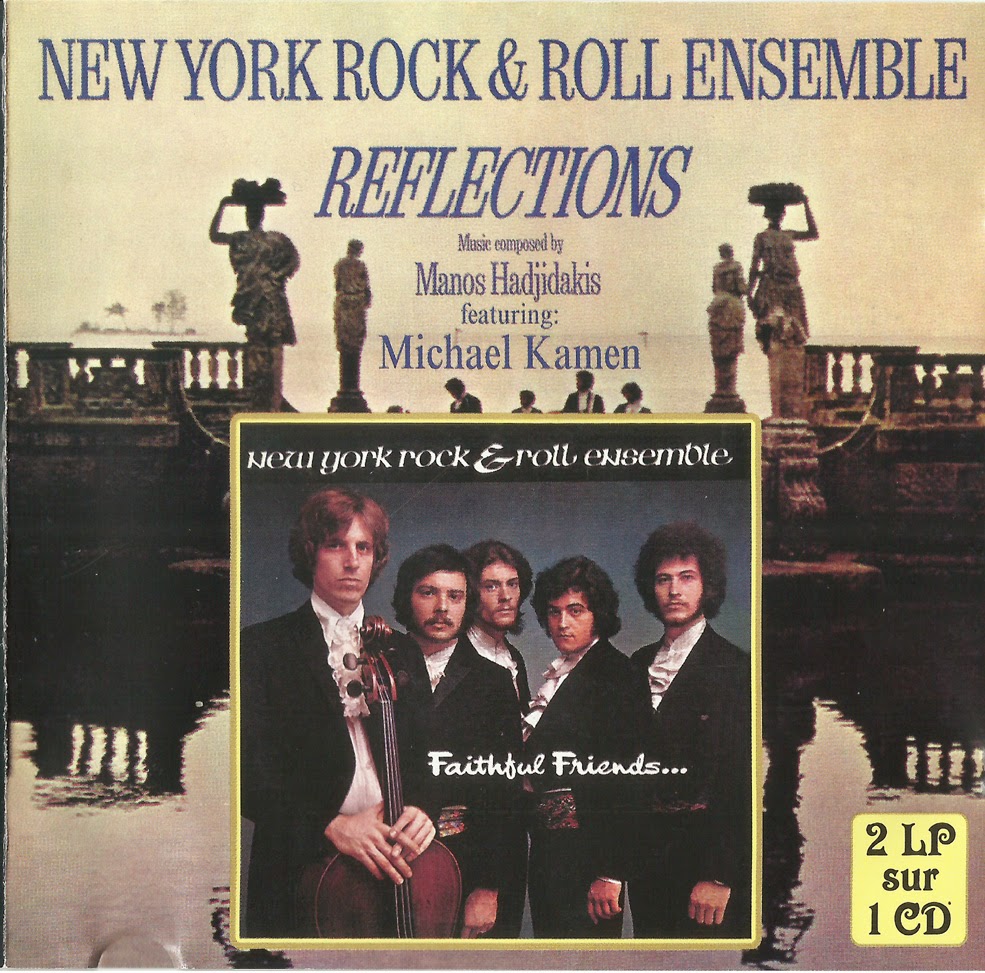
New York Rock 'N' Roll Ensemble - Faithful Friends / Reflections (1969-70 us / greece, amazing baroque folk psych rock, 2005 edition)


Over the course of their first three albums in the late 1960s, the New York Rock 'n' Roll Ensemble made their mark as one of the few bands of any era to comfortably integrate classical music and instrumentation into a rock format. Their 1968 self-titled debut had been co-produced by Shadow Morton (famous for his work with the Shangri-Las, Janis Ian, the Vanilla Fudge, and later the New York Dolls), and also showcased a quintet that could skillfully blend instrumental, compositional, and vocal input from five distinct and diverse musicians. The group's 1969 follow-up, Faithful Friends, solidified and expanded their assets while allowing themselves to take a stronger voice in the production.

Most of the songs on Faithful Friends were original compositions, and owed more to rock than classical music, with all five members contributing as songwriters.  The band also inserted brief classical pieces by Bach ("Trio Sonata No. 2 in G Major") and Thomas Morley ("Aria"), as well as a lengthier adaptation of Bach's "Brandenburg." On top of all this was a cover of one of Jimi Hendrix's less celebrated songs, "Wait Until Tomorrow." With the frequent incorporation of oboe and cello into the arrangements, and the group's oft-noted performances in tuxedos and tails, they didn't quite sound or look like any other act on the late-'60s rock scene—quite a feat, at a time when so many artists were trying to outdo each other in eclecticism or outrageousness.

The division of most of the lead vocals between keyboardist/oboist Michael Kamen and rhythm guitarist Brian Corrigan as an asset. "Michael had the more 'cultured' voice, with some early stage experience in musicals prior to the NYR&RE (also in early bands)," he notes. "He wanted badly to be the American John Lennon. Brian had [a] more bluesy voice, and could be more easily compared with Jagger. The combination was great for us and helped to set off the songs, and also helped us to remain slightly enigmatic and not so easy to cubbyhole (are they classical? Rock? Or what?)—which was both an advantage and disadvantage." Adds lead guitarist Clif Nivison (who also takes a lead vocal on "Lazy Man"), "No band I've been in since had people who could all sing lead and harmony. Michael and [drummer/oboist] Marty [Fulterman] could both hear oboe parts in almost all songs, and the cello is such a beautiful sound; it always adds color."

Of the original songs on Faithful Friends, perhaps the most familiar-sounding to the general rock audience is "Sing Lady Sing," due to its similarity to a different record that ended up getting much more exposure. "Buddy Miles took pretty much all the guitar lines that Michael and I wrote and used them in 'Them Changes,'" says Nivison. "It is the same song with a different vocal." As for the group's cover of "Wait Until Tomorrow," written by a musician with whom Miles was soon to (briefly) play, Clif explains, "Michael and I were great Hendrix fans. He heard us play his song at [the New York club] The Scene in 1969. He told us he really liked it."

It was original material, however, that was at the core of Faithful Friends, often blending rock and classical flavors into the same track without either element clashing with or overwhelming the other. Although the New York Rock & Roll Ensemble were happy with how their music was progressing, Faithful Friends, like their debut, was not a big seller, possibly because it was so hard to categorize. "I think the media was still having problems with us, our image, and our 'place' in the rock developments of that time," feels Dorian. "The West Coast was coming on strong—hippies, war resisters, the whole '60s thing was exploding all around and we were exploding with it. However, we still had our tuxedos and tails we wore playing live, and we were still often connected to the New York 'Beautiful People' scene—a difficult image that was becoming more and more of a burden. In fact, during the time of this record's release, we were breaking away from that, and so I guess we were getting mixed signals—very positive from our fan base, and more restrained from the new audience we were beginning to reach out to." The band's association with Atlantic Records was already on the verge of ending, but not before a third album of a very different sort, Reflections, emerged—a story told on Collectors' Choice Music's CD reissue of that unusual recording.

For their third--and certainly best--record the band recruited Greek composer and songwriter Manos Hadjidakis. The resulting REFLECTIONS plays like a film score--not surprisingly, given Hadjidakis's experience as a composer of just such works--with epic instrumental sweeps and passages of quiet melancholy. Many of the tracks, such as "Orpheus," "The Day," and "Kemal," incorporate the folk melodies of Hadjidakis's homeland while maintaining a baroque psychedelic touch. 
by Richie Unterberger


Tracks
Faithful Friends 1969
1. I'm Too Busy (Brian Corrigan, Martin Fulterman) - 3:05
2. City (Michael Kamen) - 3:18
3. Asking Too Much (Brian Corrigan, Michael Kamen) - 2:39
4. Trio Sonata No. 2 In G Major (Johann Sebastian Bach) - 0:53
5. Kite Song (Brian Corrigan, Michael Kamen) - 2:20
6. Wait Until Tomorrow (Jimi Hendrix) - 3:50
7. Sing Lady Sing (Brian Corrigan, Michael Kamen) - 3:17
8. Nel Cox (Brian Corrigan, Michael Kamen) - 2:53
9. Thinking Of Mary (Brian Corrigan, Dorian Rudnytsky) - 3:06
10.Faithful Friends (And Flattering Foes) (Martin Fulterman) - 3:10
11.Aria (Thomas Morley) - 1:05
12.Lazy Man (Clifton Nivison) - 2:47
13.Brandenburg (Johann Sebastian Bach, B. Corrigan, M. Fulterman, M. Kamen) - 5:20
Reflections 1970
14.Orpheus (Manos Hadjidakis, Dorian Budnytsky) - 2:37
15.The Day (Manos Hadjidakis, Brian Corrigan) - 3:42
16.Love Her (Manos Hadjidakis, Brian Corrigan) - 5:02
17.Dance Of The Dogs (Manos Hadjidakis) - 3:30
18.Kemal (Manos Hadjidakis, Martin Fulterman) - 4:32
19.Dedication (Manos Hadjidakis, Clifton Nivison) - 2:51
20.The Three Answers (Manos Hadjidakis) - 3:50
21.Street Song (Manos Hadjidakis, Brian Corrigan) - 3:23
22.Bitter Way (Manos Hadjidakis, Brian Corrigan) - 4:39
23.Noble Dame (Manos Hadjidakis, Dorian Budnytsky) - 3:31

The New York Rock 'N' Roll Ensemble
*Dorian Rudnytsky - Bass, Cello
*Martin Fulterman - Drums, Oboe
*Michael Kamen - Keyboards, Oboe
*Clifton Nivison - Lead Guitar
*Brian Corrigan - Rhythm Guitar
With 
*Manos Hadjidakis - Orchestral Arrangements (14-23)

1971-72  The New York Rock Ensemble – Roll Over / Freedomburger

Free Text
Text Host

Saturday, January 17, 2015

Crystal Syphon - Family Evil (1967-68 us, brilliant garage acid psych, 2012 Vinyl edition)


America’s great lost acid rock band.  Who knew California band Crystal Syphon had an album’s worth of material sitting in the can waiting to be heard by 60s psych rock fans?  This has to be not only one of the best reissues of 2012 but also one of the best archival classic rock discoveries of the year.

Crystal Syphon’s origins can be traced back to the Morlochs, a garage band who formed in 1965 and hailed from the San Joaquin Valley area.  As the years went by (and after several personnel changes) the Morlochs changed their name to Crystal Syphon.  Crystal Syphon played the S.F. live circuit with some of the era’s biggest names while the major labels expressed serious interest in this promising, up-and-coming group.  As the 60’s passed into the 70’s, no album or single appeared and the group members moved on to other projects, effectively putting an end to Crystal Syphon. Roaratorio did a superb job in assembling this excellent LP (vinyl only release), which was cobbled together from studio sessions, demos and live shows.  It’s arguably a fuller picture then any studio LP could give the listener, as all sides of the band are on full display, whether it be in the studio or on the live stage.

Does the music live up to the hype? You bet. The earliest tracks have a rawer sound than the later material, which is clearly influenced by big time S.F. bands Quicksilver Messenger Service, The Grateful Dead and Jefferson Airplane.  “In My Mind,” recorded in 1968, sounds like a lost outtake from the first Quicksilver album.  The deep vocals and vibrating guitar tones strongly recall the mighty Quicksilver Messenger Service.  No matter, it’s an excellent track that could have easily made any psych compilation you care to name.  “Marcy, Your Eyes” and “Paradise” two of the earliest cuts from 1967, have thick garage fuzz, naive teen vocals, and cascading acid guitar work – outstanding.  The last 15 seconds of “Paradise” are especially great.

The guitarist starts playing eastern scales and just when you think they are about to explode into the most intense raga solo you’ve ever heard the song ends – what a clever trick!  Other highlights are the menacing acid rock of “Fuzzy and Jose,” “Family Evil” and “Winter Is Cold.”  These cuts are longer, slow paced and closer in sound to Jefferson Airplane and Quicksilver Messenger Service – lots of acid guitar work, creative arrangements and spacey vocals.  “Try Something Different” is another earlier cut with a lilting folk-rock sound that recalls Buffalo Springfield in it’s guitar figures.

Every cut on Family Evil is worthwhile.  There’s nearly 50 minutes of great psych rock here – so not only a significant discovery but an absolute must own for any 60s rock fan.
by Jason Nardelli


Tracks
1. Marcy Your Eyes - 3:36
2. Paradise - 3:08
3. Have More of Everything - 5:25
4. Try Something Different - 3:42
5. Fuzzy And Jose - 7:33
6. Are You Dead Yet - 2:17
7. In My Mind - 2:43
8. Family Evil - 5:41
9. Fails to Shine - 5:46
10.Winter Is Cold - 7:01
All songs by Crystal Syphon

Crystal Syphon
*Tom Salles - Vocal, Guitar
*Jim Sanders - Vocal, Guitar
*Jeff Sanders - Vocals, Organ, Percussion
*Bob Greenlee - Bass
*Andy Daniel - Drums (1-4)
*Dave Sprinkel- Vocals, Organ, Percussion (Except #4)
*Marvin Greenlee - Drums (5-10)

Free Text
Text Host

Thursday, January 15, 2015

Lincoln Street Exit - Drive It (1970 us, superb garage psych, 2010 remaster and expanded)


Dearest Brothers and Sisters
Make no mistake about this album, it is loud, heavy, alive and ready. Lincoln St. Exit was formed in June of 1964. Since then they lost one of their musicians, Paul Chapman(who died). The three original members, Michael Martin, Mac Suazo and Lee Herres, still remain with the group. Their music is influenced greatly by the American Indian culture of New Mexico.

This is evident in the hard-driving beat and hypnotic rhythm pattern that is maintained throughout the album. Their own personal feelings and the many hard times they have encountered along the way all come through in their music. As co-writer on some of the material, our view of the war is expressed in the two compositions "Man Machine" arid "Time Has Come Gonna Die".

We move from such gospel-orientated tunes as "Going Back Home" and "Soulful Drifter" to the down home sound of "Teacher Teacher" and "Dirty Mother Blues", the latter being so heavy it shakes all of your \ital organs Our snnga also deal with modern sexual mores, as in "Straight Shootin1 Man", "Got You Babe" and "Phantom Child". Lincoln St. Exit have been together for over six years, and they're going to make it.
God Bless The Exit.
As told to Mark Janowski by Tommy Bee

This is my cup of tea, one of my desert island records. Dirty, rough, Garage, Psych, Roots 'n' Roll, Folk, well it's everything abount Rock 'n' Roll in a magic cauldron, just give a spin and let yourself to enjoy a trip far and beyond...

Lincoln St. Exit were Albuquerque, New Mexico’s premiere garage/ psych band of the late 60′s, early 70′s. In early 1969 Lincoln St. Exit, Mike Martinez, Mac Suazo, RC Gariss and Lee Herrerra recorded in Clovis New Mexico at the Norman Petty Studios and the song "Soulful Drufter" emerged from the "Drive It" Album. The album was distributed by Mainstream Records.

Artists like Janis Joplin (Pre Columbia Records) and Amboy Dukes recorded for the label at the same time.  Soulful Drifter gained radio station play and Exit had a hit record along the Great Lakes Area.  The airplay was enough to catch the ear of Motown records in Detroit.

At that time Motown was looking to increase it’s catalog of new artists on their new Rare Earth label and Exit filled the need.  Motown liked the group, a new sound, a new look and a new direction was needed.  So the idea was that they would return to their roots and create.  A new sound in music was born “American Indian Rock”. Under the management of Tom Bee the new sound emerged and the new Xit name was born.  The acronym was XIT for Xing of Indian Tribes came about because of some of the group’s ethnic background.

The first album for Motown was “Plight of the Redman” released in 1971.  It’s a history lesson from the beginning to end sung by member Mike Martinez and tells the story from the beginning of peace in the New World to their struggles with the white man in America and finally to the climatic end of the narrative speech by Mac Suazo.

XIT played many venues including the Whiskey A Go-Go in Hollywood and in 1972 the 8th International Music Festival in Venice Italy.  This festival was broadcasted to over 30 million people throughout Europe, along with countless concerts in cities and reservations across the United States and Canada.


Tracks
1. Man Machine - 4:02
2. Dirty Mother Blues - 6:55
3. Got You Babe - 3:06
4. Teacher Teacher - 2:45
5. Soulful Drifter - 2:00
6. Time Has Come Gonna Die - 4:06
7. Going Back Home - 3:03
8. Straight Shootin' Man - 3:00
9. Phantom Child - 3:14
10.The Bummer - 2:22
11.Sunny Sunday Dream - 2:58
12.St. Louis Mama (B-Side 1968) - 2:35
13.Whatever Happened To Baby Jesus (Parts 1 & 2 1968 Single) (Bonus Track) - 6:18
14.The Bummer (A-Side 1967) - 2:23
15.Sunny Sunday Dream (B-Side 1967) - 3:33
16.Who's Been Driving My Little Yellow Taxi Cab (A-Side 1966) - 2:16
17.Paper Lace (B-Side 1966) - 2:20
18.Half A Man (Bonus Track) - 3:00
19.She's Upon Her Way (Bonus Track) - 2:49
20.Open Doorway (Bonus Track) - 2:45
21.Orange Benevolent (Bonus Track) - 2:45
22.Forever Or Not At All (Bonus Track) - 3:48
23.Yellow Man Of Paris - 2:40
24.She's My Everything (Bonus Track) - 3:05

Lincoln St. Exit
*Michael Martin - Lead Vocals, Lead Guitar
*Mac Suazo - Heavy Bass Guitar
*Lee Herres - Drums And Percussion
*R. C. Gariss - Second Lead Guitar

Free Text
Text Host

Wednesday, January 14, 2015

Various Artists - Searching In The Wilderness (1964-67 multinational, astonishing garage freak beat)


While this compilation might prove mighty hard to track down, it's one of the better anthologies of raw, rare mid-'60s rock, concentrating exclusively on bands from the U.K. and Europe (i.e., this is not a "garage" compilation in the classic sense). Some of these groups enjoy a cult reputation, especially the Dutch ones (the Outsiders, Q65, Cuby & the Blizzards, the Motions); most will draw blanks even on the faces of specialist record store owners. Still, if you like the R&B/mod of the Pretty Things or the Who and are looking for stuff in that mode that's less polished, this is a good place to land. 

The Red Squares' "You Can Be My Baby" is as good as the best London 1966 mod; the Buzz's "You're Holding Me Down" is one of British producer Joe Meek's hardest-rocking sessions; Jimmy Page plays a raunchy session guitar lead on Sean Buckley's "Everybody Knows"; and the Outsiders' "Won't You Listen" is one of the wildest, most unhinged beat/punk performances of all time. There's also a rare and basic unreleased mid-'60s song by the Kinks (who are identified as the "Muswell Ravens" on the cover), "All Aboard." 
by Richie Unterberger


Tracks
1. Namelosers - But I'm So Blue - 1:43
2. The Red Squares - You Can Be My Baby - 2:17
3. The Motions - For Another Man - 1:48
4. Sean Buckley And Breadcrumbs - Everybody Knows - 2:08
5. The Boys Blue, The You Got What I Want - 2:06
6. The In Crowd - Things She Says - 1:46
7. The Cherokees - Little Lover - 1:59
8. The Outsiders - Won't You Listen - 2:48
9. The Kinks - All Aboard - 2:48
10.A Passing Fancy - I'm Losing Tonight - 2:32
11.The Outlaws - Keep A Knockin' - 2:32
12.Q-65 - It Came To Me - 2:24
13.The Golden Earrings - Chunk Of Steel - 2:27
14.Cuby And The Blizzards - I'm So Restless - 2:00
15.The Snobs - Heartbreak Hotel - 2:44
16.The Buzz - You're Holding Me Down - 3:16  
17.Alan Pounds Get Rich - Searching In The Wilderness - 2:18

Free Text
Just Paste

Monday, January 12, 2015

Various Artists - Shakin' in Athens (1964-67 greece, garage beat)


It’s very difficult to describe in only a few words the history of such a rich and underestimated pop-rock scene as existed in Greece in the sixties. This is especially true when this scene has been represented so poorly in the world of CDs, despite the glut of recent reissues. There have been a seemingly endless stream of compilations from the most obscure places on the planet, produced primarily, it seems, because those places are exotic and outrageous geographically, not because of the value of their music. 

The classic beat/garage scenes of the UK, Holland, Germany, etc. have been exhausted, with the best 45s out (again and again), and the fans of this music numbed by the saturation approach of most reissuers. Now the time is ripe for all fans of beat/garage music to focus on the Greek scene, which up until now has languished in the dark shadows that could only result from sunshine so bright. Those fans, (and hopefully you who are reading this are one of them) will discover a unique sound— not just faithful mimicking or the typical European imitation of the American garage sounds! It all started in 1965 with the release of "Geronimo Yanka" by Forminx, an arrangement of a traditional Finnish song. In one year, this single sold more than 60,000 copies (!) and became the national anthem of every Mod teenager in Greece. 

With Forminx (featuring future international superstar Vangelis Papathanasiou) now firmly established as the Beatles of Athens, other groups sprouted up from every neighbourhood, from every one of the many dark corners in Athens to try to make their mark. Many of these bands such The Idols contributing to the collection with two songs and including the most famous band member, Demis Roussos  with great international career later, with Afrotide's Child and as a solo artist,  The Juniors whose most members die in a car accident, while the remaining members - one week after the accident- played in a live show -in honor of deceased friends-  with a young English guitarist who was dressed in black and his name was..... Eric Clapton!!  

Noticeable is also the sound of the Zoo, a band that is rumoured that they were mostly students of American College of Athens,  while the Bluebirds for many of critics and not only- is the most important Greek Band of their time, having released 13 singles. But not many of the bands  were able to sign contracts with a label, except for the big names (Forminx, Olympians, Idols, Bluebirds etc.), the overwhelming majority of those groups were happy just to cut a single. After a few practice sessions, they would head for one of the very primitive local studios. These studios, tailored to record traditional Greek bouzouki music, supplemented their income by recording the wave of enthusiastic young musicians. 

Techniques were extremely primitive (cardboard egg holders nailed to walls for acoustic panels, etc.), and the pressings were very small (approximately 100-200 copies), but the excitement was real. If the single became a hit (!) the group would cut an additional 500-1000 copies (a rare occurrence). With such small pressings, imagine how difficult it is now, more than thirty years later, to find copies of any of these singles in good shape. Within the next couple of years, a very active and respectable scene managed to develop and flourish. It was an underground phenomenon (there were no magazines devoted to the music scene), fueled by imported music, and the relentless enthusiasm of Rock and Roll aficionados. 

Thanks to U.S. Armed Forces Radio (there were more than 5,000 American troops stationed in Greece), beat/garage fans were informed on a daily basis of the U.S. top ten. At night, on Greek radio, programs presented label showcases (Parlophone, EMI, etc.)— game shows that involved top ten songs, but also promoted independent Greek Rock and Roll groups. Occasionally, drawn by the prospect of Greek sunshine, European musicians visited and taught their Rock and Roll secrets to the hungry young musicians. 

The influence of British and American rock (via songs like "Shake, Rattle and Roll" and the Swingin' Blue Jeans' "Shakin' All Over") produced the "Shake," a dance like the Twist, which became hugely popular in Greece and Italy. Unlike the north areas of Europe, which embraced R & B, the Greeks and Italians along the Mediterranean preferred the stirring sounds of Rock and Roll. "Shaking" became a part of the local talk, and parents feared that their darling children might go and "shake at the disco" or "shake at the club," instead of studying to become doctors, lawyers, or architects. For roughly three years (1964-'67), it was "shaking" that dominated the club scene, and "shake" that dominated the music.

 This all but ended on April 21, 1967 when a junta took over the Greek government. Along with other political restrictions during the junta rule (1967-1974), they chased away all the long-haired Rock and Roll lovers, and concerts were prohibited (especially those with English lyrics). The Rolling Stones were allowed to come in 1967, but the concert was a disaster as fans nearly rioted in protest against the restrictions of the junta. The whole music scene collapsed. Certainly the development of Greek pop/rock music would have been very different if the political situation had not been repressive. But even under the pressure of those severe circumstances, many musical diamonds were created.


Tracks
1. The Knacks - Devil Doll - 2:36
2. Zoo - Go - 2:28
3. The Idols - Wanted by the Law - 2:44
4. The Crowns - You're My Only Love - 3:08
5. The Idols - He's the One - 2:37
6. New Hopes - I Found a Love - 2:36
7. The Blue Birds - Just Remember - 2:44
8. The Vikings - I'm Trying - 2:43
9. Olympians - Hopeless Endless Way - 3:00
10.Zoo - Six Miles From the Cage - 2:36
11.The Juniors - Miss Blue Jeans - 2:30
12.Phoenix - Senzamore - 3:09
13.Uptight - I Love You - 3:10
14.Nelli Manou - Crazy Girl - 2:44
15.The Blue Birds - Sweet Polly - 3:05
16.The Charms - It's My Life - 3:05

Free Text
Just Paste

Saturday, January 10, 2015

Zodiac - Cosmic Sounds (1967 us, imressive radiant psych space rock, 2002 edition)


At first glance and hearing, The Zodiac: Cosmic Sounds might seem like an anomaly in the Elektra catalog. When it appeared in 1967, the label was recognized primarily for its eclectic catalog of folk recordings, and starting around 1965 for its run of extremely important folk-rock records by Love, Judy Collins, Tom Rush, Tim Buckley, and others.  Just a couple of catalog numbers in advance of the album was the debut by the Doors, which would advance Elektra to a whole new level.

The Zodiac: Cosmic Sounds, however, was like none of those records. It was not so much the product of a group or artist as it was a collectively-hatched concept album, matching psychedelic mood music with spoken prose and all manner of exotic and electronic instrumentation. It was, as the subtitle boasted, "celestial counterpoint with words and music." And as the back sleeve instructed, in capital purple letters, it "MUST BE PLAYED IN THE DARK." Should there have been any doubt that it was serious, the astrological sign of each contributor listed on the back sleeve was announced, in parentheses, after each name, even for Elektra owner Jac Holzman. Artist Abe Gurvin and art director William S. Harvey concocted a suitably florid sleeve, with a mosaic of colors so bold and gaudy they nearly glowed in the dark, supplemented by huge wavy title lettering and a nocturnal backdrop.

Divided into 12 separate tracks, one for each astrological sign, it appeared just as both psychedelic rock and astrology itself were coming into vogue in the youthful counterculture. In some respects it was similar to other instrumental psychsploitation albums of the time, with a spacy yet tight groove that could have fit into the soundtrack of 1966 Sunset Strip documentaries, played in large measure by seasoned Los Angeles session musicians. In other respects, it was futuristic, embellished by some of the first Moog synthesizer ever heard on a commercial recording, an assortment of exotic percussive instruments, and sitar. 

The arrangements were further decorated by haunting harpsichord and organ, along with standard mid-1960s Los Angeles rock guitar licks. For those who took the astrology as seriously as the music, there was the dramatic reading of narrator Cyrus Faryar, musing upon aspects of each astrological sign in a rich, deep voice without a hint of irony.

Only a few of the musicians involved in the album were listed on the back cover, and much mystery has surrounded the conception and realization of the record in the ensuing years. As it happens, though, the album featured some of the creme de la creme of the Los Angeles session musician clique, as well as some notable contributors with strong ties to the early-1960s folk music that had been Elektra's backbone prior to 1965. In addition, there were precedents for albums not tied to a particular artist in the Elektra discography. 

Only two or three years before, the company had released a 13-volume series of Authentic Sound Effects, as well as records on how to play bass and blues guitar. The Zodiac: Cosmic Sounds was not an accidental one-shot aberration from an out-of-control producer, but in fact instigated by Elektra founder and president Jac Holzman himself. 

Producing the album was Alex Hassilev, one-third of the Limeliters, the successful pop-folk group of the early 1960s who had recorded their debut LP for Elektra in 1960 (followed by numerous other ones for RCA). Hassilev had recently formed a production company with Mort Garson, who had arranged one of Alex's RCA albums (as well as doing some arranging for fellow Limeliter Glenn Yarborough). 

Elektra was the type of label to take risks that others might have dismissed as reckless. "Jac, being a very adventurous guy, sonically speaking, really believed in finding new things," enthuses Hassilev. "He bought the idea of doing a kind of electronic score for this project. And Mort assembled this group of musicians, including Paul Beaver. Percussionist Richards boasted a staggering array of credits. Over the course of his lengthy career he has worked with everyone from Henry Mancini, Dizzy Gillespie, and George Harrison to Frank Zappa, Frank Sinatra, Marvin Gaye, Linda Ronstadt, and Herb Alpert, as well as on over 1700 Movies.  It was the Moog that supplied the freakiest swoops and textures on The Zodiac, and the greatest challenge to capture on tape. "The Moog, while a wonderful instrument, had very unstable oscillators," explains Hassilev. 

 Filling out the personnel for The Zodiac on more conventional guitars, bass, and drums were top Los Angeles sessionaires, although unfortunately the precise names and details have been lost to memory. Hassilev is fairly certain that bassist Carol Kaye and drummer Hal Blaine--both at the very top of the list for rock, pop, and session calls in Los Angeles in the 1960s--comprised the rhythm section. Holzman thinks Blaine was on the date for sure; Cyrus Faryar remembers Bud Shank playing bass flute, and Mike Melvoin, who played on numerous jazz and pop sessions (including some harpsichord on the Beach Boys' Pet Sounds), contributing keyboards. Kaye, who did uncounted sessions in the 1960s (including some others with Garson, and some other dates with Beaver), recently confirmed after listening to the record that it is indeed her on bass: "That's me on the whole thing. [The] double paradiddles, tons of slides, and the octave licks [are] typical of my playing." Garson, she adds, "was an extremely talented arranger. I can see his face now, sort of smiling here and there as if he was up to some mischief."

Once the music was finished, Moog and all, one more component would be needed to put it to bed. This was the spoken astrological narrative, written by Jacques Wilson, and voiced by Cyrus Faryar. Like Hassilev, Faryar was a young veteran of the early-1960s folk boom, having played with Dave Guard and the Whiskeyhill Singers (led by ex-Kingston Trio member Guard, and also including Judy Henske) and the Modern Folk Quartet. Also a session musician who played on some of Fred Neil's finest records, he was well known to Hassilev.   Over the years Faryar (who eventually recorded a couple of albums himself on Elektra in the early 1970s) came across admirers of The Zodiac and his narration in some of the most unexpected places. At one party he met the late Graham Bond, the brilliant but erratic British blues-jazz-rock musician noted for dabbling in the occult, who moved to the States in the late 1960s. 

For years afterward, Hassilev had a studio in Los Angeles and continued to produce, working on projects as diverse as albums by Hoyt Axton and Ananda Shankar (Ravi Shankar's nephew, who combined traditional Indian music with modern electronics), a single by Seals & Crofts, and commercials with Van Dyke Parks. He's still playing as part of the Limeliters, and still proud of The Zodiac: Cosmic Sounds. "What I chiefly remember is that the recording of the music for me was just a joy," he summarizes. "Working with Cyrus was wonderful, and working with Jac was great too. Jac was there for all the sessions, supervising this whole project. In that period, he was the hands-on for everything."
by Richie Unterberger


Tracks
1. Aries - The Fire-Fighter - 3:17
2. Taurus - The Voluptuary - 3:38
3. Gemini - The Cool Eye - 2:50
4. Cancer - The Moon Child - 3:27
5. Leo - The Lord Of Lights - 2:30
6. Virgo - The Perpetual Perfectionist - 3:05
7. Libra - The Flower Child - 3:28
8. Scorpio - The Passionate Hero - 2:51
9. Sagittarius - The Versatile Daredevil - 2:06
10.Capricorn - The Uncapricious Climber - 3:30
11.Aquarius - The Lover Of Life - 3:45
12.Pisces - The Peace Piper - 3:19
Music by Mort Garson Lyrics by Jacques Wilson

Personnel
*Cyrus Faryar - Narration
*Paul Beaver - Moog, Electronic Instruments
*Emil Richards - Exotic Percussion
*Bud Shank - Bass Flute
*Hal Blaine - Drums
*Carol Kaye - Bass Guitar
*Mike Melvoin - Keyboards

Free Text
Just Paste

Wednesday, January 7, 2015

Max Frost And The Troopers - Shape Of Things To Come (1968-69 us, superb garage psychedelia, 2014 remaster)


Max Frost And The Troopers were a fictional group created for the 1968 hippie-exploitation movie, Wild In The Streets. Frost was actor Christopher Jones (passed away January 31, 2014), more interestingly, the Troopers’ drummer was a young Richard Pryor. Their role in the film was to gain voting rights for 14-year-olds. Frost is elected president of the USA at the movie’s climax, and he orders everyone over 30 into concentration camps, where they are forced to take LSD. His band’s songs were equally absurd semi-political rants (‘14 Or Fight’) save for one bona fide folk-punk classic, ‘Shape Of Things To Come’. Written by Barry Mann and Cynthia Weil, the song was actually recorded by a band called the 13th Power. However, it was released under the name Max Frost And The Troopers to capitalize on the movie’s success with the youth market, and eventually reached number 22 in the USA. 

1968, garage rock, psychedelic sounds, mind expanding substances and wicked colorful fantastic movies pointing at a probably strange future or dealing with the then current dissatisfying political and social situation or with the abuse of drugs were the hottest topics of the time. The Vietnam War had reached a preliminary peak in its progress, the atmosphere was full of either love or fury. A great time to create a movie about a future society of young people taking over the reign in the USA and the first step on their path to success was a rockband, MAX FROST AND THE TROOPERS. Not much is known about the musicians who either participated on the soundtrack of the movie or on this sole album by MAX FROST AND THE TROOPERS. The band name TROOPERS is based on the term "troops," the designation Frost was used in the film to refer to his friends and followers. 

What we get to hear on the new reissue of “Shape of things to come” at hand is both: the entire studio work of MAX FROST AND THE TROOPERS plus the entire soundtrack album for the “Wild in the streets” movie and it is getting enormously colored and from time to time quite bizarre. The musical range goes from fuzzed out garage beat via soulful high energy rock numbers to a small quantity of acid freak outs. The compositions show a straight and accessible structure with a decent dance groove as it was usual in the contemporary pop music of the day. Some tinges of psychedelia like howling fuzz guitars, darker harmonies and swirling sitar lines were added for the good measure. 

All 19 songs here prove to be memorable pieces of late 1960s acid pop and despite the movie related revolutionary and political statements in the lyrics all tunes drive you into a state of sheer bliss when spinning the record. So if you are a fan of late 1960s acid pop and garage psyche in the vein of THE THIRD BARDO, THE SEEDS, THE STRAWBERRY ALARM CLOCK and THE MUSIC MACHINE, look no further ‘cause you’ve found the holy grail!
Captain-High


Tracks
1. Shape Of Things To Come (Mann, Weil) - 1:59
2. Lonely Man (Paul Wibier) - 2:36
3. Shine It On (Paul Wibier) - 2:34
4. It's Wrong (Barney Hector, Paul Wibier) - 2:17
5. Captain Hassel (Wibier, McClane, Martin, Beckner, Hector) - 2:25
6. Fifty Two Per Cent (Mann, Weil) - 2:30
7. Try To Make Up Your Mind (Paul Wibier) - 1:49
8. Let Your Mind Run Free (Paul Wibier) - 2:23
9. She Lied  (Dale Beckner, Stewart Martin) - 2:28
10.A Change Is Gonna Come (Paul Wibier, Dale Beckner) - 2:39
11.Love To Be Your Man (Mann, Weil) - 2:10
12.Free Lovin' (Guy Hemric, Paul Wibier) - 2:17
13.Les Baxter - Psychedelic Senate (Les Baxter) - 2:14
14.Fourteen Or Fight (Mann, Weil) - 2:46
15.Jerry Howard - Wild In The Streets (Guy Hemric, Les Baxter) - 2:43
16.The Second Time - Listen To The Music (Mann, Weil) - 2:48
17.The Second Time - Sally LeRoy (Mann, Weil) - 2:38
18.The Gurus - Shelly In Camp (Les Baxter) - 1:39
19.Paxton Quigley's Had the Course (Chad Stuart, Jeremy Clyde) - 2:00
Bonus Tracks 11-19

Musicians
*Paul Wibier - Vocals
*Davie Allan - Guitar
*The Arrows
*The Hollywood Wrecking Crew

Free Text
Just Paste