In The Land Of FREE we still Keep on Rockin'

It's Not Dark Yet

Plain and Fancy

Music gives soul to universe, wings to mind, flight to imagination, charm to sadness, and life to everything.

Plato

Sunday, August 21, 2011

The Ides Of March - Ideology (1965-68 us, beat psychedelia, sunshine pop, sundazed remaster edition)


This collection of 1965-1968 material, taken from rare regional singles along with a couple of previously unreleased tracks, is far removed from the Ides of March's horn-rock era (as heard on their 1970 hit "Vehicle"), both chronologically and stylistically.

When they started, the Ides were a Chicago teen band, recording mostly original songs heavily influenced by folk-rock and the British Invasion, although a few of these cuts do use brass. In general that's good news (and preferable to the horn-rock of their later career), but the harmony-heavy pop/rock of this early work isn't too exciting. In common with several other groups from the Chicago and Midwest areas, the group favored a rather clean-cut, Americanized take on British Invasion bands like the Beatles and the Hollies, though the folk-rock of the Byrds is heard in the guitar arrangements especially.

The local Chicago hits "You Wouldn't Listen" (which made number 42 nationally) and "Roller Coaster" are here, but to be tough about it, there's not enough light and shade here to put the Ides on the level of good British Invasion bands, or even of good British Invasion-influenced bands from the same region, such as the New Colony Six.

More to the point, there's too much light and not enough shade; although the harmonies are fairly impressive and the execution polished, the material is too often sunnily bland. The great exception to that is the riveting, raw folk-rocker "I'll Keep Searching," buried on a B-side, which has great bittersweet melodic hooks, melancholy harmonies, and dramatic stop-start tempos.

The disc includes two 1965 songs that they recorded as the Shondels on a super-rare self-released 45, as well as the previously unreleased originals "One and One Does Not Make Three" and "I'll Take You Back." The latter of these, an uncommonly moody tune, is actually a highlight of the collection.
by Richie Unterberger


Tracks
1. You Wouldn't Listen (Borch, Millas, Peterik) - 2:33
2. Girls Don't Grow on Trees - 2:58
3. You Need Love - 2:47
4. Roller Coaster - 2:33
5. I'll Keep Searching (Millas, Peterik) - 2:25
6. One and One Does Not Make Three - 2:23
7. Give Your Mind Wings - 2:55
8. Things Aren't Always What They Seem - 2:29
9. The Sun Ain't Gonna Shine (Anymore) (Crewe, Gaudio) - 2:21
10.Hole in My Soul - 2:54
11.I'm Gonna Say My Prayers - 3:01
12.Sha-La-La-La-Lee (Lynch, Shuman) - 2:59
13.My Foolish Pride - 2:19
14.I'll Take You Back - 2:05
15.Like It or Lump It (Peterik, Millas) - 3:28
16.No Two Ways About It (Peterik, Millas) - 2:13
17.Hole in My Soul (Stereo Mix) - 2:52
18.Girls Don't Grow on Trees (Stereo Mix) - 2:54
All Songs Written by Jim Peterik, except wher indicated

Ides Of March
*Bob Bergland - Bass
*Jim Peterik - Vocals, Guitar
*Mike Borch - Drums, Percussion
*Larry Millas - Guitar

more Ides Of March
1970 Vehicle

Free Text
Text Host

Saturday, August 20, 2011

Creme Soda - Tricky Zingers (1975 us, psychedelic rock, west coast touches)


Hailing from Milwaukee, Wisconsin, Creme Soda generated a fanatical following based on their legendary single '(I'm) Chewin' Gum/Roses All Around' which appeared on the Trinity label in 1975. Creme Soda are not an easy band to categorize as they were able to play virtually any musical genre with consummate ease.

Their only full-length album, Tricky Zingers (which also includes their 'hit' singles), also made its appearance on Trinity (Trinity CST11) in 1975 and despite the considerable interest the record generated, the band, perhaps mindful of the adage 'quit while you're ahead,' did exactly that, never to be heard of again. Tricky Zingers is an impressive and relatively overlooked recording, which, despite being recorded in 1975, has a decidedly mid-'60s feel about it.

The eleven self-penned songs range from very good to brilliant, particularly 'Tonight,' 'Keep It Heavy' and 'Roses All Around.' The album's style ranges from folkrock to wasted psychedelia, with two experimental tracks featuring drone effects and backwards guitar thrown in for good measure, as well as a couple of rootsy rock'n' roll numbers."

As one critic was moved to write ?this is a major album worthy of a high quality reissue. This is another band that lends credence to the theory that the very best psychedelia was made in the `70s


Tracks
1. Give It Up (Man) - 4:06
2. Tonight - 2:58
3. Numero Uno - 4:53
4. (I'm) Chewin' Gum - 2:41
5. Deep In A Dream - 4:28
6. The Nazz Are Blue - 3:07
7. Keep It Heavy - 2:46
8. Roses All Around - 2:11
9. And That Is That - 2:02
10.The Beat Song - 3:43
11.When It Sun Shines - 5:41
12.Daydreamin' - 2:23

Creme Soda
*Jim Wilson - Bass, Piano, Percussion, Vocals
*Bill Tanon - Guitar, Bass, Harp, Mandolin, Bowed Guitar, Vocals
*Ron Juntunen - Electric, Acoustic, Slide Guitar, Bass
*Art Hicks - Drums, Bongos

Free Text

Spring - 2 Untitled (1972 uk, smart prog rock, 2007 digipak remaster)


It took me a couple of years, but I eventually made the effort to track down a copy of "Spring 2". I would have loved a vinyl copy (not sure they exist), but all I could find was the 2007 Second Harvest CD version (Second Harvest catalog number 417). While I was happy to have the music, the rest of the package was disappointing - little in the way of liner notes, performance credits, or biographical information. At least to my ears the sound quality was also a little on the flat side.

Whereas I was instantly attracted to "Spring", I'll readily admit it took me a couple of spins to warm up to the sophomore album. Musically it wasn't really that much different than the debut, but unlike the debut only one or two of the twelve performances jumped out at you with the same vigor as the debut. That said, the album proved to be one of those that rewarded repeated spins.

'Jack and Jill' started out with a rollicking keyboard propelled rhythm pattern before Pat Moran's instantly recognizable vocals kicked in and the song started a torturous series of tempo changes. The start and stop tempo was initially kind of jarring, but once you got into the groove it was actually kind of cool Moran's voice has always fascinated me. Technically he wasn't any great shakes as a singer, but his odd Scottish accent made for some interesting performances. 'Hendle Mews' started out as a stark, keyboard dominated ballad, but about halfway through morphed into a strange pseudo-jazzy riff. Totally unexpected and not nearly as bad as you would have thought, it actually reminds me a bit of something Vince Guaraldi might have written for a Peanuts animated special.

Another ballad, 'A Painted Ship' was probably the album's most commercial track. Sporting a beautiful, haunting melody and one of Moran's least labored vocals, this one actually had commercial potential. Opening with Kipps Brown wall-of-sound organ and Pick Withers frenetic drums, 'High Horse' found the band taking their best shot at becoming ELP clones. Moran's Greg Lake impression was quite impressive though the song itself was mediocre (like most of the ELP catalog). Nice Ray Martinez guitar solo at the end of the track.

Another of the album's more commercial track, 'Feneley Avenue' benefited from a beautiful, easygoing melody and Martinez's nicest guitar solo. Great song to ponder Martin's quirky accent.  'Helping the Helpless' came about as close to being a pop song as these guys ever came.   'A Word Full of Whispers' brought the group's renown mellotrons out in full force. Nice mid-tempo rocker which sported another tasty Martinez acoustic guitar solo. Shame the song faded out just as it was starting to pick up some steam.

The first outright disappointment, the piano-propelled ballad 'Loser' never generated much in the way of energy, sounding like a demo that the band never got around to finishing up. rating:  Overlooking the awful fidelity, the song sounded like it had been recorded with the sound meters all the way in the red, 'Get My Share' was probably the album's most progressive sounding performance. Kicked along by Withers drums the track provided plenty of room for Brown to stretch out on organ and mellotron. At the same time, the song was surprisingly catchy.

An alternative version of 'Hendre Mews' this time out the song was given a much more rock oriented sound, complete with lots of Martinez lead guitar. And guess what ... This versions far superior to the other. Ironically, the alternative version of ''A Word Full of Whispers' wasn't as good. I'd place the blame on the group's decision to give this version a mild country flavor and the fact Moran's vocals came out sounding distorted.

'Fool's Gold' started out as a pretty acoustic ballad, but Martinez' chunky lead guitar quickly kicked in giving the song a much need kick in the pants. The song then opened up into a jazzy instrumental segment with some nice Martinez fuzz guitar, before closing out with a return to the original melody and an abrupt conclusion.

Not the classic the debut was, but when you consider the circumstances surrounding this one, the end results were actually surprisingly enjoyable..
BadCat


Tracks
1. Jack And Jim - 5:21
2. Hendre Mews - 4:38
3. A Painted Ship - 4:11
4. High Horse - 5:46
5. Fernley Avenue - 4:03
6. Helping The Helpless - 4:25
7. A World Full Of Whispers - 4:02
8. Losers - 4:00
9. Get My Share - 3:37
10.Hendre Mews (Bonus Track, Completely Different Mix) - 7:14
11.A World Full Of Whispers (Bonus Track, Different Version) - 3:57
12.Fool's Gold (Bonus Track) - 6:26
All songs by K. Brown, A. Maloney, R. Martinez, P. Moran, P.Withers.

 Spring
*Kipps Brown - Keyboards
*Adrian Maloney - Bass, Guitar
*Ray Martinez - Guitar, Keyboards
*Pat Moran - Vocals, Keyboards
*Pick Withers - Drums

1971  Spring (Akarma edition)

Just Paste
Free Text
Text Host

Friday, August 19, 2011

Spring - Spring (1971 uk, excellent psych, prog rock, feat Pick Withers from Dire Straits fame, 2002 remaster)


Mention the name Spring to devotees of early 70s progressive rock and you'll be met with quotes like "amazingly professional live" and "one of the first bands to use the mellotron as an integral part of their sound". However equally as many people will say "Spring? Who?" as so little is known about the band.

Formed in 1970 and based in Leicester, vocalist Pat Moran, guitarist Ray Martinez, drummer Pick Withers, bassist Adrian Maloney and keyboardist Kipps Brown had all previously played in local bands. Following a gig in Cardiff the Spring touring van broke down on the way home leaving the band stranded 'somewhere in Wales'. It was then that fate dealt one of its kinder blows for the first car to stop and help them was one driven by Kingsley Ward who owned Rockfield Recording Studios.

Recalls Ward: "I'd spent months trapesing around the country in search of new talent and here I meet a group in a broken down truck in my own home town". Inviting the band to audition, Ward snapped them up for management, heavily influenced by their mellotron-driven progressive rock. Prior to the release of their self-titled debut album (NEON NE6), produced by Elton John cohort Gus Dudgeon, Spring toured the UK supporting Velvet Underground also played with the likes of Keith Christmas and The Sutherland Brothers. This highly collectable LP, released in a triple gatefold sleeve, remained their only official release as the band went their separate ways in 1972. The second, unreleased, album, "Spring 2", has finally seen light of day in 2007 via Second Harvest.

Following the band's demise, vocalist Moran pursued a career in production and his credits include Iggy Pop, Robert Plant, Lou Gramm and Eddie Bickall to name but a few. Ray Martinez became an in-demand session guitarist working with the likes of Alkatraz, Michael Chapman, Gypsy, Tim Rose and Robert Plant. Currently a member of Showaddywaddy, Martinez also played in late 70's rock band Airwaves, whose first LP was produced by Moran. Kipps Brown worked with Ian Anderson and continues to play in local bands in Leicester whilst bassist Maloney retired from music. Pick Withers, like Martinez, took up session work and helped out the likes of Chris Jagger, Bert Jansch, Prelude, Magna Carta and Dave Edmunds before joining Dire Straits in 1978.
by Mark Brennan


Tracks
1. The Prisoner (Eight By Ten) - 5:34
2. Grail - 6:44
3. Boats - 1:53
4. Shipwrecked Soldier - 5:08
5. Golden Fleece - 6:59
6. Inside Out - 4:49
7. Song To Absent Friends (The Island) - 2:47
8. Gazing - 5:54
9. Fools Gold - 6:27
10.Hendre Mews - 7:17
11.A World Full Of Whispers - 3:58
All songs by Kipps Brown, Adrian Maloney, Ray Martinez, Pat Moran, Pick Withers
Bonus tracks 9-11

Spring

*Kipps Brown - Keyboards
*Adrian Maloney - Bass, Guitar
*Ray Martinez - Guitar, Keyboards
*Pat Moran - Vocals, Keyboards
*Pick Withers - Drums

Free Text
Just Paste

Thursday, August 18, 2011

Stone Garden - Stone Garden (1969 us, outstanding heavy psych, gear fab release)


The Stone Garden's journey began in Lewiston, Idaho in the early 1960's when my brothers and I developed a strong interest in playing music. This interest was fueled in great part to our parent's existing talent for playing organ and piano. Little did they realize the Pandora's Box that was to open shortly after starting our music lessons in grade school. Gary and I took up guitar and Neal, drums and piano.

Dad built us dreadful sounding amplifiers from old stereo gear, but they were large and after all, we were little kids and not exactly child prodigies. Christened "The Three Dimensions," we began our years of vibrating the house and irritating the neighbors with our band practices. Our first paid gig was a major event in my life and set its course from that day forward. A neighbor kid who knew we had a band convinced the local Am radio station, KRLC, to hire us to play at a "Swim and Dance Party" at the city pool. It was a huge success and besides looking cool in front of our friends and all the girls, we came home with $65.00; serious money for kids that were not quite teenagers.

Dan Merrell, a classmate from junior high school, joined the band as our full time bass player. Now a quartet, a new name was necessary. Complete with English style ruffled shirts, we became the "Knights of Sound. " Our first studio recording, "The World is Coming to an End," was made in 1965 in Doug Smith's basement facility in Clarkston, Washington. We were starting to play regularly around Lewiston and attracted the interest of Don Tunnell, a former bass player and now aspiring manager.

Since no one else was offering to make us stars, we thought that was a great opportunity to climb another rung on the ladder of success. Besides that, he lived only a block away and was old enough to buy beer. Don gets the credit for renaming us "Stone Garden" in 1967 when flower power made its impact on the world. He got the idea from a psychedelic poster of the same name and to make sure we weren't infringing on anyone, I secured permission from the publisher for us to use the name. Our hair started getting longer and the ruffled shirts were traded in for Nehru jackets. Yeah, we were hip now.

Besides always doing a few tunes of our own creation, our repertoire consisted of music from the greats of the time: Doors, Hendrix. Cream, Beatles, Creedence. We became a well-known group in the Pacific Northwest and often traveled to play teen dances in Seattle, Portland, Northern California, British Columbia, and Montana. John Purviance, a talented multi-instrumentalist, joined us in 1969 and brought new colors to our sound for the next year. By this time, Doug Smith had a new basement studio with lots more cool gear and convinced us to record a 45. He recorded the two songs, had 300 singles pressed, and only charged us $300.00! It actually received a fair amount of air play and did a lot for the band's notoriety.

Chris Adams, a disc jockey at KRLC, was a big supporter of the band and felt we could make improvements to the music by re-recording "Oceans," so we booked time at Ripcord Studios in Vancouver, Washington, a professional 8-track facility. We didn't end up releasing the material recorded there but it was an important experience for us and I am glad to see the music from those sessions included on this compact disc. In the fall of 1969, Gary left Lewiston and the band to attend college. Russ Pratt was the organ player and lead singer/songwriter of a group from a small town near Lewiston and we persuaded him to replace Gary.

That incarnation lasted only a little more than a year but Russ's vocals and organ textures took the band in an inspiring creative direction. Russ, Dan, and I graduated from high school in 1970 and with that event, major changes occurred. Russ and Dan left the group so Neal and I recruited Charles Weisgerber from another local band to play bass and Rand Harrison, a student at the University of Idaho, to sing lead and play keyboards.

The chemistry with Rand never jelled and Gary rejoined the band in 1971. Feeling that we were limited by remaining in Lewiston, we moved to Seattle and brought into fold fellow Lewistonian David Lee on electric piano and vocals. Charles returned home after awhile and was replaced by John Helton of Moscow, Idaho to complete the lineup of the last incarnation. The group broke up in early 1972 and in those last days we were known as the Speer Brothers Band, but it really was the continuing legacy of the Stone Garden.

Everyone continued in music in either a full or part time capacity. I have been fortunate to have a career as a recording artist, record producer, and studio owner. Regrettably, Dan was killed by a hit and run driver in 1972 and Gary died in 1994. This compact disc is dedicated to their memories.
by Paul Speer


Tracks
1. Oceans Inside Me (Ripcord) - 2:37
2. It's A Beautiful Day - 3:32
3. The World Is Coming To An End, - 2:34
4. Bastard - 6 :05
5. Da Da Da Da Da - 3 :35
6. Stop My Thinking (45 version) - 2:25
7. Assembly Line - 3:30
8. Woodstick - 8:25
9. SF Policeman Blues - 4:29
10.Oceans Inside Me (45 version) - 2:36
All songs by Stone Garden

The Stone Garden

*Gary Speer - Lead and rhythm guitar and lead vocals.
*Paul Speer - Lead guitar
*Neal Speer - Drums and vocals
*Dan Merrell - Bass guitar and vocals
*John Helton - Bass guitar
*David Lee - Keyboards and vocals

Free Text
Text Host

Wednesday, August 17, 2011

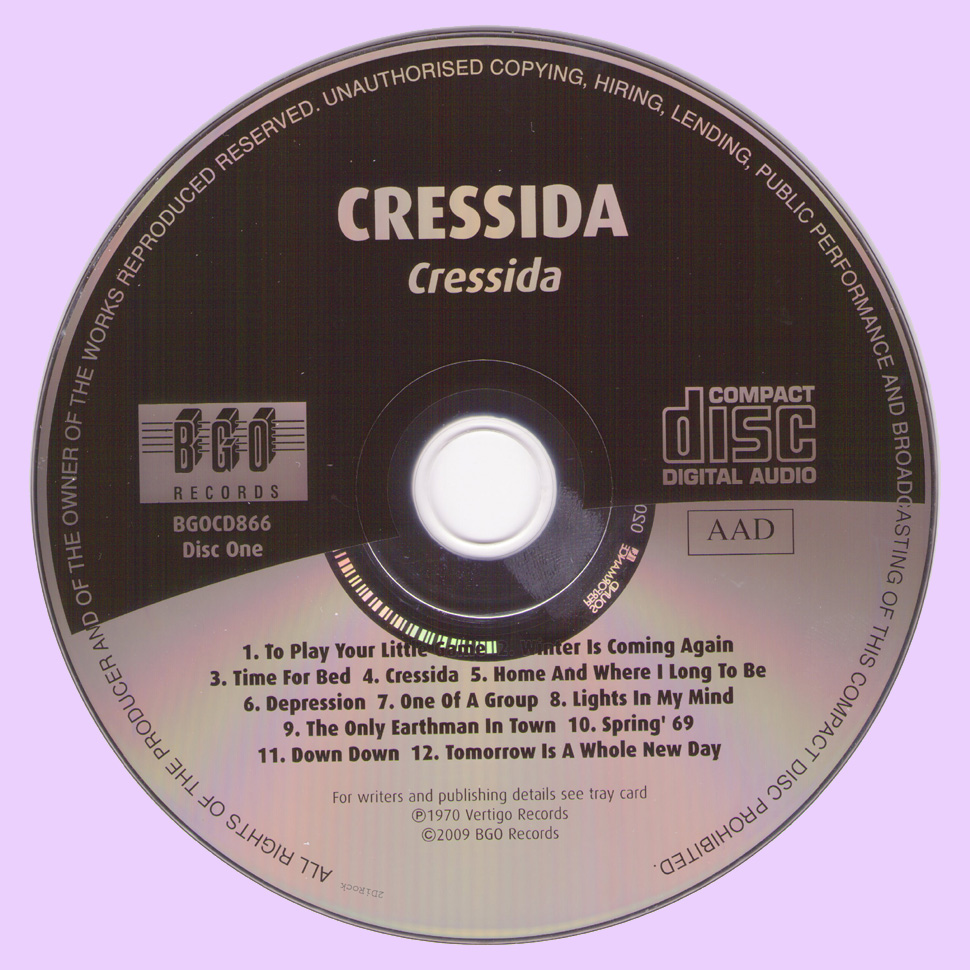
Cressida - Cressida / Asylum (1970-71 uk, superb post psych prog rock, double disc 2009 remaster issue)


In the great lottery of pop, a question that frequently has to be asked is why one group and not another? Why are groups such as The Moody Blues, King Crimson and even dear old Gentle Giant venerated, while equally lyrically and musically powerful bands such as Cressida are left, discarded as the forlorn dummies heads on the beach on the cover of Asylum? It is a hard question to answer at the best of times and even harder when you reacquaint yourself with the group's small but perfectly formed oeuvre.

By 1969, the decade-and-a-half-old form of rock and roll was clearly here to stay. The music had already traveled from the 2:30 jangle about love into song cycles, heavy riffing and, thanks to the proliferation of psychedelic substances, a new mysticism. Summers of love had been and gone and even places like Beckenham in Kent were having free festivals. A man had landed on the moon and on record, the cosmos was the limit. With their name taken from Greek mythology - the daughter of soothsayer Calchas, Cressida betrayed her eternal love Troilus, of whom Shakespeare wrote so eloquently – the group are one of those glorious footnotes that make progressive rock so very interesting.

There may be few today who can recall the power and the glory of Cressida, but the music they offered during the brief sliver of a recording career is truly more than ripe for reappraisal. The group was formed in the late 60s by keyboard and mellotron player, Peter Jennings. Adding Angus Cullen on vocals and guitar, John Heyworth on guitar, Kevin McCarthy on bass and lain Clark on drums, the group gained a reputation as a fierce live act, their music full of delicate passages and interludes of storming complexity. With Cullen's sweet, lyrical voice and an obvious nod to The Moody Blues, Cressida became one of the first signings to Vertigo, the recently-founded progressive rock offshoot of Polydor records.

Vertigo were very much in the mould of forward-thinking new record labels, well away from the suited and stuffy mainstream. With an almost arbitrary A&R policy (Patrick Campbell Lyons from the original Nirvana scouted for the label for a while), Vertigo sought to release music by acts that reflected the Zeitgeist perfectly. All with that incredible spiral logo revolving on the label: if the music didn't blow your mind, then the graphics certainly would. So, after releases by Colosseum, Juicy Lucy, Manfred Mann, Rod Stewart and Black Sabbath, Cressida's eponymous debut album, (VO 7) became the seventh release on Vertigo.

Released on the imprint's legendary spiral label in 1970, it was produced by Ossie Byrne and engineered by Robin Thompson. Byrne had previously worked with The Bee Gees and brought some of the economic simplicity of their early productions to the recordings. Its taut, prog-pop melodies won the band a small and fervent following. With tinges of blues and classical in this pungent mix, the album, although evoking King Crimson, Paul McCartney and The Moody Blues, was clearly a highly individual piece of work. From the opening pop rush of To Play Your Little Game to the great, upbeat closer, Tomorrow Is A Whole New Day, Cressida was a much-loved album for those in the know.

The deft touch and George Harrison-esque soloing of Winter Is Coming Again would have made a great pop single. Time For Bed was a whimsical jazz take on Zebedee's then-contemporaneous catchphrase. Although not a huge commercial success, the release slotted in perfectly with Vertigo's ethos, and Cressida were to given the green light to a return to the studio. But not, of course, without a few obligatory personnel changes. This was early 70s rock, after all. Guitarist John Heyworth departed in 1971, and was replaced by John Culley and New Seeker member Paul Martin Layton.

Their second album, Asylum (Vertigo 6360 025) released later that year, was a different beast altogether. The album was a denser, darker affair, relying less on Cullen's vocals. Ex- Donovan, Ginger Baker's Airforce and John Martyn reedsman Harold McNair played on the album, adding to its deeper, lilting feel than its predecessor, which focused more on instrumental passages and elaborate arrangements. The subject matter was also far less mystical than their contemporaries.

Munich (or to give it its full title, Munich 1938; Appeasement Was The Cry, Munich 1970; Mine To Do Or Die) is tremendous fun: with its subtle organ parts and great dual lead guitar as well, it can be seen as the group at their very zenith. Again produced by Byrne, Asylum featured orchestration and musical direction from Graeme Hall – who had recently also worked with Shadows offshoot Marvin, Welch & Farrar. The album remains the jewel in their crown Changes were afoot at Vertigo, and by late 1971, the group found themselves without a contract. Quietly, like so many of the era, they split up.

Drummer lain Clark went on to play with Uriah Heep for a year and John Culley became a member of another lamented prog act, Black Widow. Paul Layton returned to simpler pastures with the New Seekers and the special guest who had so enlivened the instrumentation on Asylum, Harold McNair, was to die tragically from cancer in 1971. Little has been heard from the others since. The Vertigo label, ironically, was reactivated by Universal in 2003 for bands such as The Rapture.

One of the coolest items that autumn was a skinny-fit Vertigo T-shirt with the spiral logo on it, worn by people who had little idea of the imprint's illustrious history. So, what goes around spirals around, and here we have the opportunity to revisit both of Cressida's albums, possession of which have long been an insider sign to the cognoscenti. A small, but thriving collector's market ensures that originals routinely fetch three figure sums.

We may never know why the group failed to ignite as some of their contemporaries; but what we do know, is we have two beautiful, much-loved albums available again, in a delightfully clean remaster, for the delight and delectation of all. And whereas we might be over familiar with our copies of In Search Of The Lost Chord and In The Court Of The Crimson King, Cressida and Asylum are full of sweet, yearning and strange, unfamiliar surprises, yet to be discovered.
by Daryl Easlea


Tracks
1970 Cressida

1. To Play Your Little Game - 3:24
2. Winter Is Coming Again - 4:46
3. Time For Bed - 2:22
4. Cressida - 4:03
5. Home And Where I Long To Be - 4:09
6. Depression - 5:08
7. One Of A Group - 3:43
8. Lights In My Mind - 2:49
9. The Only Earthman In Town - 3:39
10.Spring '69 - 2:20
11.Down Down - 4:20
12.Tomorrow Is A Whole New Day - 5:22


1971 Asylum
1. Asylum - 3:36
2. Munich - 9:37
3. Goodbye Post Office Tower Goodbye - 2:51
4. Survivor - 1:34
5. Reprieved - 2:31
6. Lisa - 5:09
7. Summer Weekend Of A Lifetime - 3:27
8. Let Them Come When They Will - 11:52

Cressida

*Angus Cullen - Vocals, Acoustic Guitar, Percussion (Asylum)
*Kevin McCarthy - Bass
*Iain Clark - Drums, Percussion
*Harold McNair - Flute (Asylum)
*John Heyworth - Guitar
*John Cullen - Guitar [Lead Guitar], Acoustic Guitar (Asylum)
*Peter Jennings - Harpsichord (Cressida), Organ, Piano

Free Text
Text Host

Tuesday, August 16, 2011

The Underdogs - Wasting Our Time (1970 new zealand, splendid guitar rock with various styles)


Well known througout New Zealand and Australia, The Underdogs - on this, their first LP for PYE- entertain with the total comparsion, guts and brilliance of Pig, Mann and Edwards (The Underdogs). With this jacket blurb we want to convince the uninformed that he should have listen.

We know you'll dig it. As the producer i enjoyed every minute of the 3 day session, listening to Harvey, Neil and Glen begin a song and build it on, and punch and polish it here and there -it was like watching a flower unfold. The time was right (recording had been postponed for 2 years), the material was (and is) right, and the mood was warm ebullient.

Executive producer John Kerr wisely decided that if the album was to get off the ground, Harvey, Neil and Glenn would have to do it their way. As a consequence, words and sounds simply fell into place naturally and beautifully. Hear these fantastics: Glen's introdusction to "It's a Blessing" and his extended solo on "Garden of Eden", Harvey's country solo on "Clover In The Air" and his accoustiphonic guitar and singing on his own "Tomorrow's Child", Neil's talking frog Bass on "Is he going to Die?" and his down home singing on "Clover In The Air".

As a close friend of the group, I have seen their ruthless personal huminity blossom into superb musicianship and expression that you will hear on this album.
by Bob Gillet, October 1970, Auckland, New Zealand.


Tracks
1. Tomorrow's Child - 3:18
2. Wasting My Time - 2:18
3. Old Grey Dog - 3:22
4. Name The Day - 2:05
5. It's A Blessing - 3:06
6. Every Little Thing - 5:05
7. Is He Going To Die? - 2:31
8. Duchless Of Montrose - 4:27
9. Clover In The Air - 3:42
10.Garden Of Eden - 7:37

The Underdogs
*Harvey Mann - Telecaster, Gibson, Acoustiphonic Guitars, Vocals
*Neil Edwards - "Talking Frog" Bass, Bass Guitar, Vocals
*Gleny Pig - Drum Kit, Miscellaneous Percussion
with the help of
*Bob Gillett - Glock, Recorder, Voice, Production
*Bruce Duske - Dials, Meters, Tape, Mixmaster
*John Kerr - Crystal Ball, Money

Free Text
the Free Text

Monday, August 15, 2011

Warhorse - Red Sea (1972 uk, great hard rock heavy psych, 2010 remaster with bonus tracks)


Within weeks of Nick Simper's final show with Deep Purple on July 4th 1969, he had played the Isle Of Wight Festival as part of singer Marsha Hunt's backing band White Trash, and was beginning to plan a new group of his own.

After just a couple of gigs with Marsha, Nick realised that the rest of her band weren't really up to the job, said as much, and found himself with the job of finding suitable replacements. He roped in Ged Peck on guitar (with whom he'd toured with The Flowerpot Men and Billie Davis), and his old Pirates band-mate Roger Pinner (aka Roger Truth) on drums. Pinner was soon replaced by Mac Poole. While this was going on Nick still found time for outside work, playing BBC sessions with The James Royal Set, and also putting together his own extracurricular band.

Ged Peck and Mac Poole were first on board, followed by singer Ashley Holt, who had auditioned for Deep Purple back in 1968. The James Royal Set's keyboard player Rick Wakeman took part in early rehearsals but proved unreliable, and when the band's first demo was recorded in April 1970 he was replaced by Frank Wilson. Very soon afterwards the band became a full time operation when Marsha Hunt folded her group due to the fact that she was pregnant by Mick JaggerInitial events made it look as if Warhorse's starting path would be similar to that of Deep Purple. A record contract quickly arrived (with the new Vertigo label), an album was recorded, and the band made their debut live show - supporting Mott The Hoople in Hemel Hempstead.

'Warhorse' was released in November 1970, sounding pretty much like a heavier version of Deep Purple Mk1, and fully illustrating how much Nick Simper had contributed to both bands. However, Vertigo's promotion concentrated more on the label than the album, and it undeservedly failed to chart, as did the belated single 'St.Louis' (an Easybeats song which had been in Deep Purple's live repetoire until August 1969). Around the same time, Ged Peck made his exit, apparently after increasing difficulty in dealiing with Simper's pre-eminence in the group. His replacement was Pete Parks from Black August, a band who had been sharing Warhorse's rehearsal room.

Warhorse had built up a healthy live following inside their first year, and continued to do so when Pete Parks seamlessly stepped in on guitar, but the band's fortunes had already peaked.They were forced to rush the recording of their second album 'Red Sea', which nevertheless received favourable press reviews, and pushed the band's heavy credentials forward by being more guitar based than its predecessor. However, it received very little label promotion, and soon after its June 1972 release Warhorse were dropped from the roster. Around the same time Mac Poole decided to throw his lot in with Gong, after having deputised with them for a few shows.

Drummer Mac Poole was replaced by Barney James, and Warhorse picked themselves up yet again, this time beginning to incorporate soul elements into their music.After a time Rick Wakeman appeared back in the scene. He produced a set of demos for the band, and then borrowed Holt and James to help record his UK #1 'Journey To The Centre of The Earth' solo album. Despite the fact that a new record contract for Warhorse was in the offing, both men decided to throw their lot in permanenty with Wakeman, and in June 1974 Nick Simper decided to bring the band to a close.
DP-net


Tracks
1. Red Sea - 4:16
2. Back In Time - 7:47
3. Confident But Wrong - 4:42
4. Feeling Better - 5:29
5. Sybilla - 5:30
6. Mouthpiece - 8:41
7. I (Who Have Nothing) (Carlo Donida, Jerry Leiber, Mike Stoller) - 5;11
8. Ritual (Live Version) (Warhorse) - 4:17
9. Bad Time (Demo) (N. Simper) - 4:37
10.She Was My Friend (Demo) (N. Simper) - 4:52
11.Gypsy Dancer (Demo) (N. Simper) - 4:05
12.House Of Dolls (Demo) (N. Simper) - 4:17
13.Standing Right Behind You (Demo) (N. Simper) - 4:29
All songs by P. Parks, M. Poole, A. Holt, N. Simper, except where indicated.

Warhorse
*Ashley Holt - Vocals
*Mac Poole - Drums
*Nick Simper - Bass
*Frank Wilson - Keyboards, Piano
*Peter Parks - Guitar

Free Text
Text Host

Saturday, August 13, 2011

Five Day Rain - Five Day Rain (1970 uk, fabulous psychedelic early progressive rock, 2006 remaster bonus track issue)


Five Day Rain formed in late 68 as Iron Prophet, a heavy trio comprising Rick Sharpe, Clive Shepherd and Dick Hawkes. They changed their name to Five Day Rain in early 1970, with the arrival of Graham Maitland and the beginning of the recordings we are presenting here.

The usual disagreement between musicians, management and producers led the album to be shelved (only a few acetates were pressed) and the band to split. Rick Sharpe, Shepherd and Maitland formed the short-lived Studd Pump before taking separate ways, with Sharpe joining glam rockers Streak and Maitland resurfacing with Glencoe. Five Day Rain was issued for the first time on CD a dozen years ago, with nice John Hurford artwork made for International Times magazine, but without both musicians and illustrator permit.

Our issue, made with the essential contribution of Rick Sharpe, uses the original running order and is enriched by a few bonus tracks: a Bob Dylan cover (Too Much Of Nothing) and four tracks recorded at the time but left off the purposed LP. Factory/Fleur de Lys connected early 70s UK psych monsters with all the right moves. Sounds like the aforementioned bands with a dash of Ogden-period Small Faces. Great guitar work particularly on the long trippy instrumental Rough Cut Marmalade."


Tracks
1. Marie's A Woman - 2:54
2. Don't Be Mislead (Clive Shepherd) - 2:20
3. Good Year - 4:03
4. Fallout - 3:32
5. Leave It At That (Clive Shepherd) - 5:22
6. The Reason Why - 4:44
7. Sea Song - 4:13
8. Rough Cut Marmalade - 11:05
9. Lay Me Down - 1:16
10. Too Much Of Nothing (Bob Dylan) - 3:38
11. Antonia - 3:14
12. So Don:t Worry - 3:28
13. The Boy - 5:46
14. Wanna Make Love To You - 4:58
All songs by Rick Sharpe except where indicated.

Five Day Rain
*Rick Sharpe - Guitars, Vocals, Harmonica, Percussion
*Graham Maitland - Keyboards, Accordion, Vocals
*Clive Shepherd - Bass Guitar, Vocals
*Kim Haworth - Drums
*John Holbrook - Guitars
*Sharon Tandy, Lynn Maitland - Backing Vocals
*Gerry Beckley, Dewey Bunnell, Dan Peek - Backing Vocals

Free Text
Free Text II

Friday, August 12, 2011

Goliath - Goliath (1970 uk, fantastic psych blues rock with a west coast aura, 2004 edition)


If I were a copy writer for an advertining agency, I would undoubtebly begin these notes with "Goliath are going to be gigantic etc...." Thankfully, I'm not endowed with those powers of literary imagination or the ability to create lines of such propheticsplendour, so I shall confine myself saying that this is a very good first album from an extremely promising group.

Without wishing to cause overt offence to the ladies concerned, I have always been saddened by the strange British yen for "cite" singers such as Cilla Black, Mary Hopkin, Anita Harris and their warblemates. Why haven't we ever produced a Slick or a Joplin? The answer is that to ne open, honest, and free to express emotions is, ludicrously enough, considered to be too unladylike and unrepresentative of the English Rose.

But we are not going to build Jerusalem in this green and pleasant land. It isn't very green, and at times it's very extremely unpleasant. Linda Rothwell owns up, and you can hear it. She's sup[lied with some very strong bass lines by John Williamson, and some definitive jazz overtones from Malcom Grundy's guitar.

These are morsels I have savoured: there are many others you will discover for yourself, like Joseph Rosbotham an flute and tenor and Eric Eastman on drums. There has been a knock on the door from Phil Sanderson, brandishing an obscene weapon and muttering. Goliath are going to be gigantic etc....
by David Symonds


Tracks
1. Port and Lemon Lady (John Williamson) - 4:05
2. Festival of Light (John Williamson, Linda Rothwell) - 4:58
3. No More Trash (Malcolm Grundy) - 3:43
4. Hunter's Song (John Williamson) - 9:54
5. Men (Malcolm Grundy) - 3:43
6. I Heard About a Friend (John Williamson) - 4:31
7. Prism (Malcolm Grundy) - 6:06
8. Emerge, Breath, Sunshine, Dandelion (John Williamson, Linda Rothwell) - 3:32
9. Maajun (A Taste of Tangier) (Davy Graham) - 4:30

Goliath
*Joseph Rosbotham - Flute, Tenor Sax
*Malcolm Grundy - Guitar
*Linda Rothwell - Vocals
*John Williamson - Bass
*Eric Eastman - Drums, Vibes, Percussion

Free Text
Text Host

Thursday, August 11, 2011

Ithaca - A Game For All Who Know (1972/73 uk, magnificent progressive folk, art rock)


"A Game For All Who Know" is the last album by the trio of Ferdinando, Howell, and Menelaus. At that time, John Ferdinando seems to become the centerpiece of the band, having had a hand in penning all six songs. For more details on the trio and its creation, have a look into the review of their previous album "Fly Away".

The Album. Stylistically and structurally, "A Game For All Who Know" is much in the vein of "Fly Away". In other words, the trio followed their original style right up to the end of their musical career. Of course, the music that is presented on this album is still about the same, accessible and melodious, Symphonic Art-Rock with the elements of Folk Rock. The arrangements that are featured on "A Game For All Who Know" are for the most part of an acoustic character, as well as those on "Fly Away".

However, unlike the trio's previous album, all the songs that are featured on "A Game For All Who Know" were, overall, created within the framework of a unified stylistics. As for the progressiveness of these songs, three of them, namely Journey, Questions, and Dream (tracks 1, 2, & 5), are more straightforward than any of the remaining three songs. The vocals that are present on Journey, Questions, and Dream are for the most part accompanied only by the monotonous rhythms of acoustic guitar and chords of organ.

While on Times, Feelings, and A Game For All Who Know, the instrumental arrangements are always intensive and flow nonstop regardless whether there are the vocals. All three of these songs are excellent, but the album's title-track is an absolute winner.It is filled with diverse and tasteful interplay between passages of acoustic guitar, piano, and Mellotron, and solos of electric and bass guitars. By the way, A Game For All Who is the only track on the album that features the Mellotron.

A 'chief' keyboard instrument on all the other tracks of the album is an electric organ. Apart from the album's title-track, the piano passages are present also on Journey, Questions, and Times. The solos of electric guitar and recorder play minor roles on this album. While the passages, solos, and rhythms of acoustic guitar, solos of bass guitar, and chords of organ are notable throughout the album.

As for the parts of drums and percussion, they are present on each track of the album as well. However, these parts aren't that noticeable. In fact, they are monotonous throughout the album. Which, though, doesn't much matter with regard to this kind of music. Surprisingly enough, about two thirds of the vocal parts that are featured on this album were sung by Lee Mennelaus. (In the review of "Fly Away",

I mentioned that her angelic voice fits well the music of the trio.) Undoubtedly, "A Game For All Who Know" is the most integral, coherent, and progressive album by the trio of Ferdinando, Howell, and Mennelaus. In that way, the last chapter of their creation can be considered their creative peak. Once again, I can highly recommend this album only to those who love the music of Renaissance-Mark-I and Illusion, both of which are virtually the same band, and the likes.
VM


Tracks
1. Journey - 4:56
2. Questions - 4:03
3. Times - 8:19
4. Feelings - 5:32
5. Dream - 2:58
6. A Game For All Who Know - 7:06
7. All My Life - 2:45
8. The Poem - 4:11
9. Peace of Mind [listed, but does not appear on CD]
All music and lyrics by John Ferdinando.

Ithaca
*Joe Ferdinando - Vocals, Bass, Acoustic Guitars, Organ Auto Harp
*Peter Howell - Electric, Acoustic Guitars, Mandolin, Piano, Organ, Percussion
*Lee Menelaus - Vocals
Guest musicians
*Brian Hussey - Drums
*Andrew Lowcock - Flute
*Robert Ferdinando - Classical Guitar

Free Text
the Free Text

Wednesday, August 10, 2011

Blood Sweat And Tears - New City (1975 us, excellent fusion jazz rock, 2003 with extra tracks)


In the late '60s and early '70s, Blood, Sweat & Tears was at the forefront of the rock with horns movement. But after lead singer David Clayton-Thomas' 1972 departure, both he and the band lost their commercial footing. New City finds Clayton-Thomas reconvening with Blood, Sweat & Tears after a three-year absence. Jimmy Ienner, who produced hits with the Raspberries, Grand Funk Railroad, and Three Dog Night, is behind the boards for this 1975 album. It does sound promising, but, in all honesty, New City fortunes seemed doomed from the start.

The cover of the Blues Image's "Ride Captain Ride" turns out to be more than a perfunctory exercise and gives the band a chance to show its jazz chops, and Clayton-Thomas wails to his heart's content. Allan Toussaint's "Life" gets an irreverent and funky treatment. Strangely enough, the workouts on here pale in comparison to the ballads.

The best track, the poignant "I Was a Witness to a War," is delicately arranged in the perfect key for Clayton-Thomas' subdued vocals. Janis Ian's "Applause" sustains interest, even as Clayton-Thomas' dramatic flourishes make Richard Harris seem remote.

After a few ho-hum tracks, this closes with an energetic but anti-climatic cover of the Beatles' "Got to Get You Into My Life." Although New City failed to get the band back to the top of the charts, a listener might be pleasantly surprised to hear that the band did proceed through the '70s accordingly.
by Jason Elias


Tracks
1. Ride Captain Ride (Skip Konte, Franke Konte, Mike Pinera, Carlos Pinera) - 5:06
2. Life (Allen Toussaint) - 4:24
3. No Show (Ron McClure) - 5:15
4. I Was a Witness to a War (Danny Meehan, Bobby Scott) - 5:13
5. One Room Country Shack (John Lee Hooker, Traditional) - 2:24
6. Applause (Janis Ian) - 7:47
7. Yesterday's Music (D. Clayton-Thomas, William Smith) - 4:14
8. Naked Man (Randy Newman) - 4:00
9. Got to Get You into My Life (John Lennon, Paul McCartney) - 3:22
10.Takin' It Home (Bobby Colomby) - 1:37
11.Intro - 0:25
12.Agitato (Bruce Cassidy) - 6:19
13.Nuclear Blues (D. Clayton-Thomas) - 4:08
14.Manic Depresion (J. Hendrix) - 4:45
Tracks 11-14 Bonus Live recordings, October 12 1980, at the Street Scene (Downtown LA)
 

Blood Sweat And Tears
*David Clayton-Thomas - Vocals
*Dave Bargeron - Trombone, Tuba, Baritone Horn, Bass Trumpet
*Bobby Colomby - Drums, Percussion, Background Vocals
*Joe Giorgianni - Trumpet, Flugelhorn, Piccolo Trumpet
*Tony Klatka - Trumpet, Flugelhorn, Piccolo Trumpet
*Ron McClure - Bass
*Bill Tillman - Saxophone, Background Vocals
*George Wadenius - Guitar, Background Vocals
*Larry Willis - Keyboards
*Mike Corbett - Background Vocals
*Bruce Cassidy - Trumpet, Flugelhorn, Steiner Electric Trumpet (11-14)
*Bobby Economou - Drums (11-14)
*David Piltch - Bass (11-14)
*Robert Piltch - Electric, Classical Guitar (11-14)
*Earl Seymour - Baritone, Tenor Sax, Flute (11-14)
*Vern Dorge - Alto, Soprano Sax, Flute (11-14)

Free Text
Text Host

Monday, August 8, 2011

The Rugbys - Hot Cargo (1969 us, garage psych, akarma remaster edition)


The Rugbys formed when all the members of the popular Louisville group the Oxfords left that band except the drummer, Jim Guest. Guest kept the Oxfords name and brought in members of the Spectres, soon releasing a good 45 on the Mala label.

The Rugbys took the Spectres' drummer, Glenn Howerton to replace Guest; the other members being Steve McNicol on lead guitar, his brother Jim McNicol on bass, Chris Hubbs on guitar and Doug Black on sax. The band's name supposedly came from wearing rugby shirts onstage.

At least, that was what I had read, but then Susan Harkins sent in this photo of the Rugbys signed by Jim Guest on the back, and Glenn Howerton's signature is not included. Perhaps the Oxfords changed their name to the Rugbys, then Guest left or was kicked out and restarted the Oxfords with new members.

In any case, their first release is this great version of a Doug Sahm song, "Walking the Streets Tonight", on the Top Dog label, from July, 1966. The flip side, "Endlessly", a ballad original by Steve McNicol, has been ignored until now, though mellow it's very good.

The Rugbys continued on until 1970 with some personnel changes, releasing several 45s and an album in a hard rock style.
Garage Hangover


Tracks
1. You, I (Steve McNicol) - 2:57
2. Juditha Gina (Eddy Vernon) - 2:42
3. Song to fellow man (Eddy Vernon) - 2:20
4. King and queen of the world (Steve McNicol) - 3:08
5. Stay with me (Steve McNicol) - 3:05
6. The light (Steve McNicol) - 2:26
7. Rockin' all over again (Mike Hoerni) - 2:17
8. Lines of thought (Mike Hoerni, Steve McNicol) - 4:00
9. For A Love gone (Steve McNicol) - 3:56
10.Wendegahl The Warlock (Eddy Vernon) - 6:20

The Rugbys
*Steve McNicol - Guitar, Vocals
*Mike Hoerni - Bass Guitar, Vocals
*Eddy Vernon - Keyboards, Piano, Vocals
*Glen Howerton - Drums

Sunday, August 7, 2011

Keef Hartley Band - Not Foolish Not Wise (1968-72 uk, great rock blues psych, live recordings for BBC)


Recorded at the BBC Studios, London, England between 1968 and 1972 and issued in England in 1999, Keef Hartley's Not Foolish Not Wise is, apparently, a compilation of sorts of old live recordings and some from the studio. What is maddening is that apart from a personal reminiscence by Neil Slaven that covers some of Hartley's career, there isn't one iota of information -- other than titles and songwriting credits -- as to when or where these recordings were made, or even who played on them.

One can deduce with a degree of certainty that many of these recordings were live gigs featuring outtakes and alternate material from the Halfbreed era that included the four-piece horn section of Henry Lowther (trumpet, violin), Harry Beckett (trumpet), Lyn Dobson (tenor sax, flute), and Chris Mercer (tenor sax), with Hartley on drums, the late bassist Gary Thain (formerly of Uriah Heep!), Dino Dines on keyboards, and Miller Anderson (who also served as vocalist) and Spit James on guitars.

Some come from a later edition of the band with only two horns. The music is rooted deeply in the progressive blues of the early '70s, where the influence of John Mayall's Jazz Blues Fusion project was just making itself known. But Hartley's band was deeper into a more raucous form of blues and R&B than jazz, though the horn charts are fairly sophisticated, as evidenced by the title track, "Marin County," "Too Much Thinking" with its subtly shaded trumpets shimmering over the saxophones, and the slippery funk groove of "Don't You Belong," driven by Thain's bass thud and punched up by the horns Famous Flames style. Given that many of these are live cuts and the rest are outtakes, the sound can be a tad muddy, but it only adds to the overall presence of the music.

Despite the dodgy omissions in credits, this is a vital and thoroughly engaging release, capturing a band at the stellar height of its power both live and in the studio. As Slaven put it in his liner notes, this "was a no nonsense band that played no nonsense music." Recommended for anyone ever interested in Hartley or in the evolution of British blues.
by Thom Jurek


Tracks
1. Sinning for You - 3:36
2. Spanish Fly - 6:05
3. Me and My Woman - 5:21
4. Too Much Thinking - 6:47
5. Not Foolish Not Wise - 4:33
6. Don't You Belong - 5:55
7. Marin County - 4:05
8. Always Thinking of You - 4:31
9. Don't Sing It - 5:05
10.Colours - 6:04
11.Roundabout - 6:19
12.You Can't Take it With You - 7:46
13.Just a Cry - 7:59

Musicians

*Henry Lowther - Trumpet, Violin
*Harry Beckett - Trumpet
*Lyn Dobson - Tenor Sax, Flute
*Chris Mercer - Tenor Sax
*Keef Hartley - Drums
*Gary Thain - Bass
*Dino Dines - Keyboards
*Miller Anderson - Vocals, Guitars
*Spit James - Guitars

Keef Hartley's brands
1969  Halfbreed (2008 Esoteric)
1969  The Battle Of North West Six  (2008 Esoteric)
1970  The Time Is Near (2008 Esoteric)
1970  Overdog (2005 Eclectic)
1971  Little Big Band
1972  Seventy Second Brave (2009 Esoteric)
1972  Lancashire Hustler (2008 Esoteric)

Related Act
1971  Miller Anderson - Bright City

Free Text
Text Host

Saturday, August 6, 2011

The Third Estate - Years Before the Wine (1976 us, observable concept psychedelic rock , progressive folk)


Third Estate’s “Years Before the Wine” is an ambitious and intricate psychedelic concept album from 1976 about the French Revolution (!) which blends warm Southern summer sounds (the band were from Baton Rouge, Louisiana) with baroque song structures. Never fear, the serious subject matter is no match for the strong songwriting and light, flowing music.

Stunning vocals from Fae Ficklin on the title track are lovely, but even without them this album would richly deserve its status as a psychedelic classic. Stark, intimate production, with tasty fuzz guitar, backwards tape-loop soundscapes and beautiful treated acoustic guitar, puts one in mind of the Ithaca/Agincourt/Friends trilogy from England. The sound of exploration is evident everywhere, as the band spreads its wings, and glorious harmonies flow forth.

The previously unreleased album recorded as Agonistes (the Greek word for The Fighters) in 1973 shows that the later recordings were no fluke—it can stand alone as one of the most beguiling folk/psych albums we’ve ever heard..


Tracks
1a. Years Before the Wine - Destiny (Robert Everett, Chas Harrell) - 4:44
 b. Years Before the Wine - Overcast (Robert Everett, Chas Harrell) - 5:35
2. Useless Things (Robert Everett) - 3:34
3. Look at Me (Chas Harrell) - 8:42
4. Kings (Robert Everett, Chas Harrell) - 2:32
5. Puppet City (Robert Everett, Chas Harrell) - 8:07
6. Think It's Time (Robert Everett, Chas Harrell) - 4:40
7. The Third Estate (Robert Everett) - 5:31

Third Estate
*Robert Everett - 6-String Electric, Acoustic Guitars, Bass, Piano, Organ, Maracas, Wind Chimes, Vocals
*Chas Harrell - 12-String Acoustic Guitars, 6-String Electric Guitars, Saws, Hammers, Vocals
*Jerry Lang - Drums, Guiro, Bells, Claves
*Fae Ficklin - Vocals

Free Text
Text Host

Friday, August 5, 2011

Beckett - Beckett (1974 uk, fine progressive rock with some hard traces)


Beckett Vocalist Terry Wilson-Slesser, a native of Newcastle upon Tyne, was to figure in ex-Free guitarist Paul Kossoff's solo outfit Back Street Crawler and was later hook up with Charlie. The vocalist was also known to be in contention during 1980 for the AC/DC frontman vacancy following Bon Scott's death.

Wilson-Slesser had replaced original Beckett singer Rob Turner, the previous frontman having been killed in an auto accident. Soon after this appointment guitarist Les Tones quit. The group's first major performance was supporting UFO at Newcastle's City Hall. Beckett carved out a live reputation by performing residencies at the infamous Star Club in Hamburg, Germany. Beckett , having scored the financial backing of Island Publishing, then underwent a major line-up change.

The band's 'My Lady' single was a clear flexi-disc given away free at gigs in 1974, the same year the band released their eponymously titled album, produced by Family's Roger Chapman, on the Raft label subsidiary of Warner Bros. On the live front Beckett supported the likes of Wizzard, Slade, Free, Ten Years After, Thin Lizzy and The Faces. The band performed at the 1974 Reading Festival, after which they switched labels to CBS Records. For a period Wilson-Slesser was rehearsing with Mott The Hoople musicians following Ian Hunter's exit.

The Beckett concerts with Free would ultimately lead to an eventual union between Terry Wilson-Slesser and guitarist Paul Kossoff in Back Street Crawler. Slesser was known to be in contention for the AC/DC frontman position during 1980 after Bon Scott's death. The singer also acted as backing vocalist on Def Leppard's 'Pyromania' album. The Beckett song 'A Rainbow's Gold' was covered by Iron Maiden as a B side on their 1984 hit single '2 Minutes To Midnight'. That same year Wilson-Slesser acted as an offstage singer for the Michael Schenker Group, performing on a European and Japanese tour.
The Rock Detector


Tracks
1. Once Upon a Time... The End - 0:55
2. Rolling Thunder - 5:23
3. Rainclouds - 5:10
4. Life's Shadow - 6:51
5. New Dawn Chorus - 1:02
6. A Rainbow's Gold - 4:40
7. Don't Tell Me I Wasn't Listening - 5:30
8. Green Grass Green - 4:35
9. My Lady - 3:26
10.True Life Story - 5:36

Beckett
*Robert Barton - Guitar, Vocals
*Keith Fisher - Drums
*Terry Wilson-Slesser - Vocals
*Ian Murray - Bass
*Kenny Mountain - Guitar, Keyboards, Vocals
*Tim Hinkley - Keyboards

Free Text
Just Paste

Thursday, August 4, 2011

Wednesday, August 3, 2011

Bruce Cockburn - Circles In The Stream (1977 canada, remarkable live at the peak of his early career, 2005 deluxe edition)


Released shortly after the transitional In the Falling Dark, Circles in the Stream seemed to serve as the final chapter in Bruce Cockburn's promising yet inconsistent early career. Recorded live in Toronto, the record brings together some of Cockburn's best songs from this period, including the beautiful meditation "All the Diamonds in the World," the bluesy "Mama Just Wants to Barrelhouse All Night Long," and "Lord of the Starfields" from his previous release.

And while there isn't anything drastically different here, many of the tracks are more assured and fully realized than their studio counterparts, with Cockburn's guitar and voice front and center -- solo or backed by subtle bass, percussion, and piano or marimba. There are also a scattering of new tunes that mix nicely with the older material, with the Native American tribute "Red Brother, Red Sister" and the instrumental "Deer Dancing Round a Broken Mirror" the true standouts.

Strong performances and a good selection of songs help Circles in the Stream succeed not only as a good live album, but also as a decent retrospective of Cockburn's first seven years.
by Brett Hartenbach


Tracks
1. The Pipes, the Pipes - 1:23
2. Starwheel - 3:56
3. Never So Free - 4:06
4. Deer Dancing Around a Broken Mirror - 4:37
5. Homme Brûlant - 6:17
6. Free To Be - 2:54
7. Mama Just Wants to Barrelhouse All Night Long - 4:24
8. Cader Idris - 7:05
9. Arrows of Light - 4:15
10.One Day I Walk - 4:29
11.Love Song - 3:52
12.Red Brother Red Sister - 4:06
13.Lord of the Starfields - 5:29
14.All the Diamonds in the World - 2:46
15.Dialogue With the Devil - 9:34
16.Joy Will Find a Way - 4:48
17.God, Bless the Children - 5:15

Musicians

*Bruce Cockburn - Vocals, Acoustic Guitar, Electric Guitar, Dulcimer
*Patrick Godfrey - Vocals, Electric Piano, Marimba
*Bill Usher - Vocals, percussion
*Ray MacKay - Cornemuse, Bagpipe
*Bob Boucher - Bass

Bruce Cockburn releases
1970  Bruce Cockburn (Japan issue)
1973  Night Vision (Japan Issue)

Free Text
Text Host

Tuesday, August 2, 2011

Bruce Cockburn - Bruce Cockburn (1970 canada, wonderful debut album, 2007 japan remaster)


In 1966 Bruce Cockburn was asked to join an Ottawa band called The Children, which lasted for about a year. In the spring of 1967, he joined the final lineup of the Esquires before moving to Toronto in the summer to form The Flying Circus with former Bobby Kris & The Imperials members Marty Fisher and Gordon MacBain and ex-Tripp member Neil Lillie. The group recorded some material in late 1967 (which remains unreleased) before changing its name to Olivus in the spring of 1968, by which point Lillie (who changed his name to Neil Merryweather) had been replaced by Dennis Pendrith from Livingstone's Journey.

Olivus opened for The Jimi Hendrix Experience and Cream in April 1968. That summer Cockburn broke up Olivus, intending to go solo but ending up in the band 3's a Crowd. with David Wiffen, Colleen Peterson and Richard Patterson, who had played with him in The Children. Cockburn left this band in the spring of 1969 to pursue a solo career.

He had made his first solo appearance at the Mariposa Folk Festival in 1967, and was the headliner when Beldin Arechavala cancelled in order to appear at Woodstock in 1969. In 1970 he released his first, self-titled, solo album. Cockburn's phenomenal guitar work and songwriting skills won him an enthusiastic following. His early work sparkles with rural and nautical imagery, Biblical metaphors, and a sense of delight in the belief that whatever happens here on earth, heaven is not far away.

Raised as an agnostic, early in his career he became a devout Christian. Many of his albums from the 1970s refer to his Christian belief, which in turn informs the concerns for human rights and environmentalism expressed on his 1980s albums. His references to Christianity in his music include the Grail imagery of 20th-century Christian poet Charles Williams and the ideas of theologian Harvey Cox, but they are so subtle and musical that they do not exclude nonbelievers.


Tracks
1. Going To The Country - 3:10
2. Thoughts On A Rainy Afternoon - 3:42
3. Together Alone - 2:42
4. The Bicycle Trip - 4:05
5. The Thirteenth Mountain - 4:45
6. Musical Friends - 2:54
7. Change Your Mind - 2:19
8. Man Of A Thousand Faces - 5:40
9. Spring Song - 4:19
10.Keep It Open - 1:40

Musicians
*Bruce Cockburn - 6,12 String Guitar, Piano, Bass Drum
*Michael Ferry - Tongue
*Dennis Pendrith - Bass

Bruce Cockburn releases
1973  Night Vision (Japan issue)
1977  Circles In The Stream (Deluxe Edition)

Free Text
Text Host